Market Outlook
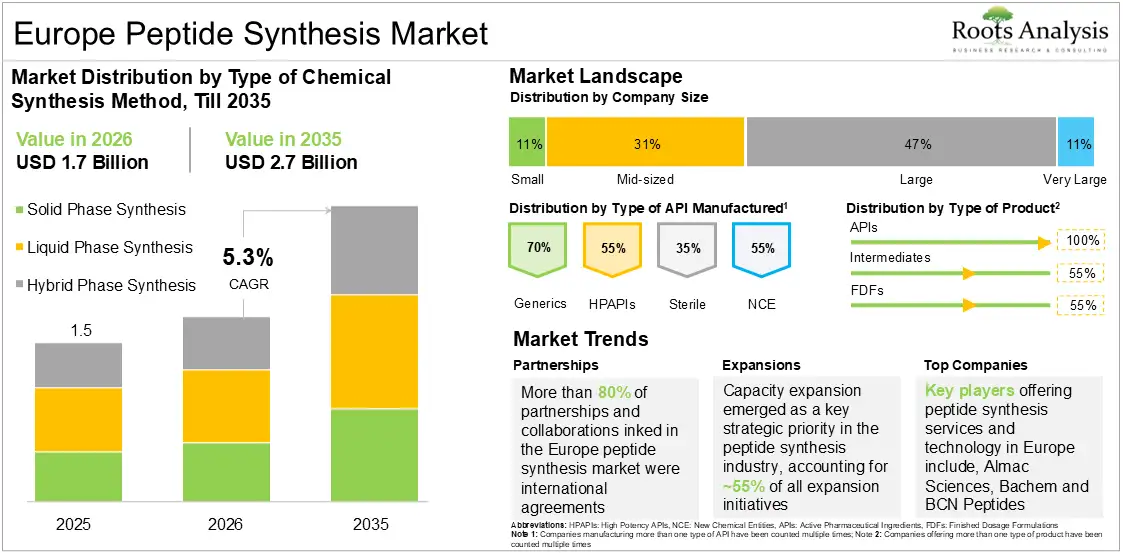
The Europe peptide synthesis market, valued at USD 1.5 billion in 2025, is projected to reach USD 1.7 billion in 2026 and USD 2.7 billion by 2035, with a CAGR of 5.3% during the forecast period from 2026 to 2035.
To learn more about this report, request a free sample copy
Market Report: Key Takeaways
Market Size and Trends
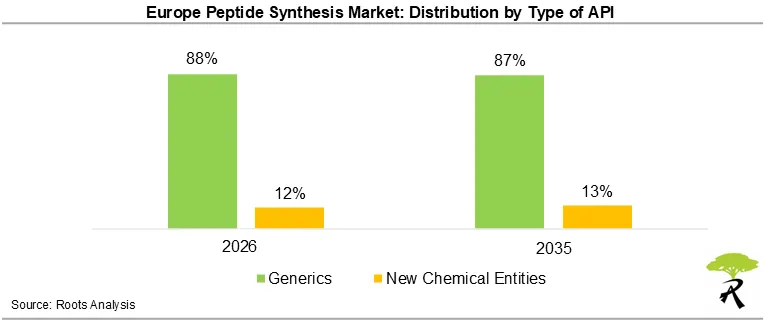
- Generic APIs account for the largest (around 90%) share of the current market.
- Chemical synthesis dominates the current Europe peptide synthesis market.
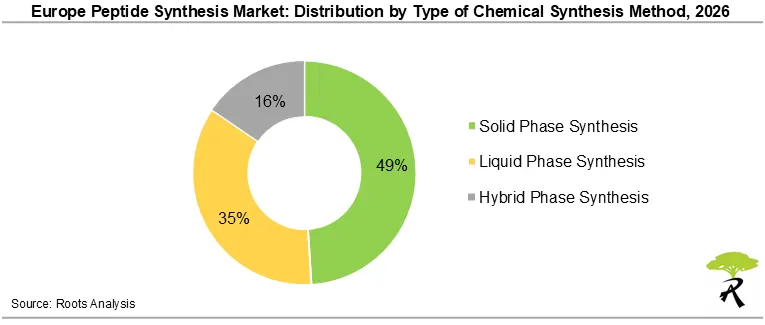
- Solid-phase synthesis method captures the largest (close to 50%) share of the current market, and the trend is unlikely to change in the future.
- Commercial scale is likely to hold the current largest market share in the Europe peptide synthesis market.
- Large and very large companies collectively represent the leading company-size segment.
Key Market Statistics
- Market Size in 2026: $1.7 billion
- Estimated Market Size in 2035: $2.7 billion
- CAGR (Till 2035): 5.3%
Market Introduction
Peptides are an established therapeutic modality that combines high target specificity with characteristics of both small molecules and biologics. Advances in solid-phase, liquid-phase, and hybrid-phase peptide synthesis, together with improvements in automation, purification and analytical characterization, have enhanced manufacturing efficiency and product quality. These advances support the development of therapeutics for metabolic, oncological, infectious, and rare diseases.
Across Europe, demand for peptide synthesis is rising as more peptide-based medicines progress through development and commercialization. The uptake of GLP-1 and related metabolic therapies is increasing demand for development and commercial-scale peptide manufacturing. Specialist peptide manufacturers and CDMOs, including Bachem, PolyPeptide Group, and CordenPharma, continue to expand their peptide manufacturing capacities to address regional and global demand. Europe's emphasis on quality and regulatory compliance also supports its position as a major base for clinical and commercial scale peptide synthesis.
The regional market also benefits from pharmaceutical research and a broad peptide-therapy pipeline. According to the European Federation of Pharmaceutical Industries and Associations (EFPIA), the European pharmaceutical industry invested approximately €60 billion in research and development in 2025, highlighting the region's continued commitment to advancing innovative therapeutics. Rising research activities across leading biotechnology clusters in countries such as Germany, Switzerland, Denmark, and the United Kingdom are further accelerating the discovery and optimization of next-generation peptide therapeutics for diverse clinical indications.
Through 2035, market growth is expected to be supported by demand for peptide therapeutics and greater outsourcing to specialized CDMOs. Investments in high-potency manufacturing, continuous-flow synthesis, automated production, and integrated development-to-commercial platforms are expected to strengthen Europe's competitive position.
Leading Companies in the Europe Peptide Synthesis Market
| Company |
YoE |
European Footprint |
Core Peptide Synthesis Focus |
Market Relevance |
| Bachem |
1971 |
Switzerland |
Peptide and oligonucleotide APIs, GMP manufacturing, custom peptide synthesis |
Bachem is one of Europe's most prominent peptide CDMOs, with its Bubendorf site positioned as its largest GMP hub for peptide and oligonucleotide manufacturing. |
| CordenPharma |
2006 |
Switzerland / Germany |
SPPS, LPPS, peptide APIs, GLP-1 peptide manufacturing |
CordenPharma is highly relevant due to its peptide platform spanning SPPS and LPPS, from gram-scale to multi-ton peptide API capacity. |
| PolyPeptide |
1952 |
Switzerland / Sweden / France / Belgium |
Peptide and oligonucleotide-based APIs, cGMP manufacturing |
PolyPeptide operates a global network of six cGMP-certified facilities across Europe, the US and India, including Malmö, Strasbourg and Braine-l'Alleud. |
| Almac Sciences |
2002 |
UK / Northern Ireland |
GMP peptide manufacture, custom peptide synthesis, peptide APIs |
Almac is a strong European peptide manufacturing entity, with GMP peptide manufacturing experience across UK, Europe and US customer programs. |
| BCN Peptides |
1989 |
Spain |
GMP peptide API manufacturing and solid phase peptide synthesis |
BCN Peptides is a Europe-based GMP API manufacturer with more than 30 years of peptide production experience and facilities in Barcelona. |
| Biosynth |
1966 |
Switzerland / Netherlands / UK |
Custom peptide synthesis, complex peptides, peptide libraries, GMP peptides |
Biosynth is relevant for Europe because its peptide expertise spans Vivitide, Pepscan, Cambridge Research Biochemicals and Pepceuticals, with R&D-to-GMP peptide capabilities. |
Abbreviation: YoE: Year of Establishment
Market Segmentation
Based on the research, we have segmented the Europe peptide synthesis market report into the type of API, type of peptide synthesis method, type of chemical synthesis method, scale of operation, company size and country.
By Type of API
- Generic APIs, New Chemical Entities
By Type of Peptide Synthesis Method
- Chemical Synthesis, Non-Chemical Synthesis
By Type of Chemical Synthesis Method
- Solid Phase Synthesis, Liquid Phase Synthesis, Hybrid Phase Synthesis
By Scale of Operation
- Preclinical / Clinical Scale, Commercial Scale
By Company Size
- Small Companies, Mid-sized Companies, Large and Very Large Companies
By Country
- Belgium, Switzerland, UK, Germany, Ireland, Netherlands, Italy, France, Sweden, Rest of European Countries
Key Market Insights
What Factors are Driving Increased Adoption of Peptide Synthesis within Europe?
- Expanding Demand for Metabolic Peptide Therapeutics: The rapid uptake of peptide-based treatments for obesity and type 2 diabetes is substantially increasing demand for clinical- and commercial-scale peptide synthesis in Europe. In fact, PolyPeptide reported that metabolic products represented 57% of its revenue in 2025. Further momentum is expected as new formulations enter the market; in 2026, the EMA recommended the first oral GLP-1 therapy for weight management, potentially widening patient access beyond injectable products.
- Large-Scale Expansion of European Manufacturing Capacity: European peptide manufacturers and CDMOs are investing heavily in solid-phase peptide synthesis, purification, and integrated drug-product capabilities. For instance, in 2025, CordenPharma announced an investment exceeding €500 million in a Swiss facility with more than 5,000 liters of SPPS reactor capacity. Such investments strengthen regional supply availability and support the progression of peptide candidates from development to commercial production.
What are the Main Challenges to Europe Peptide Synthesis Market Growth?
- Complex Scale-Up and Impurity Control: Peptide synthesis involves repeated deprotection, coupling and washing cycles, making process performance increasingly difficult to maintain as molecular length and structural complexity rise. For illustration, even 99% efficiency at each coupling step produces only approximately 61% theoretical full-length material across a 50-residue sequence before purification. Manufacturers must control deletion, truncated, and insertion sequences, stereoisomers, aggregation, and other closely related impurities.
- Cost Competition from Non-European Manufacturers: European peptide producers operate under stringent environmental, labor, quality, and regulatory requirements, which can raise manufacturing costs compared with suppliers in lower-cost regions. The European Commission notes that EU manufacturers can face compliance expenses that some non-EU producers may not incur, while Europe's pharmaceutical manufacturing base is experiencing increasing competition from China and India.
Recent Developments in Europe Peptide Synthesis Market
- In July 2026, Bachem signed a strategic agreement to supply large peptide volumes and committed more than CHF 500 million to a greenfield production facility in Sisslerfeld, Switzerland. Customer prepayments and long-term commitments support the project, with commercial production expected in 2030.
- In June 2026, the European Medicines Agency's guideline on the development and manufacture of synthetic peptides came into effect. It establishes requirements covering SPPS, fragment condensation, starting materials, process controls, impurity characterization, conjugation, comparability, and documentation for investigational and marketed products.
- In May 2026, UK-based Vapourtec installed a fully operational Peptide-Builder system at the University of Münster in Germany. The fast-flow SPPS platform is supporting research on difficult 10 to 40 amino-acid sequences for peptide therapeutics targeting protein-RNA interactions.
Industry Experts on Europe Peptide Synthesis Market
Driven by accelerating demand for metabolic and other peptide-based therapeutics, along with continued advances in automated, modular and process-intensified synthesis technologies, the European peptide synthesis market is poised for sustained growth.
Thomas Meier (former Chief Executive Officer at Bachem) stated, "In recent years, the use of peptides for medicines has experienced a transformative shift, evolving from a niche sector to an independent and vital therapeutic modality that bridges the gap between small and large molecules. This shift is largely driven by the increasing recognition and application of peptide-based medicines for prevalent health conditions, particularly diabetes, obesity, and their associated comorbidities. Today, 88 peptide medicines have gained approval, with an additional 215 advancing through late-stage clinical trials—clear indicators of the growing reliance on peptide therapeutics."
Discussions with multiple stakeholders in this domain influenced the opinions and insights presented in this study. The market report includes transcripts of the following discussions:
- Chief Scientific Officer, Co-Founder, Small Company, India
- Chief Financial Officer, Small Company, Germany
- Chief Business Officer, Small Company, US
- Founder and Owner, Small Company, Germany
- Vice President, Peptides, Large Company, Ireland
- Senior Director of Scientific Affairs and Technical Marketing, Small Company, US
- Senior Manager, Peptide Business Project Leader, Large Company, Japan
In addition, the market report includes transcripts of the following third-party discussions:
- Chief Executive Officer and President, Large Company, Switzerland
- Chief Executive Officer and President, Small Company, Japan
- Chief Executive Officer, Large Company, Switzerland
- Chief Executive Officer, Large Company, US
- Chief Scientific Officer, Large Company, UK
- Chief Scientific Officer, Large Company, UK
- Chief Scientific Officer, Large Company, US; President, Small Company, US
- Chief Solutions Officer, Large Company, US
- Executive Director and Head of Biocatalysis, Very Large Company, US
- Vice President of Research and Development, Large Company, Switzerland
Market Share Insights
Based on the Type of API Which Segment Holds the Largest Market Share?
- Based on the Europe peptide synthesis market analysis, the generic APIs segment is likely to occupy a higher (around 90%) market share in the current year. This dominance is due to Europe's cost-conscious healthcare and procurement environment, where almost 70% of medicines dispensed are generics and national payers routinely favor affordable off-patent products. Further, the expiry of patents for several clinically established peptide therapeutics, coupled with national reimbursement policies and competitive tender-based procurement across major European markets, has accelerated the commercialization and uptake of generic peptide APIs.
- The new chemical entities segment is anticipated to be the faster-growing segment in this industry, with an annualized growth rate (CAGR) of 6.2% during the forecast period. This growth is primarily owing to Europe's expanding pipeline of innovative peptide therapeutics and the resulting demand for customized GMP synthesis, process development and clinical-to-commercial scale-up services.
Which Type of Peptide Synthesis Method Captures the Largest Europe Peptide Synthesis Market Share?
- Currently, chemical synthesis methods are likely to capture the highest market share. This dominance is primarily attributable to the region's mature solid-phase and liquid-phase peptide synthesis infrastructure and its concentration of specialist CDMOs capable of supporting development through commercial-scale production. Chemical synthesis also enables precise sequence control and the incorporation of non-natural amino acids, lipidation, and other modifications increasingly required in complex peptide therapeutics, making it preferable to recombinant production for many short- and medium-chain molecules.
- The non-chemical synthesis methods are likely to be the faster-growing segment in this industry, during the forecast period. This growth is primarily driven by Europe's increasing development of longer, structurally complex and bioactive peptides that become difficult, waste-intensive or uneconomical to manufacture through conventional stepwise chemical synthesis. Notably, Switzerland-based Bachem is advancing chemo-enzymatic peptide synthesis with EnzyTag, using peptiligase enzymes to manufacture peptides exceeding 40 amino acids, cyclic molecules, and small proteins with fewer protecting-group operations and improved process sustainability.
By Chemical Synthesis Method, Which Segment Holds the Highest Share in the Europe Peptide Synthesis Market?
- Currently, the solid-phase synthesis method occupies the highest (close to 50%) Europe peptide synthesis market share. This leadership is primarily attributable to Europe's substantial installed base of automated, GMP-compliant SPPS capacity and the region's strong exposure to high-volume metabolic peptide programs. For instance, PolyPeptide's large-scale SPPS facility in Braine-l'Alleud, Belgium, reached its target utilization rate by the end of 2025; additional SPPS capacity became operational in Strasbourg, France, for ramp-up during 2026; and the company is doubling capacity in Malmö, Sweden.
- The hybrid phase synthesis methods are likely to grow at the highest CAGR (7.2%) during the forecast period. This growth is primarily owing to European manufacturers' increasing use of integrated SPPS–LPPS and fragment-condensation processes for complex, long-chain, and aggregation-prone peptides. These methods retain the sequence control and modification flexibility of SPPS while reducing the resin, solvent, and raw-material burden associated with conventional stepwise synthesis. For instance, CordenPharma's hybrid TAPS platform reduces solvent use by more than 90% and raw-material requirements by over 50%.
Scope of Europe Peptide Synthesis Market Report
| Key Report Attribute |
Details |
| Segments Covered |
- Type of API, Type of Peptide Synthesis Method, Type of Chemical Synthesis Method, Scale of Operation, Company Size, and Countries
|
| Key Players Profiled |
- Almac Sciences, Bachem, BCN Peptides, Biosynth, CordenPharma, and PolyPeptide
(A complete list of companies captured is available in the report)
|
PowerPoint Presentation
(Complimentary) |
Available |
| Customization Scope |
15% Free Customization |
Excel Data Packs
(Complimentary) |
Available |
Report Authorship
This report was authored by Tanvi Chadha, member of Roots Analysis healthcare and pharmaceutical research practice. Her work focuses on drug development and manufacturing, competitive intelligence, company benchmarking and market forecasting.
Independence and Non-Affiliation
Roots Analysis is an independent secondary and primary market research publisher. This report is not affiliated with, endorsed by, or produced on behalf of any company named or profiled within it, including all key players and industry expert interviewees referenced above.
Roots Analysis' findings draw on a combination of secondary research and primary interviews with industry experts, of the kind referenced above, to validate market sizing, segment shares, and forecast assumptions independently of any single company's disclosures.
Frequently Asked Questions
What is peptide synthesis in the pharmaceutical industry?
In the pharmaceutical industry, peptide synthesis involves the controlled assembly of amino acids to produce synthetic peptides for therapeutic, vaccine and diagnostic applications.What are the various chemical synthesis methods for peptide synthesis?
Peptides are manufactured using three principal chemical synthesis approaches: solid phase peptide synthesis (SPPS), liquid phase peptide synthesis (LPPS) and hybrid phase peptide synthesis.What is the projected Size of the Europe peptide synthesis market?
The market size is projected to reach USD 2.7 billion by 2035. What is the growth rate of the Europe peptide synthesis market?
The market is expected to grow at an annual rate of 5.3% from 2026 to 2035.Who are the key Europe-based peptide synthesis companies?
Almac Sciences, Bachem, BCN Peptides, Biosynth, CordenPharma and PolyPeptide.Is Roots Analysis affiliated with the companies profiled in this report?
Roots Analysis is an independent secondary and primary market research publisher. This report is not affiliated with, endorsed by, or produced on behalf of any company named or profiled within it, including all key players and industry expert interviewees referenced above.