
Lowest Price Guaranteed
Slides
237
Last Updated
August 2025
View Count
17260
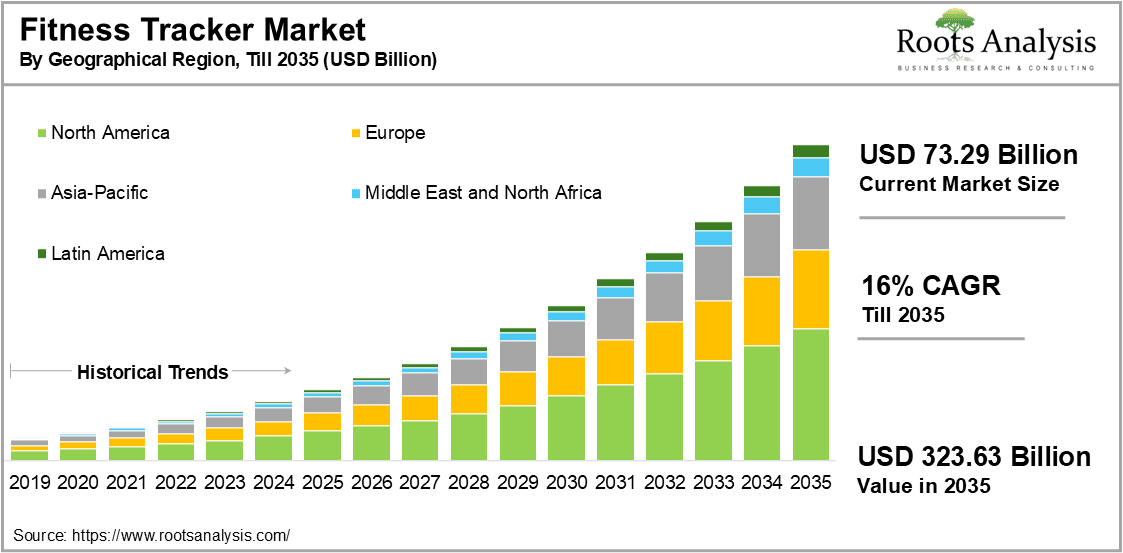
The global fitness tracker market, valued at USD 60.96 billion in 2024, is expected to reach USD 73.29 billion in 2025 and USD 323.63 billion by 2035, representing a compounded annual growth rate (CAGR) of 16% during the forecast period.
 |
To learn more about this report, request a free sample copy
Fitness tracker is a form of wearable device that helps in monitoring physical activity of the body. With growing awareness about health and adoption of healthy lifestyles, wearable trackers emerge as a revolutionary device that helps to meet fitness goals. These fitness trackers features biosensors that helps to collect data about vital health parameters such as heart rate, step counts, calorie burned, oxygen saturation and sleep patterns in real time. The data collected through fitness trackers can be synchronized with computer systems and smartphone apps to share data with healthcare practitioners and get necessary advice to achieve health goals.
In addition to fitness goals, these wearable devices have remarkably transformed the healthcare industry, offering on-time information to the clinicians for treatment decisions for patients with chronic conditions. It is worth noting that chronic conditions such as heart diseases and obesity has significantly increased on global level. A recent analysis report published by the World Obesity Federation reported that nearly 3 billion people globally are suffering from obesity and being overweight. This growing concern of obesity has further necessitated the demand for fitness trackers to monitor heart rate, calorie burn and sleep pattern to maintain good health.
Considering the ongoing demand, several market players are taking strategic initiatives to develop advanced fitness trackers with exclusive features. Companies such as Apple, Fitbit, Garmin, and Samsung are launching new fitness trackers with extensive features that enable tracking of vital health parameters. For instance, in January 2025, Samsung launched its fitness band Samsung Galaxy Fit3 in the US in combination with Samsung Galaxy A16 5G smartphone. The fitness band features a wide range of sensors, such as gyro sensors, barometer, accelerometer, light rate sensors and optical heart rate sensors, along with a battery life of ~2 weeks. These sensors offer instant monitoring of blood oxygen level, sleep monitoring, and support over 100 workout modes to offer personalized exercise experience.
Similarly, many industrial players are enhancing their technological innovations integrating artificial intelligence and machine learning to offer more personalized predictive health insights to seek proactive approach for health management. Driven by the growing initiatives, the global fitness tracker industry is anticipated to grow at a steady rate during the forecast period.
The market report covers a brief discussion on the leading players who are currently active across different segments on the fitness tracker industry as mentioned in the table below.
| Key Report Attributes | Details | |
| Historical Trend | Since 2019 | |
| Forecast Period | Till 2035 | |
| Current Market Size | USD 73.29 billion | |
| Market Size 2035 | USD 323.63 billion | |
| Market CAGR | ~16% | |
| Type of Fitness Tracker |
|
|
| Type of Application |
|
|
| Wearing Type |
|
|
| Type of Display |
|
|
| Type of Age Group |
|
|
| Type of Compatibility |
|
|
| Type of Distribution Channel |
|
|
| Key Geographical Region |
|
|
| Key Companies Profiled |
|
|
| PowerPoint Presentation (Complimentary) |
Available | |
| Customization Scope | 15% Free Customization | |
| Excel Data Packs (Complimentary) |
Available | |
One of the key objectives of the fitness tracker market report was to estimate the current market size, opportunity and the market growth potential, over the forecast period, till 2035. We have provided informed estimates on the likely evolution of the market for the forecast period.
Additionally, the market report features the likely distribution of the current and forecasted opportunity within the market distributed across various segments such as type of fitness tracker (smart watches, smart bands, smart clothing and other fitness trackers), type of application (heart rate tracking, sleep monitoring, glucose monitoring, sports, running tracking, cycling tracking and other applications), wearing type (hand wear, leg wear, head wear and other wearing types), type of display (monochrome display and colored display), type of age group (adult's fitness trackers and children’s fitness trackers), type of compatibility (Android, iOS, Tizen, windows, other compatibilities), type of distribution channel (online and offline), geographical region (North America, Europe, Asia-Pacific, Middle East and North Africa, and Latin America), and leading players.
To account for the uncertainties associated with the development of fitness trackers and to add robustness to our model, we have provided three market forecast scenarios, portraying the conservative, base and optimistic tracks of the market’s evolution.
All actual figures have been sourced and analyzed from publicly available information forums and primary research discussions. Financial figures mentioned in this market research report are in USD, unless otherwise specified.
Based on the type of fitness tracker, the global fitness tracker market size is segmented into smart watches, smart bands, smart clothing and other fitness trackers. Currently, smart watches accounts for the highest share (48%) of the market driven by versatility, convenience and quick integration with mobile applications. Further, smart watches feature advanced sensors and Wi-Fi / Bluetooth connectivity. These sensors and instant connectivity enable real-time tracking of heart rate, calories burned and sleep pattern which is essential to make precise fitness goal plans and everyday health management.
It is important to highlight here that smart bands segment is anticipated to grow at a higher CAGR during the forecast period. These devices features with extended battery life, lightweight, and advanced sensors that helps to collect fitness data.
The global market is segmented based on the type of application into heart rate tracking, sleep monitoring, glucose monitoring, sports, running tracking, cycling tracking and other applications. According to our projection, currently running tracking occupies the highest fitness tracker market share (nearly 25%). This dominance is due to the rising preferences for fitness trackers to track run rate to achieve fitness goals. Furthermore, fitness trackers features Bluetooth connectivity that ensure instant alert notifications to the users during running, making it a valuable tracker to optimize running fitness.
However, in the long run, we believe heart rate tracking and sleep monitoring segment is likely to register a higher CAGR during the forecast period. This can be attributed to the growing awareness about disease consequences and significances of regular monitoring practices to live a quality life.
The market for fitness tracker is further bifurcated based on wearing type into hand wear, leg wear, head wear and other wearing types. Based on the wearing type, currently hand wear is dominating the market with nearly 75% fitness tracker market share. This dominance is due to the wearing convenience and easy access to data in real-time. Moreover, these fitness trackers can easily be integrated with smartphones that helps to receive direct notification about health parameters for quick fitness decisions.
However, in the long run, leg wear segment is expected to grow at a higher CAGR during the projected period. This highest growth rate is attributed to the growing integration of advanced technologies for manufacturing smart shoes that promote step tracking, workout tracking and fall detection.
Based on the type of display, the global fitness tracker market size is distributed into monochrome display and colored display. Currently, colored display accounts for the highest share of the market. This can be attributed to the fact that colored display offer more data visualization, easy tracking of vital parameters such as step counter, heart rate and more due to color vibrancy. Driven by the growing preference, this segment will continue to remain dominant and is likely to grow at a higher CAGR during the forecast period.
The global market is segmented based on the age group into adult's fitness trackers and children’s fitness trackers. According to our analysis, currently adult fitness trackers account for the highest fitness tracker market share. This can be attributed to the growing usage of fitness trackers by adults to monitor heart rate, calories burn and running rate. The information helps to achieve fitness goals and receive healthcare on time.
However, in the long run, we believe that children’s fitness trackers are likely to grow at a higher CAGR rate during the forecast period. This is likely to be the result of growing adoption of fitness trackers for monitoring physical activities in children. These fitness trackers help parents in tracking vital activities signs such as sleep pattern and activity level which is important to maintain overall health of the children.
Based on the type of compatibility, the global fitness tracker market is divided into Android, iOS, Tizen, windows and other compatibilities. According to our projection, currently iOS accounts for the highest share of the market. This can be attributed to the growing number of people with Apple products that demand seamless connectivity with fitness trackers.
However, in the long run, we believe that Android segment is likely to grow at a higher CAGR during the forecast period. This is likely to be the result of higher compatibility of fitness trackers with wide range of android-based devices, which is estimated to drive the demand for fitness trackers with android compatibility.
This segment highlights the distribution of global fitness tracker industry into online and offline. According to our market study, currently online distribution channel accounts for the largest fitness tracker market share (64%). It is important to highlight here that online distribution channel offer higher accessibility and affordability to purchase fitness trackers. Furthermore, the heightened popularity of e-Commerce services for purchasing smart wearables has contributed to the highest growth of this segment. Driven by the growing preferences of online distribution channels, this segment will remain dominant and is likely to grow at a higher CAGR during the forecast period.
The global fitness tracker market is distributed across different geographical regions such as North America, Europe, Asia-Pacific, Middle East and North Africa, and Latin America. With widespread adoption of smart wearables in US and rising awareness of health & fitness, North America is currently dominating the market with the highest share of 42%. Notably, the growing health associated issues such as diabetes and obesity due to sedentary lifestyle have surged the demand for fitness trackers to manage health conditions in North America.
The market for fitness tracker in Europe holds a substantial share driven by the growing adoption of remote monitoring and wearable devices to mitigate the rising prevalence of chronic diseases in Europe. However, in Asia-Pacific, the fitness tracker industry is growing consistently at a higher CAGR during the forecast period. Several factors such as growing popularity of fitness trackers among athletes and fitness enthusiasts, rising healthcare expenditure and demand for advance wearable solutions to enable remote patient monitoring.
The “Fitness Tracker Market: Industry Trends and Global Forecasts, till 2035” market report features an extensive study of the current market landscape, market size and future opportunity within the fitness tracker industry, during the given forecast period. The market report highlights the efforts of several stakeholders involved in this rapidly emerging segment of the wearable devices industry. Key takeaways of the market data analysis are briefly discussed below.
Currently, the global market landscape features wide array of small, mid-sized and large industrial players who are extensively focusing on designing smart fitness trackers. In order to leverage the competitive edge, the key players of the industries has taken strategic initiatives to expand their product portfolio and technological innovations. For instance, in February 2024, Samsung launched Galaxy Ring, fitness tracker that helps to monitor heart rate, respiratory rate and sleep pattern.
The market also has the presence of some small, new entrants in the market. A few such players include WHOOP, Oura Ring, AmazFit and Endefo. As more market players continue to expand their innovations in this market, we believe the industry will remain competitive, offering enormous opportunities to industrial players for providing advanced fitness trackers with extensive features.
Some of the major fitness tracker market growth drivers that are propelling the industry include growing awareness about the benefits of staying fit, and the technological innovations allowing the same. It is important to highlight here that global population is becoming more conscious about overall well-being and requirement of physical activity to manage health. Driven by the growing trend, the global population is adopting fitness trackers that offer real-time data tracking of their physical activity, sleep pattern, heart rate and oxygen level. The information about vital parameters helps to make an informed decision about nutrition and physical exercises. In addition to rising health awareness, growing improvement in technologies such as IoT sensors, battery life, integration of AI and data analytics to get more precision in tracking information has further contributed to the growth of the market.
Fitness trackers industry is growing exponentially; however, some challenges may hinder its adoption rate. Some of the potential challenges includes stringent healthcare guidelines and data privacy concerns. Notably, fitness trackers require internet connectivity or Bluetooth connectivity for sharing and transmitting data. This transmission of data through different networks raises concern of data security. One such major data breach was reported in 2021, when 61 million records from Apple and Fitbit users were reportedly found in an unsecured database.
Thus, companies are required to adhere with data regulation policies such as HIPAA (Health Insurance Portability and Accountability) and European Union General Data Protection Regulation to ensure complete data privacy and security. Furthermore, complex healthcare regulations for implementation of digital technologies in collecting, sharing and storing patients personal health information may impede the market growth during the forecast period.
Some of the top trends that are anticipated to be the key growth factor for the market are healthcare integration, fitness apps and heightened demand of fitness trackers for geriatric population. It is worth mentioning here that with rising risk of chronic disease among geriatric population, industrial players are aiming to the innovative fitness trackers for geriatric population. However, the primary focus is on develop advanced fitness trackers that are specifically tailored to address age-related health issues, such as hypertension, diabetes and cardiovascular disorders. Further, several industrial players are designing fitness trackers that aid in fall detection, monitor blood pressure and heart rate.
In addition, the growing adoption of fitness apps and trackers in managing health remotely has further fueled the demand for these smart wearable devices. Fitness trackers ensure excellent compatibility with electronic health record systems. The vital information of health parameters collected through fitness trackers can be shared to EHR systems so healthcare experts can offer preventive treatment. Thus, the increasing role of fitness trackers in delivering preventive healthcare has further offered unprecedented opportunities to industrial leaders for driving innovation.
The global market for fitness trackers is currently valued at USD 73.29 billion. Driven by the growing awareness of health and role of fitness tracking is achieving fitness goals, the market is expected to reach at USD 323.63 billion by 2035, anticipated to grow at a CAGR of 16% during the forecast period.
It is important to highlight here that several athletes have shown active interest in the industry to promote the adoption of fitness trackers and fitness applications. Recently, in May 2024, Cristiano Ronaldo (football star) signed an investment deal in Whoop (wearable technology startup company) aiming to expand its global market reach in fitness tracker and wearable device industry.
Examples of key players engaged in this domain (which have also been captured in this report) include Apple, ADIDAS, Fitbit, Fossil, Garmin, Google, Huawei Technologies, HTC, Motorola, Nike, Polar Electro, LG Electronics, Sony, Samsung and Xiaomi. This market report includes an easily searchable excel database of all the companies focusing on the development of fitness tracker devices and applications.
Several recent developments have taken place in the fitness tracker industry. We have outlined some of these recent initiatives below.