
Lowest Price Guaranteed
Pages
210
Last Updated
September 2026
View Count
25621
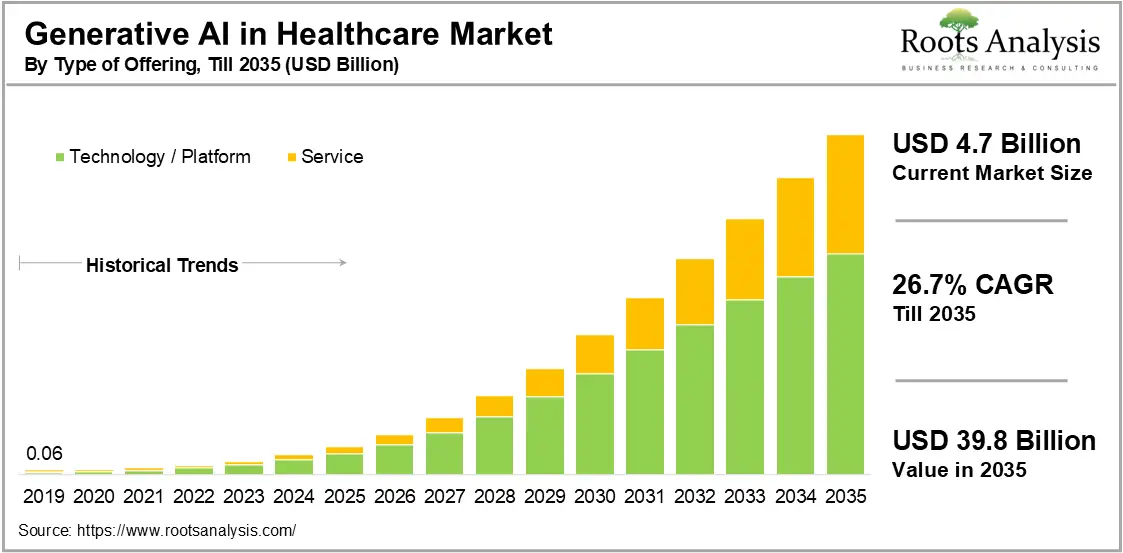
The generative AI in healthcare market was valued at USD 3.3 billion in 2025 and is projected to reach USD 4.7 billion in 2026 and USD 39.8 billion by 2035, representing a CAGR of 26.7% during the forecast period 2026 to 2035.
To learn more about this report, request a free sample copy
Healthcare organizations are managing persistent clinical-workflow inefficiencies, rising administrative burden and workforce pressure. According to the 2026 physician wellbeing survey conducted by the Physician Foundation in collaboration with Medscape, 55% of physicians reported often experiencing feelings of burnout. Among physicians experiencing distress, 61% cited excessive workload, staff shortages, or insufficient time with patients as a leading contributor, while 42% identified administrative burdens, including prior authorization, documentation, and insurance requirements. These pressures increase interest in tools that can reduce documentation and other repetitive administrative work while preserving clinician oversight.
Drug discovery and development is another important area of demand. Published literature indicates that roughly 90% of drug candidates entering clinical development do not ultimately reach approval, underscoring the cost, time and attrition associated with pharmaceutical R&D. Generative AI is therefore being explored for activities such as target and molecule ideation, molecular design, literature synthesis, protocol support and clinical-trial workflow optimization, although performance remains use-case dependent and requires experimental or clinical validation.
Healthcare providers and life sciences companies are also dealing with growing volumes of structured and unstructured data across electronic health records, medical imaging, scientific literature, clinical trials and operational systems. This is increasing demand for generative AI tools that can summarize information, automate documentation, support knowledge retrieval and integrate with existing workflows.
Strategic partnerships and venture funding are further supporting market development as healthcare organizations, technology vendors and pharmaceutical companies move from experimentation toward production deployments. The commercial opportunity, however, will depend on demonstrable workflow value, integration with existing systems, data governance, security, regulatory compliance and the reliability of model outputs.
The market analysis evaluates current and forecasted opportunity across the following segments:
Generative AI is a branch of artificial intelligence that uses generative models to create or transform content such as text, images, code, molecular structures, summaries and synthetic data. In healthcare, these capabilities are being evaluated and deployed across clinical documentation, research, drug discovery, diagnostic support, patient communication and administrative workflows. In clinical settings, AI-generated outputs require appropriate validation, governance and human oversight and should support, rather than replace, qualified clinical judgment.
The study combines secondary research, proprietary databases and primary research discussions to estimate market size, evaluate competitive activity and assess adoption trends. Secondary research includes company disclosures, investor materials, academic literature, regulatory and policy sources, industry publications and other publicly available information. Market assumptions are triangulated across multiple sources, and the forecast model includes conservative, base and optimistic scenarios to account for uncertainty in key parameters.
The report includes detailed transcripts of primary discussions with the following stakeholders:
Financial figures in this report are presented in USD unless otherwise specified. The primary-research discussions provide commercial, market and scientific perspectives across the US, Israel and France.
The clinical-based purpose segment accounts for nearly 70% of the current market and is expected to remain the leading segment through the forecast period. Its position reflects the concentration of high-value generative AI use cases in patient-facing and clinical workflows, including diagnostic support, treatment assistance, clinical documentation and patient communication. These applications directly address clinician workload and care-process efficiency, supporting continued demand from healthcare organizations.
The technology / platform segment currently leads the market because healthcare and life-science organizations require a core software layer to access, configure and deploy generative models across different workflows. Platforms such as NVIDIA BioNeMo, Insilico Medicine Chemistry42 and Iktos Makya illustrate how vendors package domain-specific models and tools for healthcare and life-science applications. The services segment is expected to grow comparatively faster as adoption expands, since implementation often requires systems integration, data preparation, interoperability work, validation, governance and workflow customization.
The treatment segment is estimated to hold the largest share in the current market. Demand is supported by use cases such as treatment-planning assistance, longitudinal information summarization, patient communication and care-workflow support, which place generative AI close to recurring clinical decision and care-delivery processes. Adoption nevertheless depends on clinical validation, governance, human review and clear accountability because AI-generated outputs can influence patient-facing decisions.
Healthcare providers hold the largest share of the market because hospitals, health systems and physician organizations can deploy generative AI across multiple high-frequency workflows, including clinical documentation, knowledge retrieval, patient communication, coding, scheduling, claims and revenue-cycle support. Pharmaceutical and life science companies are expected to grow comparatively faster as use expands across drug discovery, clinical development, scientific knowledge management and other research-intensive workflows.
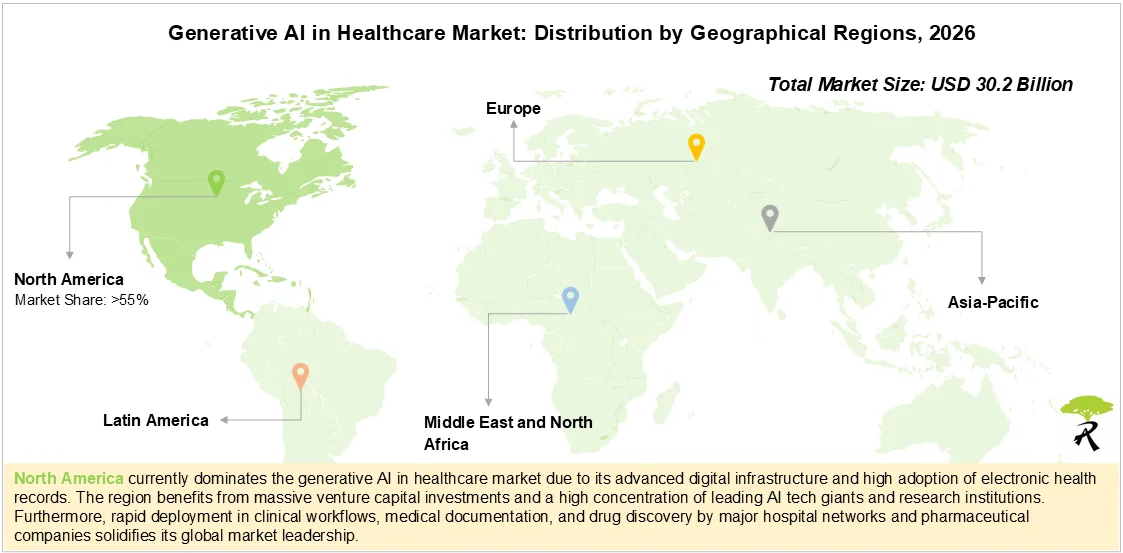
North America accounts for more than 55% of the current market opportunity and is expected to remain the leading region through the forecast period. Its position is supported by a dense technology-vendor ecosystem, mature cloud and healthcare IT infrastructure, substantial research and venture investment, and early enterprise adoption among health systems and life-science companies. Asia-Pacific is expected to be the fastest-growing region as digital-health investment, public-sector AI programs and healthcare IT modernization expand across markets such as China, India, Japan, South Korea and Singapore.
Generative AI is being applied across drug discovery and development, clinical-trial support, documentation, patient communication, knowledge retrieval and administrative workflows. In electronic health record environments, conversational tools can use natural language processing to summarize clinical information, draft notes and help clinicians retrieve relevant patient context. These systems can support efficiency, but clinical use requires appropriate validation, safeguards and human review.
The market landscape captured in the underlying study is fragmented and includes both established technology companies and emerging start-ups. Close to 60 providers were identified, and more than 85% of the identified companies offered technology or platform-based solutions. Around 50% of the captured players offered platforms or services related to virtual nursing assistance. These figures describe the provider's landscape and solution mix, not market revenue shares. Administrative use cases also extend into medical coding, claims workflows and revenue cycle management, making clinicians, hospital administrators and revenue cycle teams important buyer groups alongside IT and innovation functions.
Large language models (LLMs) are one important class of generative AI models used for text-heavy healthcare workflows such as clinical documentation, summarization, patient communication and research synthesis. Generative pre-trained transformer (GPT) models are a specific family of transformer-based language models; not every generative AI system is GPT-based, and not every healthcare AI application is an LLM.
Natural language processing (NLP) underpins many documentation, coding and EHR-integration workflows by enabling systems to process free-text clinical notes, patient messages and physician dictation. Computer vision and multimodal AI complement generative AI in imaging-heavy workflows such as radiology and pathology; however, computer vision itself is a broader AI field and should not be treated as synonymous with generative AI.
AI agents are an emerging implementation pattern in which a model can coordinate multiple steps or tools toward a defined task, such as triaging a non-emergency patient inquiry, retrieving approved information and drafting a follow-up for clinician review. In healthcare, agentic workflows require clear permissions, monitoring, escalation pathways and human oversight, particularly when outputs could affect patient care.
Synthetic data can be used to supplement model development and testing by generating artificial records, text or images that resemble real-world data. Synthetic data can reduce direct reliance on identifiable records in some workflows, but it does not automatically eliminate privacy, representativeness or bias risks; model-training datasets and synthetic outputs still require governance and validation.
The broader technology ecosystem also includes foundation-model and cloud infrastructure providers. The report's company universe includes Anthropic, while AWS, Google and Microsoft are among the profiled technology companies; deployments may also use services such as AWS, Google Cloud or Microsoft Azure depending on the architecture, security requirements and integration model.
Healthcare buyers must evaluate data privacy, cybersecurity, model accuracy, transparency, algorithmic bias, auditability and human oversight before deploying generative AI in production workflows. For US deployments involving protected health information, HIPAA obligations depend on the organization's role and how data is handled. A technology provider that creates, receives, maintains or transmits electronic protected health information on behalf of a HIPAA covered entity may be a business associate and can require a business associate agreement and appropriate safeguards. HIPAA should therefore be treated as a use-case-specific compliance requirement rather than a blanket label for every AI vendor.
In Europe, AI deployments may also be subject to the GDPR and, depending on the intended use, the EU AI Act and medical-device rules. These requirements reinforce the need for risk management, data governance, documentation and human oversight in healthcare AI deployments.
Examples of companies profiled in the report include Amazon Web Services, C3 AI, Exscientia (now part of Recursion), Google, Huma, IBM, Iktos, LeewayHertz (part of The Hackett Group), Medical IP, Microsoft, NVIDIA, OpenAI, Oracle, PhamaX and Syntegra. The complete report includes an expanded database of generative AI technologies, platforms and service providers active across healthcare applications. Company references are included solely for factual market analysis and competitive-intelligence purposes; inclusion does not imply endorsement, sponsorship, partnership or any other business relationship with Roots Analysis.
Alongside the core market report, clients receive complimentary Excel data packs covering the market landscape, product competitiveness analysis, partnerships and collaborations, and market forecast and opportunity analysis. A complimentary PowerPoint presentation summarizing the full report is also included, and 15% free customization scope is available on request. The report is designed to support R&D and regulatory affairs teams and pharmaceutical business development, benchmarking their capabilities and competitive positioning
This report is authored by Simrit Gupta and Rupali Vadhera, part of Roots Analysis healthcare and pharma research practice. All findings are based on proprietary databases, executive interviews, and regulatory analysis, and were subject to internal peer review prior to publication.
Roots Analysis is an independent market research and consulting firm. Findings in this report are based on primary research discussions with industry stakeholders, together with publicly available secondary sources and internal market analysis, unless otherwise noted.
Roots Analysis is not affiliated with, endorsed by, sponsored by or produced on behalf of any company named, profiled or quoted in this report. References to Microsoft, Google, NVIDIA, Amazon Web Services, OpenAI, Oracle and other organizations are included solely for factual market analysis and competitive-intelligence purposes. This report is intended for market research and business-information purposes and should not be construed as medical, legal, regulatory or investment advice.