Health Insurance Market
Health Insurance Market by Insurance Type (Group Health Insurance and Individual / Family Health Insurance), Provider / Payor (Public and Private), Plan / Network Type (PPO, HMO, EPO and POS), Demographics (Adults and Seniors), Level of Coverage (Silver and Gold), Geographical Regions (North America, Europe, Asia-Pacific, Latin America, and Middle East and North Africa), and Key Players - Trends and Forecast 2026-2035
-
Lowest Price Guaranteed
-
Pages
457 -
Last Updated
October 2026 -
View Count
3124 -
Market Outlook
The health insurance market, valued at USD 2.41 trillion in 2025, is projected to reach USD 2.56 trillion in 2026 and USD 4.54 trillion by 2035, representing a CAGR of 6.6% during the forecast period 2026 to 2035.
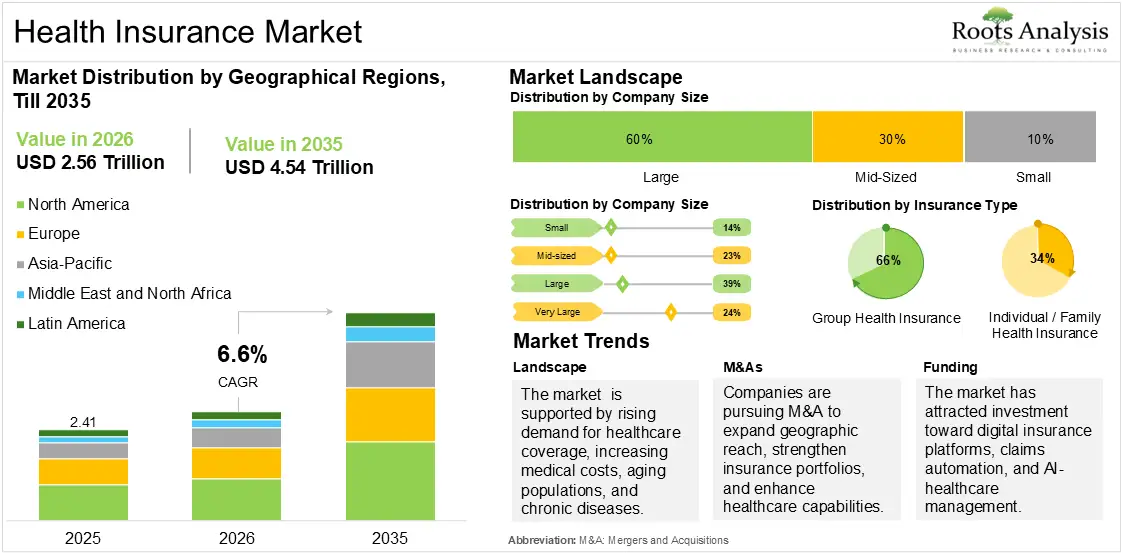
To learn more about this report, request a free sample copy
Market Report: Key Takeaways
Market Size & Trends
- The group health insurance holds the leading share because employers and other organized groups aggregate enrollment and simplify distribution, contribution collection and risk pooling.
- Public payors lead the provider / payor category, reflecting the central role of tax-funded and social insurance systems in financing population coverage.
- Preferred provider organization, or PPO, plans lead the approved plan / network type segment, while point of service, or POS, plans are positioned as the fastest-growing category within this predominantly US-specific taxonomy.
- Adults hold the leading share by demographics, while seniors are expected to expand faster as ageing increases the frequency and complexity of healthcare use.
- Silver coverage leads the approved level-of-coverage segment, while gold coverage is expected to grow faster.
- North America is expected to capture the largest share of the health insurance market, supported by extensive public and private coverage channels, employer-sponsored insurance and mature managed-care infrastructure.
Key Market Statistics
- Market Size in 2026: $2.56 Trillion
- Estimated Market Size in 2035: $4.54 Trillion
- CAGR (2026-2035): 6.6%
- North America: Largest market in 2026
- Asia-Pacific: Fastest growing region
Market Introduction
The health insurance market comprises risk-pooling arrangements that finance or reimburse eligible healthcare expenses for enrolled individuals. Coverage may be funded through government taxes, mandatory social contributions, employer and employee contributions, individual premiums, or a combination of these sources. The market includes individual and family policies, group insurance, public and private coverage, managed-care plans, and medical expense benefits covering services such as hospitalization, physician care, diagnostics, medicines, maternity, and preventive care.
The market serves employers, governments, individuals, and families, with beneficiaries accessing healthcare through reimbursement, cashless, or direct-billing arrangements. Insurers and public payors manage claims, provider networks, utilization, and reimbursement, while brokers, agents, employers, digital platforms, and government agencies support distribution and enrollment. Revenue models include risk-bearing insurance, where the payor assumes claims risk, and administrative arrangements where claims or network management is outsourced while financial risk remains with the purchaser.
The health insurance market is distinct from healthcare delivery, health technology, and other insurance segments. Hospital, pharmacy, and telehealth services revenues are generally excluded unless earned by an insurance entity under a defined insurance or care-management arrangement. Cross-country comparisons also require consideration of differences in public financing, social contributions, insurance structures, and reporting practices, as plan classifications such as HMO, PPO, and EPO are not globally standardized.
Market Segmentation
Based on the research, we have segmented the health insurance market into insurance type, provider / payor, plan / network type, demographics, level of coverage, and geographical regions.
- By Insurance Type: Group Health Insurance and Individual / Family Health Insurance
- By Provider / Payor: Public and Private
- By Plan / Network Type: PPO, HMO, EPO, POS
- By Demographics: Adults and Seniors
- By Level of Coverage: Silver and Gold
- By Geographical Regions: North America, Europe, Asia-Pacific, Latin America, and Middle East and North Africa
Health Insurance Market Key Insights
What Are the Key Drivers of Growth in the Health Insurance Market?
- Rising Need for Financial Protection: Persistent gaps in healthcare coverage and the burden of out-of-pocket expenses are encouraging governments, employers, and households to expand or purchase health insurance. Public programs are widening eligibility and subsidizing coverage, while private insurance provides additional protection against high medical costs.
- Growing Burden of Chronic and Age-Related Conditions: Longer life expectancy and the increasing prevalence of chronic diseases are driving sustained demand for consultations, medicines, diagnostics, rehabilitation, and coordinated care. This is supporting the expansion of senior-focused plans and insurance products integrated with disease management and care-navigation services.
- Expansion of Employer-Sponsored Coverage: Growth in formal employment and competition for skilled workers are supporting group health insurance adoption. Employers increasingly use health benefits to attract and retain employees, while corporate plans provide supplementary coverage, broader provider access, and additional outpatient, wellness, and preventive-care benefits.
What are the Main Challenges for Market Growth?
- Affordability and Rising Premiums: Increasing healthcare and administrative costs can push premiums beyond the affordability of households and smaller employers, leading to lower enrollment or selection of narrower coverage. Higher deductibles and co-payments may further limit access to necessary care and increase financial exposure for insured members.
- Adverse Selection and Underwriting Challenges: Individuals with higher expected healthcare needs are more likely to seek comprehensive coverage, while healthier members may opt out as premiums increase. Mandates, subsidies, risk-adjustment mechanisms, and enrollment rules help manage this imbalance but add regulatory and operational complexity.
- Provider Costs and Utilization Management: Controlling provider prices and healthcare utilization remains challenging. Broad networks can increase access but reduce negotiating leverage, while narrow networks may lower costs but create access and out-of-network concerns. Prior authorization and claims controls can manage spending but may increase administrative burdens.
Recent Developments in Health Insurance Market
- In September 2026, Niva Bupa Health Insurance migrated its core policy administration systems to Oracle Cloud Infrastructure to enhance operational efficiency, resilience, and scalability, while enabling faster product launches and supporting future AI adoption.
- In September 2026, Amazon Pay India entered the health insurance distribution segment through a partnership with HDFC ERGO. The platform, operating as a registered corporate insurance agent, expanded its insurance offering amid rising medical costs and relatively low personal health insurance penetration in India.
- In September 2026, AXA Hong Kong and Macau launched GBA EverGuard Medical Insurance, offering coverage across Greater China with access to healthcare networks in mainland China, Hong Kong, and other eligible locations. The product targets growing demand for cross-border healthcare and greater treatment flexibility.
- In August 2026, Prudential HCL Health Insurance commenced operations in India following regulatory registration. The 70:30 joint venture between Prudential and HCL Group is focused on digitally enabled health insurance products, preventive healthcare services, and AI-powered customer experiences.
Scope, Methodology and Industry Experts Interviews
The health insurance market is evolving beyond traditional hospitalization coverage, with insurers increasingly focusing on preventive care, digital claims processing, affordability, and broader customer participation. Rising medical costs and the need for more efficient insurer–provider interactions are also creating pressure for greater standardization across the healthcare ecosystem.
Highlighting the importance of improving efficiency and expanding coverage, Mayank Bathwal, Chief Executive Officer of Aditya Birla Health Insurance, stated, "Standardisation of hospital rates is the need of the hour. It will bring in a lot of predictability and efficiency in the system." He also emphasized the role of the National Health Claims Exchange (NHCX) in streamlining data exchange between hospitals and insurers and enabling faster claims processing.
Detailed insights were obtained from publicly available discussions with senior stakeholders across the global health insurance industry, including chief executives and healthcare, business, commercial and insurance leaders.
- Chief Executive Officer, Leading Health Insurance Company, India
- Managing Director & Chief Executive Officer, Leading General Insurance Company, India
- Managing Director & Chief Executive Officer, Health Insurance Company, India
- Managing Director & Chief Executive Officer, Leading Insurance Company, India
- Managing Director & Chief Executive Officer, Major General Insurance Company, India
- Chief Executive Officer, Leading Health Insurance Company, UK
- Chief Executive Officer, Global Health Insurance Provider, UK
- Chief Executive Officer, Digital Health Insurance Company, US
- Chief Executive Officer, Major Health Insurance Company, US
- Chief Executive Officer, International Private Medical Insurance Company, Global
Market Share Insights
Which Insurance Type Accounts for the Largest Share of the Health Insurance Market?
The Group health insurance holds the leading market share, supported by the ability to enroll employees or members under a single contract. This model reduces per-member acquisition and administrative costs, facilitates premium collection through employers, and benefits from larger risk pools, standardized administration, and negotiated provider networks.
Which Demographic is Leading the Health Insurance Market?
Adults are expected to account for the largest share of the health insurance market by 2035, as they comprise the core working-age population covered through employer-sponsored plans, social insurance programs, and individual policies. Their participation also supports balanced risk pools, while adults commonly serve as primary policyholders for family coverage.
On the other hand, the seniors are expected to be the fastest-growing demographic category, driven by aging populations and higher demand for chronic disease management, pharmaceuticals, diagnostics, hospitalization, and coordinated care. Growth is supported by public coverage, supplemental insurance, and senior-focused plans, although affordability and the challenges of pricing higher-frequency, long-duration healthcare risks remain key constraints.
Which Level of Coverage Leads the Health Insurance Market?
The silver coverage holds the leading share within the approved level-of-coverage segment. Under the US Affordable Care Act Marketplace, Silver plans represent a mid-level balance between premiums and member cost sharing. They are also the required plan category for eligible consumers seeking cost-sharing reductions, supporting their broad adoption.
Which Provider / Payor Category Leads the Health Insurance Market?
Public payors hold the leading share of the health insurance market, supported by government- and social insurance-funded healthcare programs that cover large population groups. Their scale is driven by mandatory contributions, tax-based funding, and broad eligibility, enabling risk pooling across extensive populations.
Private payors are expected to be the fastest-growing category, driven by rising demand from households and employers for faster access, broader provider choice, supplemental benefits, and coverage beyond public healthcare packages. Digitalization and partnerships with banks, employers, digital platforms, and healthcare providers are further expanding private insurance distribution, although affordability and regulatory requirements remain key considerations.
Regional Analysis: Which Geographical Region is Leading the Health Insurance Market?
North America Is Expected to Lead the Health Insurance Market
North America accounts for the largest share of the health insurance market, supported by extensive public healthcare programs, widespread employer-sponsored coverage, regulated individual insurance markets, and mature managed-care infrastructure. The region also benefits from established claims administration, pharmacy benefit management, and contracted provider networks.
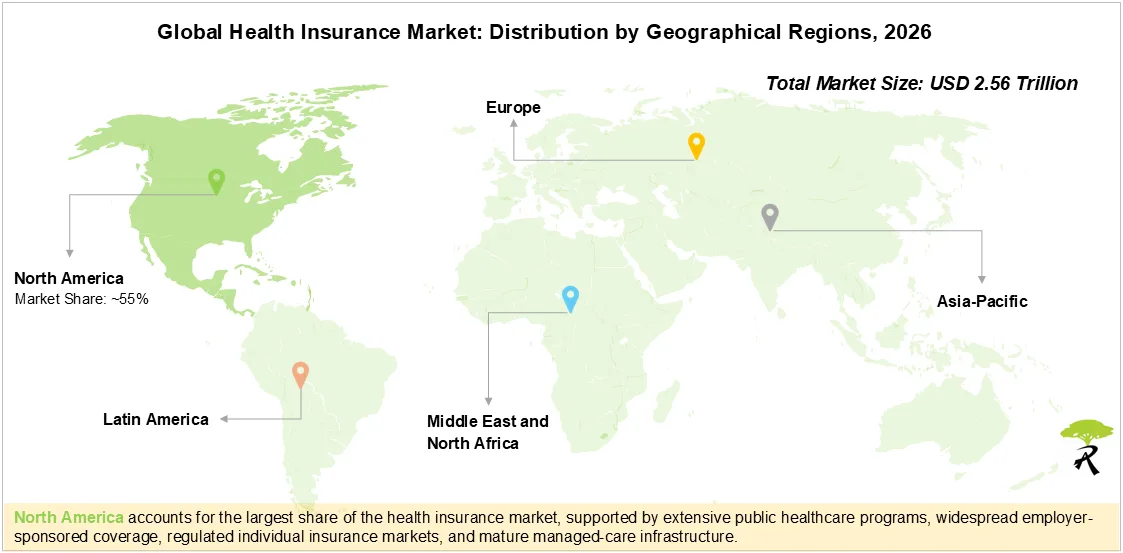
Asia-Pacific to Register Fastest Growth by 2035
Asia-Pacific is expected to be the fastest-growing region, driven by rising disposable incomes, urbanization, formal employment, digital insurance distribution, and government initiatives aimed at reducing out-of-pocket healthcare spending. Growth varies across the region due to differences in public coverage, private insurance penetration, regulatory frameworks, and healthcare infrastructure.
Key Players Profiled in Health Insurance Market
The global health insurance market is served by a diverse range of private health insurers, managed-care organizations, integrated healthcare and insurance providers, multinational insurance groups, and government-backed health insurance entities, including UnitedHealth Group, Elevance Health, CVS Health, Cigna Group, Humana, Centene, Allianz, AXA, Ping An Insurance, and Bupa.
Report Deliverables and Customization
The report includes complimentary Excel data packs covering market landscape analysis, company competitiveness, company profiles, partnerships and collaborations, funding and investments, and market sizing and forecast analysis. A complimentary PowerPoint presentation is available, and up to 15% customization can be requested subject to data availability.
Report Authorship
Author(s): Simriti Gupta and Pemba Lahmo. Both authors contribute to Roots Analysis's healthcare and pharma research practice, covering health insurance, healthcare financing, payer landscape, and insurance market studies.
Independence and Non-Affiliation
This report is an independent work of market research and analysis published by Roots Analysis. It is not affiliated with, sponsored by, endorsed by, or reviewed by Elevance Health, CVS Health, Cigna Group, Humana, or any other health insurer, healthcare company, insurance brand, or regulatory body referenced within it. No content in this report should be construed as medical advice. Roots Analysis maintains its own proprietary primary research process, and does not receive compensation from any company profiled within the report, in exchange for inclusion or favorable characterization.