
Lowest Price Guaranteed
Slides
236
Last Updated
September 2025
View Count
13278
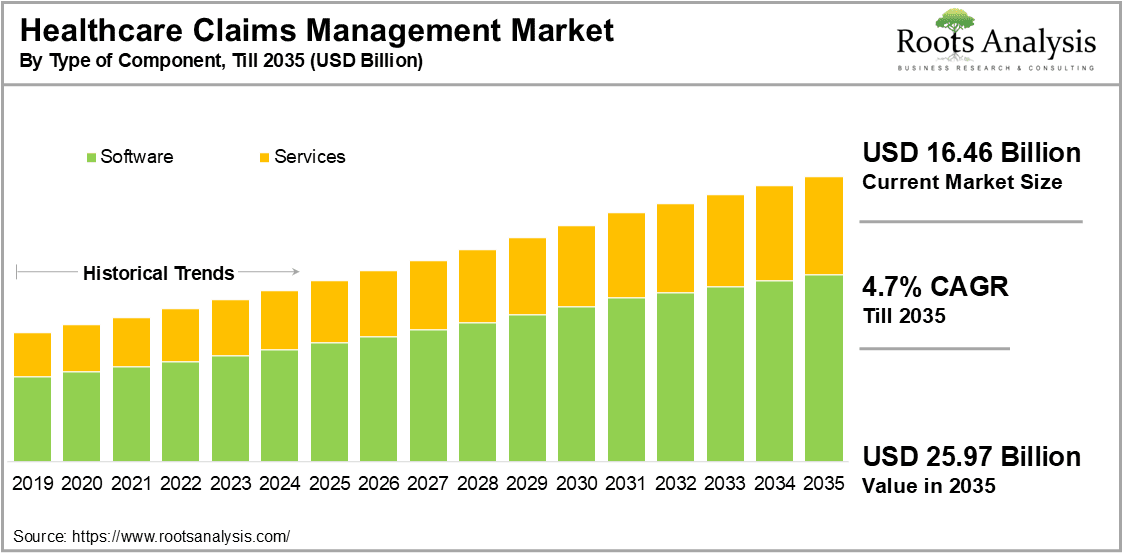
The global healthcare claims management market, valued at USD 15.56 billion in 2024, is estimated to grow to USD 16.46 billion in 2025 and USD 25.97 billion by 2035, representing a CAGR of 4.7% during the forecast period.
 |
To learn more about this report, request a free sample copy
Medical claims are a crucial billing format that healthcare provider submit to the patent or patient’s insurance provider for the services. These bills include medical codes that determine healthcare services provided, such as procedures, diagnosis, medical device support, medical transportation and pharmaceuticals. The entire process of bill submission to process and managing healthcare claims between patients, providers and insurance companies is known as medical claims management. Traditionally, medical claims are handled manually, which enhances labor work, invites manual errors and sometimes cause claims rejection. In order to make medical claims processes accurate and easier, medical claims management software emerge as potential solutions.
Medical claims management software and services encompasses a variety of features that automate the patient’s eligibility process, verification, accurate coding diagnosis, claim submission and procedures to the insurance companies. Moreover, the systems has been designed to automate the follow up process on reimbursement and claim status through automation system and adoption of metaverse in healthcare. With the integration of seamless healthcare claim management software, chances of errors will be reduced, and payers will get timely claims. Additionally, the growing preferences for digital healthcare solutions and electronic health records has further necessitated the demand for healthcare claims management software for smooth reimbursement claiming process.
Notably, there is a huge impact of digital transformation on healthcare claims processing. To date, several healthcare claim management software has been developed by the industrial players that aid in efficient claiming process.
For instance, in October 2024, Oracle announced the availability of Oracle Health Clinical Data Exchange (a cloud-based medical claims management solution) that automate data exchange between healthcare providers and payers for streamlining medical claiming processes. The system is built on Oracle Cloud Infrastructure that offers a centralized network for secure medical record transmission for speedy approval, thereby reducing overall time and cost of patient clinical services claim. Likewise, several market players are aiming to accelerate the innovations and development of advanced healthcare claims management solutions to enhance claims evaluation and decision process. However, the primary focus on the key players, such as Microsoft, IBM and Oracle will be on enhancing data security and designing advanced cloud-solutions. Considering the ongoing innovations in this field and rising demand for claims management software, we believe healthcare claims management market will continue to grow at a steady pace during the forecast period.
The market report highlights the invaluable information about leading healthcare claims processing companies and software providers who are presently active across different segments of the market as mentioned in the table below.
| Key Report Attributes | Details | |
| Historical Trend | Since 2019 | |
| Forecast Period | Till 2035 | |
| Market Size 2035 | $25.97 Billion | |
| CAGR (Till 2035) | 4.7% | |
| Type of Component |
|
|
| Type of Solution |
|
|
| Type of Deployment |
|
|
| Type of Application |
|
|
| End User |
|
|
| Geographical Regions |
|
|
| Key Companies Profiled |
|
|
| PowerPoint Presentation (Complimentary) |
Available | |
| Customization Scope | 15% Free Customization | |
| Excel Data Packs (Complimentary) |
Available | |
One of the key objectives of the healthcare claims management market report was to estimate the current size, opportunity and the market growth potential, over the forecast period, till 2035. We have provided informed estimates on the likely evolution of the market for the forecast period.
The global healthcare claims management market analysis report also features the likely distribution of the current and forecasted opportunity within the market across various segments, such as type of component (software and services), type of solution (integrated solutions and standalone solutions), type of deployment (cloud-based, on-premise and web-based), type of application (claims management, medical billing, coding, fraud detection, compliance management and other applications), end user (hospital providers and hospital payers), geographical region (North America, Europe, Asia-Pacific, Middle East and North Africa, and Latin America) and leading players.
In order to account for future uncertainties associated with some of the key parameters and to add robustness to our model, we have provided three market forecast scenarios, namely conservative, base, and optimistic scenarios, representing different tracks of industry’s evolution.
All actual figures have been sourced and analyzed from publicly available information forums and primary research discussions. The financial figures mentioned in this market report are in USD, unless otherwise specified.
Based on the type of component, the global market is segmented into software and services. According to our projection, software currently holds the dominating position with the highest healthcare claims management market share (66%). Software based healthcare claims management solution can easily integrate with existing systems to ensure streamlined claim lifecycle. Moreover, software facilitates automation for claims submission, billing, coding and offer real time verification to enhance evaluation performance. The significance offered by the software, such as accuracy, efficiency and real-data compliance to enhance claims cycle management has further supported the highest share of the software.
However, it is important to highlight here that the services segment is likely to grow at a higher CAGR during the forecast period. This is likely to be because healthcare claim management services from third party save time, help to navigate complex billing regulations, reduce errors and enhance accuracy in reimbursement claims. Furthermore, outsourcing of healthcare claims management services helps to focus on providing quality care instead of spending time in claim processing, which is likely to be a key factor for lucrative growth potential.
On the basis of type of solution, the global healthcare claims management market size is distributed into integrated solutions and standalone solutions. According to our study, integrated solutions account for the highest share (71%) of the market. Integrated solutions provide a broad platform by combining multiple functionalities to enhance accuracy in claims management. Moreover, integrated solutions in healthcare claims management can easily integrate with medical billing software, electronic health record systems and other healthcare applications. These solutions allow healthcare practitioner streamlined workflows and data exchange for end-to-end claims management capabilities. By integrating integrated solutions, healthcare practitioners are not required to connect multiple systems for claim processing and patient data collection, which further bolstered the demand for integrated solutions in the healthcare industry.
It is important to highlight here that standalone solution provide specific tools that focus only on claims management and processing. These solutions have been designed to handle specific claims management requirements for healthcare systems. However, it is worth mentioning that owing to the multiple functionalities of integrated solutions, this segment will remain dominant and is likely to grow at a higher CAGR during the forecast period.
This segment highlights the distribution of global market across different types of deployment, such as cloud-based, on-premise and web-based. Currently, web-based deployment accounts for the highest healthcare claims management market share (nearly 50%). This can be attributed to the fact that healthcare providers currently use web-based portals to submit claims electronically. The data contains information about services used, patient details, cost and diagnosis codes for processing medical claims. Moreover, web-based systems offer real-time access to data to determine if patients have received insurance claims or patient is eligible for medical insurance. In addition, web-based deployment ensures direct communication between healthcare payers and providers for easy claiming process, which further supported the highest share of this segment.
However, it is important to highlight here that cloud-based deployment in healthcare claims management solutions holds a competitive position in the market and is likely to grow at a higher CAGR during the forecast period. Cloud-billing services are cost-saving strategies in healthcare claims processing for providers and can be integrated with existing medical claims management software for easy processing. Further, the data transmission flexibility and accessibility in real-time make this deployment an exceptional alternative for claims management. Driven by the growing adoption across the healthcare sector, cloud-based deployment may dominate the market during the forecast period.
Based on the type of application, the healthcare claims management market size is segmented into claims management, medical billing, coding, fraud detection, compliance management and other applications. Currently, medical billing accounts for the highest share (nearly 60%) of the market. This can be attributed to the fact that medical billings on time is utmost important for timely insurance claims and the highest revenues for healthcare providers. Thus, in order to reduce the manual errors, on-time billing claims and reducing chance of payment rejection, healthcare sector and medical claims insurance providers are adopting healthcare claims management software, anticipated to be a key reason for highest share.
However, in the future, we believe that claims management or processing segment is likely to grow at a higher CAGR during the projected period. Medical claims processing is a tedious process as it involves the adjudication, review and payment of medical claims submitted. The entire process involves verification, eligibility, coding review, submission and payment reconciliation. In such instance, healthcare claim management software emerges as a potential solution to maintain accuracy in overall verification process and optimize overall efficiency of medical claims management process. Thus, growing adoption of healthcare claims management solutions for claims management is likely to be the key reason for unprecedented growth.
The global market is distributed across different types of end users, such as hospital providers and hospital payers. According to our healthcare claims management market analysis, presently hospital providers account for the largest share (nearly 70%) of the overall market. This can be attributed to the fact that healthcare providers are the largest adopter of healthcare claims management software and services to optimize their payment clearance task and minimize errors during claiming processes. Furthermore, the growing adoption of digital health solutions and advancements in the healthcare infrastructure for implementing advanced cloud-based management solutions has further increased the adoption of medical claims management solutions.
Notably, the healthcare payers segment is anticipated to register a higher CAGR during the forecast period. This is primarily due to the increasing adoption of healthcare claims management software by healthcare payers for detecting frauds in claiming processes. Moreover, healthcare payers are focusing on integrating software and solutions to eliminate labor costs, which further become a key reason for the lucrative growth of this segment during the projected period.
The global healthcare claims management market is distributed across different geographical region, such as North America, Europe, Asia-Pacific, Middle East and North Africa, and Latin America. Among these, North America currently dominating the market, accounting for 40% of the overall revenue share. According to the regional analysis of healthcare claims management industry, North America’s healthcare sector is shifting towards digital healthcare solutions to enhance quality care and overall patient outcomes. Furthermore, the healthcare sector in this region are adopting medical claims management software to improve claims processing, which is likely to be a key growth factor of the market in this region.
However, the global market in Asia-Pacific is likely to register a higher CAGR during the forecast period. This can be attributed to the increasing acceptance of medical insurance, healthcare digitization and supportive guidelines for the expansion of healthcare IT infrastructure.
The “Healthcare Claims Management Market: Industry Trends and Global Forecasts, till 2035” research report features an extensive study of the focus on competitive landscape of strategic initiatives, emerging mega trends, big pharma initiatives, company profiles and key drivers and restraints. The market report highlights the efforts of several stakeholders engaged in this rapidly evolving segment of the healthcare IT industry. Key takeaways of the market report are briefly discussed below.
Currently, the market landscape features the presence of various small, mid-sized and large companies. These industrial players are focusing on technological innovations and integration of AI technology to automate the process of healthcare claims management. In order to leverage a competitive edge, the key players of the market has taken strategic initiatives such as collaboration, partnerships and extending their services. For instance, in February 2024, Max Life Insurance shifted to Oracle Exadata Database which is currently running Exadata platform in Oracle Cloud Infrastructure. Migration has been done to migrate its core systems to its OCI including claims management, policy insurance and customer services management to improve claims application processes.
Overall, the market seems highly fragmented and competitive driven by the presence of several well-established new-entrants who are aiming to leverage advanced tools for designing healthcare claims management software, and data transmission security systems.
Healthcare systems are required to intricate complex coding systems, data requirements and billing guidelines for medical claim submission. Navigating complex guidelines may create difficulties in the claiming process and may cause penalties to the patients. In order to mitigate the growing concern, healthcare claims management software has been adopted on a large scale to ensure adherence to the coding and billing regulations.
Moreover, the healthcare claims management software and services have been adopted to reduce the manual errors and maximize the reimbursement claiming process. In addition, the unexpected increase in medical billing costs due to errors has further fueled the demand for healthcare claims management software during the forecast period.
Some of the major challenges in healthcare claims management market that are likely to hinder market progress includes data privacy and security concerns. It is important to highlight here that data sharing through cloud services and internet connection is prone to breaching, therefore, rising the risk of data privacy. A recent report published by IBM shows that nearly 3,556 cyber security and 604 organizations witness data breaching activities, overall. Moreover, there is a 10% increase noticed in the breaching activities in the year 2024 that cost a loss of around USD 4.88 million. Driven by the rising data privacy risk, there is a high demand for cybersecurity measures to ensure safe and secure data transmission for claims management. Furthermore, the key players are required to compile up with HIPAA to ensure seamless data security of patient data during claims management processes.
Healthcare Claims Management Market Trends: Integration of AI Technology, Shift Towards Predictive Analytics and Value Based Reimbursement Claims Model
Some of the notable growth factors include integration of AI technology for shift towards predictive analytics tools. Currently, the global market players are focusing on the integration of artificial intelligence to enhance automation in the industry and reduce overall manual errors. Furthermore, the shift towards predictive analytics tools to identify frauds, anomalies and minimizing rejections has further offered key opportunities for the industrial players to drive innovations in this field. In addition, value-based reimbursement models to increase patient outcomes and offer quality care have further anticipated to be a key growth factor of the market. It is important to highlight here that growing penetration of telehealth services and remote patient monitoring devices has further increased the demand for healthcare claims management software in the healthcare industry.
Currently, the global healthcare claims management market size is USD 16.46 billion and is poised to reach USD 25.97 billion by 2035. Driven by the growing demand for advanced predictive analysis software for managing administrative tasks and claims management in healthcare industry, this market is expected to grow at a CAGR of 4.7% during the forecast period. It is worth noting that several industrial leaders are forging strategic partnerships to enhance the development of healthcare claims management software and offer comprehensive services. For instance, in September 2024, CareCloud announced a strategic partnership with ChartSwap (a medical and billing records provider) to launch latest CareCloud solution powered by ChartSwap. This strategic partnership aims to improve the Request for Information process within healthcare industry. This information is useful for managing medical claims and handling medical records. Driven by the ongoing partnerships, we believe that the market will remain investible for the long term.
Examples of key healthcare claims management industry (which have also been captured in this report) include Accenture, Athenahealth, Carecloud, Cognizant, Conifer Health Solutions (a subsidiary of Tenet Healthcare), eClinicalWorks, IBM, Mckesson, Optum (a subsidiary of United Health), Oracle, Plexis Healthcare Systems, Quest Diagnostics, Tebra, The SSI Group and Veradigm (earlier known as Allscripts Healthcare Solutions). This market report includes an easily searchable excel database of all the companies focusing on the development of software or services for healthcare claims management.
Several recent developments have taken place in the healthcare claims management industry. We have outlined some of these recent initiatives below.