


 Download Free Sample
 Buy Now
Market Size
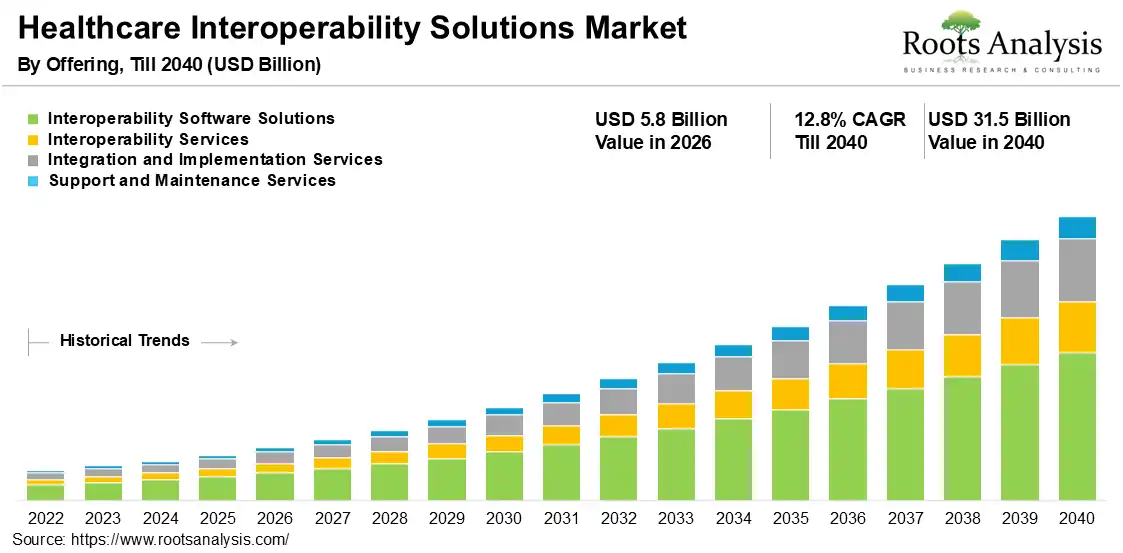
The global healthcare interoperability solutions market is expected to rise from USD 5.8 billion in 2026 to reach USD 31.5 billion by 2040, growing at a CAGR of 12.8% over the forecast period 2026 to 2040, driven by regulatory interoperability mandates and cloud-native FHIR adoption.
See What’s in the Full Report – Request Your Complimentary Insights!
Market Report: Key Takeaways
- Based on Offering, Interoperability Software Solutions is both the dominant and fastest-growing category, holding 52.0% share in 2026 and expanding at 13.6% CAGR through 2040, driven by reusable platform economics.
- Based on Deployment Mode, Cloud-Based Deployment is both the dominant and fastest-growing category, holding 49.0% share in 2026 and expanding at 15.4% CAGR through 2040, driven by API scalability.
- Based on Application, Clinical Data Exchange capture 30.0% market share in 2026, whereas Payer-Provider Data Exchange register a 15.3% CAGR through 2040, driven by prior authorization automation.
- Based on End User, Healthcare Providers capture 48.0% market share in 2026, whereas Healthcare Payers registers a 14.2% CAGR through 2040, driven by payer API mandates.
- Based on Geography, North America capture 44.0% market share in 2026, whereas Asia-Pacific registers a 16.2% CAGR through 2040, driven by national digital health infrastructure.
Healthcare Interoperability Solutions Market Outlook
Healthcare data exchange is shifting from interface-by-interface integration toward reusable FHIR interoperability solutions and governed exchange networks. Earlier demand centered on HL7 integration engine projects, C-CDA routing, and basic record transport. Current buyers now expect API orchestration, semantic normalization, payer-provider data exchange, and AI-ready clinical data pipelines. The healthcare interoperability solutions market will grow at a 12.8% CAGR through 2040 as software-led platforms replace one-off connectivity work.
Federal interoperability policy is the strongest near-term growth driver because it turns data exchange from an IT project into a compliance requirement. HHS and ONC announced in June 2026 that TEFCA surpassed one billion health records exchanged, confirming national scale for secure health information exchange. This milestone raises buyer expectations around QHIN connectivity, patient access, cross-network trust, and measurable exchange performance under federal audit pressure.
Long-term growth will accelerate as cloud deployment, semantic interoperability, and FHIR APIs reshape procurement through 2040. Oracle Health received TEFCA QHIN designation in November 2025 and linked customer onboarding to Oracle Health Connection Hub. Vendors that combine standards, workflow consoles, and governed data access will gain share. The outlook remains high-growth, with adoption moving from compliance-led exchange toward operational data infrastructure across providers, payers, and networks.
Healthcare Interoperability Solutions Market Dynamics
Healthcare Interoperability Solutions Market Drivers
Regulatory exchange programs now pull healthcare data interoperability from optional modernization into budgeted compliance work. TEFCA, CMS interoperability actions, and information blocking enforcement create measurable pressure on providers, payers, and networks. HHS announced in September 2025 an active enforcement stance against health data blocking, including potential civil monetary penalties up to USD 1 million per violation. This policy pressure supports demand for auditable healthcare data exchange platforms.
Healthcare Interoperability Solutions Market Restraints
Legacy interface estates slow adoption because many providers still depend on HL7 v2 interfaces, C-CDA exchange, and custom workflows. On-premises deployment still holds 33.0% share in 2026, limiting cloud migration speed for hospitals with complex electronic health records environments. Integration and implementation services also lose share through 2040 as buyers prefer reusable platforms. Vendors must still fund migration, testing, terminology mapping, and support for mixed standards.
Healthcare Interoperability Solutions Market Opportunities
Payer-provider automation creates the clearest growth opening because utilization management, prior authorization, and claims workflows need standardized clinical data. CMS proposed FHIR-based prior authorization standards for drugs in April 2026, linking interoperability directly to administrative workflow modernization. Payer-provider data exchange will grow at 15.3% CAGR through 2040. Vendors that connect clinical context with administrative APIs can win higher-value accounts.
Healthcare Interoperability Solutions Market Challenges
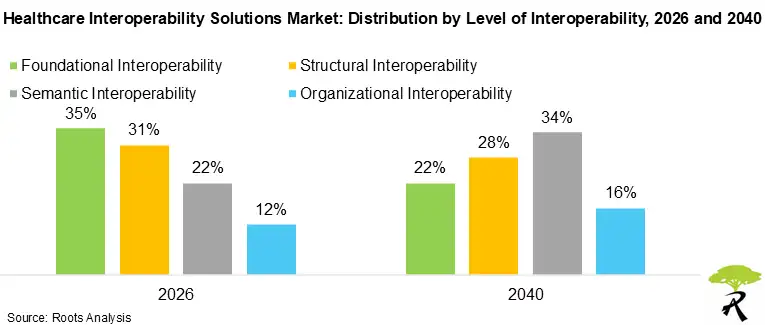
Semantic interoperability remains difficult because exchanged records often lack consistent meaning across EHRs, payers, pharmacies, and public agencies. Foundational interoperability leads with 35.0% share in 2026, showing that many buyers still need basic connectivity before advanced normalization. FHIR APIs lead data standard share, yet HL7 v2 and C-CDA remain important installed-base formats. Competitive advantage depends on supporting old interfaces while moving customers toward AI-ready data models.
Healthcare Interoperability Solutions Market Size Estimation Methodology
- As a starting point, we screened multiple credible secondary sources for healthcare interoperability solutions market anchors across historical, current, and long-term forecast years. We normalized each source to a global scope, constant U.S. dollar basis, and comparable inclusion of software, services, cloud deployment, and healthcare data exchange platforms. We excluded the aggressive outlier because its base-year profile sat above the current source cluster.
- Moving forward, we mapped the addressable market to verified segmentation dimensions across offering, deployment mode, interoperability level, application, end user, interface standard, and geography. This step separated recurring software revenue from integration and implementation services. It also distinguished FHIR APIs, HL7 v2 interfaces, C-CDA exchange, DICOM exchange, X12 claims transactions, and proprietary APIs.
- Building on this, we used market-specific demand indicators to test segment direction. The review considered regulatory submission counts, QHIN participation, health information exchange transaction volumes, EHR connectivity footprints, cloud health data service adoption, and payer-provider API mandates. These indicators helped identify why cloud-based deployment, FHIR APIs, semantic interoperability, and payer-provider data exchange gain share through 2040.
- Drawing upon these, we assigned 2026 and 2040 segment shares by comparing adoption maturity, compliance urgency, switching cost, and buyer budget ownership. Provider spending remained the largest end-user pool because EHR connectivity and clinical workflows drive near-term procurement. Payer spending gained share because prior authorization APIs, value-based care, and administrative data exchange shift interoperability into reimbursement operations.
- The projected value was then calculated by applying the consensus CAGR curve to the normalized base, current, and terminal-year anchors. We used a 12.8% CAGR for the core healthcare interoperability solutions market forecast and adjusted sub-segment CAGRs around that benchmark. Higher rates were assigned to cloud deployment, FHIR APIs, semantic interoperability, and Asia-Pacific where adoption signals were stronger.
- Finally, we stress-tested the forecast against regulatory timing, vendor positioning, and installed-base friction. TEFCA scale, CMS interoperability programs, information blocking enforcement, and cloud data residency requirements supported upside. Legacy HL7 estates, on-premises dependencies, terminology mapping, and support costs moderated the adoption curve. The final model balances compliance-driven demand with the operational pace of healthcare IT replacement cycles.
Healthcare Interoperability Solutions Market Share Insights
Market Share by Deployment Mode
According to our analysis, cloud-based deployment leads as health systems seek scalable API management, elastic storage, and lower interface maintenance costs. Microsoft showed Azure Health Data Services supporting FHIR and DICOM interoperability in January 2025. Further, cloud-based deployment will expand fastest as AI workloads require normalized, governed, and cloud-accessible clinical data. Redox highlighted cloud-based FHIR data pipelines with Databricks in June 2025.
Market Share by Level of Interoperability
Foundational Interoperability leads because many providers still require connectivity before advanced data normalization. CMS announced foundational digital health infrastructure actions in June 2025, including provider directory and API enhancements.
Semantic Interoperability will grow fastest as AI, analytics, and value-based care need usable data. Redox and Kno2 announced an October 2025 alliance covering HL7v2, FHIR, X12, CDA, and proprietary formats.
Want Information on Specific Region / Segment?
Regional Analysis: North America Leads the Market and Asia-Pacific is Likely to Register Higher CAGR
Presently, North America holds 44.0% share in 2026. The region leads through mature EHR penetration, federal interoperability rules, payer-provider API mandates, and deep vendor ecosystems. CMS launched a patient-centric health technology ecosystem initiative in July 2025.
On the contrary, Asia-Pacific registers a 16.2% CAGR from 2026 to 2040. The growth will accelerate through national digital health IDs, cloud migration, and public-sector interoperability programs. India reported 100 crore ABHA-linked health records under ABDM in May 2026.
Europe remains a major structural market because EHDS creates a long-run legal and technical framework. The EHDS Regulation was published in March 2025 and entered into force on 26 March 2025.
Market Ecosystem Analysis
The scoped ecosystem includes 26 vendors, with seven Tier 1 leaders, fourteen Tier 2 specialists, and five emerging entrants. Commercial activity concentrates around EHR platforms, hyperscaler health-data services, QHIN-enabled networks, and integration engines. Platform convergence dominates, as EHRs, QHINs, cloud FHIR stores, and workflow vendors converge around CMS-aligned data exchange. CMS made this force explicit in July 2025, when more than 60 companies pledged support and 21 networks targeted CMS Aligned Network status. Competitive advantage is shifting from interface coverage to workflow-embedded, identity-enabled, AI-ready longitudinal data because providers need less manual retrieval and faster clinical context.
- Oracle Health received QHIN designation in November 2025, expanding Oracle Health Information Network exchange across providers, payers, and government agencies. In April 2026, Oracle Health achieved CMS Aligned Network status and integrated CLEAR1 for digital identity-based check-in. This pressures EHR competitors that still separate exchange, identity, and intake workflows. It strengthens patient access, clinical data exchange, and organizational interoperability.
- Epic and Humana launched data-sharing features in November 2025 to automate coverage verification for more than 800,000 Medicare Advantage members. Epic’s payer-platform integration shifts interoperability from record retrieval toward front-desk automation. This raises the barrier for payer-provider tools that lack embedded EHR workflow access. It strengthens administrative data exchange, patient access, and payer-provider data exchange.
- Altera Digital Health and Health Gorilla announced a June 2025 partnership integrating Health Gorilla’s QHIN-enabled network into Sunrise EHR. The integration gives Sunrise users longitudinal records, including labs, encounters, medications, and social determinants data. This pressures standalone HIE portals by putting exchange inside EHR workflows. It strengthens clinical data exchange, care coordination, and provider-focused semantic interoperability.
- AWS made HealthLake available in Europe’s Ireland Region in June 2025 for EU-resident FHIR storage, transformation, and analytics. This strengthens AWS positioning for European cloud deployments and population-health analytics. It pressures integration-only vendors that lack compliant regional data infrastructure. It also reinforces FHIR APIs, cloud deployment, and life-sciences data workflows.
- Microsoft’s Azure Health Data Services added US Core 6 and USCDI v3 support in October 2025. Microsoft also blocked new Azure API for FHIR deployments from April 2025, steering users toward Azure Health Data Services. This consolidates FHIR, DICOM, and MedTech data into a broader Azure workspace. It strengthens structural interoperability, DICOM exchange, and cloud-based deployment.
- Google Cloud added Cloud Healthcare API availability in Qatar and Saudi Arabia in October 2025. Google also added DICOM Studio in October 2025 and DICOM updates and patches in August 2025. These releases strengthen Middle East coverage and imaging exchange. They pressure vendors focused only on FHIR while hospitals need FHIR, HL7v2, and DICOM coverage.
- Redox and Kno2 formed an October 2025 strategic alliance covering Redox integration and Kno2’s QHIN-enabled national connectivity. Their combined network covers HL7v2, FHIR, X12, CDA, and proprietary formats. This lowers onboarding friction for providers, payers, and digital health vendors. It strengthens integration services, clinical data exchange, and hybrid interoperability workflows.
- Redox expanded Redox Engine in October 2025 with enrichment, orchestration, and AI-tool integration inside interoperability workflows. This shifts Redox from connectivity middleware toward workflow orchestration. It pressures interface-engine vendors that still monetize one-off integrations. It strengthens interoperability software, proprietary APIs, and AI-ready workflow automation.
- Rhapsody announced general availability of Rhapsody Axon in March 2026 for FHIR, HL7v2, X12, and API integrations. Axon automates integration steps inside Rhapsody and Corepoint platforms. This raises productivity expectations for integration and implementation services. It strengthens support services, hybrid deployment, and multi-standard interface management.
- Surescripts received QHIN status in April 2025, adding another national exchange route under TEFCA. Datavant launched its Clinical Insights Platform in March 2025 for payer and risk-bearing provider data workflows. Together, these moves expand specialist influence across network exchange and payer-provider analytics. They strengthen payer-provider data exchange, risk adjustment, and administrative data exchange.
Startup Companies and their Key Highlights
- Zus Health
- Event type: CMS Interoperability Framework early-adopter recognition
- Month and year: July 2025
- Stated purpose of the event: Zus joined the CMS framework to support patient-centered data exchange and aligned-network participation.
- Market implication: This accelerates shared health-data platforms for digital health builders and risk-bearing provider workflows.
- 1upHealth
- Event type: Top-performer recognition in KLAS CMS Payer Interoperability Report 2025
- Month and year: November 2025
- Stated purpose of the event: 1upHealth highlighted its score of 87.3 and payer interoperability performance under CMS-0057-F requirements.
- Market implication: This strengthens payer-facing FHIR compliance, patient access, provider access, and payer-to-payer exchange.
- Moxe Health
- Event type: Strategic partnership
- Month and year: October 2025
- Strategic partner name: Greenway Health
- Stated purpose of the event: The partnership automates clinical data exchange for ambulatory practices inside Greenway EHR workflows.
- Market implication: This accelerates payer-provider clinical data exchange and reduces portal, fax, and manual chart-retrieval work.
- Particle Health
- Event type: CMS initiative support commitment
- Month and year: July 2025
- Stated purpose of the event: Particle pledged support for secure, patient-centered data sharing under the CMS interoperability framework.
- Market implication: This supports API-based clinical record access for providers, payers, health systems, and developer platforms.
- b.well Connected Health
- Event type: Additional investment
- Month and year: February 2025
- Lead investor or strategic partner name: RTI International
- Stated purpose of the event: b.well expanded into pharma and life sciences through RTI’s investment and partnership.
- Market implication: This extends consumer-mediated interoperability into life-sciences research, real world evidence solutions, and consented patient engagement.
Healthcare Interoperability Solutions Market Trends / Opportunities
FHIR API Standardization in the Healthcare Interoperability Solutions Market Expanding Platform-Led Competition
FHIR APIs are becoming the main competitive control point as regulation, developer ecosystems, and cloud tools converge around standardized exchange. Epic published new FHIR APIs for DICOM image characteristics in its May 2025 release, widening imaging-related interoperability use cases through existing EHR developer channels. This strengthens platform stickiness for EHR vendors and raises the value of certified developer access.
Payer-provider workflows are turning FHIR from a compliance standard into an automation layer for utilization management. CMS proposed FHIR-based prior authorization standards for drugs in April 2026, linking interoperability rules to payer operations. This creates larger commercial opportunities for vendors that connect clinical data with administrative exchange.
TEFCA and QHIN Scaling in the Healthcare Interoperability Solutions Market Raising Network Entry Requirements
Nationwide exchange is moving from participation claims toward measurable network volume and operational trust. HHS and ONC announced in June 2026 that TEFCA surpassed one billion health records exchanged, creating a scale marker for secure data exchange. This favors vendors that can prove governance, identity, consent, and cross-network performance.
Enterprise vendors are using QHIN connectivity to make interoperability part of broader customer retention. Oracle Health Information Network received TEFCA QHIN designation in November 2025 and linked enrollment to Oracle Health Connection Hub. This raises switching costs for health systems already tied to enterprise EHR workflows and managed onboarding consoles.
Cloud-Native Health Data Infrastructure Turning Interoperability into AI-Ready Data Operations
Cloud deployment is gaining share because AI, analytics, and population health tools need normalized, governed, and accessible health data. AWS HealthLake became available in the AWS Europe Ireland Region in June 2025 to support FHIR-standard storage, transformation, and analysis with EU data residency. Regional cloud availability helps vendors address compliance-sensitive buyers.
Integration platforms are adding intelligence features because healthcare integration teams need automation beyond message routing. Redox launched AI capabilities in June 2026, including an MCP server, AI Assistant Suite, and intelligent in-flight data processing. This shifts competition toward data operations, not only interface connectivity, and rewards vendors with reusable integration intelligence.
Your Business is Unique – Why Shouldn’t Your Report Be?
Market Access Considerations
TEFCA Participation and QHIN Connectivity
TEFCA participation shapes market access because nationwide exchange requires trust frameworks, identity controls, and operational readiness. HHS and ONC announced in June 2026 that TEFCA surpassed one billion health records exchanged, raising performance expectations for networks and connected vendors. Companies without QHIN pathways or partner access face slower enterprise sales cycles. QHIN-enabled vendors gain credibility with providers, payers, public agencies, EHR purchasing teams, and compliance committees.
Cloud Data Residency and Regional Health Data Infrastructure
Cloud access depends on data residency, security review, and regional service availability. AWS HealthLake became available in the AWS Europe Ireland Region in June 2025 to support FHIR-standard storage, transformation, and analysis with EU data residency. Regional infrastructure helps cloud vendors address privacy-sensitive buyers. Providers with strict residency requirements may still delay migration or prefer hybrid deployment until governance teams and enterprise risk teams approve cloud operating models.
Information Blocking Compliance and Auditability
Information blocking enforcement creates access barriers because vendors must prove data availability, policy alignment, and defensible exchange workflows. HHS announced in September 2025 an active enforcement stance and cited potential civil monetary penalties up to USD 1 million per violation. This raises compliance costs for smaller vendors. Platforms with audit trails, consent controls, exception tracking, and workflow evidence gain stronger procurement positioning during legal and security review.
How Stakeholders Benefit from the Key Focus Areas of Our Healthcare Interoperability Solutions Market Report
TEFCA scale, CMS interoperability actions, and information blocking enforcement make interoperable health data a commercial priority now. The report supports decisions on segment prioritization, vendor selection, partnership strategy, and technology roadmaps.
- Unmet Needs and Market Gaps in Healthcare Interoperability Solutions Market: The report identifies gaps between basic connectivity and usable data across foundational, structural, semantic, and organizational interoperability. Commercial teams can use this gap map to decide whether to position around HL7 integration, FHIR APIs, terminology normalization, or managed exchange workflows. Product leaders can prioritize features that reduce migration, mapping, and audit burden.
- Funding and Venture Investment Opportunities in Healthcare Interoperability Solutions Market: The report highlights where growth concentrates across cloud deployment, semantic interoperability, payer-provider exchange, and FHIR APIs. Investors and corporate development teams can use these segment CAGRs to screen acquisition targets, partnership candidates, and emerging platforms. The analysis also separates enterprise leaders from specialist vendors and emerging companies such as Zus Health, 1upHealth, Moxe Health, Particle Health, and b.well Connected Health.
- Technology Innovation and Adoption Trends: The report tracks adoption curves across FHIR APIs, HL7 v2 interfaces, C-CDA exchange, DICOM exchange, X12 claims transactions, and proprietary APIs. Technology executives can use this view to decide which standards require near-term support and which standards will gain share through 2040. The analysis also covers AI-ready data infrastructure, cloud-based deployment, and intelligent integration workflows.
- Healthcare Interoperability Solutions Market Competitive Landscape and Industry Analysis: The report maps tiered competitors across enterprise EHR interoperability, cloud health data services, integration engines, QHIN-enabled networks, and shared health data platforms. Strategy teams can compare Oracle Health, Epic Systems Corporation, InterSystems Corporation, AWS, Microsoft, Google Cloud, Salesforce, Redox, Health Gorilla, Kno2, and other named vendors by role. This supports build, buy, partner, and account targeting decisions.
- Mapping Strategic Partnerships and Ecosystem Synergies: The report shows how partnerships create access to networks, standards coverage, and customer workflows. Business development teams can assess moves such as the Redox and Kno2 alliance for clinical data exchange orchestration across nationwide workflows. This helps identify which partners can extend connectivity, improve data transformation, or strengthen payer-provider exchange.
- Healthcare Interoperability Solutions Market CAGR and Growth Trends: The report explains why the market grows at 12.8% CAGR through 2040 and which segments grow faster. Planning teams can use the annual forecast and share tables to size opportunities by offering, deployment, application, end user, interface standard, and geography. The analysis identifies cloud deployment, FHIR APIs, semantic interoperability, healthcare payers, and Asia-Pacific as priority growth areas.
Healthcare Interoperability Solutions Market: Scope of the Report
| Key Report Attributes | Details | |
| Forecast Period | Till 2040 | |
| Market Size 2026 | USD 5.8 Billion | |
| Market Size 2040 | USD 31.5 Billion | |
| CAGR (Till 2040) | 12.8% | |
| Segments Covered |
|
|
| Geographical Regions Covered |
|
|
| Key Sections Covered |
|
|
Market Segmentation
The Healthcare Interoperability Solutions Market report presents an in-depth analysis, highlighting the capabilities of various stakeholders, based on different segments, such as offering, deployment mode, level of interoperability, application, end user, interface / data standard, geographical regions, and leading players.
By Offering
- Interoperability Software Solutions
- Interoperability Services
- Integration and Implementation Services
- Support and Maintenance Services
By Deployment Mode
- Cloud-Based Deployment
- On-Premises Deployment
- Hybrid Deployment
By Level of Interoperability
- Foundational Interoperability
- Structural Interoperability
- Semantic Interoperability
- Organizational Interoperability
By Application
- Clinical Data Exchange
- Administrative Data Exchange
- Population Health Management
- Care Coordination
- Patient Access and Patient Engagement
- Payer-Provider Data Exchange
- Public Health Reporting
By End User
- Healthcare Providers
- Healthcare Payers
- Pharmacies
- Health Information Exchanges
- Public Health Agencies
- Life Sciences and Research Organizations
By Interface / Data Standard
- FHIR APIs
- HL7 v2 Interfaces
- C-CDA / CDA Exchange
- DICOM / Imaging Exchange
- X12 / Claims Transactions
- Direct Secure Messaging
- Proprietary / Custom APIs
By Geographical Regions
- North America
- US
- Canada
- Mexico
- Rest of North America
- Europe
- Austria
- Belgium
- Denmark
- France
- Germany
- Ireland
- Italy
- Netherlands
- Norway
- Russia
- Spain
- Sweden
- Switzerland
- UK
- Rest of Europe
- Asia-Pacific
- China
- India
- Japan
- Singapore
- South Korea
- Rest of Asia-Pacific
- Latin America
- Argentina
- Brazil
- Chile
- Colombia
- Venezuela
- Rest of Latin America
- Middle East and Africa (MEA)
- Egypt
- Iran
- Iraq
- Israel
- Kuwait
- Saudi Arabia
- UAE
- Rest of MEA
- Rest of the World


