Healthcare LLMOps Market by Component / Offering (LLMOps Platforms, Model Evaluation and Validation Tools, Observability and Monitoring Tools, Governance, Risk and Compliance Software, Data Orchestration and RAG Infrastructure, and Professional Services and Integration Services), Deployment Mode, Model / Technical Approach, Application / Use Case, End User, LLMOps Lifecycle Function, Geographical Regions, and Leading Players – Trends and Forecasts, 2026-2040
Market Size
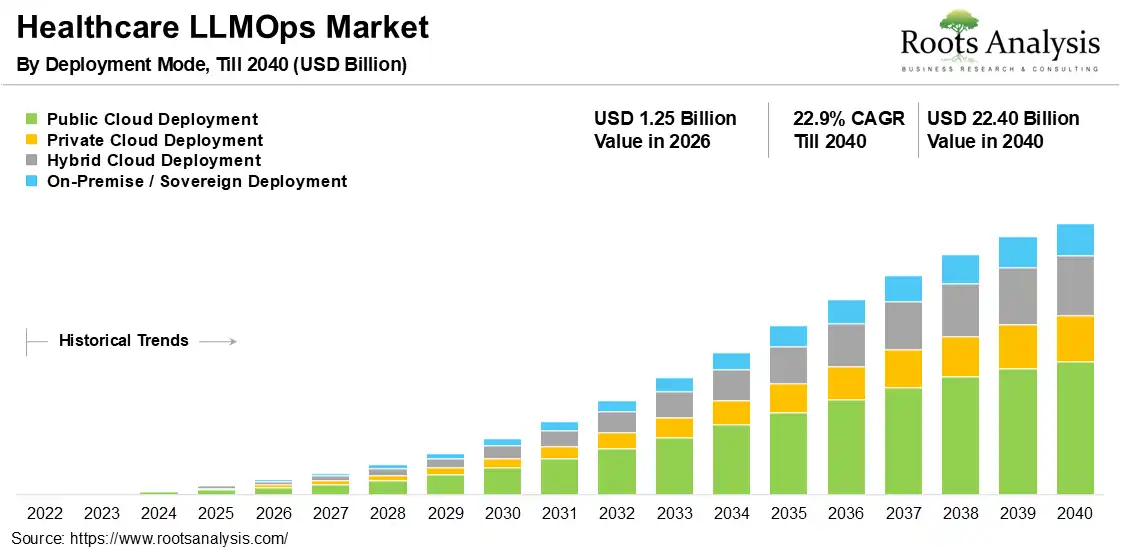
The global healthcare LLMOps market is expected to rise from USD 1.25 billion in 2026 to reach USD 22.40 billion by 2040, growing at a CAGR of 22.9% over the forecast period 2026 to 2040, driven by governed clinical AI workflows and agentic automation.
See What’s in the Full Report – Request Your Complimentary Insights!
Market Report: Key Takeaways
- Based on Geography, North America captures 48.0% market share in 2026, whereas Asia-Pacific registers a 27.2% CAGR through 2040, due to rapid cloud, AI infrastructure, and digital healthcare scaling.
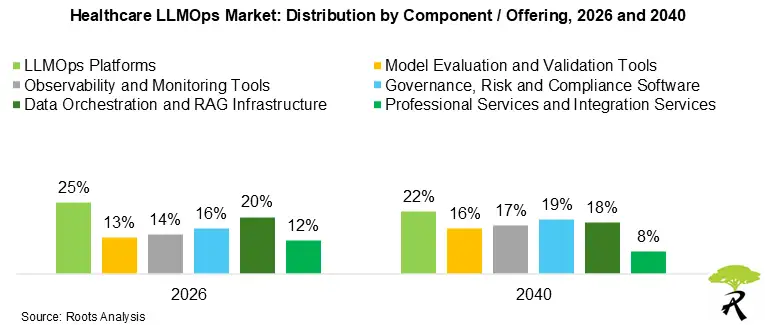
- Based on Component / Offering, LLMOps platforms capture 25.0% market share in 2026, whereas Model evaluation and validation tools register a 24.7% CAGR through 2040, as regulated deployments demand test evidence.
- Based on Deployment Mode, Public cloud deployment captures 49.0% market share in 2026, whereas Hybrid cloud deployment registers a 25.0% CAGR through 2040, as regulated workloads balance hyperscale AI with local controls.
- Based on Application / Use Case, Clinical documentation and ambient scribing captures 26.0% market share in 2026, whereas Prior authorization and payer operations register a 29.8% CAGR through 2040, driven by administrative automation.
- Based on End User, Healthcare providers / health systems capture 45.0% market share in 2026, whereas Payers and health plans register a 28.0% CAGR through 2040, as agentic workflows attack claims and authorization friction.
Healthcare LLMOps Market Outlook
Healthcare LLMOps is shifting from experimental GenAI pilots into governed production infrastructure for clinical, administrative, and life-sciences workflows. Early demand centered on clinical documentation, healthcare data search, and prompt design. Current buying now favors integrated deployment, evaluation, monitoring, RAG infrastructure, and audit control. Health systems need LLM lifecycle layers that reduce hallucination risk, protect sensitive data, and connect AI outputs with electronic health records workflows. Budget scrutiny now pushes buyers toward measurable ROI.
Current healthcare LLMOps market growth reflects three linked pressures: clinician workload, payer-provider friction, and rising AI governance expectations. FDA’s January 2025 AI-enabled medical device draft guidance strengthened lifecycle-management expectations for developers and buyers. These controls make validation evidence central to procurement decisions. Oracle Health reported in April 2026 that Southwest General used Clinical AI Agent across 18 specialties and reduced documentation and after-hours work.
Through 2040, the market will remain high-growth but gradually moderate as basic deployment layers mature. Faster growth will move toward evaluation, monitoring, governance, hybrid deployment, and agentic AI systems. Google Cloud detailed Gemini-powered agentic healthcare workflows in March 2026, moving deployments toward automated patient-centered action. Long-term adoption will favor vendors that prove clinical safety, workflow depth, and measurable operating impact. This creates a defensible, compliance-led growth path.
Healthcare LLMOps Market Dynamics
Healthcare LLMOps Market Drivers
Clinical workflow automation is pulling healthcare LLMOps from pilots into enterprise buying cycles. Clinical documentation and ambient scribing hold 26.0% share in 2026 because ROI appears directly in clinician time. Public cloud deployment holds 49.0% share as hyperscalers provide managed AI, security controls, and integration capacity. Microsoft introduced Dragon Copilot in March 2025 to streamline clinical documentation, surface information, and automate tasks.
Healthcare LLMOps Market Restraints
Validation burden slows healthcare AI operations adoption because clinical buyers require evidence before scaling production use. Model evaluation and validation tools will grow at 24.7% CAGR through 2040, showing procurement pressure around safety testing. FDA’s January 2025 draft guidance reinforced lifecycle-management expectations for AI-enabled medical device developers. These requirements increase documentation, monitoring, and governance costs for smaller vendors.
Healthcare LLMOps Market Opportunities
Agentic AI systems create the largest expansion opportunity as deployments move beyond search and documentation. This technical approach will grow at 30.0% CAGR through 2040, faster than all other model approaches. AWS launched Amazon Connect Health in March 2026 to automate verification, scheduling, documentation, and coding tasks. Vendors that combine workflow orchestration, monitoring, and healthcare compliance can capture payer and provider demand.
Healthcare LLMOps Market Challenges
Healthcare AI governance remains fragmented across EHR workflows, cloud architectures, payer operations, and regulated clinical evidence. Hybrid cloud deployment will grow at 25.0% CAGR as buyers balance hyperscale AI with data residency and local control. Governance and audit management will grow at 25.4% CAGR, reflecting rising validation and monitoring expectations. Vendors must prove safety, integration depth, and auditability before health systems standardize large language model operations.
Healthcare LLMOps Market Size Estimation Methodology
- As a starting point, the model defined the healthcare LLMOps market around deployment, evaluation, monitoring, governance, data orchestration, and integration services. It used healthcare large language model operations as the operating layer for provider, payer, pharma, biotech, medical device, and digital-health deployments. Standalone public estimates remained limited. The forecast therefore used adjacent LLMOps software, MLOps, healthcare generative AI, healthcare AI, RAG, and healthcare AI agent benchmarks.
- Moving forward, the forecast screened 17 credible secondary and industry sources for comparable growth ranges and scope fit. Reported CAGRs ranged from 21.3% to 44.1% across adjacent categories. Ultra-aggressive broad LLM forecasts and narrow non-healthcare scopes were removed because they overstated addressable demand. Retained inputs reflected governed clinical AI workflows, regulated deployment needs, and healthcare-specific operating constraints.
- Building on this, the model mapped segment shares against verified adoption signals. Inputs included hyperscaler healthcare AI launches, EHR-integrated clinical agents, and AI governance tools. Component shares reflected platform adoption first, followed by faster evaluation, monitoring, and governance growth. Deployment shares used current public cloud dominance, then shifted demand toward hybrid and sovereign models as data-control needs rise.
- Drawing upon these, application weights were calibrated around documented healthcare use cases from the inputs. Clinical documentation and ambient scribing led near-term adoption because workflows show visible productivity impact. Prior authorization and payer operations received the fastest growth curve because rules-heavy tasks support repeatable agentic automation. Life-sciences weighting also considered clinical trial databases as demand signals, without treating them as provider workflow evidence.
- The projected value was then built through a year-by-year forecast curve from 2022 to 2040. The curve uses faster early adoption as health systems commercialize GenAI workflows, then moderates as base deployment layers mature. Segment-level CAGRs were calculated from 2026 and 2040 shares, maintaining consistency with the overall 22.9% CAGR. This approach prevents high-growth subsegments from exceeding the total addressable market logic.
- Finally, the forecast was cross-checked against company validation URLs, product-launch timing, regulatory guidance, and segment insight paragraphs. Regulatory submission counts were treated as governance-pressure indicators, not revenue proxies. The company database separated Tier 1 Leaders, Tier 2 Specialists, and Emerging or Startup vendors by role. Final assumptions favored auditable evidence, healthcare workflow integration, and compliance readiness over generic AI capability.
Healthcare LLMOps Market Share Insights
Market Share by Component / Offering
According to our analysis, LLMOps platforms lead because health systems need integrated deployment, prompt, retrieval, monitoring, and security layers. Platform buying also reduces vendor fragmentation during early clinical AI rollouts.
Model evaluation and validation tools will grow fastest as clinical buyers demand measurable safety evidence. RAG quality, hallucination control, retrieval accuracy, and clinical consistency will become procurement gates.
Market Share by Deployment Mode
Public cloud deployment leads because hyperscalers provide managed AI, scalable compute, and enterprise security controls. Healthcare buyers also favor faster model access and integrated workflow services.
Hybrid cloud deployment will grow fastest as clinical data remains sensitive and locally governed. Buyers will combine cloud-scale foundation models with local processing and controlled data residency.
Want Information on Specific Region / Segment?
Regional Analysis: North America Leads the Market and Asia-Pacific is Likely to Register Higher CAGR
Presently, North America holds 48.0% share in 2026. The region leads because it combines hyperscale cloud infrastructure, advanced EHR adoption, capital access, and regulated AI oversight. Provider demand remains strongest where documentation burden, payer friction, and clinical staffing pressure converge.
On the contrary, Asia-Pacific registers a 27.2% CAGR from 2026 to 2040. The region will grow fast as cloud investment, hospital digitization, and localized AI deployment accelerate together. India, Singapore, Japan, and South Korea will anchor demand for scalable and compliant clinical AI operations.
Market Ecosystem Analysis
Within the provided 25-company universe, eight Tier 1 platforms control most visible Healthcare LLMOps commercialization. Leaders such as Microsoft, AWS, Google Cloud, Oracle Health, Epic, OpenAI, Anthropic, and NVIDIA anchor deployment, infrastructure, workflow integration, and model access. Platform convergence is the dominant consolidation dynamic, as cloud, EHR, ambient documentation, governance, and agent orchestration increasingly bundle into one operating layer. Competitive advantage is shifting toward vendors that combine clinical workflow access, governed data grounding, evaluation controls, and audit-ready deployment evidence.
- In March 2026, AWS launched Amazon Connect Health to automate patient verification, scheduling, histories, documentation, and medical coding. The platform raises barriers for standalone LLMOps vendors because it embeds evaluation, EHR integration, and evidence mapping into operational workflows. This strengthens public cloud deployment, agentic AI systems, clinical documentation, and care coordination segments.
- In March 2026, Google Cloud positioned Gemini-powered healthcare agents around Vertex AI, Gemini Enterprise, clinical data grounding, and audit-ready transparency. This pressures smaller RAG and orchestration vendors because providers can deploy agents inside an enterprise-grade cloud control plane. The move strengthens data orchestration, RAG infrastructure, model governance, patient engagement, and clinical decision-support workflows.
- In March 2025, Microsoft launched Dragon Copilot by combining Dragon Medical One, DAX Copilot, fine-tuned generative AI, and healthcare-adapted safeguards. Microsoft strengthens clinical documentation LLMOps by controlling voice capture, transcription, ambient AI, note creation, and workflow automation. The launch increases pressure on point-solution scribe vendors and strengthens provider-facing clinical documentation segments.
- In February 2026, Oracle Health added order-creation capabilities to Oracle Health Clinical AI Agent using ambient listening. The feature drafts labs, imaging, medications, and follow-up appointments for clinician review. Oracle strengthens EHR-native deployment, clinical documentation, care coordination, and prompt-to-order workflow segments.
- In August 2025, Epic unveiled broad AI features covering Art for Clinicians, Emmie, Penny, AI charting, RCM, and operational workflows. Epic’s scale raises distribution pressure on independent documentation, coding, scheduling, and patient-facing AI vendors. The activity strengthens EHR-native LLMOps, revenue cycle management, patient engagement, and clinical workflow automation segments.
- Epic also disclosed collaboration with Microsoft for AI charting, using Dragon Ambient AI technology for transcription inside Epic workflows. This creates a hybrid control model where EHR distribution and ambient AI depth reinforce each other. It narrows white space for standalone scribes unless they prove specialty depth, cost savings, or better integration.
- In February 2025, Censinet released Censinet TPRM AI and Censinet ERM AI for healthcare AI governance and risk management. The launch strengthens governance, risk and compliance software by automating third-party AI assessments and enterprise risk workflows. It raises procurement barriers for AI vendors that lack explainable security, governance, and audit documentation.
- In February 2025, Arize AI highlighted a USD 70 million Series C for AI observability and LLM evaluation. The funding strengthens monitoring and evaluation capacity for production agents, including regulated enterprise and healthcare deployments. It supports model evaluation, observability, benchmarking, and lifecycle monitoring segments.
- In June 2025, Fiddler AI partnered with Carahsoft to expand public-sector access to AI observability and security solutions. The platform monitors LLM applications for hallucinations, toxicity, PII leakage, and prompt injection risks. This strengthens security controls, model monitoring, governance, and regulated deployment segments relevant to healthcare agencies.
Startup Companies and their Key Highlights
- Abridge
- Event type and funding amount: Series D, USD 250 million
- Month and year: February 2025
- Lead investor or strategic partner name: Elad Gil and IVP
- Stated purpose of the event: Develop AI capabilities and grow commercially
- Market implication: Accelerates clinical documentation and revenue-cycle documentation because Abridge already serves about 100 U.S. healthcare systems.
- Ambience Healthcare
- Event type and funding amount: Series C, USD 243 million
- Month and year: July 2025
- Lead investor or strategic partner name: Oak HC/FT and Andreessen Horowitz
- Stated purpose of the event: Expand reach to more health systems and build more products
- Market implication: Accelerates ambient documentation, coding, and clinical documentation integrity across U.S. health systems.
- OpenEvidence
- Event type and funding amount: Series B, USD 210 million
- Month and year: July 2025
- Lead investor or strategic partner name: Google Ventures and Kleiner Perkins
- Stated purpose of the event: Expand strategic content partnerships and build its advanced medical knowledge library
- Market implication: Accelerates medical knowledge search and clinical decision-support RAG because the model depends on trusted content partnerships.
- Nabla
- Event type and funding amount: Series C, USD 70 million
- Month and year: June 2025
- Lead investor or strategic partner name: HV Capital
- Stated purpose of the event: Build out agentic AI for clinical workflows
- Market implication: Accelerates ambient documentation and agentic clinical workflow automation across providers and physician groups.
- Assort Health
- Event type and funding amount: Series C, USD 120 million
- Month and year: June 2026
- Lead investor or strategic partner name: Menlo Ventures
- Stated purpose of the event: Scale voice AI agent platform for healthcare
- Market implication: Accelerates patient access, scheduling, intake, eligibility, referrals, and front-office automation in U.S. provider workflows.
Healthcare LLMOps Market Trends / Opportunities
Agentic Healthcare LLMOps Moving From Search Assistance to Workflow Automation
Agentic AI systems are shifting demand from answer generation toward multi-step healthcare workflow execution. Google Cloud detailed Gemini-powered agentic healthcare workflows in March 2026 to move organizations from siloed data entry to automated patient-centered action. This shift strengthens vendors that control orchestration, workflow context, and downstream clinical actions.
Administrative automation is expanding the commercial scope beyond clinicians and EHR users. AWS launched Amazon Connect Health in March 2026 to automate verification, scheduling, documentation, and coding tasks. The implication is stronger demand from payer operations, contact centers, and revenue-cycle teams.
Evaluation and Governance Layers Becoming Procurement Gates in Healthcare LLMOps
Evaluation tools are becoming core infrastructure because healthcare buyers need measurable safety evidence. AWS published a February 2025 approach for evaluating healthcare generative AI applications using LLM-as-a-judge on AWS. This trend supports faster growth for validation vendors that test retrieval quality, clinical consistency, and hallucination risk.
Regulatory expectations are pushing governance from compliance documentation into operating architecture. FDA issued January 2025 draft guidance for AI-enabled medical device developers covering lifecycle management and marketing submissions. Vendors with audit trails, monitoring controls, and model-change documentation gain stronger positioning with regulated buyers.
EHR-Integrated Clinical AI Turning Documentation Into Competitive Workflow Ownership
EHR-integrated agents are making documentation a control point for broader clinical AI adoption. Oracle reported in April 2026 that Southwest General used Clinical AI Agent across 18 specialties and reduced documentation and after-hours work. This strengthens platforms that embed LLMOps directly inside clinician workflow.
Nurse-facing copilots are extending clinical AI beyond physician documentation into team-based care operations. Ambience Healthcare launched Chart Chat in April 2026 as an EHR-integrated AI copilot for nurses. This broadens competition toward specialty depth, role-specific workflows, and coding-linked automation.
Hybrid Deployment and Regional AI Policy Reshaping Healthcare LLMOps Access
Hybrid deployment is gaining importance because healthcare data remains sensitive, local, and regulated. Google Cloud expanded its enterprise AI commitment in Singapore in August 2025, supporting Gemini access across regional enterprise environments. Vendors that support regional control can compete better in cross-border healthcare accounts.
National AI policy is creating demand for safe, transparent, and accountable healthcare AI operations. India launched its Strategy for AI in Healthcare and operational data-AI framework in February 2026. Localized compliance readiness will become a commercial differentiator for cloud, governance, and integration providers.
Your Business is Unique – Why Shouldn’t Your Report Be?
Market Access Considerations
Clinical Validation and Lifecycle Governance
Healthcare LLMOps vendors must prove model behavior, not only product functionality. FDA’s January 2025 draft guidance for AI-enabled medical devices reinforced lifecycle management, marketing submissions, and postmarket governance expectations. This raises access costs for startups because buyers expect validation files, audit trails, and change-control processes. Vendors with governance-by-design can scale faster across regulated provider and medical device accounts. This favors Tier 1 platforms that can absorb compliance work.
Healthcare-Specific Evidence and Procurement ROI
Commercial access depends on proof that LLMOps reduces workload, improves throughput, or controls risk. Southwest General’s April 2026 Oracle Health deployment across 18 specialties linked clinical AI adoption to lower documentation and after-hours work. Such evidence influences buying committees because operational savings are easier to defend than broad AI capability. Vendors with measurable deployment outcomes can shorten procurement cycles and strengthen pricing. It also supports premium positioning for measurable clinician productivity gains overall.
Hybrid Cloud, Privacy, and Regional Control
Hybrid cloud capability increasingly determines who can serve sensitive healthcare workloads at enterprise scale. Public cloud still leads, but hybrid deployment will grow faster as buyers combine foundation-model access with local data controls. Google Cloud’s August 2025 regional enterprise AI expansion in Singapore shows how regional availability supports regulated adoption. Vendors lacking private, hybrid, or sovereign options may lose large hospital and government accounts. This requirement changes sales cycles because architecture reviews often precede pilots.
EHR Integration and Workflow Ownership
EHR integration determines market access because clinicians rarely adopt tools outside daily documentation and ordering workflows. Oracle Health added order-creation capabilities to Clinical AI Agent in February 2026, using ambient listening to draft clinical orders for physician review. This market behavior favors vendors with embedded workflows, specialty context, and review controls. Standalone tools face slower commercialization unless they connect deeply with clinical systems. It also increases partnership value for infrastructure and EHR-native suppliers.
How Stakeholders Benefit from the Key Focus Areas of Our Healthcare LLMOps Market Report
Healthcare LLMOps matters now because clinical GenAI is moving from pilots into governed workflow infrastructure. Clinician workload, payer-provider friction, and AI governance pressure make this market commercially urgent. The report supports decisions on segment prioritization, vendor positioning, partnership targeting, and technology investment.
- Unmet Needs and Market Gaps in Healthcare LLMOps: The report identifies where current solutions fail to meet healthcare buyer requirements across evaluation, monitoring, RAG infrastructure, and audit management. Product and commercial teams can use these gaps to decide which modules to build, bundle, or acquire. The strongest gaps sit around hallucination control, workflow integration, and evidence suitable for regulated procurement.
- Funding and Venture Investment Opportunities in Healthcare LLMOps: The report highlights faster-growth areas where capital can target defensible healthcare AI infrastructure. Investment teams can compare 30.0% CAGR for agentic AI systems with 25.4% CAGR for governance and audit management. This supports decisions on startup screening, platform roll-ups, and specialist vendors with compliance-led differentiation.
- Technology Innovation and Adoption Trends: The report tracks how adoption is shifting from documentation assistants toward agentic workflows, multimodal models, and hybrid deployment. Technology teams can use this evidence to prioritize model evaluation, observability, orchestration, and data-residency controls. These signals support roadmap decisions where clinical safety, EHR integration, and workflow automation shape adoption speed.
- Healthcare LLMOps Competitive Landscape and Industry Analysis: The report maps Tier 1 Leaders, Tier 2 Specialists, and Emerging or Startup vendors by market role. Commercial teams can benchmark hyperscalers, EHR-native agents, governance platforms, observability tools, and clinical documentation specialists. This supports positioning decisions, white-space analysis, and account targeting across providers, payers, and life-sciences buyers.
- Mapping Strategic Partnerships and Ecosystem Synergies: The report shows how partnerships connect cloud infrastructure, EHR workflows, AI agents, governance, and healthcare data layers. Business development teams can identify where platform vendors need specialist evaluation, monitoring, or clinical workflow depth. This supports partner selection, co-selling strategies, and ecosystem entry planning for regulated healthcare accounts.
- Healthcare LLMOps CAGR and Growth Trends: The report explains why the healthcare LLMOps market will expand at 22.9% CAGR from 2026 to 2040. Strategy and finance teams can compare geography, component, deployment, application, end-user, and lifecycle-function growth curves. This supports market-entry timing, budget allocation, and segment prioritization across high-growth areas such as payer operations and agentic systems.
Healthcare LLMOps Market: Scope of the Report
| Key Report Attributes | Details | |
| Forecast Period | Till 2040 | |
| Market Size 2026 | USD 1.25 Billion | |
| Market Size 2040 | USD 22.40 Billion | |
| CAGR (Till 2040) | 22.9% | |
| Segments Covered |
|
|
| Geographical Regions Covered |
|
|
| Key Sections Covered |
|
|
Market Segmentation
The Healthcare LLMOps Market report presents an in-depth analysis, highlighting the capabilities of various stakeholders, based on different segments, such as component / offering, deployment mode, model / technical approach, application / use case, end user, LLMOps lifecycle function, geographical regions, and leading players.
By Component / Offering
- LLMOps Platforms
- Model Evaluation and Validation Tools
- Observability and Monitoring Tools
- Governance, Risk and Compliance Software
- Data Orchestration and RAG Infrastructure
- Professional Services and Integration Services
By Deployment Mode
- Public Cloud Deployment
- Private Cloud Deployment
- Hybrid Cloud Deployment
- On-Premise / Sovereign Deployment
By Model / Technical Approach
- Proprietary Healthcare LLMs
- Open-Source and Fine-Tuned LLMs
- Retrieval-Augmented Generation Systems
- Multimodal Healthcare Models
- Agentic AI Systems
- Small Language Models / Task-Specific Models
By Application / Use Case
- Clinical Documentation and Ambient Scribing
- Patient Engagement and Navigation
- Clinical Decision Support and Knowledge Search
- Revenue Cycle Management and Coding
- Prior Authorization and Payer Operations
- Drug Discovery and Clinical Research
- Regulatory Evidence and Safety Surveillance
- Care Coordination and Scheduling
By End User
- Healthcare Providers / Health Systems
- Payers and Health Plans
- Pharmaceutical and Biotechnology Companies
- Medical Device and Diagnostics Companies
- Digital Health Vendors
- Contract Research Organizations
- Government and Public Health Agencies
By LLMOps Lifecycle Function
- Prompt and Workflow Design
- Model Fine-Tuning and Adaptation
- Evaluation and Benchmarking
- Deployment and Orchestration
- Monitoring and Observability
- Governance and Audit Management
- Security and Privacy Controls
By Geographical Regions
- North America
- US
- Canada
- Mexico
- Rest of North America
- Europe
- Austria
- Belgium
- Denmark
- France
- Germany
- Ireland
- Italy
- Netherlands
- Norway
- Russia
- Spain
- Sweden
- Switzerland
- UK
- Rest of Europe
- Asia-Pacific
- China
- India
- Japan
- Singapore
- South Korea
- Rest of Asia-Pacific
- Latin America
- Argentina
- Brazil
- Chile
- Colombia
- Venezuela
- Rest of Latin America
- Middle East and Africa (MEA)
- Egypt
- Iran
- Iraq
- Israel
- Kuwait
- Saudi Arabia
- UAE
- Rest of MEA
- Rest of the World


