Healthcare Simulators Market Overview
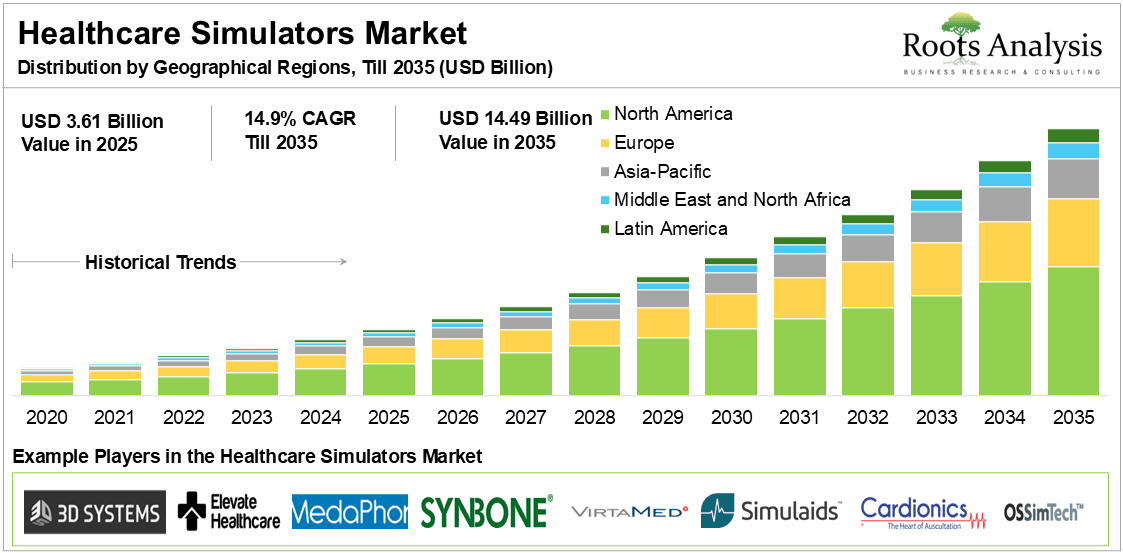
The global healthcare simulators market size, valued at USD 3.04 billion in 2024, is projected to reach USD 3.61 billion in 2025 and USD 14.49 billion by 2035, representing a CAGR of 14.9% during the forecast period.
To learn more about this report, request a free sample copy
Healthcare Simulators Market: In Summary
- The increasing usage of cutting-edge technologies for treating patients has further surged the demand for healthcare simulators so they can train themselves prior to performing procedures on actual patients.
- The global healthcare simulators market size is projected to reach USD 3.61 billion in 2025 and USD 14.49 billion by 2035, representing a CAGR of 14.9% during the forecast period.
- Currently, North America holds nearly 50% of the healthcare simulators market share. In Asia-Pacific, the market for healthcare simulators is expected to register a higher CAGR during the forecast period.
- Presently advanced life support segment holds the largest share of the global market due to the increasing integration of advanced simulation technologies, such as AR / VR for training the healthcare personnel.
- Industrial players, such as Elevate Healthcare (based in Sarasota, Florida), and Endo (based in Pennsylvania, US) are greatly emphasizing launching new products to expand product portfolio.
- Some of the popular products developed by these industrial players are simbionix surgical simulators, ultrasound trainers, and surgical models.
Healthcare simulators refer to the tools and technologies that are used to create real-world healthcare scenarios to train and educate healthcare personnels. These simulators include high-fidelity manikins, computer-based simulators, virtual reality-based models, and software. Healthcare simulators provide a risk-free environment for anatomical study, practice procedures, teamwork training and decision-making. This training methodology has become increasingly vital in modern medical education as it allows practitioners to master cognitive, technical, and behavioral skills in controlled environments.
Additionally, the increasing usage of cutting-edge technologies for treating patients has further surged the demand for healthcare simulators so they can train themselves prior to performing procedures on actual patients. By allowing professionals to practice and refine their skills in a controlled environment, simulations can help reduce medical errors and improve patient outcomes.
It is worth mentioning that the need for healthcare simulators has significantly increased due to the growing medical education systems where practitioners / students can improve their skills using these innovative technologies. Driven by the ongoing demand, several industrial players are showing active interest in this field. For instance, in March 2025, Endo announced the launch of first-of-its-kind spatial computing injection simulator for Peyronie’s disease. This simulator harnesses the potential of spatial computing to augment an immersive learning environment to learn injection techniques for healthcare providers on Apple Vision Pro. With continuous innovation and increasing demand, we expect that the healthcare simulators market will continue to expand at a steady pace during the forecast period.
Healthcare Simulators Market: Report Attributes
| Key Report Attributes |
Details |
| Historical Trend |
Since 2020 |
| Forecast Period |
Till 2035 |
| Market Size 2025 |
USD 3.61 Billion |
| Market Size 2035 |
USD 14.49 Billion |
| CAGR (Till 2035) |
14.9% |
One of the key objectives of the healthcare simulators market report was to estimate the current size, opportunity, and the market growth potential, over the forecast period, till 2035. We have provided informed estimates on the likely evolution of the market for the forecast period.
The global healthcare simulators market analysis report also features the likely distribution of the current and forecasted opportunity within the market across various segments, such as type of category, type of fidelity, type of offering, end user, geographical regions and leading players.
In order to account for future uncertainties associated with some of the key parameters and to add robustness to our model, we have provided three market forecast scenarios, namely conservative, base, and optimistic scenarios, representing different tracks of industry’s evolution.
Prevailing patient safety concerns, medical errors, and increasing penetration of advanced technologies have validated the demand for healthcare simulators. Industrial players are taking strategic initiatives to launch AI-powered healthcare simulators, software and augment reality to provide a realistic learning environment to healthcare practitioners.
Recent Developments in Healthcare Simulators Market
Several recent developments in the field of healthcare simulators industry have occurred, and we outlined some of these below.
- In May 2025, Envoke (UK based startup company) successfully raised USD 1 million to develop, flight simulator for lab equipment. This simulator creates a virtual model of each machine to provide e-learning on medical devices
- In April 2025, SimX (formerly known as CAE Healthcare) announced a strategic collaboration with Elevate aiming to transform medical training and education. Under this collaboration, the company will bring together SimX’s cutting-edge VR simulation platform and Elevate’s expertise in physical simulation and enhance patient outcomes in healthcare.
- In March 2025, Broward Health opened the new state-of-the-art Advanced Training Sim Lab at Broward Health Medical Center. The addition of the Advanced HAL® S3201 multipurpose patient simulator is designed to replicate real-life medical scenarios. This known as a high-fidelity medical dummy / simulator offers a realistic representation of medical situations, providing healthcare professionals an opportunity to train themselves in a risk-free environment.
- In February 2025, Aspen Medical and BlueRoom Simulations announced a partnership to launch mixed reality (MR) technology for defense healthcare training. This newly launched platform will combine Aspen Medical’s training expertise and development techniques with BlueRoom’s flagship MR simulator technology, which is specifically designed for first responder competency programs.
Healthcare Simulators Market Segmentation Insights
The market report provides comprehensive information on healthcare simulators technology providers who are currently active across various segments of the industry as mentioned in the table below.
Healthcare Simulators Market: Market Segmentation
| Market Segmentations |
Details |
| Type of Category |
- Advanced Life Support (ALS) (Adult ALS, Pediatric ALS, Neonatal ALS, and Advanced Trauma Life Support (ATLS))
- Basic Life Support (BLS)
- Clinical Skills Trainers
- Gynecology
- Orthopedic Workshop Bones
- Nursing Skills and Patient Care (Ostomy Care, Blood Pressure, Bandaging, Intubation and Injections)
- Others
|
| Type of Fidelity |
- Low-Fidelity
- Medium-Fidelity
- High-Fidelity
|
| Type of Offering |
- Interventional / Surgical Simulators (Laparoscopic Surgical Simulators, Gynecology Simulators, Cardiovascular Simulators, Arthroscopic Surgical Simulators and Other Interventional / Surgical Simulators)
- Endovascular Simulators
- Ultrasound Simulators
- Dental Simulators
- Eye Simulators
- Patient Simulation (Task Trainer Simulation, Manikin-Based Simulation, and Standardized Patient Simulation)
|
| End User |
- Hospitals
- Academic Institutes
- Military Organizations
- Others
|
| Geographical Regions |
- North America
- Europe
- Asia-Pacific
- Middle East and North Africa
- Latin America
|
| Market in North America |
|
| Market in Europe |
- France
- Germany
- Italy
- Spain
- UK
- Rest of Europe
|
| Market in Asia-Pacific |
- China
- India
- Japan
- South Korea
- Rest of the Asia-Pacific
|
| Market in Middle East and North Africa |
- Egypt
- Saudi Arabia
- United Arab Emirates
|
| Market in Latin America |
|
Healthcare Simulators Market Share Insights
Market Share by Type of Category: Advanced Life Support Segment Holds the Largest Share
- Based on the type of category, the global market is segmented into advanced life support (ALS) (adult ALS, pediatric ALS, neonatal ALS, and advanced trauma life support (ATLS)), basic life support (BLS), clinical skills trainers, gynecology, orthopedic workshop bones, nursing skills and patient care (ostomy care, blood pressure, bandaging, intubation and injections), and others. According to the healthcare simulators market report, presently advanced life support segment holds the largest share of the market. This is primarily due to the increasing integration of advanced simulation technologies, such as AR / VR for training healthcare personnel.
- Notably, nursing skills and patient care segment is likely to expand at a higher CAGR during the forecast period. The heightened demand for trained nursing staff for patient care has underscored the need for healthcare simulators to train nurses.
Market Share by Type of Fidelity: Low Fidelity Holds Largest Share
- The global market is segmented across different types of fidelity, such as low-fidelity, medium-fidelity, and high-fidelity. Currently, the low-fidelity segment holds the largest share of the healthcare simulators market growth. This can be attributed to the fact that low fidelity based simulators are affordable and are highly versatile to teach fundamental skills. It serves as an anatomical model to train healthcare staff with different techniques to enhance patient outcomes.
- It is worth mentioning that high fidelity segment is likely to register a higher CAGR during the forecast period. This is primarily due to the heightened demand for immersive web-based simulators and software that closely mimic real-life clinical scenarios to train medical staff.
Market Share by Type of Offering: Patient Simulation Segment is Dominating the Market
- This segment is distributed across different types of offering, such as interventional / surgical simulators (laparoscopic surgical simulators, gynecology simulators, cardiovascular simulators, arthroscopic surgical simulators and other interventional / surgical simulators), endovascular simulators, ultrasound simulators, dental simulators, eye simulators and patient simulation (task trainer simulation, manikin-based simulation, and standardized patient simulation). Based on our healthcare simulators market forecast, the patient simulation segment currently holds the highest share of the market. Patient simulation, such as task trainer simulation and manikin-based simulation serves as standardized tools for training healthcare practitioners.
- It is expected that the endovascular simulators and ultrasound simulators segments are likely to register a higher CAGR during the forecast period. This is primarily due to the increasing demand for specialized training simulators to provide training about using ultrasound equipment for accurate diagnostics and gaining expertise in minimally invasive procedures (using surgical robots) using endovascular simulators prior performing on patients.
Market Share by End User: Hospitals Holds Majority of the Market Share
- The global market is categorized across different end users, such as hospitals, academic institutes, military organizations, and others. Currently, hospitals hold the majority of healthcare simulators market size. This is potentially due to the widespread adoption of healthcare simulators to train medical staff and optimize workflow to reduce medical errors during patient treatment.
- Notably, the hospital segment will continue to maintain its dominance and is expected to register higher CAGR during the forecast period. This is driven by the increasing usage of manikins and real medical devices to practice hands-on skills, such as surgery, childbirth, and CPR. These are highly realistic and allow for tactile feedback and team-based training.
Market Share by Geographical Regions: North America is Dominating the Market
- The global market is distributed across North America, Europe, Asia-Pacific, Middle East and North Africa, and Latin America. Currently, North America holds nearly 50% of the healthcare simulators market share. Several factors, such as rising advanced healthcare infrastructure, strong emphasis on advanced medical training and patient safety are driving the demand for healthcare simulators in this region.
- In Asia-Pacific, the market for healthcare simulators is expected to register a higher CAGR during the forecast period. Continuous development of modernized healthcare infrastructure and increasing adoption of advanced technologies to train healthcare professionals are expected to propel the industry in this region.
Healthcare Simulators Market: Report Deliverables
| Report Deliverables |
Details |
Excel Data Packs
(Complimentary) |
Available |
| Key Healthcare Simulators Companies Profiled |
- Cardionics (US)
- Gaumard Scientific (US)
- Elevate Healthcare (Formerly CAE Healthcare) (US)
- HRV Simulation (France)
- Laerdal Medical (Norway)
- Limbs & Things (UK)
- Mentice (Europe)
- Operative Experience (Marylad)
- OssimTech (US)
- Kyoto Kagaku (Japan)
- Simulab (US)
- Simulaids (New York)
- SynBone (Switzerland)
- VirtaMed (Switzerland)
- VRMagic Holding (Germany)
(A complete list of companies captured is available in the report) |
PowerPoint Presentation
(Complimentary) |
Available |
| Customization Scope |
15% Free Customization |
Healthcare Simulators Market Major Takeaways
The “Healthcare Simulators Market Report: Industry Trends and Global Forecasts, till 2035” market report features an extensive study of the current market landscape, market size, market share, market growth, market trends, market value, market forecast, market outlook, statistics, and future opportunities for healthcare simulators industrial players. The market research report lays emphasis on the healthcare simulators technologies that are being developed. Key takeaways of the market report are briefly discussed below.
Healthcare Simulators Competitive Landscape: How is Market Fragmented?
The market features several established players and emerging innovators competing to make robust positions in this industry. Industrial players, such as Elevate Healthcare, and Endo are greatly emphasizing launching new products to expand product portfolio. Some of the popular products developed by these industrial players are simbionix surgical simulators, ultrasound trainers, and surgical models.
It is worth mentioning that these industrial players are presently increasing focus on technological innovations, such as integration of AI technologies and AR / VAR technologies. For instance, in March 2025, XCath announced the incorporation of NVIDIA Isaac for healthcare (a developer framework for AI healthcare robotics) within XCath’s platform for enabling physical AI. The recent advancements in XCath’s platform helps to deliver the highest standard of care for stroke and other complex vascular conditions to patients globally.
Furthermore, presently these market players are developing advanced simulators, such as specialized task trainers, anatomical models, and AI-driven patient responses, and cloud-based scenario management. This trend toward comprehensive solutions reflects the market's maturation and the growing sophistication of end-user requirements.
Healthcare Simulators Market Size Analysis: Which Region Holds the Highest Share?
In 2025, the healthcare simulators market is valued at USD 3.61 billion and is expected to reach USD 14.49 billion by 2035. In terms of region, currently North American represents the largest market share and is expected to maintain its dominance during the forecast period. This regional strength can be attributed to substantial healthcare expenditure, technological innovation, and extensive medical education infrastructure that continues to adopt simulation-based training methodologies at accelerating rates.
Market Drivers: What Factors are Driving the Healthcare Simulators Market?
Growing Complexity of Medical Procedures
Modern healthcare involves complex medical procedures that require extensive practice before implementation with real patients. Minimally invasive surgeries, complex diagnostic procedures, and emergency response protocols all demand hands-on experience that simulation can provide in a risk-free environment. Simulation technology enables practitioners to develop confidence and competence through repeated practice of intricate procedures before performing them on actual patients.
Expansion of Medical Education Infrastructure
Another key factor that propels the market is the growing expansion of medical education infrastructure. This substantial increase in medical education institutions globally has created significant demand for simulation technologies to ensure their graduates meet contemporary standards of medical practice.
Market Challenges: What are the Challenges in Healthcare Simulators Industry?
Insufficient Psychological Fidelity
While physical simulators have become increasingly sophisticated, achieving the psychological fidelity that makes learners fully engaged and realistic with simulations remains a significant challenge. The effectiveness of simulation training significantly depends on learners perceiving the simulation as a believable environment, which influences their level of engagement, and the learning outcomes achieved.
High Implementation Costs
Notably, healthcare simulators require substantial upfront investment which creates a significant barrier for the market players. It is worth noting that the installation of medical manikins, virtual reality systems, physical spaces, trained personnel, and maintenance create significant cost considerations that many institutions struggle to justify despite the educational benefits. Beyond the initial equipment purchase, ongoing expenses for consumables, facility management, course design, and instructor compensation add to the total cost of ownership for simulation programs.
Market Trends: What are the Key Healthcare Simulators Market Trends?
Integration of Artificial Intelligence
Artificial intelligence, a metaverse in healthcare in healthcare technology, is revolutionizing the healthcare simulators industry by creating adaptive learning environments that can customize clinical scenarios to enhance individuals learning experience. individual learners based on their performance and knowledge gaps. These AI-driven simulators encourage the continuous advancement of competencies and clinical reasoning. Additionally, the virtual patient’s simulation model powered by AI can react and adapt to learners' actions, providing a dynamic training environment that better reflects the complexity of real patient interactions
Virtual and Augmented Reality Expansion
VR and AR technologies are creating increasingly immersive simulation experiences that can be delivered with greater flexibility and potentially lower costs than traditional physical simulators. These technologies enable learners to practice in realistic virtual environments accessible from multiple locations, expanding the reach of simulation education beyond dedicated simulation centers. The integration of haptic feedback and advanced visual rendering continues to enhance the realism of these virtual training environments.
Healthcare Simulators Market Report Coverage
The market report presents an in-depth analysis, highlighting the capabilities of various stakeholders in the healthcare simulators industry, across different geographies. Amongst other elements, the market report includes:
- An Infographic Executive Summary
- Market Landscape of Healthcare Simulators Developers
- Company Competitiveness Analysis
- Company Profiles
- SWOT Analysis
- Market Impact Analysis
- Market Forecast Analysis
From the Author’s Desk
Author’s View on Healthcare Simulators Market
The market for healthcare simulators has a broad scope of progress in the upcoming years driven by its high demand in medical institutions and healthcare sector to provide training of various healthcare procedures. As simulation technologies become increasingly sophisticated and integrated with broader educational methodologies, their impact on healthcare quality and patient outcomes will continue to grow, cementing their essential role in medical education. While challenges remain—particularly regarding cost, instructor availability, and technological limitations, continuous innovation in AI, virtual reality, and adaptive learning systems promise to address many of these barriers. Companies that can navigate these challenges while capitalizing on emerging opportunities will find substantial growth potential in this dynamic market.
Glossary
- Healthcare Simulators: It refers to the tools and technologies that resemble real-world medical scenarios for practice, training and education healthcare personnel and medical students.
- Medical Simulators: It is a form of software or technology-based tools that simulate real-world clinical scenarios by offering realistic representations of patients, and surgical instruments, and optimize workflows.
Frequently Asked Questions
What are healthcare simulators?
It refers to state-of-the-art technology or software based solutions, such as learning modules, and task trainers to facilitate hand-on practice on various healthcare procedures in a safe environment. What is the current market size of healthcare simulators?
The current healthcare simulators market size is likely to be USD 3.61 billion in 2025.What is the CAGR of healthcare simulators market?
The global market for healthcare simulators is likely to grow at a CAGR of 14.9% till 2035.Which geographical segment is likely to capture majority share in the Healthcare simulators industry, by 2035?
North America is dominating the healthcare simulators market.How big is the healthcare simulators industry?
The global market size for healthcare simulators is likely to reach USD 14.49 billion in 2035.Which are the medical simulation devices top manufacturers?
3D Systems, Cardionics, Gaumard Scientific, Elevate Healthcare (Formerly CAE Healthcare), HRV Simulation, Laerdal Medical, Limbs & Things, Mentice, Medaphor, Operative Experience, OssimTech, Kyoto Kagaku, Simulab, Simulaids, SynBone, VirtaMed, and VRMagic Holding.What are the factors driving the market for healthcare simulators?
Shortage of patient volunteers, rising medical institutes and growing demand for advanced tech-driven solutions to train medical staff on various medical procedures before they actually start treating patients.