
Lowest Price Guaranteed
Pages
199
Last Updated
October 2025
View Count
10900
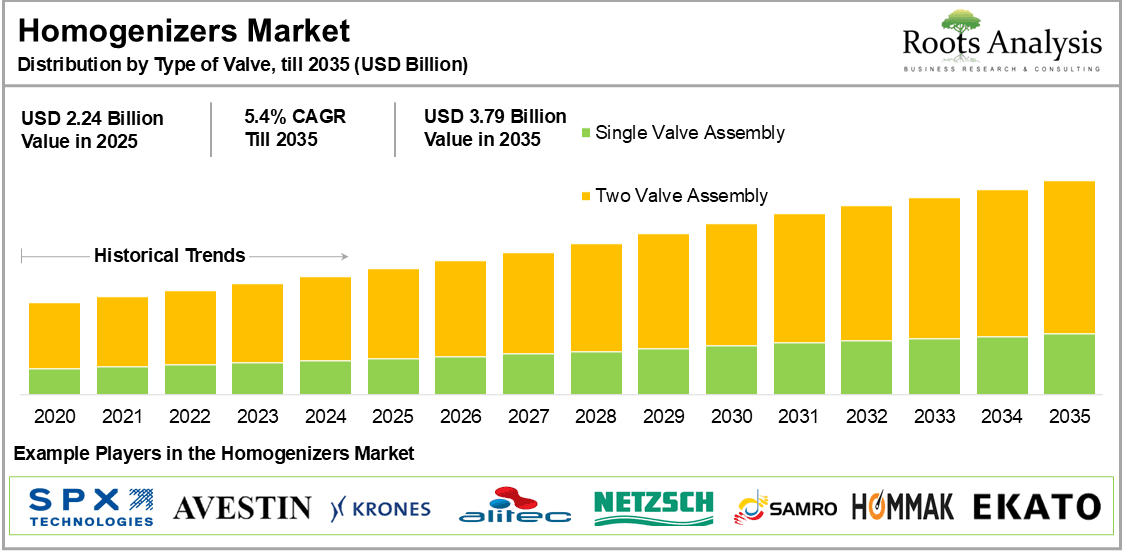
The global homogenizers market size, valued at USD 2.10 billion in 2024, is projected to reach USD 2.24 billion in 2025 and USD 3.79 billion by 2035, representing a CAGR of 5.4% during the forecast period.
 |
To learn more about this report, request a free sample copy
A homogenizer is a mechanical device / equipment used to blend, mix, and emulsify solutions to prepare uniform mixture or suspension. These instruments are gaining traction in the pharmaceutical industry for live cell nano-encapsulation, drug development, and particle size reduction. Notably, the integration of homogenizers helps to improve drug delivery, bioavailability and enhance dispersion rates by reducing the particle size. Consequently, homogenized drugs are highly stable and are easily absorbed into the body when administered.
It is worth noting that high pressure homogenization machinery also plays a significant role in cell lysis, and extraction to extract components like enzymes and proteins, which are used to make therapeutic drugs. Additionally, homogenizers aid in the development of nanoparticles formulation that are widely used as drug delivery system to enhance drug absorbency in the body.
Notably, the benefits offered by high-shear homogenizers, the pharmaceutical industry is increasingly utilizing this machinery for drug development. Beyond pharmaceutical, homogenizers are widely used in the cosmetic industry, food & beverage industry to prepare uniform solutions. This increasing usage across a wide range of industries has catered to the attention of industrial players for innovations and product portfolio expansion.
In addition to product launch, the market players are emphasizing technological innovations, such as Internet of Things (IoT), and artificial intelligence (AI) to increase product quality and automation to reduce labor work. Interestingly, the consistent demand across wide industrial vertical along with ongoing innovations offer a long-term competitiveness in the homogenizers market, making it investible for the long term.
| Key Report Attributes | Details | |
| Historical Trend | Since 2020 | |
| Forecast Period | Till 2035 | |
| Market Size 2025 | USD 2.24 Billion | |
| Market Size 2035 | USD 3.79 Billion | |
| CAGR (Till 2035) | 5.4% | |
One of the key objectives of the homogenizers market report was to estimate the current size, opportunity, and the market growth potential, over the forecast period, till 2035. We have provided informed estimates on the likely evolution of the market for the forecast period.
The global homogenizers market analysis also features the likely distribution of the current and forecasted opportunity within the market across various segments, such as type of synthesizer, application area, type of technology, type of form factor, end user, geographical regions and leading players.
In order to account for future uncertainties associated with some of the key parameters and to add robustness to our model, we have provided three market forecast scenarios, namely conservative, base, and optimistic scenarios, representing different tracks of industry’s evolution.
Several recent developments in the field of homogenizers industry have occurred, and we outlined some of these below.
The market report provides comprehensive information on homogenizers industrial players who are currently active across various segments of the industry as mentioned in the table below.
| Market Segmentations | Details | |
| Type of Homogenizer |
|
|
| Type of Valve |
|
|
| End User |
|
|
| Geographical Regions |
|
|
| Market in North America |
|
|
| Market in Europe |
|
|
| Market in Asia-Pacific |
|
|
| Market in Middle East and North Africa |
|
|
| Market in Latin America |
|
|
| Report Deliverables | Details | |
| Excel Data Packs (Complimentary) |
Available | |
| Key Homogenizers Companies Profiled |
|
|
| PowerPoint Presentation (Complimentary) |
Available | |
| Customization Scope | 15% Free Customization | |
The “Homogenizers Market Report: Industry Trends and Global Forecasts, till 2035” market report features an extensive study of the current market landscape, market size, market share, market growth, market trends, market value, market forecast, market outlook, statistics, and future opportunities for homogenizers industry market players. The market research report lays emphasis on the homogenizers products that are being developed for pharmaceutical and healthcare industry. Key takeaways of the market report are briefly discussed below.
The homogenizers market is experiencing immense competition, with a mix of established market players and agile regional startups. Notably, the market players are emphasizing technological advancements and cost-effectives to enhance the acceptance across global healthcare, pharmaceutical and other industrial verticals. For instance, Sonic (US), Avestin (US) and Yaohua Group (China) are actively emerging with new ideas and lower prices-based homogenizers.
Furthermore, the global market players are expanding their product portfolios, catering to diverse industrial homogenizers needs, and pursuing geographical diversification. For instance, in January 2025, Tetra Pak (Switzerland) announced the expansion of its new range of homogenizers, such as Tetra Pak® Homogenizer 15C and Tetra Pak® Homogenizer 20C. This new range of homogenizers is efficient, simple, and flexible for performing solution mixing tasks.
Moreover, the innovative HD21 homogenization device also allows the homogenization process and pressure adjustments to be conducted within the same compact machine with a single pressure adjustment.
In 2025, the homogenizers market growth is valued at USD 2.24 billion and is poised to reach USD 3.79 by 2035. This unprecedented growth is driven by the increasing adoption of laboratory homogenizers across diverse industrial verticals, including pharmaceutical and Food & beverages. Furthermore, emerging players find success through specialization, cost-effectiveness, and agility within high-growth niches. This dynamic creates potential for smaller, innovative companies focusing on specific technological advancements (AI integration, and green technologies) and seeking to expand their capabilities or geographical reach. The increasing emphasis on sustainability and strategic partnerships further indicates an evolving competitive strategy that extends beyond mere product features.
Homogenizers are important for achieving consistent drug formulation, enhancing drug bioavailability, and facilitating cell disruption for extracting active compounds, such as proteins and DNA. Their role extends to the efficient production of vaccines and advanced therapies. Rising investments in research and development within these sectors, coupled with the increasing prevalence of chronic diseases, directly reflects the higher demand for sophisticated homogenization equipment.
It is worth mentioning that industrial players are widely emphasizing technological innovations. For instance, the continuous advancements in high-pressure, and ultrasonic homogenizers, along with microfluidic technologies, are consistently optimizing particle size reduction and enhancing product stability. The integration of automation, IoT sensors for real-time monitoring, and artificial intelligence (AI) for predictive maintenance further boosts operational efficiency and productivity. These technological advances are likely to be the key driver for the homogenizers market.
High capital investment for installing homogenizers specifically advanced high-pressure homogenizers models may limit the adoption of homogenizers across different industries. It is worth noting that the complex design, precision engineering, and the specialized technology incorporated within homogenizers may further enhance the overall cost. Thus, high cost can limit adoption, especially for small and medium-sized enterprises with more constrained budgets.
Homogenizers specifically those utilized in the pharmaceutical and food and beverage industry must require adherence with regulatory guidelines and Good Manufacturing Practices (GMP). Obtaining the necessary approvals and maintaining compliance can be time-consuming and expensive, potentially hindering the homogenizers market growth in these critical segments. Moreover, the stringent guidelines require immense documentation process, which is challenging and time-consuming. Therefore, these challenges in homogenizers supply chain and regulatory compliance may disrupt market growth.
The market players are increasingly integrating advanced automation and control systems in modern homogenizers. This development streamlines homogenization processes, significantly boosts productivity, and reduces the need for manual intervention. In addition, the incorporation of Internet of Things (IoT) technology is transforming these devices into smart systems. This integration helps in real-time data collection, analysis, and reporting, ensuring synchronized operations and enhancing data accuracy across laboratories or production environments.
In addition, AI algorithms are being developed and integrated into homogenizers to enable predictive maintenance. This allows for the identification of wear and tear in components before failures occur, significantly reducing unplanned downtime and associated operational costs.
A growing consumer and industry focus on environmental responsibility is prompting manufacturers to prioritize sustainability. This is leading to the introduction of energy-efficient homogenizers that minimize resource consumption and reduce environmental impact, aligning with broader global sustainability goals. In addition, the increasing emphasis on nanotechnology and personalized medicine presents a significant growth opportunity. Homogenizers are crucial for creating nanoparticles for advanced targeted drug delivery devices, vaccines, and other cutting-edge materials, pushing the boundaries of what is achievable in particle size reduction.
Furthermore, the government policies influencing homogenizers market positively, accelerating the adoption of homogenizers. Notably, governments set stringent regulations for product quality, purity, and safety in industries like food, pharmaceuticals, and healthcare. These regulations often mandate specific particle size reduction, stability, and uniformity, directly increasing the demand for high-performance homogenizers. For instance, in the pharmaceutical sector, good manufacturing practices are require for rigorous validation (Installation Qualification, Operational Qualification, and Performance Qualification) of equipment like homogenizers to ensure consistent and safe drug formulations.
The market report presents an in-depth analysis, highlighting the capabilities of various stakeholders in the homogenizers industry, across different geographies. Amongst other elements, the market report includes:
The homogenizers market is a dynamic and essential sector with a clear trajectory of growth. Its foundational role across diverse industries, coupled with continuous innovation in smart and sustainable technologies is offering significant opportunities to industrial players for strategic investment, particularly for those willing to embrace technological leadership, and application-specific opportunities. The industry is also witnessing a transformative shift towards "Homogenizer 4.0," characterized by enhanced automation, IoT integration for real-time monitoring, and AI for predictive maintenance. These advancements promise to deliver more energy-efficient, user-friendly, and highly specialized solutions, which further offer lucrative opportunities to industrial players for innovations.