


 Download Free Sample
 Buy Now
Market Size
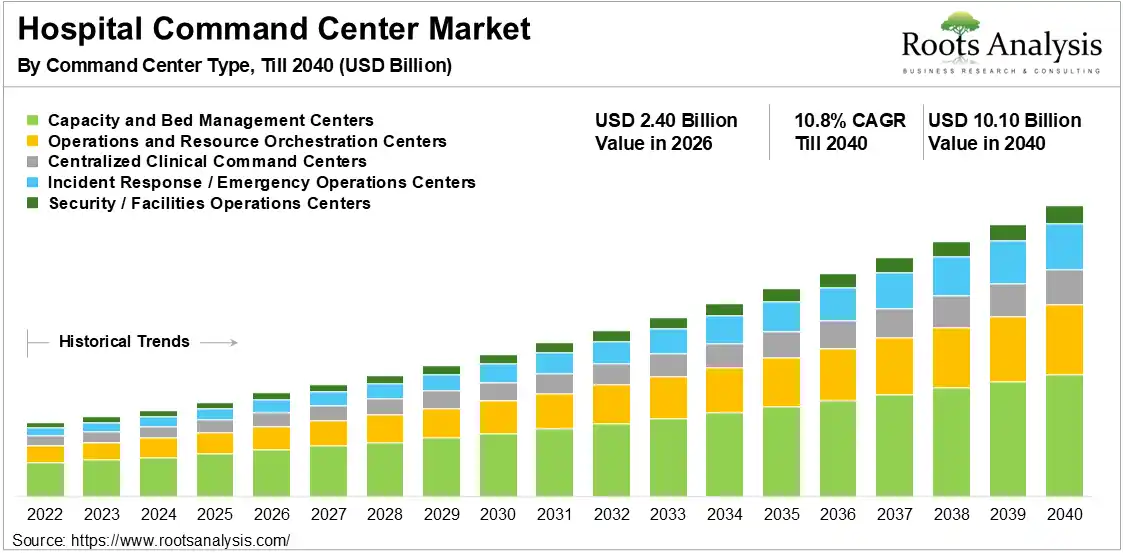
The global hospital command center market is expected to rise from USD 2.40 billion in 2026 to reach USD 10.10 billion by 2040, growing at a CAGR of 10.8% over the forecast period 2026 to 2040, driven by hospital-wide demand for real-time capacity orchestration.
See What’s in the Full Report – Request Your Complimentary Insights!
Market Report: Key Takeaways
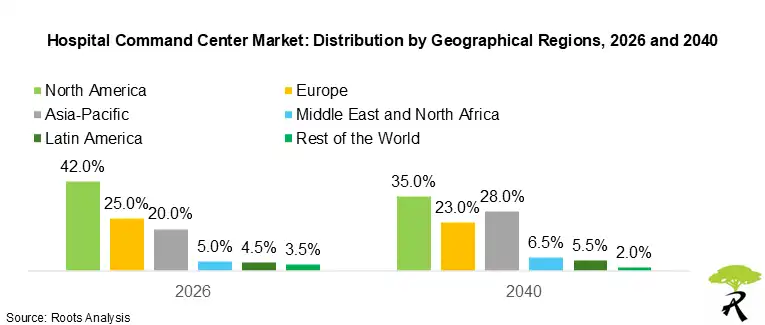
- Based on Geography, North America captures 42.0% market share in 2026, whereas Asia-Pacific registers a 13.5% CAGR through 2040, supported by digital hospital infrastructure expansion.
- Based on Component, Software is both the dominant and fastest-growing category, holding 56.0% share in 2026 and expanding at 11.6% CAGR through 2040, driven by AI-enabled orchestration platforms.
- Based on Deployment Model, Cloud-based is both the dominant and fastest-growing category, holding 48.0% share in 2026 and expanding at 13.0% CAGR through 2040, driven by multi-site scalability.
- Based on Application / Primary Use Case, Capacity Management / Bed Placement captures 30.0% market share in 2026, whereas Emergency Response / Surge Response registers a 13.4% CAGR through 2040, reflecting rising surge-readiness requirements.
- Based on Functional Module, Data Aggregation and Interoperability capture 21.0% market share in 2026, whereas Simulation and Digital Twin register a 15.6% CAGR through 2040, driven by scenario-based operational planning.
Hospital Command Center Market Outlook
Hospital command center adoption is shifting from static visibility rooms toward AI-enabled orchestration across capacity, transfers, staffing, and clinical monitoring. Earlier deployments centered on bed boards, physical control rooms, and manual escalation. Current demand favors cloud-based software, real-time hospital operations dashboards, electronic health record interoperability, and predictive workflows that reduce boarding, discharge delays, and disconnected transfer decisions. The hospital command center market remains high growth because operational strain now affects access, margins, and safety.
Growth today comes from capacity pressure, predictive AI adoption, and policy-backed digital hospital programs. U.S. hospitals are already using predictive AI more widely, with nearly 70% reporting adoption in 2024. In February 2026, India’s health ministry announced an AI-enabled E-ICU Command Centre linking Yashoda Medicity with MMG District Hospital for real-time critical-care monitoring. This shows public-sector demand for command-center models beyond mature North American systems.
Through 2040, cloud-first platforms, computational twins, RTLS and IoT hospital tracking, and workflow automation will widen the market beyond capacity centers. TeleTracking launched Decision IQ in November 2025, using a computational twin to predict capacity and discharge timing. Buyers will favor platforms that move from prediction to accountable escalation across sites. The market will keep accelerating where hospitals connect predictive insight with operational action.
Hospital Command Center Market Dynamics
Hospital Command Center Market Drivers
Predictive capacity orchestration is replacing manual escalation because hospitals need earlier visibility into beds, transfers, staffing, and discharge timing. Nearly 70% of U.S. hospitals used predictive AI in 2024, signaling readiness for AI predictive analytics for hospital operations. This adoption supports real-time hospital operations dashboards that turn fragmented operational data into faster patient-placement and surge-response decisions across congested networks.
Hospital Command Center Market Restraints
Interoperability complexity slows deployment because command centers require normalized EHR, bed, staffing, transport, and facility feeds. Data Aggregation and Interoperability leads functional modules with 21.0% share in 2026, which shows how foundational integration remains. Hospitals with legacy systems, inconsistent workflow data, and fragmented clinical operations must spend more before dashboards, forecasting models, or alerting engines can deliver reliable decisions at scale.
Hospital Command Center Market Opportunities
AI-enabled automation creates an opening for vendors that connect forecasting, escalation, and operational workflow design. Qventus announced Allina Health as the inaugural AI Solution Factory client in December 2025, expanding work around inpatient capacity and operational AI workflows. This opportunity favors platforms that sell measurable throughput gains instead of standalone visualization software or disconnected analytics tools for health systems.
Hospital Command Center Market Challenges
Clinical trust remains a gating issue because command centers influence transfer acceptance, bed placement, discharge timing, and emergency routing. Predictive models must fit local workflows, escalation rules, staffing constraints, and governance expectations. Buyers will scrutinize transparency, auditability, and EHR integration before scaling automation across multi-hospital networks, especially where AI recommendations affect patient safety and operating-room prioritization during peak demand periods.
Hospital Command Center Market Size Estimation Methodology
- As a starting point, the hospital command center market forecast used multiple credible secondary sources covering healthcare command centers, patient-flow platforms, and hospital operations software. The baseline excluded narrow operations-only estimates when scope did not include clinical command centers, RTLS and IoT integration, transfer coordination, and emergency operations. This scope prevented over-weighting single-use dashboards that do not orchestrate hospital-wide access, capacity, or surge response.
- Moving forward, the model mapped vendor evidence against actual command-center functions, including bed placement, transfer centers, discharge acceleration, E-ICU oversight, and quality monitoring. Company validation URLs were used to separate full command-center platforms from adjacent analytics, telehealth, RTLS, and clinical communication systems. The review also classified GE HealthCare, TeleTracking, Oracle, Epic, Philips, Stryker, Palantir, and Microsoft as broad ecosystem anchors.
- Building on this, segment splits were developed from hospital EHR and ADT integration requirements, bed census workflows, transfer-center records, staffing rosters, discharge timestamps, and RTLS event streams. These inputs helped weight software, hardware, and services across cloud-based, on-premise, and hybrid deployment models. Functional modules were then cross-checked against interoperability, dashboarding, predictive forecasting, alerting, simulation, KPI reporting, and RTLS requirements.
- Drawing upon these, regional assumptions reflected EHR maturity, public-sector digital hospital programs, multi-hospital network density, and command-center deployment evidence. North America received a higher current share because enterprise health systems already operate integrated capacity and access-management programs. Asia-Pacific received the highest growth rate because public hospitals are localizing hub-and-spoke critical-care models. Europe, Latin America, Middle East and Africa, and Rest of the World were sized around digitization pace and procurement maturity.
- The projected value was then tested against segment-level growth logic rather than a single top-down CAGR. Software, cloud deployment, emergency response, simulation and digital twin, and third-party virtual command center operators received higher growth assumptions because their adoption depends on scalable AI workflows and multi-site orchestration. Slower assumptions were applied to hardware-heavy deployments, on-premise models, and security-focused facilities operations where replacement cycles constrain growth.
- Finally, the forecast was reconciled with vendor activity, partnership intensity, AI adoption signals, and hospital operational constraints. Recent launches from TeleTracking, Oracle, GE HealthCare, Qventus, Stryker, and Artisight supported faster growth in predictive forecasting, workflow automation, and smart hospital command center modules. The final output balances market growth with integration barriers, clinical governance needs, and the cost of enterprise workflow redesign.
Hospital Command Center Market Share Insights
Market Share by Component
According to our analysis, software leads because command centers depend on orchestration layers, dashboards, forecasting models, and workflow engines. In October 2025, GE HealthCare said its new cloud-first SaaS solution will use AI and predictive analytics for recommended actions.
Software will also grow fast as hospitals shift from visualization rooms to action-oriented automation platforms. In June 2025, LeanTaaS launched iQueue for Surgical Clinics as an AI-powered, cloud-based capacity and patient-flow software expansion.
Market Share by Command Center Type
Capacity and Bed Management Centers lead because bed visibility delivers immediate operational and financial value. In June 2026, Becker’s reported Sutter Health’s Epic command center added 12 equivalent beds per day.
Operations and Resource Orchestration Centers will expand fast as command centers move beyond bed boards into enterprise optimization. In June 2025, TeleTracking and Palantir partnered to combine operational workflows with AI-powered decision intelligence.
Want Information on Specific Region / Segment?
Regional Analysis: North America Leads the Market and Asia-Pacific is Likely to Register Higher CAGR
Presently, North America holds 42.0% market share in 2026 and leads through high EHR penetration, established transfer-center infrastructure, and deeper capital access. Large health systems also fund enterprise programs that link patient flow, staffing, and access management. In October 2025, GE HealthCare announced collaborations with Queen’s Health Systems and Duke Health for AI-driven hospital operations software.
On the contrary, Asia-Pacific will scale quickly through public-sector digitization, tertiary hospital expansion, and demand for remote critical-care oversight. The region will localize command-center models for district hospitals, high-volume metros, and hub-and-spoke clinical networks. In February 2026, India’s health ministry announced an AI-enabled E-ICU Command Centre for real-time critical-care monitoring.
Market Ecosystem Analysis
Eight Tier 1 leaders control most visible commercial activity, while 12 specialists defend workflow niches and five emerging entrants attack bedside sensing. Platform convergence is the dominant consolidation dynamic, as EHR, operations, RTLS, virtual-care and ambient-intelligence layers move toward one command view. The primary commercial force is capacity creation without new beds, forcing vendors to prove faster transfers, shorter stays and lower clinician workload. Competitive advantage is shifting from dashboards toward closed-loop orchestration across beds, staff, transfers, rooms, devices and EHR workflows.
- GE HealthCare used its October 2025 Queen’s Health Systems and Duke Health work to advance AI-driven hospital operations software. The move strengthens capacity management and transfer coordination, while raising the data-layer barrier for smaller dashboard vendors.
- Oracle added March 2025 emergency-management capabilities across Patient Flow, Transfer Center and Command Center Dashboard modules. The update strengthens surge response, mass transfer handling and bed management for large health systems.
- Epic gained a high-visibility replacement win when Johns Hopkins launched Capacity Management Dashboards system-wide in October 2025. The shift pressures standalone command center vendors by strengthening EHR-native capacity management and KPI reporting.
- TeleTracking and Palantir partnered in June 2025 to combine Operations IQ with Foundry and AIP. The integration strengthens predictive forecasting, staffing workflows and operational command centers, pressuring narrower workflow vendors.
- LeanTaaS received February 2025 Best in KLAS recognition for Capacity Optimization Management. The recognition supports its position in cloud-based capacity, staffing and patient-flow software for enterprise health systems.
- Systematic released Columna Flow 2025.5 in October 2025 with Tracklite, mobile dashboards and Command Centre insights. The release strengthens European patient-flow, asset visibility and workforce tasking use cases without heavy RTLS infrastructure.
- Philips highlighted CoxHealth’s virtual command center in June 2025, expanding support across med-surg and step-down units. This strengthens centralized clinical command centers, quality monitoring and staffing leverage beyond intensive-care use cases.
- Stryker’s March 2026 SmartHospital coverage showed an AI operating layer connecting devices, data and care teams. Its care.ai and Vocera assets strengthen hardware-software bundling, virtual nursing and patient-room command workflows.
- Artisight advanced smart-hospital control-room logic in August 2025 through AI and computer vision for hospital workflows. LookDeep launched aimee in August 2025, integrating room awareness with EHR, nurse-call and smart-device systems. Together, they pressure RTLS-only tools by fusing monitoring, documentation and escalation.
- Kontakt.io launched Kio Agents in February 2025 for house managers managing patient flow, assets and nurse staffing. The launch moves RTLS and IoT integration toward workflow automation, not just location visibility.
Startup Companies and their Key Highlights
- Artisight
- Event type: Smart-hospital platform scaling and product-market coverage
- Month and year: August 2025
- Lead investor or strategic partner name: NVIDIA
- Stated purpose of the event: Advance smart-hospital operations using AI, computer vision and EHR-integrated automation.
- Market implication: Accelerates centralized clinical command centers and smart patient rooms by embedding ambient sensing into workflow execution.
- Kontakt.io
- Event type: Product launch, Kio Agents
- Month and year: February 2025
- Stated purpose of the event: Replace dashboards and phone calls with agentic AI for patient flow, assets and nurse staffing.
- Market implication: Accelerates RTLS / IoT integration and workflow automation for hospital operations and house management teams.
- LookDeep Health
- Event type: Product launch, aimee AI assistant
- Month and year: August 2025
- Lead investor or strategic partner name: Nexus Bedside
- Stated purpose of the event: Combine sight, sound and language for hospital-room assistance and virtual-care workflows.
- Market implication: Accelerates quality monitoring, virtual nursing and bedside escalation within centralized clinical command centers.
Hospital Command Center Market Trends / Opportunities
Hospital Command Center Market Shift From Dashboards to AI Workflow Automation Creating Platform Differentiation
Operational software is moving from passive visibility to recommended actions across capacity, discharge, staffing, and transfers. GE HealthCare announced collaborations with The Queen’s Health Systems and Duke Health in October 2025 to advance AI-powered command center technologies. Vendors that automate operational choices will gain stronger positioning than dashboard-only providers.
Healthcare operations automation is becoming a product-development priority because buyers want faster rollout cycles. Qventus unveiled its AI Solution Factory in September 2025 to accelerate healthcare AI rollouts and automate operational workflows across health systems. This shift rewards vendors that can translate workflow bottlenecks into repeatable software modules.
Simulation and Computational Twins Turning Capacity Planning Into Throughput Advantage
Scenario planning is becoming a core module as hospitals test bottlenecks before queues form. TeleTracking launched Decision IQ in November 2025, using a computational twin to predict capacity and discharge timing. Simulation capabilities will separate advanced patient flow command center platforms from static reporting tools.
Digital-twin functionality is expanding from planning support into operational decision intelligence. TeleTracking and Palantir announced a June 2025 partnership combining Operations IQ with Foundry and AIP for AI-powered healthcare operations insights. Partnerships between workflow specialists and AI platforms will shape future competitive alliances.
Smart Hospital Ambient Intelligence Expanding Hospital Command Center Market Boundaries
Computer vision is pulling command centers closer to bedside, operating-room, and virtual nursing workflows. Artisight introduced operating-room computer vision capabilities in August 2025 that document OR milestones directly into the EHR. This expands the addressable opportunity from capacity management into clinical operations automation.
Device-rich smart hospital deployments are increasing the infrastructure layer behind command-center workflows. UChicago Medicine partnered with Artisight in April 2026 to deploy more than 1,800 devices across inpatient, perioperative, and emergency care settings. Hardware-linked AI platforms will compete through implementation scale and data-capture breadth.
Emergency Operations Capabilities Converting Surge Readiness Into Procurement Demand
Emergency response functionality is becoming a buying requirement as health systems plan for mass transfers and evacuation events. Oracle introduced emergency operations capabilities in March 2025 within Oracle Health’s clinical operations suite. Vendors with embedded surge workflows can address budgets beyond routine patient flow optimization software.
Critical-care command centers are spreading into public-sector and hub-and-spoke hospital models. India’s Union Health Minister inaugurated an AI-enabled E-ICU Command Centre in February 2026 for real-time monitoring of critically ill patients. This creates commercial openings for localized platforms that support district hospitals and regional referral networks.
Your Business is Unique – Why Shouldn’t Your Report Be?
Market Access Considerations
EHR Interoperability and FHIR Integration Burden
Interoperability determines market access because command centers depend on clean feeds from EHR, ADT, staffing, bed, transport, and facility systems. FHIR integration and normalized workflow data enable dashboards, alerts, and predictive models to operate across departments. Vendors without proven integration services face longer implementations, weaker references, and higher buyer skepticism in multi-hospital networks, especially when hospitals compare platform reliability at scale. Strong integration credentials can shorten sales cycles and support premium positioning during board-level transformation programs.
Clinical AI Governance and Auditability
AI governance shapes commercialization because command-center recommendations can affect bed placement, transfer acceptance, discharge prioritization, and critical-care escalation. ASTP / ONC reporting that nearly 70% of U.S. hospitals used predictive AI in 2024 raises buyer expectations around safety review and local oversight. Vendors that document model logic, escalation rules, and audit trails can compete more credibly during enterprise procurement reviews and clinical governance committees across large systems.
RTLS, IoT, and Device Deployment Costs
Device infrastructure shapes access because smart hospital workflows need sensors, cameras, RTLS tags, edge connectivity, and implementation support. UChicago Medicine’s April 2026 Artisight deployment covered more than 1,800 devices across inpatient, perioperative, and emergency settings. This raises entry costs for smaller vendors but strengthens platforms that combine software, data capture, and workflow automation for measurable clinical operations outcomes over time. Procurement will favor vendors with deployment capacity and services depth across care settings.
Multi-site Workflow Standardization
Large health systems require standardized workflows before command-center platforms can scale across facilities. Sutter Health’s 27-hospital capacity-balancing model shows the market behavior shaping enterprise adoption, with command-center workflows used across a multi-hospital network. Vendors must support local variation while giving leadership consistent KPIs, transfer logic, and capacity views for system-wide access decisions across regions and service lines. This favors configurable enterprise platforms over point solutions during systemwide rollouts.
How Stakeholders Benefit from the Key Focus Areas of Our Hospital Command Center Market Report
Capacity pressure, predictive AI adoption, and multi-site hospital operations make command-center investment commercially urgent. The research connects segment growth, vendor positioning, and technology adoption signals to decisions on market entry, platform selection, partnerships, and capital allocation.
- Unmet Needs and Market Gaps in Hospital Command Center Market: The report identifies gaps in capacity management, transfer coordination, discharge acceleration, and quality monitoring workflows. Corporate planning teams can use this view to decide whether to prioritize bed placement, emergency response, staffing, or centralized clinical command centers. The analysis also shows where hospitals still need interoperability, escalation automation, and real-time operational intelligence.
- Funding and Venture Investment Opportunities in Hospital Command Center Market: The report tracks growth pockets across software, cloud-based deployment, simulation and digital twin modules, and third-party virtual command center operators. Capital allocation teams can use these signals to assess where platform expansion or minority investment has stronger upside. Qventus, Artisight, and other AI-focused vendors indicate where workflow automation is attracting commercial attention.
- Technology Innovation and Adoption Trends: The report explains how predictive forecasting, machine learning, RTLS, IoT integration, and ambient intelligence are changing command-center design. Hospital technology executives can use this insight to compare point tools against enterprise orchestration platforms. The adoption analysis supports buy, partner, or build decisions around dashboards, alerting, simulation, and virtual care workflows.
- Hospital Command Center Market Competitive Landscape and Industry Analysis: The report maps GE HealthCare, TeleTracking, Oracle, Epic, Philips, Stryker, Palantir, Microsoft, and specialist vendors by role and tier. Commercial teams can use this structure to identify direct competitors, adjacency threats, and white spaces by component, deployment model, and use case. The company database also helps prioritize partner outreach and account targeting.
- Mapping Strategic Partnerships and Ecosystem Synergies: The report links partnerships to specific workflow needs, including AI operations, patient throughput, emergency management, and smart hospital infrastructure. Business development teams can use this map to decide whether to partner with EHR-native platforms, AI decision-intelligence providers, RTLS vendors, or clinical workflow specialists. The partnership view supports ecosystem positioning before product launches or regional expansion.
- Hospital Command Center Market CAGR and Growth Trends: The report shows the market growing at 10.8% CAGR through 2040, with faster expansion in Asia-Pacific, cloud-based deployment, simulation and digital twin, and third-party operators. Growth teams can use these trends to prioritize geographies, modules, and customer types with stronger expansion potential. The segment CAGR analysis supports pricing, sales coverage, and roadmap sequencing decisions.
Hospital Command Center Market: Scope of the Report
| Key Report Attributes | Details | |
| Forecast Period | Till 2040 | |
| Market Size 2026 | USD 2.40 Billion | |
| Market Size 2040 | USD 10.10 Billion | |
| CAGR (Till 2040) | 10.8% | |
| Segments Covered |
|
|
| Geographical Regions Covered |
|
|
| Key Sections Covered |
|
|
Market Segmentation
The Hospital Command Center Market report presents an in-depth analysis, highlighting the capabilities of various stakeholders, based on different segments, such as component, deployment model, application / primary use case, command center type, functional module, end use / customer type, geographical regions, and leading players.
By Component
- Software
- Hardware
- Services
By Deployment Model
- Cloud-based
- On-premise
- Hybrid
By Application / Primary Use Case
- Capacity Management / Bed Placement
- Transfer Coordination
- Emergency Response / Surge Response
- Staffing and Workforce Management
- Discharge Acceleration
- Quality and Safety Monitoring
By Command Center Type
- Capacity and Bed Management Centers
- Operations and Resource Orchestration Centers
- Centralized Clinical Command Centers
- Incident Response / Emergency Operations Centers
- Security / Facilities Operations Centers
By Functional Module
- Data Aggregation and Interoperability
- Real-time Operational Intelligence / Dashboards
- Predictive Forecasting and Machine Learning
- Alerting, Escalation and Workflow Automation
- Simulation and Digital Twin
- Performance and KPI Reporting / Business Intelligence
- RTLS / IoT Integration
By End Use / Customer Type
- Large Health Systems / Multi-hospital Networks
- Tertiary / Academic Medical Centers
- Community and Regional Hospitals
- Ambulatory Surgery Centers and Integrated Clinics
- Third-party Virtual Command Center Operators / Managed Service Providers
By Geographical Regions
- North America
- US
- Canada
- Mexico
- Rest of North America
- Europe
- Austria
- Belgium
- Denmark
- France
- Germany
- Ireland
- Italy
- Netherlands
- Norway
- Russia
- Spain
- Sweden
- Switzerland
- UK
- Rest of Europe
- Asia-Pacific
- China
- India
- Japan
- Singapore
- South Korea
- Rest of Asia-Pacific
- Latin America
- Argentina
- Brazil
- Chile
- Colombia
- Venezuela
- Rest of Latin America
- Middle East and Africa (MEA)
- Egypt
- Iran
- Iraq
- Israel
- Kuwait
- Saudi Arabia
- UAE
- Rest of MEA
- Rest of the World


