


 Download Free Sample
 Buy Now
Market Size
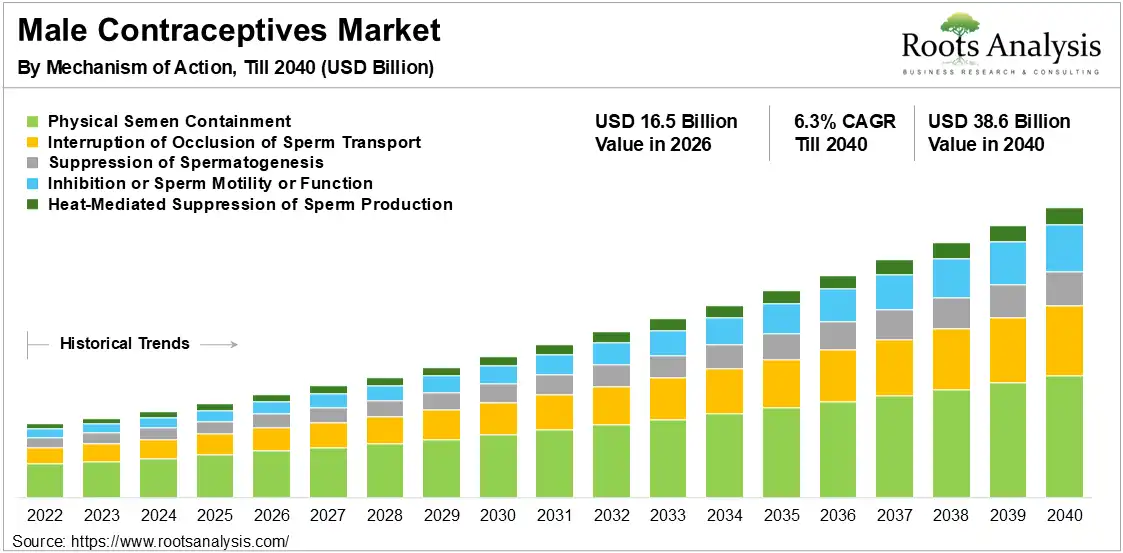
The global male contraceptives market is expected to rise from USD 16.5 billion in 2026 to reach USD 38.6 billion by 2040, growing at a CAGR of 6.3% over the forecast period 2026 to 2040, driven by reversible product innovation.
See What’s in the Full Report – Request Your Complimentary Insights!
Market Report: Key Takeaways
- Based on method type, condoms capture 72.0% market share in 2026, whereas non-hormonal pharmacological methods register a 33.7% CAGR through 2040, driven by oral pipeline progress.
- Based on mechanism of action, physical semen containment captures 72.0% market share in 2026, whereas spermatogenesis suppression registers a 32.7% CAGR through 2040, supported by human trials.
- Based on duration of action, single-use coital methods capture 72.0% market share in 2026, whereas on-demand pharmacological methods register a 38.3% CAGR through 2040, reducing adherence burdens.
- Based on distribution channel, drugstores and retail pharmacies capture 33.0% market share in 2026, whereas e-commerce registers a 9.3% CAGR through 2040, supported by discreet purchasing.
- Based on geography, North America captures 34.0% market share in 2026, whereas Asia-Pacific registers an 8.4% CAGR through 2040, supported by localized trials and digital retail.
Male Contraceptives Market Outlook
Pipeline innovation is shifting male contraception beyond a market long dominated by condoms and vasectomy. Condoms still hold 72.0% share in 2026, but their share falls as reversible methods advance. Oral drugs, hormonal gels, hydrogel implants, and thermal devices now broaden the technology base. Supply pressure also affects established products. Raw-material, freight, and shipping disruptions raise manufacturing and pricing risks across global condom supply chains. These pressures constrain near-term price stability.
Current growth reflects demand for reversible male contraception, stronger clinical evidence, and clearer development targets. WHO’s March 2026 consultation covered spermatogenesis suppression, sperm-function inhibition, and vas-deferens occlusion, giving developers a more structured product framework. This alignment can reduce development uncertainty and support more consistent regulatory engagement across candidate classes. Contraline also secured USD 92.5 million in June 2026 for NES/T Gel and ADAM development.
Through 2040, the male contraceptives market will accelerate as non hormonal contraceptive pills, on-demand methods, and long-acting reversible products enter commercialization pathways. Non-hormonal pharmacological methods will grow at 33.7% CAGR, while on-demand pharmacological methods will grow at 38.3%. NEXT Life Sciences advanced Plan A and NLS-133 into Phase II during March 2026. The outlook remains high-growth but dependent on clinical validation, manufacturing scale, reimbursement, and access.
Male Contraceptives Market Dynamics
Male Contraceptives Market Drivers
Demand for user-controlled, reversible contraception is expanding the commercial case for pills, gels, and hydrogel implants. A multi-country study found 61% first-year interest in novel male methods, indicating demand beyond condoms and vasectomy. Clinical progress supports that interest, while WHO target product profiles now organize candidates around spermatogenesis suppression, sperm-function inhibition, and vas-deferens occlusion. These factors support a 6.3% overall CAGR through 2040.
Male Contraceptives Market Restraints
Clinical validation remains the main restraint because new methods must show efficacy, safety, reversibility, and acceptable recovery of fertility. Early candidates also face long development timelines before prescription revenue can replace established condom volumes. Vasectomy retains a mature clinical pathway, while condoms require no prescription or procedure. These advantages keep developmental pharmacological and implantable methods below 3% combined share in 2026, limiting near-term commercial scale.
Male Contraceptives Market Opportunities
Non-hormonal pharmacological methods create the strongest opportunity, with a forecast 33.7% CAGR through 2040. Oral administration could reduce procedural barriers and fit familiar consumer behavior. YourChoice’s July 2025 first-in-human findings reported YCT-529 safety and pharmacokinetic results in 16 healthy men. Successful later-stage development could open future prescription channels and shift competition toward differentiated efficacy, reversibility, dosing, and tolerability profiles.
Male Contraceptives Market Challenges
Supply economics and policy shifts create uneven access across established and emerging products. Karex planned 20% to 30% condom price increases in April 2026 after raw-material, freight, and shipping disruptions tightened supply. China also applied a 13% value-added tax to condoms and contraceptive pills in January 2026. Developers must manage clinical costs, capacity, retail pricing, and country-specific policy changes.
Male Contraceptives Market Size Estimation Methodology
- As a starting point, the model established a 2022 baseline using condom sales volumes, retail pricing, vasectomy procedure activity, and public-health procurement. Regional totals were reconciled across drugstores, supermarkets, e-commerce, clinics, institutional buyers, and sexual-wellness retailers. This step separated recurring product revenue from surgical service value and prevented double counting across channels. Trade-flow data and materials production volumes tested the availability of latex, polyisoprene, and polyurethane supply.
- Moving forward, the male contraceptives market pipeline was mapped through clinical trial databases, company disclosures, and peer-reviewed human studies. Candidates were classified by method, delivery route, mechanism, duration, and development stage. Stage-adjusted commercialization assumptions distinguished approved condom and vasectomy demand from hormonal gels, non-hormonal pills, vas-occlusive hydrogels, injections, and thermal devices. Patent filing volumes and licensing activity identified technology concentration and likely competitive entry points.
- Building on this, regulatory submission counts, drug approval timelines, and WHO target product profiles informed launch timing and compliance risk. The assessment tracked required evidence for efficacy, safety, reversibility, fertility recovery, and device performance. Separate timing assumptions were applied to oral drugs, topical gels, intravasal implants, and wearable thermal products. Their clinical and regulatory pathways differ.
- Drawing upon these, adoption curves incorporated the 61% first-year interest recorded for novel male contraceptive methods. Uptake assumptions were moderated by prescription requirements, procedure acceptance, dosing frequency, partner confidence, and willingness to pay. Channel-specific conversion rates reflected discreet e-commerce purchasing, pharmacy access, clinic capacity, and institutional procurement behavior across each region.
- The projected value was then, after reconciliation, converted into annual segment values using category-specific growth rates. Forecast shares were tested across method type, administration route, mechanism, duration, distribution channel, and geography. The model preserved a 100% total within every segmentation. Faster pipeline categories gained share from condoms, vasectomy, and other mature methods.
- Finally, the forecast was stress-tested against funding disclosures, raw-material costs, freight disruption, tax policy, and clinical development outcomes. Scenario ranges examined delayed approvals, slower adoption, higher condom pricing, and faster e-commerce penetration. Results were cross-checked against multiple credible secondary sources, company evidence, and the annual forecast curve to confirm internal consistency through 2040. Base, upside, and downside cases quantified how these variables could alter segment adoption.
Male Contraceptives Market Share Insights
Market Share by Administration or Delivery Route
According to our analysis, external barrier-device use leads because condoms require no prescription, procedure, or clinical infrastructure. Established production, retail placement, and institutional purchasing reinforce availability across income groups. Church & Dwight highlighted its major non-latex TROJAN launch in January 2026.
Oral administration will grow fast because pills align with familiar behavior and avoid procedural barriers. Clinical progress will convert latent user interest into prescription revenue following approvals. YourChoice published reversible oral YCT-529 efficacy findings in March 2025.
Market Share by Mechanism of Action
Physical semen containment leads because condoms provide immediate action, user control, and protection against sexually transmitted infections. Mature quality standards and multinational supply chains also limit adoption barriers. Church & Dwight reported Trojan-led domestic sales growth in October 2025.
Spermatogenesis suppression will scale as hormonal gels and non-hormonal pills progress through clinical development. Multiple delivery routes will broaden choice while maintaining safety and reversibility objectives. YourChoice reported active Phase Ib/IIa YCT-529 development in July 2025.
Want Information on Specific Region / Segment?
Regional Analysis: North America Leads the Market and Asia-Pacific is Likely to Register Higher CAGR
Presently, North America holds 34.0% market share in 2026 leading through mature consumer brands, biotechnology funding, clinical networks, and regulatory expertise. This ecosystem supports commercial condom demand alongside advanced pharmacological and device development. YourChoice reported first-in-human YCT-529 safety data in July 2025.
On the contrary, Asia-Pacific registers an 8.4% CAGR from 2026 to 2040 and expands through large consumer populations, digital retail adoption, public-health programs, and localized clinical development. Australia and New Zealand increasingly provide early clinical infrastructure for male-contraceptive candidates. NEXT Life Sciences launched Plan A clinical trials in Australia in March 2025.
Market Ecosystem Analysis
Within this 22-company scope, five Tier 1 leaders anchor most commercial activity, along with 11 specialists and six emerging developers. Brand-owner concentration paired with outsourced high-volume manufacturing defines consolidation across retail condoms and institutional procurement. Premium material innovation and procurement-scale resilience now reshape competitive behavior as input volatility increases pricing pressure. Advantage is shifting toward players combining differentiated materials, regulatory access, clinical evidence, and reliable cross-border supply.
- Reckitt: In October 2025, Reckitt reported that Durex Intensity launches accelerated European Durex growth to mid-single digits. The rollout strengthens premium single-use barriers and pressures rivals across pharmacies, specialty retailers, and e-commerce.
- Church & Dwight: In October 2025, Church & Dwight launched Trojan G.O.A.T. condoms using patent-pending Ultra Flex non-latex material. This strengthens premium non-latex barriers and raises formulation barriers for smaller brands across North American retail channels.
- Okamoto Industries: In February 2025, FDA cleared Okamoto's 0.04 ZERO ZERO FOUR male latex condom as substantially equivalent. The clearance expands U.S. access for ultra-thin latex products and raises testing barriers for premium entrants.
- Karex: In April 2026, Karex said it would raise prices by 20% to 30% amid supply disruptions. The move strengthens scaled manufacturers' leverage while pressuring public-health buyers and smaller suppliers across global procurement channels.
- Cupid: In November 2025, Cupid secured a leading position in South Africa's five-year national condom procurement program. The award strengthens African public-health procurement and raises scale, distributor coordination, and delivery barriers for smaller suppliers.
- YourChoice Therapeutics and Quotient Sciences: In March 2025, the companies reported a 28-day YCT-529 study underway with 50 men. This advances oral non-hormonal contraception and expands daily pharmacological options beyond condoms and vasectomy.
- NEXT Life Sciences: In June 2025, NEXT reported 100% delivery-system success in a Canadian Plan A clinical trial. The result lowers procedural complexity for intravasal hydrogel placement and strengthens long-acting reversible methods within clinics.
- Contraline: In June 2026, Contraline closed a $92.5 million Series B supporting NES/T development and additional pipeline assets. The financing raises capital barriers while strengthening topical hormonal and intravasal non-hormonal development positions.
Startup Companies and their Key Highlights
- Contraline, Inc. | Series B Financing
- Event type and funding amount: $92.5 million Series B financing
- Month and year: June 2026
- Lead investors: BVF Partners L.P. and RA Capital Management
- Stated purpose: Advance NES/T Gel into late-stage development and support additional pipeline assets
- Market implication: Accelerates daily topical hormonal contraception while funding a broader reversible male-contraceptive pipeline
- Contraline, Inc. | Global Exclusive License
- Event type: Global exclusive license for NES/T Gel
- Month and year: February 2026
- Strategic partner: Population Council
- Stated purpose: Transfer NES/T leadership to Contraline for late-stage development, regulatory engagement, and global approvals
- Market implication: Combines daily topical hormonal contraception with Contraline's long-acting intravasal development platform
- NEXT Life Sciences, Inc. | Canadian Clinical Trial
- Event type: Completion of a second Plan A delivery-system clinical trial
- Month and year: June 2025
- Stated purpose: Validate the Plan A delivery system and practitioner procedure in Canadian participants
- Market implication: Accelerates clinic-based intravasal placement by demonstrating repeatable execution for a long-acting reversible method
- YourChoice Therapeutics | 28-Day Clinical Study
- Event type: A 28-day YCT-529 study underway in 50 men
- Month and year: March 2025
- Development partner: Quotient Sciences
- Stated purpose: Continue human evaluation after early dosing was well tolerated without serious adverse events
- Market implication: Advances oral non-hormonal contraception targeting sperm production beyond condoms and permanent vasectomy
Male Contraceptives Market Trends / Opportunities
Non-Hormonal Oral Pipelines Expanding Male Contraceptives Market Prescription Competition
Oral non-hormonal candidates are moving male contraception toward familiar prescription behavior. Communications Medicine published Phase Ia YCT-529 safety and pharmacokinetic findings from 16 healthy men in July 2025. Human evidence strengthens the commercial case for differentiated oral products and future pharmacy distribution.
Reversible efficacy evidence is improving confidence in sperm-production suppression without systemic hormones. University of Minnesota researchers reported 99% pregnancy prevention in mice and fertility recovery after YCT-529 treatment ended in March 2025. Stronger reversibility data could accelerate investment while raising competitive expectations for safety and recovery timelines.
Vas-Occlusive Hydrogels Creating Long-Acting Competition Beyond Vasectomy
Hydrogel systems are creating reversible alternatives to permanent sperm-transport interruption. NEXT Life Sciences launched Australian clinical trials of Plan A in March 2025. The company advanced Plan A and NLS-133 into Phase II by March 2026, increasing pressure on other device developers.
Long-duration evidence is becoming a key differentiator for intravasal products. Contraline reported no detected sperm in two ADAM participants at 24 months during April 2025. Its June 2026 financing supports further ADAM testing, linking clinical durability directly with capital access and commercialization speed.
WHO Product Profiles Reducing Development Ambiguity Across Male Contraceptives Market Candidates
Target product profiles are giving developers clearer performance categories for emerging methods. WHO opened consultation in March 2026 across spermatogenesis suppression, sperm-function inhibition, and vas-deferens occlusion. Shared benchmarks can improve portfolio comparison and reduce uncertainty during clinical planning and regulatory engagement.
Licensing partnerships are consolidating responsibility for late-stage execution and market preparation. Contraline secured global rights to NES/T Gel from Population Council in February 2026. The agreement places development, regulatory engagement, and commercialization under one operator, which can shorten decision cycles and strengthen competitive accountability.
Your Business is Unique – Why Shouldn’t Your Report Be?
Market Access Considerations
Clinical Evidence for Safety, Efficacy, and Fertility Recovery
New entrants must prove contraception, tolerability, reversibility, and fertility recovery before they can scale prescription or procedural products. This requirement lengthens development and favors companies with capital for multi-stage clinical programs. YCT-529’s July 2025 Phase Ia findings covered safety and pharmacokinetics in 16 healthy men, but later efficacy evidence remains essential. Strong clinical packages will support physician confidence, regulatory review, and differentiated market positioning. Smaller developers may need licensing partners or specialized clinical platforms to fund those requirements.
Regulatory Pathway Clarity Across Drug and Device Classes
Male contraceptive pills, gels, implants, injections, and thermal devices face different evidence and submission requirements. WHO’s March 2026 target product profile consultation grouped candidates by spermatogenesis suppression, sperm-function inhibition, and vas-deferens occlusion. Clearer benchmarks can reduce planning uncertainty, but developers still need route-specific safety and performance data. Companies that align trials early can improve regulatory efficiency and commercialization timing. Misalignment can force protocol changes, duplicate testing, and slower entry into regional approval pathways.
Manufacturing Economics, Freight Exposure, and Tax Policy
Condom access depends on material availability, high-volume production, freight capacity, and retail affordability. Karex planned 20% to 30% price increases in April 2026 as raw-material and shipping disruptions tightened supply. China’s January 2026 introduction of a 13% value-added tax added another pricing constraint. Scale, sourcing resilience, and local pricing flexibility therefore shape competitive access. Institutional suppliers also face tender pricing pressure, which can limit pass-through of higher costs globally.
Channel Reach Across Retail, Clinics, and Institutional Buyers
Access varies sharply by product route. Condoms move through mass retail, while gels, pills, implants, and procedures require clinical or pharmacy infrastructure. Drugstores lead with 33.0% share in 2026, but e-commerce will grow at 9.3% CAGR through 2040. Church & Dwight reported strong Amazon adoption for TROJAN G.O.A.T. in May 2026. Competitors need channel-specific education, fulfillment, and provider engagement strategies. Hospital and clinic access will matter more as long-acting and prescription methods reach commercialization globally.
How Stakeholders Benefit from the Key Focus Areas of Our Male Contraceptives Market Report
Reversible product innovation, clinical progress, and changing condom economics make male contraception commercially urgent across mature products and emerging technologies. The report connects pipeline maturity, segment growth, regulatory pathways, channel shifts, and regional demand. These findings support portfolio allocation, investment screening, technology planning, partnership development, and market-entry decisions.
- Unmet Needs and Market Gaps in Male Contraceptives Market: The analysis identifies where condoms and vasectomy fail to meet demand for reversible, user-controlled, and non-hormonal options. Product planners can compare oral, topical, injectable, intravasal, thermal, and surgical gaps by duration and mechanism. This supports decisions on which unmet need offers the clearest path to adoption, differentiation, and sustainable pricing.
- Funding and Venture Investment Opportunities in Male Contraceptives Market: The report maps capital signals across hormonal gels, non-hormonal pills, and vas-occlusive hydrogels. Investment committees can assess whether clinical stage, reversibility evidence, and regulatory readiness justify exposure. Contraline’s USD 92.5 million financing also provides a benchmark for late-stage capital intensity. This supports deal screening, diligence priorities, and portfolio timing.
- Technology Innovation and Adoption Trends: The research compares adoption curves for oral administration, topical gels, injections, intravasal implants, and wearable thermal devices. Research and product teams can see which technologies gain share fastest and which face procedural resistance. The analysis supports platform selection, trial design priorities, dosing decisions, and evidence plans for safety, efficacy, and fertility recovery.
- Male Contraceptives Market Competitive Landscape and Industry Analysis: The competitive review separates established condom leaders, specialist manufacturers, clinical-service partners, and emerging contraceptive developers. Commercial teams can assess where scale, brand reach, manufacturing depth, or pipeline maturity creates an advantage. The tiered company database supports competitor tracking, whitespace analysis, channel positioning, and prioritization of high-potential accounts or technologies.
- Mapping Strategic Partnerships and Ecosystem Synergies: The report tracks licensing, clinical development, commercialization responsibility, institutional procurement, and distribution relationships across the ecosystem. Partnership executives can identify where developers need regulatory expertise, trial capacity, manufacturing scale, or market access. The Contraline and Population Council agreement illustrates how rights consolidation can accelerate execution. This supports partner selection and alliance structuring.
- Male Contraceptives Market CAGR and Growth Trends: The forecast shows 6.3% overall CAGR through 2040, with faster growth in non-hormonal and on-demand methods. Finance and planning teams can compare share gains across method, route, mechanism, duration, channel, and geography. This supports revenue scenarios, resource allocation, regional sequencing, and risk-adjusted prioritization of segments with the strongest expansion potential.
Male Contraceptives Market: Scope of the Report
| Key Report Attributes | Details | |
| Forecast Period | Till 2040 | |
| Market Size 2026 | USD 16.5 Billion | |
| Market Size 2040 | USD 38.6 Billion | |
| CAGR (Till 2040) | 6.3% | |
| Segments Covered |
|
|
| Geographical Regions Covered |
|
|
| Key Sections Covered |
|
|
Market Segmentation
The Male Contraceptives Market report presents an in-depth analysis, highlighting the capabilities of various stakeholders, based on different segments, such as method type, administration or delivery route, mechanism of action, duration of action, distribution channel, geographical regions, and leading players.
By Method Type
- Condoms
- Vasectomy
- Hormonal Pharmacological Methods
- Non-Hormonal Pharmacological Methods
- Vas-Occlusive Implants and Injections
- Thermal Contraceptive Methods
By Administration or Delivery Route
- External Barrier-Device Use
- Oral Administration
- Topical Transdermal Application
- Injectable Administration
- Intravasal Implant Placement
- Wearable Thermal-Device Use
- Surgical Intervention
By Mechanism of Action
- Physical Semen Containment
- Interruption or Occlusion of Sperm Transport
- Suppression of Spermatogenesis
- Inhibition of Sperm Motility or Function
- Heat-Mediated Suppression of Sperm Production
By Duration of Action
- Single-Use Coital Methods
- On-Demand Pharmacological Methods
- Daily Short-Acting Methods
- Periodic Intermediate-Acting Methods
- Long-Acting Reversible Methods
- Permanent Methods
By Distribution Channel
- Drugstores and Retail Pharmacies
- Supermarkets and Hypermarkets
- E-Commerce and Online Pharmacies
- Hospitals and Clinics
- Public-Health and Institutional Procurement
- Specialty Sexual-Wellness Retailers
By Geographical Regions
- North America
- US
- Canada
- Mexico
- Rest of North America
- Europe
- Austria
- Belgium
- Denmark
- France
- Germany
- Ireland
- Italy
- Netherlands
- Norway
- Russia
- Spain
- Sweden
- Switzerland
- UK
- Rest of Europe
- Asia-Pacific
- China
- India
- Japan
- Singapore
- South Korea
- Rest of Asia-Pacific
- Latin America
- Argentina
- Brazil
- Chile
- Colombia
- Venezuela
- Rest of Latin America
- Middle East and Africa (MEA)
- Egypt
- Iran
- Iraq
- Israel
- Kuwait
- Saudi Arabia
- UAE
- Rest of MEA
- Rest of the World


