Microbiome Diagnostics Market Overview
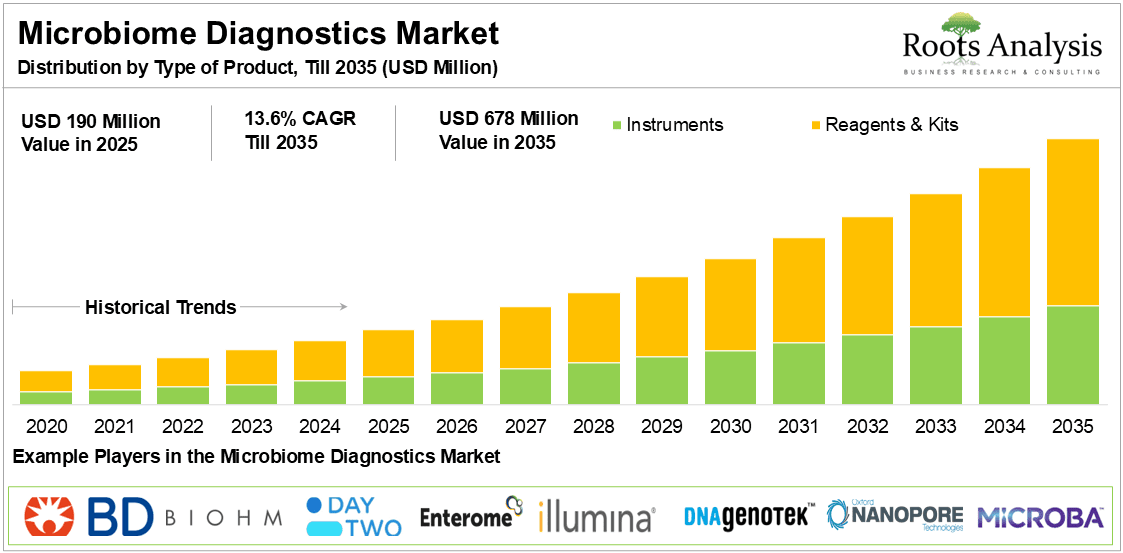
The global microbiome diagnostics market size, valued at USD 163 million in 2024, is projected to reach USD 190 million in 2025 and USD 678 million by 2035, representing a CAGR of 13.6% during the forecast period.
To learn more about this report, request a free sample copy
Microbiome Diagnostics Market: In Summary
- The strong correlation between the microbiome and chronic conditions is accelerating the adoption of diagnostic tools to understand disease etiology and drug response, enabling tailored treatment plans.
- Innovations in sequencing technologies, such as shotgun metagenomic sequencing and 16S rRNA sequencing are enabling comprehensive microbiome study.
- The fecal segment dominates with over 50% market share due to its rich microbial diversity and ease of collection, offering insights into gut health and chronic diseases. The saliva segment is projected to grow at a higher CAGR due to its non-invasive collection and abundance of biomarkers.
- Reagents & Kits hold the largest share (nearly 65%) due to their essential role in DNA / RNA extraction and multi-step analysis in microbiome research. This segment is expected to maintain its dominance and high growth.
- The North America region is dominating the market by holding 50% of the market revenue, attributed to the presence of established industry players and a high incidence of chronic conditions. Asia-Pacific is poised for the highest CAGR, indicating emerging opportunities and growing awareness in the region.
- Market players, such as Microba Life Sciences (Australia), Genetic Analysis (Norway), Enterome (France), and Viome Life Sciences (US) are actively pursuing strategic partnerships, collaborations, and product diversification, including microbiome data analysis tools and personalized medicine diagnostics.
- A significant trend is the integration of microbiome data with proteomics, genomics, and metabolomics. This holistic approach offers more predictive disease analysis, deeper insights into host-microbe interactions, and supports personalized medicine, increasing demand for advanced diagnostic and sequencing platforms.
- The future holds the promise of rapid, user-friendly, and cost-effective PoC microbiome testing. The integration of Artificial Intelligence (AI) is set to enhance the precision and speed of microbiome analysis, extending its application beyond disease diagnosis into personalized nutrition and lifestyle guidance.
Microbiome Diagnostics Market Introduction
Human microbiome refers to the ecosystem of trillions of microorganisms that have potential to affect severity of a disease, susceptibility and recovery from a disease. These microorganisms directly influence the immune function and metabolism of humans. It is worth noting that the study of microbiome helps to understand disease pathogenesis, personalized therapeutic interventions, and progression. With growing concern of chronic diseases, such as irritable bowel syndrome, inflammatory bowel disease and cancers, there is a surge in the demand for microbiome diagnostic tools.
Furthermore, the growing shift towards tailored medicine to meet individual patients requirements and increasing microbiome research / metabolomics are contributing to the demand for microbiome diagnostic technologies. Notably, microbiome diagnostic technologies, such as shotgun metagenomic sequencing, and 16s rRNA sequencing helps in microbiome study and its potential role in disease prognosis and treatment efficacy.
This rapidly growing awareness about microbiomes is catering the attention of industrial players for innovations in microbiome diagnostics technologies. Several market players are leveraging partnerships and collaborations to develop cost-effective and cutting-edge solutions for microbiome diagnostics. For instance, in February 2025, Leucine Ruch Bio (India) announced a strategic partnership with Precision Diagnosticos (Brazil) to expand BugSpeaks (Leucine Rich Bio’s flagship microbiome testing technology) to Brazilian market. Besides technology expansion, the industrial players also focus on initiating education programs to raise awareness about microbiome and its key role in disease management. These rising initiatives are likely to propel the microbiome diagnostics market at a steady pace in the future.
Microbiome Diagnostics Market: Report Attributes
| Key Report Attributes |
Details |
| Historical Trend |
Since 2020 |
| Forecast Period |
Till 2035 |
| Market Size 2025 |
USD 190 Million |
| Market Size 2035 |
USD 678 Million |
| CAGR (Till 2035) |
13.6% |
One of the key objectives of the microbiome diagnostics market report was to estimate the current size, opportunity, and the market growth potential, over the forecast period, till 2035. We have provided informed estimates on the likely evolution of the market for the forecast period.
The global microbiome diagnostics market analysis also features the likely distribution of the current and forecasted opportunity within the market across various segments, such as type of sample, type of product, type of technology, application area, end user, geographical regions, and leading players.
In order to account for future uncertainties associated with some of the key parameters and to add robustness to our model, we have provided three market forecast scenarios, namely conservative, base, and optimistic scenarios, representing different tracks of industry's evolution.
Recent Developments in Microbiome Diagnostics Market
Several recent developments in the field of microbiome diagnostics industry have occurred and we have outlined some of these below:
- In May 2025, Mapmygenome (India) announced a strategic acquisition of Microbiome Insight (Canada) to introduce its integrated genomics and microbiome testing services to North American region.
- In April 2025, Microba Life Sciences (Australia) announced two primitive developments, such as a strategic partnership with the Colonscopy Clinic (Australia) and its wholly owned partner, Integrated Gut Health (Australia) and release a clinical utility result for its MetaPanel™, gastrointestinal pathogen test.
- In April 2025, Sova Health (India) launched gut microbiome test (GMT) and food intolerance test (FIT) with an aim of understanding symptoms gut problems and providing evidence-based solutions to improve gut health.
- In January 2025, PacBio (US) and Intus Bio (US) unveiled GutID (first commercial human gut health test) which is powered by Intus Bio’s Titan-1 platform and PacBio’s HiFi sequencing technology. This newly launched GutID sets the new benchmark in gut microbiome testing, offering precise diagnostics for disease treatment.
Microbiome Diagnostics Market Segmentation Insights
The market report presents an in-depth analysis of microbiome diagnostic technologies developers who are currently active across various segments of the industry as mentioned below:
Microbiome Diagnostics Market: Market Segmentation
| Market Segmentations |
Details |
| Type of Sample |
|
| Type of Product |
- Instruments
- Reagents & Kits
|
| Type of Technology |
- Metatranscriptomics
- Shot Gun Metagenomics
- 16s rRNA Sequencing
|
| Application Area |
- Research Application
- Disease Diagnostics Application (Metabolic Diseases, Gastrointestinal Disorders, and Others)
|
| End User |
- Academic & Research Institutes
- Hospitals
- Pharmaceutical & Biotechnology Companies
|
| Geographical Regions |
- North America
- Europe
- Asia-Pacific
- Middle East & Africa
- Latin America
|
| Market in North America |
|
| Market in Europe |
- France
- Germany
- Italy
- Spain
- UK
- Rest of Europe
|
| Market in Asia-Pacific |
- China
- India
- Japan
- South Korea
- New Zealand
- Rest of the Asia-Pacific
|
| Market in Middle East & Africa |
- Egypt
- Saudi Arabia
- South Africa
- United Arab Emirates
|
| Market in Latin America |
|
Industry Experts on Microbiome Diagnostics Market
Experts believe that microbiome diagnostics will change the healthcare experts approach to treat patients with a tailored approach.
“Pierre Belichard (CEO of Enterome) said that, we have been looking at the evolution of the gut microbiome composition over time in Crohn’s disease. We have identified bacteria that are always downregulated or upregulated when the disease is active and developed a test that can replace colonoscopy.”
Microbiome Diagnostics Market Share Insights
Market Share by Type of Sample: Why is Fecal Segment Widely Used for Microbiome Analysis?
- The global market is segmented across different types of samples, such as skin, fecal, saliva, and others. According to the microbiome diagnostic market outlook, the fecal segment is holding the highest share (over 50%) of the market. This can be ascribed fecal matter is a byproduct of digestive process and contains diverse population of microorganisms that helps to gain insight about gut microbiome and underlying causes of chronic diseases, such as metabolic disorders and certain forms of cancer. Additionally, the ease of collection, and availability of technologies, such as 16s rRNA gene sequencing that helps in comprehensive profiling of microorganisms are likely to be the key growth factor for this segment.
- It is worth mentioning that the saliva segment will gain momentum at a higher CAGR in the future. This is potentially due to the non-invasive approach for sample collection and saliva contains various biomarkers (DNA, RNA, proteins, hormones, metabolites, and immune components) that originate from both the oral cavity and the bloodstream as a plasma filtrate.
Market Share by Type of Product: Why Reagents & Kits Segment Holds Highest Share?
- This segment is bifurcated across different type of product, such as instruments and reagents & kits. Based on the microbiome diagnostics industry analysis, presently reagents & kits account for the highest share (nearly 65%) of the market. Microbiome research requires extraction of DNA / RNA from complex biological samples. The multi-step analysis process requires specialized reagents, and kits. This increasing usage of reagents & kits in microbiome research is likely to be a key driver for this segment.
- It is important to highlight here that the reagents & kits segment is likely to remain dominant and continue to grow at a higher CAGR in the future. This can be attributed to the fact that the reagents & kits are widely used for sample library preparation.
Market Share by Type of Technology: 16s rRNA Sequencing Segment Holds the Highest Share
- This segment highlights the distribution of global market across different types of technology, such as metatranscriptomics, shot gun metagenomics, and 16s rRNA sequencing. According to the microbiome diagnostics market forecast, the 16s rRNA sequencing segment holds the largest share of the market. This dominance is likely to be the result of increasing advancements in 16s rRNA gene sequencing technology, which makes it ideal for identifying and analyzing microbial communities.
- In the long run, shot gun metagenomics segment is likely to grow at a higher CAGR in the future. This lucrative growth is due to the rising need for shot gun data to identify specific genes and gut microbes that are responsible for antibiotic resistance. Moreover, the shot gun data is also helpful to understand the pathway involved in drug metabolism, which further helps to develop tailored drug to treat wide range of disease.
Market Share by Application Area: Will Disease Diagnostics Application Dominate the Market in the Future?
- Based on the application area, the global market is segmented into research applications, disease diagnostics applications (metabolic diseases, gastrointestinal disorders, and others). Among these, disease diagnostics applications segment holds the largest share (over 55%) of the microbiome diagnostics market size. This can be attributed to the rising adoption of microbiome or gastrointestinal disease diagnostics technologies / platforms for disease diagnosis and understanding the role of microbiome dysbiosis in diseases.
- It is important to highlight here that the research applications segment will grow at a higher CAGR during the forecast period. This is potentially due to the ongoing research on microbiomes to uncover microbiome biomarker and therapeutic targets.
Market Share by End User: Are Pharma and Biotech Companies Investing More in Microbiome Diagnostics?
- The global market is further categorized across different types of end user, such as academic & research institutes, hospitals, and pharmaceutical & biotechnology companies. Currently, hospitals segments are holding maximum microbiome diagnostics market share (nearly 50%). This can be attributed to the increasing adoption of microbiome diagnostics tools to improve diagnosis, monitor disease progression and personalized treatment.
- In the long run, the pharmaceutical & biotechnology companies’ segment is likely to grow at a higher CAGR during the forecast period. This lucrative growth is due to the increasing collaborations and investment by industrial players in microbiome diagnostics, drug discovery and development of microbiome-based therapies.
Market Share by Geographical Regions: North America Region Holds the Largest Share
- The global market is distributed across North America, Europe, Asia-Pacific, Middle East & Africa, and Latin America. According to the microbiome diagnostics market analysis, presently North America is dominating the industry by holding more than 50% of the overall revenue share. This dominance reflects the presence of established industrial players who are undertaking strategic initiatives to develop advanced microbiome diagnostics solutions and rising concern of chronic conditions specifically gastrointestinal diseases and cancer in this region.
- In Asia-Pacific, the market for microbiome diagnostics is likely to grow at a higher CAGR during the forecast period. This is potentially due to the increasing research on microbiome, and its role in diseases and treatment. Moreover, government initiatives to support microbiome research has further fueled the growth of the market in this region.
Microbiome Diagnostics Market: Report Deliverables
| Report Deliverables |
Details |
Excel Data Packs
(Complimentary) |
Available |
| Key Microbiome Diagnostics Companies Profiled |
- BD Biosciences (US)
- BIOHM Health (US)
- Bione Ventures (India)
- Biome Diagnostics (Austria)
- DayTwo (Israel)
- DNA Genotek (US)
- Enterome (US)
- Evvy (New York)
- Genetic Analysis (Norway)
- Illumina (US)
- Microba (US)
- Oxford Nanopore Technologies (UK)
- Quantbiome (Australia)
- ViennaLab Diagnostics (Austria)
- Viome Life Sciences (US)
(A complete list of companies captured is available in the report) |
PowerPoint Presentation
(Complimentary) |
Available |
| Customization Scope |
15% Free Customization |
Microbiome Diagnostics Market Key Takeaways
The "Microbiome Diagnostics Market Report: Industry Trends and Global Forecasts, till 2035" market report features an extensive study of the current market landscape, market size, market share, market growth, market trends, market value, market forecast, market outlook, statistics, and future opportunities for microbiome diagnostics technologies providers. The market research report lays emphasis on the microbiome data analysis tools / technologies that are being developed for life science companies and research organizations. Key takeaways of the market report are briefly discussed below.
Competitive Landscape: Competitive Landscape and Leading Companies in Microbiome Diagnostics Sector
The microbiome diagnostics market landscape features a mix of well-established and new entrants. Owing to the growing focus on microbiome research, several market players, such as Microba Life Sciences (US), Genetics Analysis (Norway), Enterome (France) and Viome Life Sciences (US) are leveraging opportunities to develop advanced diagnostics technologies and sequencing platforms. Moreover, industrial players are aiming for product portfolio diversification, such as microbiome data analysis tools, and personalized medicine microbiome diagnostics technologies for detailed analysis of microbiome.
Notably, strategic partnerships, collaborations and product diversification will remain the center focus in this field, which makes this market competitive during the forecast period.
Some of the potential industrial players who are presently showing active interest in the field are as follows:
- DNA Genotek (a subsidiary of OraSure Technologies) (Canada): DNA Genotek is a leading player in the market and is well known for its OMNIgene® GUT collection kits, offering ambient temperature stabilization of microbial DNA and RNA from fecal samples.
- Microba Life Sciences (US): This company is well known for its comprehensive gut microbiome analysis services and products, often catering to both research and clinical applications.
- Genetic Analysis (Norway): Genetic analysis has specialization in gut microbiota analysis with its CE-marked GA-map® Dysbiosis Test, particularly for IBD and IBS patients.
- Enterome SA (France): A clinical-stage biopharmaceutical company focusing on the gut microbiome, with diagnostic potential linked to its therapeutic pipeline.
- Viome Life Sciences (US): Offers direct-to-consumer (DTC) microbiome and metatranscriptome testing for personalized health insights and microbiome biomarker discovery.
Market Drivers: What are the Main Drivers Behind Microbiome Diagnostics Adoption?
Several factors that are accelerating the human microbiome diagnostics market are listed below:
Rising Prevalence of Chronic Diseases: How Next-Generation Sequencing in Diagnostics Helps in Disease Treatment?
With growing concern about chronic diseases, gastrointestinal disorders, metabolic disorders and oncological disorders, market players are focusing on microbiome research. Notably, microbiomes have a strong correlation with chronic conditions and disease management. By using advanced microbiome diagnostics tools and technologies, research are able to understand the underlying reason of diseases, dysbiosis microbiota and how gut microbiota response towards a therapeutic drug. This information helps to develop a tailored treatment plan to meet individual patients’ requirement, making microbiome diagnostics an invaluable tool for managing chronic conditions.
Shift Towards Personalized Medicine: How Microbiome Diagnostics Helps in Personalized Medicine?
It is worth noting that the shift towards personalized medicine has further increased the demand for microbiome diagnostics. Notably, precision healthcare diagnostics tools offer a pathway for clinicians to understand disease mechanism and role of microbiome in disease treatment. With detailed analysis, clinicians can provide personalized treatment to patients to enhance clinical outcomes.
Market Challenges: What are the Biggest Challenges for Companies Entering the Microbiome Diagnostics Space?
Several factors that may hinder the microbiome diagnostics market growth are listed below:
Complex Regulatory Landscape for Microbiome Diagnostics
Variability in sequencing protocols, and bioinformatics analysis across different platforms may create a significant challenge for the market players. Furthermore, the complex regulatory landscape for microbiome diagnostics may create challenges for product development and approval process. As a result, market players witness delay in commercialization of sequencing technologies.
High Cost of Microbiome Diagnostics Tools: How are Tariffs and Supply Chain Issues Affecting Microbiome Diagnostics Costs?
Notably, the cost of advanced microbiome sequence is high in comparison to traditional diagnostic approach. Lack of insurance coverage or unclear reimbursement policies may limit its adoption in healthcare industry. Additionally, the implementation of heavy tariffs on microbiome diagnostics reagents, kits and raw materials may increase the overall expenditure on microbiome technologies, which is likely to be a significant restraint for the market players.
Market Trends: What Are the Emerging Trends in Microbiome Diagnostics for Personalized Medicine 2025?
Despite challenges, the market for microbiome diagnostics is propelled at a steady rate in the future. Several microbiome-based diagnostics market trends are listed below.
Integration with Multi-Omics Data
It is important to highlight here that the market players are increasingly focusing on the integration of microbiome data with proteomics, genomics, and metabolomics for more predictive analysis of disease. This integration of multi-omics data is further increasing the demand for advanced microbiome diagnostics technologies and sequencing platforms. By gaining deeper insight about host-microbe interactions and overall physiological states, clinicians can provide personalized medicine to improve patient outcomes. This holistic approach of tailored treatment has further accelerated the demand for microbiome diagnostics in the future.
Point-of-Care Microbiome Testing and AI Integration: How is AI Being Used in Microbiome Diagnostic Tools?
The future of microbiome diagnostics market seems promising with increasing microbiome diagnostics technology advancements. Some of the notable trends that are shaping industrial growth, include the development of point-of-care microbiome testing for more rapid, user-friendly and cost-effective microbiome testing. In addition, market players are aiming to integrate artificial intelligence to enhance precision and speed of microbiome analysis. Beyond disease diagnosis and treatment, microbiome diagnostics are likely to enter into the personalized nutrition and lifestyle guidance industry to make health management more effective and personalized.
Microbiome Diagnostics Market Size Analysis: What is the Impact of High-Throughput Sequencing on Microbiome Diagnostic Accuracy?
In 2025, microbiome diagnostics market is valued at USD 190 million and is estimated to reach USD 678 million by 2035. This dynamic growth is due to the growing microbiome research and awareness about the potential of gut microbes in diseases and drug response. Notably, the integration of advanced AI-powered high-throughput sequencing technologies enhance precision in data analysis. The precise information helps in designing treatment plans to meet individual patients’ preferences. This rising adoption of advanced microbiome diagnostics technologies is likely to propel the market in the future.
Microbiome Diagnostics Market Report Coverage
The market report presents an in-depth analysis, highlighting the capabilities of various stakeholders in the microbiome diagnostics industry, across different geographies. Amongst other elements, the market report includes:
- An Infographic Executive Summary
- Regulatory Scenario
- Comprehensive Database of Leading Players
- Competitive Landscape
- Porter’s Five Forces Analysis
- Value Chain Analysis
- Company Competitiveness Analysis
- Startup Ecosystem in the Microbiome Diagnostics Market
- Company Profiles
- Partnerships and Collaborations
- Market Forecast and Opportunity Analysis
- Adjacent Market Analysis
- Key Winning Strategies
Glossary
- Microbiome: The refers to the collection of all microorganisms (bacteria, fungi, viruses, archaea) living in a particular environment, such as the human body.
- 16S rRNA Sequencing: It is a common molecular technique which is used to identify and quantify bacteria in a sample by sequencing a specific gene (16S ribosomal RNA) unique to bacteria.
- Shotgun Metagenomics: It is a sequencing approach that aims to sequence all DNA into a microbial community, providing a more comprehensive view of diversity and functional potential.
- Metatranscriptomics: This refers to the study of all RNA transcripts in a microbial community, providing insights into gene expression and microbial activity.
- Next-Generation Sequencing (NGS): It is a high-throughput sequencing technology that allow for rapid and cost-effective sequencing of millions of DNA fragments simultaneously.
From the Author’s Desk
Author’s View on Microbiome Diagnostics Market
The microbiome diagnostics market represents a foundational shift for personalized treatment approach to meet individual patients’ requirements. Its exponential growth is driven by scientific research breakthroughs and increasing awareness about the role of microbiomes in disease diagnosis and treatment. In addition, the convergence of advanced technologies (artificial intelligence, and multi-omics) with growing clinical validation are some of the promising opportunities that are propelling the growing of this industry. The future of medicine will undoubtedly be influenced by the microbiome, making this sector a high-growth area for discerning investors.
Frequently Asked Questions
What is microbiome diagnostics?
The refers to the use of advanced technologies and analytical methods to characterize and analyze microbial communities for disease detection, diagnosis, monitoring, and personalized health management.What is the projected size of the global microbiome diagnostics market by 2035?
The market for microbiome diagnostics is expected to reach USD 678 million by 2035.How is the CAGR for microbiome diagnostics trending through 2035?
The market for microbiome diagnostics industry is expected to grow at a CAGR of 13.6% during the forecast period.Which regions are leading the microbiome applications adoption?
North America is dominating microbiome diagnostics due to the increasing technological innovations, and awareness about microbiome in disease diagnosis and treatment.Who are the leading vendors and solution providers in the microbiome diagnostics market?
BD Biosciences (US), BIOHM Health (US), Bione Ventures (India), Biome Diagnostics (Austria), DayTwo (Israel), DNA Genotek (US), Enterome (US), Evvy (New York), Genetic Analysis (Norway), Illumina (US), Microba (US), Oxford Nanopore Technologies (UK), Quantbiome (Australia), ViennaLab Diagnostics (Austria), and Viome Life Sciences (US).Which diseases are most targeted by microbiome-based diagnostics?
Microbiome-based diagnostics technologies are widely adopted to target a wide range of diseases, specifically those associated with gastrointestinal problems, such as diseases like inflammatory bowel disease (IBD), obesity, type 2 diabetes, and certain cancers are heavily targeted.What trends are shaping R&D in microbiome diagnostics?
Rising shift towards multi-omics, decentralized testing models and tailored therapeutic drugs are some of the recent trends that are shaping the R&D in microbiome diagnostics industry.