


 Download Free Sample
 Buy Now
Market Size
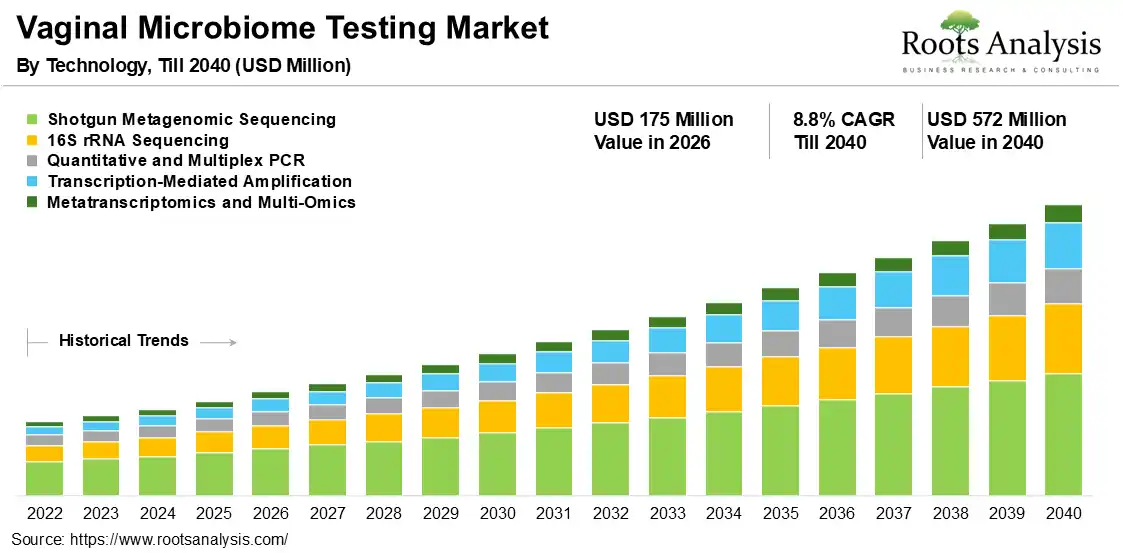
The global vaginal microbiome testing market is expected to rise from USD 175 million in 2026 to reach USD 572.0 million by 2040, growing at a CAGR of 8.8% over the forecast period 2026 to 2040, driven by molecular diagnostics and convenient self-collection.
See What’s in the Full Report – Request Your Complimentary Insights!
Market Report: Key Takeaways
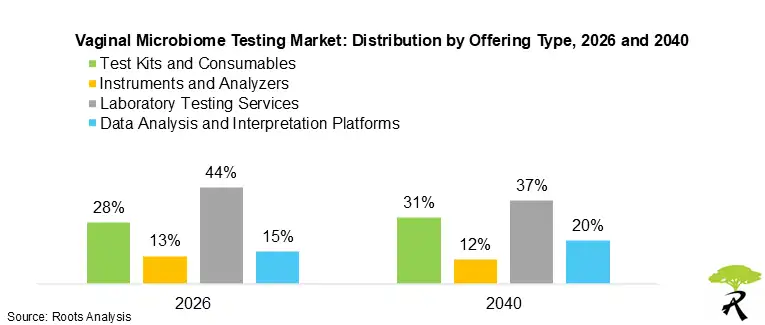
- Based on offering type, laboratory testing services capture 44.0% market share in 2026, whereas data analysis and interpretation platforms register an 11.1% CAGR through 2040, supported by expanding test volumes and automated clinical interpretation.
- Based on technology, quantitative and multiplex PCR capture 35.0% market share in 2026, whereas metatranscriptomics and multiomics register a 13.4% CAGR through 2040, supported by demand for functional microbial and host-response information.
- Based on application, vaginal infection diagnosis captures 46.0% market share in 2026, whereas pregnancy and preterm-birth risk research registers an 11.1% CAGR through 2040, supported by expanding longitudinal obstetric research.
- Based on end user, hospitals and gynecology clinics capture 34.0% market share in 2026, whereas direct-to-consumer and home users register a 12.0% CAGR through 2040, supported by private collection and virtual care.
- Based on geography, North America captures 41.0% market share in 2026, whereas Asia-Pacific registers an 11.2% CAGR through 2040, supported by expanding sequencing capacity and private diagnostic investment.
Vaginal Microbiome Testing Market Outlook
Vaginal microbiome testing shifts from episodic laboratory diagnosis toward integrated platforms combining self-collection, sequencing, interpretation, and virtual care. Laboratory testing services still hold 44.0% of 2026 demand, reflecting concentrated accreditation, quality assurance, and specialist review. Data analysis platforms, at-home vaginal microbiome test kits, and personalized reporting are gaining share. Users seek privacy, faster access, longitudinal tracking, and clinically understandable results beyond conventional vaginitis panels.
Growth now comes from molecular vaginitis testing, reproductive-health applications, and policy recognition of microbiome-based diagnostics. Quantitative and multiplex PCR command 35.0% of technology demand because laboratories value standardized workflows, absolute quantification, and rapid turnaround. In August 2025, the UK government highlighted earlier, more accurate, and personalized diagnosis through vaginal microbiome testing. This policy signal supports clinical validation, research funding, and clearer commercial adoption pathways.
Through 2040, the vaginal microbiome testing market will remain high-growth at an 8.8% CAGR. Growth will shift toward metatranscriptomics, multi-omics, automated interpretation, and point-of-care testing. Metatranscriptomics and multi-omics will grow at 13.4%, the fastest technology rate. In May 2026, Evvy launched EvvyAI using data from more than 100,000 tests to support vaginal-health guidance. Long-term growth remains strong, although evidence quality, regulation, and reimbursement will shape commercial winners across markets.
Vaginal Microbiome Testing Market Dynamics
Vaginal Microbiome Testing Market Drivers
Clinical demand increasingly favors molecular vaginitis testing that distinguishes bacterial vaginosis, Candida, Trichomonas, and broader microbial patterns within actionable workflows. Vaginal infection diagnosis captures 46.0% of 2026 applications, while hospitals and gynecology clinics hold 34.0% of end-user demand. Quantitative and multiplex PCR lead technology adoption at 35.0% because rapid turnaround and standardized quantification support treatment decisions. Private self-collection and virtual care further widen access beyond clinic-based sampling.
Vaginal Microbiome Testing Market Restraints
Clinical adoption remains constrained by uneven evidence linking microbiome profiles with treatment selection, recurrence prevention, fertility outcomes, and pregnancy risks. Centralized laboratory testing still represents 66.0% of 2026 settings because contamination controls, accreditation, bioinformatics, and specialist interpretation remain difficult to reproduce. Broad sequencing panels can also generate findings without established clinical action. These limitations slow reimbursement, complicate physician confidence, and separate research-grade discovery from scalable diagnostic use.
Vaginal Microbiome Testing Market Opportunities
At-home self-collection creates the clearest expansion opportunity by combining privacy, prepaid logistics, repeat testing, and remote treatment pathways. Direct-to-consumer and home users will grow at 12.0% through 2040, while at-home testing reaches the same rate. In June 2025, Organon and Evvy connected microbiome-guided bacterial vaginosis diagnosis with same-day prescription access through Evvy’s United States platform. Similar integrated models can convert test results into care rather than standalone information.
Vaginal Microbiome Testing Market Challenges
Competitive advantage increasingly depends on translating complex microbial data into reproducible, clinically understandable outputs across diverse populations. Shotgun metagenomic sequencing will gain share, while metatranscriptomics and multi-omics grow at 13.4%, raising computational and interpretation requirements. Companies must manage vaginal swab collection and stabilization, laboratory quality, longitudinal comparability, and secure data handling within one workflow. Failure at any step can weaken diagnostic confidence, increase operating costs, and limit partnerships with clinics or fertility centers.
Vaginal Microbiome Testing Market Size Estimation Methodology
- As a starting point, the assessment fixed a narrow commercial boundary for the vaginal microbiome testing market. It included profiling tests, molecular vaginitis panels, self-collection products, laboratory services, interpretation platforms, and enabling sequencing workflows. Company product pages and clinical laboratory test menus separated commercial offerings from general microbiome research, supportive care, and unrelated gynecological diagnostics. This boundary prevented double counting across tests, instruments, services, and software.
- Moving forward, the research reconciled demand signals across 22 credible market and industry sources. The review compared laboratory service activity, molecular panel availability, self-collection adoption, sequencing usage, clinical study activity, and regulatory submission counts. Government reviews and official company disclosures helped validate whether identified technologies had reached commercial use, remained research-focused, or were approaching point-of-care deployment. Conflicting category labels were normalized into one consistent segmentation.
- Building on this, the model triangulated historical market values with bottom-up indicators from commercial test availability and laboratory participation. Offering shares reflected where revenue accrues across consumables, instruments, services, and interpretation platforms. Technology shares considered installed molecular workflows, sequencing accessibility, turnaround requirements, and relative clinical use. Application, end-user, and testing-setting estimates were cross-checked so each dimension independently summed to 100.0%.
- Drawing upon these, segment forecasts applied different adoption curves rather than one uniform market growth rate. Faster curves covered multi-omics, automated interpretation, pregnancy research, direct-to-consumer use, at-home collection, and Asia-Pacific expansion. Slower curves reflected mature laboratory services, established PCR workflows, centralized testing, and regions with weaker commercialization infrastructure. Clinical evidence, reimbursement readiness, sequencing capacity, digital-health adoption, and private diagnostic investment shaped each curve.
- The projected value was then calculated annually through 2040 using the reconciled 8.8% compound growth path. Segment values combined their base-year shares with individual CAGRs, allowing gains in shotgun metagenomic sequencing, multi-omics, interpretation platforms, and home testing. The model checked that yearly segment totals remained aligned with the overall forecast. Sensitivity review focused on regulatory timing, clinical adoption, and the pace of consumer migration from centralized testing.
- Finally, the outputs were tested against company launches, partnerships, funding events, government reviews, and regulatory submissions dated from 2025 onward. These events served as directional checks rather than direct revenue inputs. Share movements also had to match integrated telehealth access, rising AI interpretation, fertility research, and investment in faster point-of-care panels. The final forecast favors conservative, internally consistent assumptions over unsupported precision.
Vaginal Microbiome Testing Market Share Insights
Market Share by Technology
According to our analysis, quantitative and multiplex PCR lead because laboratories value lower costs, rapid turnaround, absolute quantification, and standardized workflows. In December 2025, Roche launched its CE-marked cobas BV/CV PCR assay for bacterial vaginosis and candida vaginitis.
Metatranscriptomics and multi-omics grow fastest because RNA, metabolites, and host-response markers add context beyond microbial abundance. In January 2025, Cmbio expanded its multi-omics software and artificial intelligence infrastructure through the Eagle Genomics asset acquisition.
Market Share by End User
Hospitals and gynecology clinics lead because they control symptomatic patient flow, prescribing, reimbursement, and follow-up care. In June 2026, bioMérieux submitted its 20-minute multiplex PCR vaginitis panel for FDA clearance and CLIA waiver.
Direct-to-consumer and home users grow fastest as privacy, convenience, telehealth, and repeat testing reduce access barriers. In June 2026, Tiny Health incorporated a menopause metric into its at-home vaginal microbiome testing results for older users.
Want Information on Specific Region / Segment?
Regional Analysis: North America Leads the Market and Asia-Pacific is Likely to Register Higher CAGR
Presently, North America leads through mature molecular diagnostic infrastructure, accredited laboratories, capital availability, and established digital-health distribution. Specialized companies also combine home collection, certified testing, telehealth consultation, and prescription access within integrated platforms. In June 2025, Organon and Evvy expanded microbiome-guided bacterial vaginosis care through Evvy’s United States testing and telehealth platform.
On the contrary, Asia-Pacific grows fastest as sequencing capacity, private diagnostics, digital-health adoption, and localized women’s-health demand expand. Regional companies will increasingly combine lower-cost laboratory operations with artificial intelligence, bioinformatics, and personalized-health distribution. In May 2025, India-based MapmyGenome acquired Microbiome Insights, adding a CAP-accredited laboratory, microbial sequencing assets, and bioinformatics capabilities.
Market Ecosystem Analysis
Within the 21-company scope, nine Tier 1 leaders anchor broad activity, while seven specialists and five emerging entrants occupy narrower positions. Platform convergence dominates, as Bio-Me combined quantitative qPCR profiling with Pelvic Relief’s distribution and clinical channels in June 2025.
The strongest commercial force is test-to-care integration, exemplified by Evvy’s June 2025 prescription pathway with Organon. Advantage is shifting toward validated self-collection and actionable interpretation, matching the MHRA’s August 2025 priorities.
- In March 2025, Evvy added fertility insights to its vaginal microbiome test.
- In June 2025, Evvy and Organon made XACIATO available through Evvy for eligible bacterial vaginosis patients.
- In May 2026, Tiny Health said sales rose 2,000% within 48 hours following a viral social post.
- An August 2025 study found Cepheid’s Xpert Xpress MVP usable across trained and untrained point-of-care operators.
- In April 2025, Quest reported strong demand for vaginitis self-collection at its patient service centers.
- In June 2025, Bio-Me and Pelvic Relief launched a UK vaginal microbiome test using highly parallel qPCR.
- An April 2025 study compared Daye’s diagnostic tampon with clinician-collected and self-collected vaginal swabs for HPV.
Startup Companies and their Key Highlights
- Tiny Health
- Event type: Commercial demand surge
- Month and year: May 2026
- Market implication: The reported sales spike accelerates direct-to-consumer adoption but raises clinical-evidence and interpretation expectations.
- Daye
- Event type: Peer-reviewed collection-device evaluation
- Month and year: April 2025
- Stated purpose: Compare the diagnostic tampon with clinician-collected and self-collected vaginal swabs for high-risk HPV detection.
- Market implication: The study supports tampon-based collection, lowering sampling friction for at-home vaginal screening and microbiome assessment.
- Pelvic Relief
- Event type: Partnership and vaginal microbiome test launch
- Month and year: June 2025
- Strategic partner: Bio-Me AS
- Stated purpose: Commercialize a qPCR-based test quantifying more than 50 bacterial and fungal vaginal targets.
- Market implication: The launch strengthens European access through home users, healthcare professionals, fertility clinics, and wellness providers.
- Visby Medical
- Event type: Financing round
- Funding amount: Approximately USD 55 million, with potential funding reaching USD 65 million
- Month and year: June 2025
- Lead investor: Catalio Capital Management
- Stated purpose: Accelerate the launch and distribution of its FDA-authorized at-home Women’s Sexual Health Test.
- Market implication: Rapid, instrument-free PCR raises speed, regulatory, and treatment-connectivity benchmarks for North American at-home vaginal testing.
- YON E Health
- Event type: Pre-seed funding
- Funding amount: EUR 250,000
- Month and year: November 2025
- Lead investor: PMK-Group
- Stated purpose: Develop an at-home device measuring vaginal pH and basal body temperature for reproductive-health monitoring.
- Market implication: The device advances longitudinal monitoring adjacent to microbiome testing, particularly fertility and infection-risk applications.
Vaginal Microbiome Testing Market Trends / Opportunities
Shotgun Metagenomics and Multi-Omics Expanding Differentiated Testing Portfolios
Shotgun metagenomic sequencing will increase from 24.0% of technology demand in 2026 to 31.0% by 2040. Its broader organism coverage supports differentiated reports and personalized vaginal health testing beyond targeted panels. In February 2026, Evvy added six bacterial vaginosis microbial subtypes after analyzing more than 100,000 samples. Larger datasets can strengthen classification advantages and customer retention.
Metatranscriptomics and multi-omics will grow at 13.4%, the fastest technology rate, because functional signals add context beyond microbial abundance. In January 2025, Cmbio acquired Eagle Genomics assets to expand scalable multi-omics software and artificial intelligence capabilities. Providers combining wet-laboratory depth with vaginal microbiome bioinformatics can compete on interpretation quality rather than test breadth alone.
At-Home Collection and Virtual Care Reshaping Vaginal Microbiome Testing Market Access
At-home self-collection will gain from 16.0% of testing settings in 2026 to 24.0% by 2040. Standardized swabs, prepaid logistics, and remote care reduce geographic and scheduling barriers. In June 2025, Organon and Evvy linked home microbiome testing with bacterial vaginosis diagnosis and same-day prescription access. Integrated care pathways can raise conversion and repeat use.
Direct-to-consumer and home users will expand at 12.0%, outpacing hospitals, laboratories, fertility centers, and academic users. In June 2026, Tiny Health added a menopause metric to at-home vaginal microbiome results for older users. Segment-specific interpretation can broaden lifetime customer value while helping smaller providers avoid direct competition with high-throughput clinical laboratories.
AI Interpretation and Longitudinal Data Strengthening Vaginal Microbiome Testing Market Differentiation
Automated interpretation will become more valuable as test volumes rise and longitudinal datasets become harder to review manually. Data analysis and interpretation platforms will grow at 11.1% through 2040. In May 2026, Evvy launched EvvyAI using data from more than 100,000 vaginal microbiome tests. Proprietary datasets can create defensible guidance systems and lower reporting costs.
Outcome evidence increasingly supports competition based on care impact, not only organism detection. In August 2025, Evvy reported that 75.5% of more than 1,000 patients experienced symptom relief, while bacterial vaginosis recurrence reached 30%. Companies that connect microbial findings with longitudinal symptoms and treatment pathways can improve clinical credibility and partnership value.
Fertility and Pregnancy Research Opening Higher-Growth Clinical Applications
Fertility microbiome testing will gain relevance as clinics investigate associations between vaginal communities and in vitro fertilization outcomes. In May 2025, Evvy began a clinical study with multiple fertility clinics to assess those relationships. Providers that generate reproducible fertility evidence can access specialist channels and support differentiated clinical partnerships.
Pregnancy and preterm-birth risk research will grow at 11.1%, supported by longitudinal obstetric datasets and potentially preventable risk signals. In October 2025, Evvy linked its expanding dataset with research into preterm-birth prevention and pregnancy biomarkers. Commercial progress will depend on validation that converts exploratory associations into clinically actionable risk assessment.
Your Business is Unique – Why Shouldn’t Your Report Be?
Market Access Considerations
Clinical Evidence and Actionable Interpretation
Clinical evidence determines whether a microbiome profile becomes a reimbursable diagnostic, fertility service, or consumer wellness report. Broad sequencing can identify diverse organisms, but unclear treatment relevance limits physician adoption and payer support. In August 2025, Evvy reported 75.5% symptom relief among more than 1,000 patients, with 30% bacterial vaginosis recurrence. Competitors need comparable outcome evidence to secure clinical partnerships and defend premium interpretation. This requirement raises evidence costs and favors platforms with longitudinal datasets.
Laboratory Accreditation and Quality-Control Infrastructure
Laboratory accreditation and contamination control strongly influence which providers can scale comprehensive sequencing and quantitative PCR services. Centralized laboratories hold 66.0% of 2026 testing settings because specialist processing and bioinformatics remain difficult to decentralize. In May 2025, MapmyGenome acquired Microbiome Insights, adding a CAP-accredited laboratory, microbial sequencing assets, and bioinformatics capabilities. Established quality systems shorten commercialization timelines and strengthen confidence among clinics, researchers, and partners. Smaller entrants may require laboratory partnerships before entering regulated clinical channels.
Clearance and Point-of-Care Deployment
Regulatory clearance shapes whether rapid vaginitis panels can move from centralized laboratories into clinics and near-patient settings. Point-of-care testing will grow at 10.4%, but developers must prove analytical performance within simplified workflows. In June 2026, bioMérieux submitted its 20-minute multiplex PCR vaginitis panel for FDA clearance and a CLIA waiver. Successful clearance can expand placement, while delayed review preserves advantages for established laboratory networks. Regulatory strategy therefore directly affects capital needs, launch timing, and distribution reach.
Integration of Testing, Telehealth, and Prescription Access
Care-pathway integration determines whether at-home results produce treatment, referrals, or only informational reports. Self-collection reduces access barriers, yet stand-alone testing can lose value when users cannot interpret findings or obtain appropriate care. In June 2025, Organon and Evvy linked microbiome-guided bacterial vaginosis diagnosis with same-day prescription access. Providers combining testing, telehealth, and treatment navigation can scale faster and compete beyond laboratory accuracy alone. This model also improves follow-up continuity and creates stronger referral relationships.
How Stakeholders Benefit from the Key Focus Areas of Our Vaginal Microbiome Testing Market Report
Demand for molecular vaginitis testing, self-collection, and personalized interpretation is making vaginal microbiome testing commercially urgent. The report connects technology adoption, segment economics, regional growth, clinical evidence, and access constraints. These findings support portfolio, investment, partnership, and commercialization decisions through 2040.
- Unmet Needs and Market Gaps in Vaginal Microbiome Testing Market: The analysis identifies gaps between broad microbial detection and clinically actionable treatment guidance. It compares unmet needs across infection diagnosis, fertility assessment, pregnancy research, personalized health, and home collection. Product teams can use these findings to prioritize evidence generation, target underserved applications, and avoid undifferentiated sequencing offers.
- Funding and Venture Investment Opportunities in Vaginal Microbiome Testing Market: The report maps funding signals against technology maturity, clinical evidence, and scalable delivery models. It highlights higher-growth areas such as multi-omics, interpretation platforms, pregnancy research, direct-to-consumer use, and point-of-care testing. Corporate development teams and investors can assess where capital supports defensible datasets, regulatory progress, laboratory capacity, or integrated care. This comparison separates scalable opportunities from early demand alone.
- Technology Innovation and Adoption Trends: Technology benchmarking compares quantitative PCR, transcription-mediated amplification, 16S rRNA sequencing, shotgun metagenomics, and emerging multi-omics workflows. It shows which technologies gain share, where interpretation complexity rises, and why automated reporting matters. Laboratory directors and technology leaders can select platform investments, bioinformatics capabilities, and development priorities aligned with expected adoption curves.
- Vaginal Microbiome Testing Market Competitive Landscape and Industry Analysis: The competitive assessment separates integrated at-home platforms, specialist sequencing providers, clinical laboratories, molecular assay companies, and enabling technology suppliers. It evaluates their roles without treating ecosystem presence as verified revenue leadership. Strategy and business development teams can identify direct rivals, adjacent partners, white-space positions, and acquisition candidates. The mapping clarifies positions across the vaginal microbiome testing competitive landscape.
- Mapping Strategic Partnerships and Ecosystem Synergies: Partnership mapping shows how test developers combine laboratories, collection products, telehealth, fertility clinics, software, and prescription access. It distinguishes partnerships that expand distribution from those that strengthen evidence or technology depth. Commercial leaders can use this structure to shortlist partners, define complementary capabilities, and design collaborations. These choices move users from sample collection toward actionable care.
- Vaginal Microbiome Testing Market CAGR and Growth Trends: The forecast explains the 8.8% overall CAGR through 2040 and the different growth paths beneath it. It compares share changes across offerings, technologies, applications, users, testing settings, and regions. Finance, planning, and market-entry teams can prioritize faster-growing segments, test assumptions against slower categories, and allocate resources using consistent annual forecasts.
Vaginal Microbiome Testing Market: Scope of the Report
| Key Report Attributes | Details | |
| Forecast Period | Till 2040 | |
| Market Size 2026 | USD 175.0 Million | |
| Market Size 2040 | USD 572.0 Million | |
| CAGR (Till 2040) | 8.8% | |
| Segments Covered |
|
|
| Geographical Regions Covered |
|
|
| Key Sections Covered |
|
|
Market Segmentation
The Vaginal Microbiome Testing Market report presents an in-depth analysis, highlighting the capabilities of various stakeholders, based on different segments, such as offering type, technology, application, end user, testing setting, geographical regions, and leading players.
By Offering Type
- Test kits and Consumables
- Instruments and Analyzers
- Laboratory Testing Services
- Data Analysis and Interpretation Platforms
By Technology
- Shotgun Metagenomic Sequencing
- 16S rRNA Sequencing
- Quantitative and Multiplex PCR
- Transcription-Mediated Amplification
- Metatranscriptomics and Multi-Omics
By Application
- Vaginal Infection Diagnosis
- Reproductive and Fertility Assessment
- Pregnancy and Preterm-Birth Risk Research
- Personalized Vaginal Health Management
- Gynecological Disease and Biomarker Research
By End User
- Hospitals and Gynecology Clinics
- Diagnostic Laboratories
- Fertility Centers
- Academic and Research Institutions
- Direct-To-Consumer and Home Users
By Testing Setting
- Centralized Laboratory Testing
- Point-Of-Care Testing
- At-Home Self-Collection
By Geographical Regions
- North America
- US
- Canada
- Mexico
- Rest of North America
- Europe
- Austria
- Belgium
- Denmark
- France
- Germany
- Ireland
- Italy
- Netherlands
- Norway
- Russia
- Spain
- Sweden
- Switzerland
- UK
- Rest of Europe
- Asia-Pacific
- China
- India
- Japan
- Singapore
- South Korea
- Rest of Asia-Pacific
- Latin America
- Argentina
- Brazil
- Chile
- Colombia
- Venezuela
- Rest of Latin America
- Middle East and Africa (MEA)
- Egypt
- Iran
- Iraq
- Israel
- Kuwait
- Saudi Arabia
- UAE
- Rest of MEA
- Rest of the World


