report-pricing-dollar

mRNA Therapeutics Market Size, Share, Trends, Industry Analysis Report

mRNA Therapeutics Market by Target Indication (Non-Small Cell Lung Cancer, Melanoma, Muscle-Invasive Urothelial Carcinoma, Propionic Acidemia, and Cystic Fibrosis) and Geographical Regions (North America, Europe and Asia-Pacific) – Trends and Forecast, 2027-2035

  • Lowest Price Guaranteed

  • Slides
    267

  • Last Updated
    July 2026

  • View Count
    5753

Market Size

The mRNA therapeutics market, valued at USD 201 million in 2027, is projected to reach USD 2,023 million by 2030 and USD 9,988 million by 2035 (this represents the opportunity only for those mRNA therapeutics that are developed for non-COVID applications).
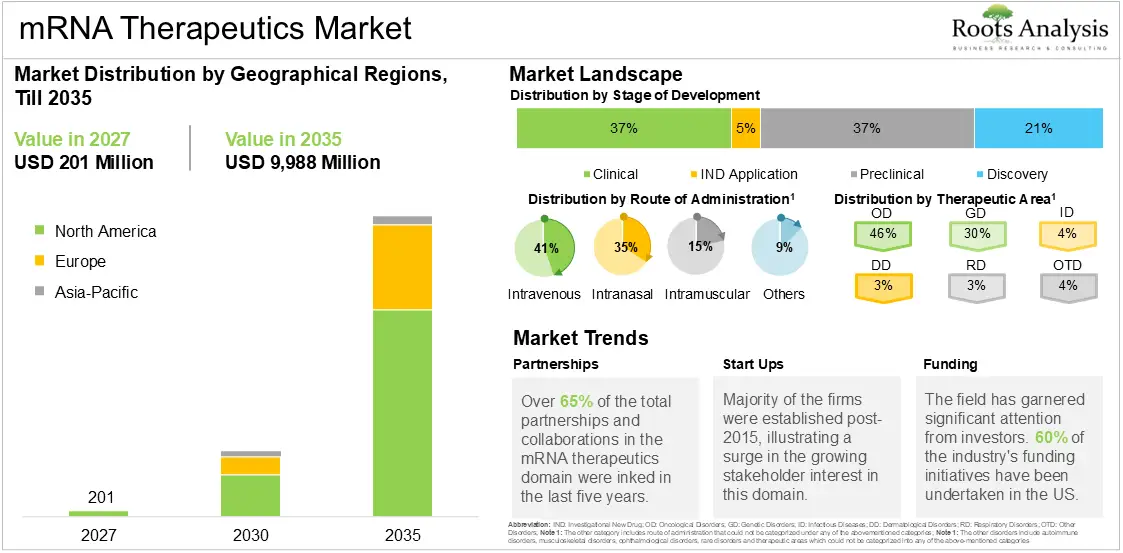
Global mRNA Therapeutics Market Growth, 2027 to 2035

To learn more about this report, request a free sample copy

Market Report: Key Takeaways

  • In terms of target indication, non-small cell lung cancer is anticipated to capture the majority of the revenue share by 2035.
  • In terms of geographical regions, North America is expected to hold largest market share by 2035.

Market Overview

mRNA therapeutics represent a transformative advancement in modern medicine, leveraging messenger ribonucleic acid to enable intracellular expression of therapeutic proteins within patient cells. Unlike traditional therapies that rely on externally manufactured proteins or small molecules, mRNA-based approaches instruct the body to transiently produce specific proteins, offering a highly flexible and programmable platform. This technology enables rapid development timelines, precise targeting of disease pathways, and scalable manufacturing, positioning it as a promising solution across a wide range of therapeutic areas.

The mRNA therapeutics landscape is evolving beyond its early validation phase towards a diversified pipeline spanning oncology, rare genetic disorders, and emerging regenerative medicine applications. A key area of focus is cancer immunotherapy, where mRNA is being utilized to encode tumor-associated antigens, immune modulators, or personalized neoantigens to stimulate targeted anti-tumor immune responses. In parallel, significant progress is being made in protein replacement therapies for rare diseases, where mRNA therapeutics can transiently restore expression of proteins that are deficient or dysfunctional.

Additionally, applications in cardiovascular, metabolic, and autoimmune diseases are gaining traction, reflecting the platform’s broad therapeutic potential. Notably, in January 2026, Acuitas Therapeutics acquired a majority stake in RNA technologies & therapeutics to combine RNA construct optimization with lipid nanoparticle (LNP) delivery expertise, reflecting a broader industry trend toward vertical integration to accelerate development timelines and improve therapeutic efficacy. While only a limited number of mRNA therapeutics have reached regulatory approval to date, the field is witnessing sustained investment and strategic collaborations aimed at accelerating development and commercialization. In the post-pandemic era, the focus has shifted towards long-term therapeutic applications beyond infectious diseases, driving broader adoption of mRNA platforms.

Leading mRNA Therapeutics and Developers

Therapeutic Developer YoE HQ (Country) Phase of Development Route of Administration Target Indication
mRNA-4157 Moderna 2010 US Phase III Intramuscular Non-Small Cell Lung Cancer
BNT111 BioNTech 2008 Germany Phase II Intravenous Melanoma
LUNAR®-CF Arcturus Therapeutics 2013 US Phase II Intranasal Cystic Fibrosis
RCT1100 Recode Therapeutics 2015 US Phase II Intranasal Primary Ciliary Dyskinesia

Abbreviations: YoE: Year of Establishment; HQ: Headquarters

Recent Developments in mRNA Therapeutics Market

  • In June 2026, Moderna announced plans to expand mRNA production capacity in Germany. The strategy aims to leverage existing infrastructure and potentially collaborate with the German government, reflecting ongoing investment in scaling mRNA therapeutics manufacturing capabilities and strengthening its European footprint.
  • In June 2026, BioNTech announced the acquisition of CureVac for $1.25 billion, aiming to expand proprietary mRNA platform capabilities and oncology pipeline. The acquisition consolidates expertise in mRNA-based therapeutics to enhance innovation, scale manufacturing, and expand global competitiveness in the mRNA therapeutics market.
  • In May 2026, BioNTech collaborated with Boehringer Ingelheim to evaluate combination therapies in small cell lung cancer, incorporating its investigational portfolio, including immunotherapies and mRNA-based approaches.

mRNA Therapeutics Market Trends

  • Partnerships and Collaborations: The market is experiencing a notable increase in partnership and collaboration activities. For example, in January 2026, Moderna entered into a collaboration agreement with Recordati with an aim to advance the development and commercialization of their investigational propionic acidemia therapeutic, mRNA-3927. Additionally, several other companies are actively engaging in strategic collaborations to strengthen research capabilities and support the progression of clinical trials.
  • Funding and Investments Analysis: Funding in the mRNA therapeutics domain has increased significantly over the past few years, reflecting growing interest of investors in this domain. This sustained influx of capital is enabling companies to expand research pipelines, accelerate development timelines, and move more candidates toward commercialization. A notable example is Reprogram Biosciences, which in May 2026 secured USD 6 million in seed funding to advance its mRNA-based in situ cell reprogramming approach designed to transform tumors into antigen-presenting sites and trigger robust systemic antitumor immune responses.
  • Clinical Trial Analysis: The mRNA therapeutics market is growing rapidly, with over 10% of the total mRNA development pipeline currently in late-stage (Phase III) clinical trials, indicating strong clinical maturity and progress toward commercialization. About 70% of development activity is driven by Moderna and BioNTech.
  • Patent Analysis: There has been a significant surge in patent activity within the mRNA therapeutics domain in the last five years, underscoring the rapid pace of innovation in the post-pandemic era. This upward trend reflects increasing efforts by companies to protect novel technologies, driven by the broad applicability of mRNA across multiple therapeutic areas.
  • Big Pharma Analysis: Large pharmaceutical companies like Pfizer, Sanofi, and Bayer are working with smaller mRNA-focused companies to grow their capabilities. Among these, Pfizer has emerged as a leading participant in such partnerships, followed by Sanofi, which has also expanded its presence through strategic acquisitions, including Translate Bio. These companies are actively focusing on the development of novel vaccines and therapeutic solutions leveraging mRNA technology.

Industry Experts on mRNA Therapeutics Market

The mRNA therapeutics market is poised for remarkable transformation and sustained growth in the coming years.

Stephane Bancel (Chief Executive Officer, Moderna), stated, “We believe mRNA represents a transformative new class of medicines with the potential to address a wide range of diseases. What makes this platform so powerful is not just its rapid development capability, but its scalability across multiple therapeutic areas ranging from infectious diseases to oncology and rare genetic disorders. As the technology matures and manufacturing infrastructure expands, mRNA therapeutics are poised to become a cornerstone of modern medicine, driving sustained growth in the global biopharmaceutical market.”

Discussions with multiple stakeholders in this domain influenced the opinions and insights presented in this study. The market report includes detailed transcripts of interviews conducted with the following individuals:

  • Business Development Manager, Mid-sized Organization, Australia
  • Senior Director Business Development, Large Organization, Belgium
  • Team Leader, Large Organization, South Korea

In addition, the market report includes transcripts of the following other third-party discussions:

  • Director of Advanced Drug Delivery, Mid-sized Organization, UK
  • Deputy Director, Mid-sized Organization, US
  • Co-founder and Chief Executive Officer, Mid-sized Organization, Germany
  • Co-founder, Large Organization, Germany
  • Chief Executive Officer, Large Organization, US
  • Chief Executive Officer, Mid-sized Organization, US
  • Chief Executive Officer, Large Organization, US
  • Chief Executive Officer, Large Organization, Italy
  • President, Mid-sized Organization, Switzerland
  • Medical Professional, Large Organization, Germany

Market Drivers

  • Rising Prevalence of Chronic and Complex Diseases: The increasing global burden of oncological disorders, genetic disorders, and autoimmune conditions is driving demand for advanced therapeutic solutions, including targeted therapies, biologics, and gene-based treatments.
  • Advancements in Precision Medicine and Targeted Therapies: Growing adoption of personalized medicine leveraging biomarkers, genomics, and molecular diagnostics accelerates the development and uptake of highly specific therapeutics with improved efficacy and enhanced safety profiles.
  • Rising Investment and Collaborations: The mRNA therapeutics domain is witnessing robust funding from both public and private sectors. Governments, venture capital firms, and pharmaceutical companies are heavily investing in mRNA R&D and manufacturing infrastructure. Strategic partnerships between biotech firms and large pharmaceutical companies are accelerating clinical development and commercialization. These collaborations help in sharing technological expertise, reducing development risks, and expanding global reach, thereby fueling market growth.

Market Segmentation Analysis

Market Share by Type of Target Indication

Based on the type of target indication, the market is segmented into non-small cell lung cancer, melanoma, muscle-invasive urothelial carcinoma, propionic acidemia and cystic fibrosis.

According to our market forecast and detailed clinical pipeline analysis, the non-small cell lung cancer sub-segment is projected to capture the highest market share by 2035. This growth is primarily driven by the high global prevalence of NSCLC and the substantial unmet clinical need, particularly among patients diagnosed at advanced stages. The complex tumor heterogeneity associated with NSCLC makes it an ideal candidate for immunotherapy-driven approaches and personalized vaccines, especially those leveraging mRNA platforms, thereby accelerating pipeline innovation and expanding oncology applications. Further, increasing adoption of emerging technologies such as next-generation sequencing and AI-enabled biomarker discovery is enabling precision-targeted therapies. These advancements are strengthening the commercial potential of mRNA-based therapeutics in NSCLC.

Additionally, a robust competitive landscape, characterized by active participation from biotech innovators and large pharmaceutical companies, is fostering rapid advancements through strategic collaborations, partnerships, and licensing agreements. The evolving regulatory landscape, including expedited approval pathways and supportive frameworks for breakthrough therapies, is also playing a critical role in accelerating clinical development timelines. Concurrently, rising investment opportunities from both public and private sectors are fueling research and development activities, reinforcing confidence in the segment’s long-term viability.
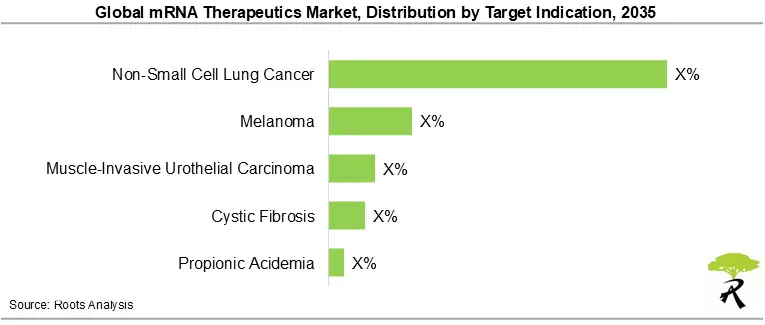
Global mRNA Therapeutics Market, Distribution by Target Indication, 2035

North America Dominates the mRNA Therapeutics Market

On the basis of geographical region, the global market is distributed across North America, Europe and Asia-Pacific.

Among these regions, North America will continue to dominate mRNA therapeutics market till 2035. This dominance is primarily driven by the region’s well-established mRNA technology ecosystem, characterized by the presence of pioneering companies with clinically validated platforms and extensive product development capabilities. The region has advanced expertise in lipid nanoparticle delivery systems, which play a critical role in enhancing mRNA stability, cellular uptake, and targeted delivery. North American companies hold significant intellectual property and technical know-how in LNP formulation and scalable manufacturing processes, thereby creating high barriers to entry for emerging players.

In addition, the successful large-scale commercialization of mRNA-based COVID-19 vaccines has led to the development of robust, GMP-compliant manufacturing infrastructure across the region. These facilities are now being leveraged to support an expanding pipeline of mRNA therapeutics across diverse therapeutic areas, including oncology, rare and genetic disorders.

Asia-Pacific: An Emerging Growth Spot

While North America continues to dominate the market, Asia-Pacific is projected to register the highest CAGR during the forecast period among all geographical regions. This accelerated growth is primarily driven by increasing investments in biotechnology and life sciences, particularly in countries such as China, India, South Korea, and Japan, where governments are actively supporting mRNA research, vaccine development, and domestic manufacturing capabilities. The region is witnessing a rapid expansion of biopharmaceutical infrastructure, including the establishment of mRNA production facilities, technology transfer partnerships, and innovation hubs.

mRNA Therapeutics Market: Scope of the Report

Key Report Attributes Details
Forecast Period Till 2035
Market Size 2027 USD 201 Million
Market Size 2035 USD 9,988 Million
CAGR (2027-2035) 63%
Key Players Profiled
  • Moderna
  • BioNTech
  • Providence Therapeutics
  • Suzhou Abogen Biosciences
  • CureVac
  • RNAimmune (Subsidiary of Sirnaomics)
  • Turn Biotechnologies
  • Arcturus Therapeutics
  • Walvax
(A complete list of companies captured is available in the report)
Segments Covered
  • Target Indication
  • Geographical Regions
Excel Data Packs
(Complimentary)
  • Market Landscape
  • Product Competitiveness Analysis
  • Partnership and Collaboration Analysis
  • Funding and Investment Analysis
  • Go-No-Go Framework
  • Patent Analysis
  • Big Pharma Initiatives
  • Clinical Trial Analysis
  • FDA Approval Strategies
  • Start Up Health Indexing
  • Market Forecast and Opportunity Analysis
PowerPoint Presentation
(Complimentary)
  • Available
Customization Scope
  • 15% Free Customization

Market Segments

Based on the research, we have segmented the mRNA Therapeutics Market into target indication and geographical regions.

By Target Indication

  • Non-Small Cell Lung Cancer
  • Melanoma
  • Muscle-Invasive Urothelial Carcinoma
  • Propionic Acidemia
  • Cystic Fibrosis

By Geographical Regions

  • North America
    • US
    • Canada
  • Europe
    • Germany
    • France
    • Italy
    • UK
    • Spain
    • Rest of Europe
  • Asia-Pacific
    • China
    • Japan
    • Australia
    • South Korea

Frequently Asked Questions

What are mRNA therapeutics?

mRNA therapeutics are medicines that use messenger RNA (mRNA) to instruct the body’s cells to produce specific proteins, which can help prevent, treat, or cure diseases.

What does mRNA do to the human body?

mRNA carries genetic instructions from DNA to cells, guiding them to produce specific proteins needed for normal body functions.

What are the key growth drivers for mRNA therapeutics market?

The key value drivers of this market include a significant rise in the overall healthcare expenditure, increased R&D spending, a surge in mRNA-focused research initiatives and mRNA technological advancements in the recent past.

Which region has the highest share of mRNA therapeutics industry?

Presently, North America is likely to capture highest share of the market.

How big is mRNA therapeutics market?

The market size is estimated to be worth USD 201 million in 2027.

What is the outlook for mRNA therapeutics market?

The market size is estimated to reach USD 9,988 million by 2035.

Who are the leading players in mRNA therapeutics market?

Arcturus Therapeutics, BioNTech, CureVac, Moderna, Providence Therapeutics, RNAimmune (subsidiary of Sirnaomics), Suzhou Abogen Biosciences, Turn Biotechnologies and Walvax.