Market Size
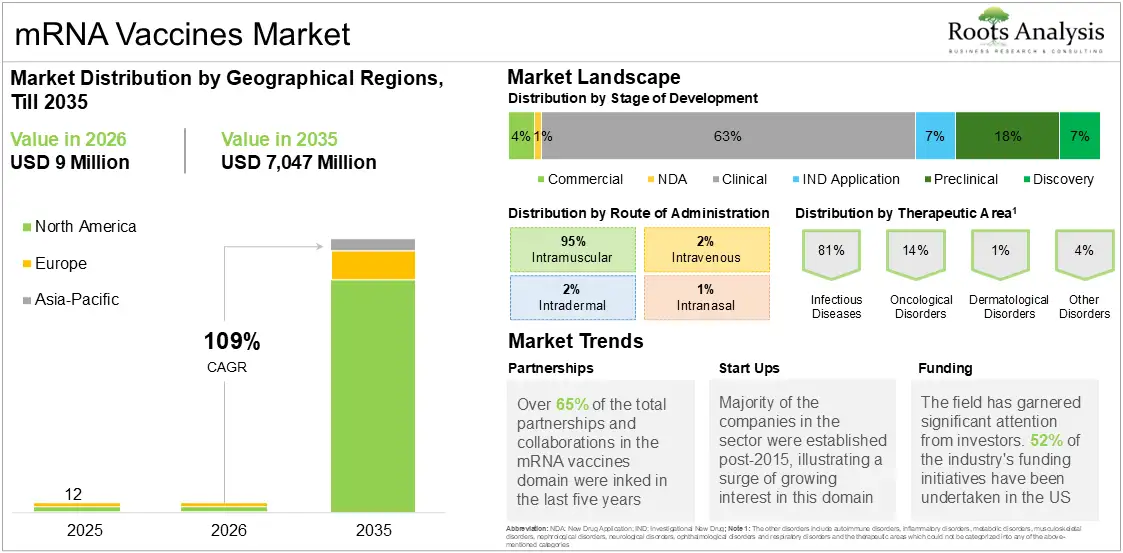
The mRNA vaccines market, valued at USD 12 million in 2025, is projected to reach USD 9 million in 2026 and USD 7,047 million by 2035 (this represents the market opportunityonly for mRNA vaccines developed for non-COVID applications).
To learn more about this report, request a free sample copy
Market Report: Key Takeaways
- In terms of target indication, the respiratory syncytial virus (RSV) infection is likely to capture the majority of the current revenue share.
- In terms of geographical regions, North America accounts for the largest market share, primarily due to increased research activity in vaccines and therapeutics, along with favorable regulatory pathways supporting vaccine approvals.
Market Overview
The mRNA vaccines market represents a transformative advancement in preventive medicine and the broader landscape, utilizing messenger ribonucleic acid (mRNA) to instruct host cells to produce specific antigens and elicit targeted immune responses. This platform enables rapid vaccine design, mRNA manufacturing scalability, faster development cycles, and greater adaptability, making it particularly suited for addressing both established and emerging infectious diseases.
The landscape is increasingly shifting beyond its initial pandemic-driven applications toward a broader mRNA vaccine and therapeutics market, supported by expanding clinical pipelines and commercialization opportunities. A key area of focus is RSV, where mRNA-based vaccine candidates are actively progressing to address significant unmet medical needs, particularly among older adults and high-risk pediatric populations.
Alongside RSV, research efforts are expanding into other respiratory and viral infections, including influenza and cytomegalovirus, demonstrating the growing applications of mRNA medicine across infectious disease prevention and immunotherapy markets.
The growing clinical pipeline highlights strong momentum, with multiple mRNA vaccine candidates advancing through mid- and late-stage clinical trials across diverse indications. In addition, more than 100 mRNA-based candidates are currently being developed for cancer-related indications, underscoring the industry's expansion beyond infectious diseases.
This progress underscores increasing confidence in the platform’s immunogenicity, safety profile, and ability to support rapid antigen updates in response to evolving viral strains. The Vaccine Development Companies Landscape spans organizations advancing antigen design, formulation, clinical evaluation and scalable production. The post-pandemic period has witnessed a normalization of demand. However, continued innovation in non-COVID vaccine development, manufacturing optimization, and enabling technologies is expected to support sustained market growth and long-term commercial expansion. At present, a limited number of mRNA vaccines on the market have achieved regulatory approval, while several others are progressing through advanced clinical evaluation stages. Across related applications, lipid CMO supplies specialist development and manufacturing capacity for lipids used in advanced formulations.
Overall, the mRNA vaccine manufacturing landscape is entering a phase of rapid expansion, characterized by diversification into high-impact infectious diseases and increasing focus on next-generation preventive solutions beyond pandemic-driven demand.
Leading mRNA Vaccines and Developers
| Vaccines |
Developer |
YoE |
HQ (Country) |
Phase of Development |
Route of Administration |
Target Indication |
| Comirnaty |
BioNTech |
2008 |
Germany |
Commercial |
Intramuscular |
COVID-19 |
| mResvia |
Moderna |
2010 |
United States |
Commercial |
Intramuscular |
Respiratory Syncytial Virus Infection |
| LUNAR®-mRNA-1010 |
Moderna |
2010 |
United States |
Phase III |
Intramuscular |
Influenza |
Abbreviations: YoE: Year of Establishment; HQ: Headquarters
Recent Development
- In June 2026, FDA indicated Moderna’s mRNA-based influenza vaccine (mFlusiva) showed superior efficacy in adults aged 50–64 compared to standard flu shots, and is currently under regulatory review. The application includes traditional and accelerated approval pathways, marking potential first approval of an mRNA seasonal flu vaccine in the US.
- In June 2026, CEPI announced up to USD 50 million in funding support for Moderna’s mRNA-based Ebola vaccine candidate targeting the Bundibugyo strain during an active outbreak in Africa.
- In April 2026, Moderna received authorization from the European Commission for its mRNA combination vaccine targeting influenza and COVID-19 (mRNA-1083), marking the first approved dual respiratory mRNA vaccine globally.
mRNA Vaccines Market Trends
- Partnerships and Collaborations: The mRNA vaccines domain is witnessing a surge in partnership and collaboration activities. For example, in February 2026, Moderna entered into a collaboration with the Mexican government with the aim of supporting the development of a local mRNA ecosystem. As part of this partnership, Moderna will supply its respiratory vaccine portfolio and facilitate technology transfer to enable domestic production of mRNA-based vaccines. Further, various companies are actively pursuing strategic collaborations to enhance their research capabilities and facilitate the advancement of clinical trials.
- Funding and Investment Analysis: Investment in the mRNA vaccine domain has grown substantially in recent years, underscoring increasing investor interest in its preventive healthcare potential. This continuous capital inflow is supporting the expansion of vaccine development programs, enhancing mRNA manufacturing capabilities, and expediting the progression of candidates through clinical trials toward commercialization.
- Clinical Trial Analysis: mRNA vaccines are rapidly emerging as a pivotal modality across multiple therapeutic areas, supported by a growing number of clinical trials assessing their safety and efficacy. Further, over 50% of these trials have been completed, reflecting steady progress in clinical development. Additionally, over 70% of the trials evaluating mRNA vaccines and therapeutics have been managed or funded by industry players. Among them, Moderna has emerged as the most active participant, leading in the number of trials conducted, followed by BioNTech and Sanofi.
- Patent Analysis: The mRNA vaccines sector has experienced strong growth in patent filings, with over 1,060 patents filed or approved worldwide. This shows that innovation has increased rapidly, particularly following the COVID-19 pandemic. Companies are increasingly focused on protecting their intellectual property, as mRNA technology has broad applications across multiple therapeutic areas, including infectious diseases and cancer.
- Big Pharma Analysis: Large pharmaceutical companies like Pfizer, Sanofi, and Bayer are working with smaller mRNA-focused companies to grow their capabilities. Among these, Pfizer is leading in such efforts, followed by Sanofi, which significantly expanded its mRNA portfolio.
Industry Experts on mRNA Vaccines Market
Discussions with multiple stakeholders in this domain influenced the opinions and insights presented in this study. The market report includes detailed transcripts of interviews conducted with the following individuals:
- Business Development Manager, Mid-sized Organization, Australia
- Senior Director Business Development, Large Organization, Belgium
- Team Leader, Large Organization, South Korea
In addition, the market report includes transcripts of the following third-party discussions:
- Director of Advanced Drug Delivery, Mid-sized Organization, UK
- Deputy Director, Mid-sized Organization, US
- Co-founder and Chief Executive Officer, Mid-sized Organization, Germany
- Co-founder, Large Organization, Germany
- Chief Executive Officer, Large Organization, US
- Chief Executive Officer, Mid-sized Organization, US
- Chief Executive Officer, Large Organization, US
- Chief Executive Officer, Large Organization, Italy
- President, Mid-sized Organization, Switzerland
- Medical Professional, Large Organization, Germany
Market Drivers
- Rapid Development and High Adaptability of mRNA Technology: mRNA platforms allow vaccine design and modification in a much shorter time compared to traditional approaches. This flexibility enables quick response to emerging viral strains and new pathogens, making it highly attractive for pandemic preparedness and seasonal vaccine updates.
- Advancements in Delivery Systems and Manufacturing Scalability: Improvements in lipid nanoparticle delivery systems and large-scale manufacturing capabilities have significantly enhanced the stability, efficiency, and commercial viability of mRNA vaccines. This has reduced production bottlenecks and made large-volume global distribution more feasible.
- Increasing Investment and Strategic Collaborations: There has been a substantial increase in funding from governments, private investors, and pharmaceutical companies toward mRNA vaccine development. Strategic collaborations between biotech firms and large pharmaceutical companies are accelerating research, mRNA manufacturing, and commercialization capabilities. These partnerships help share expertise, reducing development risks, and expanding global reach. The strong financial backing and collaborative ecosystem are key drivers supporting sustained market expansion.
- Expanding Applications Beyond Infectious Diseases: mRNA vaccines are increasingly being explored for applications in oncology, rare diseases, and personalized medicine. Their ability to encode specific antigens makes them highly suitable for targeted therapies, such as cancer vaccines. Ongoing clinical trials and positive early-stage results are encouraging broader adoption in multiple therapeutic areas. This diversification of applications is significantly enhancing the long-term growth potential of the mRNA vaccines domain.
- Shift from Conventional mRNA to Next-Generation RNA Platforms: The RNA landscape is witnessing a transition from conventional mRNA technologies toward next-generation RNA platforms, including self-amplifying RNA, circular RNA, and trans-amplifying RNA systems. These advanced modalities offer improved stability, enhanced protein expression, and reduced dosing requirements. As a result, they are increasingly being explored to overcome the limitations of first-generation mRNA therapies and expand applications beyond infectious diseases.
Market Segmentation Analysis
Which Type of Indication Accounts for the Largest Share in the mRNA Vaccines Market?
Based on the type of target indications, the market is divided into RSV infection, metastatic / R / R head and neck cancer, influenza, norovirus acute gastroenteritis and mononucleosis.
According to our market projection, the influenza segment is expected to account for the majority of the overall market share. This can be attributed to the efficiencies of mRNA vaccines that directly solve long-standing scientific and commercial limitations unique to flu vaccines.
Influenza viruses undergo rapid antigenic drift and occasional shift, requiring frequent reformulation of vaccines. mRNA vaccines also enable ultra-fast sequence-to-product turnaround, allowing manufacturers to update antigen sequences much closer to the flu season, significantly improving strain match accuracy and real-world vaccine effectiveness.
Additionally, influenza offers a recurring, high-volume annual demand cycle, unlike most infectious diseases where vaccination is one-time or infrequent. This aligns well with mRNA’s scalable, cell-free manufacturing model, where the same production infrastructure can be reused each season with only sequence modifications.
As a result, manufacturers benefit from stronger operating leverage and improved margin potential. Furthermore, mRNA vaccines generate robust immune responses by inducing antibodies that block viral infection while also activating immune cells that eliminate infected cells.
Regional Analysis: Which Regions are Showing the Fastest Growth in the mRNA Vaccines Industry?
North America Market: Securing the Highest Share
On the basis of geographical regions, the global market is distributed across North America, Europe and Asia-Pacific.
Among these regions, North America is expected to dominate the mRNA vaccines market by 2035 and is expected to grow at the fastest rate. This can be attributed to the region’s early and concentrated investment in mRNA platform development, particularly by leading biotech firms such as Moderna and Pfizer in collaboration with BioNTech. These companies built strong proprietary mRNA design, lipid nanoparticle delivery systems, and large-scale manufacturing capabilities well before the COVID-19 pandemic, giving them a significant first-mover advantage. Within this workflow, lipid nanoparticle manufacturing produces delivery systems that protect and transport mRNA, RNAi and other nucleic-acid payloads.
In addition, substantial funding and risk-sharing support from the US government under initiatives like Operation Warp Speed accelerated clinical development, regulatory approvals, and commercialization timelines specifically for mRNA-based products.
The region also benefits from a highly advanced regulatory framework led by the FDA, which established clear and rapid approval pathways for novel mRNA technologies, alongside a strong ecosystem of contract manufacturing organizations, cold-chain logistics infrastructure, and academic research institutions specializing in RNA biology.
Furthermore, North America holds a dominant position in intellectual property related to mRNA synthesis, modification, and delivery technologies, creating high entry barriers for competitors.
mRNA Vaccines Market: Scope of the Report
| Key Report Attributes |
Details |
| Historical Trend |
Since 2023 |
| Forecast Period |
Till 2035 |
| Market Size 2026 |
USD 9 Million |
| Market Size 2035 |
USD 7,047 Million |
| CAGR (Till 2035) |
109% |
| Key Players Profiled |
- Arcturus Therapeutics
- BioNTech
- CureVac
- Ethris
- Gennova Biopharmaceuticals
- Immorna
- Innovac Therapeutics
- Kernal Biologics
- Moderna
- Providence Therapeutics
- Recode Therapeutics
- Rejuvenation Technologies
- RNACure
- RNAimmune
- Strand Therapeutics
- Suzhou Abogen Biosciences
- Turn Biotechnologies
- Walvax
(A complete list of companies captured is available in the report) |
| Segments Covered |
- Target Indication
- Geographical Regions
|
Excel Data Packs
(Complimentary) |
- Market Landscape
- Product Competitiveness Analysis
- Partnership and Collaboration Analysis
- Funding and Investment Analysis
- Go/No-Go Framework
- Patent Analysis
- Big Pharma Initiatives
- Clinical Trial Analysis
- FDA Approval Strategies
- Startup Health Indexing
- Market Forecast and Opportunity Analysis
|
PowerPoint Presentation
(Complimentary) |
|
| Customization Scope |
|
Market Segments
Based on the research, we have segmented the mRNA Vaccines Market into target indication and geographical regions.
By Target Indication
- RSV Infection
- Metastatic / R / R Head and Neck cancer
- Influenza
- Norovirus Acute Gastroenteritis
- Mononucleosis
By Geographical Regions
- North America
- Europe
- Germany
- France
- Italy
- UK
- Spain
- Rest of Europe
- Asia-Pacific
- China
- Japan
- Australia
- South Korea
Frequently Asked Questions
What are mRNA vaccines?
mRNA vaccines are a class of vaccines that utilize messenger ribonucleic acid (mRNA) to deliver genetic instructions into host cells, enabling them to synthesize a specific antigenic protein derived from a pathogen.How many mRNA vaccines are on the market?
Presently, seven mRNA vaccines are commercially available in the market.How big is the mRNA vaccines market?
The mRNA vaccines market size is estimated to be worth USD 9 million in 2026.What is the outlook for the mRNA vaccines market?
The mRNA vaccines market size is estimated to reach USD 7,047 million by 2035.What are the top three vaccine companies?
Arcturus Therapeutics, BioNTech and Moderna.Which region has the highest share of mRNA vaccines industry?
Presently, North America is likely to capture the largest share of the mRNA vaccines market.