
Lowest Price Guaranteed
Pages
324
Last Updated
August 2026
View Count
5742
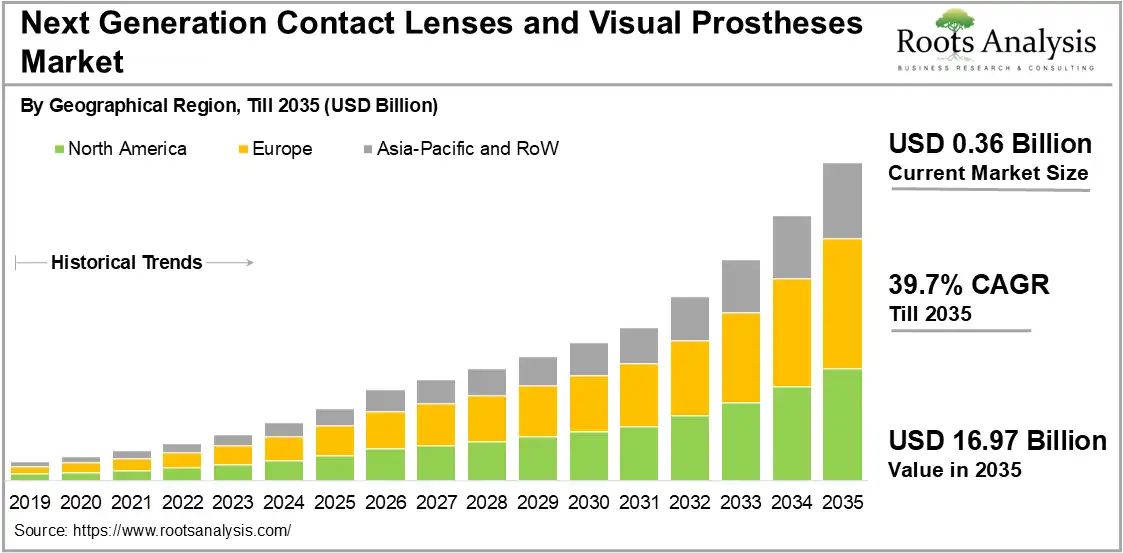
The global next generation contact lenses and visual prostheses market, valued at USD 0.36 billion in 2024, is projected to reach USD 0.60 billion in 2025 and USD 16.97 billion by 2035, representing a CAGR of 39.7% during the forecast period.
To learn more about this report, request a free sample copy
Given the growing incidences of refractive disorders such as myopia, hyperopia, presbyopia and astigmatism, there is a surge in the demand for corrective lenses. Earlier, convention eye-vision corrective glasses were used by the person with refractive disorders. Traditional glasses offer limited field of vision, become foggy during rains or dew times and have adaptive issues. Moreover, the tight eye-glasses frames put pressure on the nose bridge and side of the head, which may leave marks. Considering these concerns, industrial leaders have come up with contact lenses that are thin, easy to wear, offer a wide field of vision and do not get affected by environmental conditions.
It is important to highlight here that contact lenses are primarily used for correcting vision associated disorders. However, with growing unmet requirements in the ophthalmology field and availability of advanced biomaterials, contact lenses have been widely adopted wide range of applications in the field of ophthalmology. Furthermore, in a recent report of America Academy of Ophthalmology, it is reported that nearly 2 million eye injuries occur annually in the United States that result into vision loss.
Conventionally, eye drops have been in practice to delivery drug into the eye these eye drops pose several challenges such as low bioavailability and limited exposure to the pharmacological interventions. In order to address the growing incidences of eye injuries, the key industrial leaders have developed therapeutic contact lenses for treating / protecting the eye.
With therapeutic contact lenses, industrial leaders are exploring contact lenses for disease monitoring and diagnosing purposes. For instance, diabetes and glaucoma are the two potential disease conditions that may impact vision of an individual. Therefore, pharmaceutical players are currently developing contact lenses to track and access various disease associated parameters. It is important to highlight here that 10 contact lenses have already received approval from the FDA for purposes other than vision correction. Some of the notable examples include CUSTOMFLEX® ARTIFICIALIRIS (aniridia, 2018) and EYEMATE® (glaucoma, 2017).
It is worth highlighting here that there is a rapid increase witnessed in the number of blind and partially sighted individuals. According to the National Eye Institute, nearly 1.3 million people are blind, while 2.9 million individuals have poor vision, in the US. It is estimated that the number of cases of blindness and poor vision are likely to reach 2.2 million and 5 million, respectively, by 2030, in the same region. Driven by growing concern, several industrial leaders are focusing on the development of next generation vision restoration solutions such as bionic eyes (visual prosthetics) with fitted contract lenses. Visual prosthetics leverage electrical pulses for the stimulation of optic nerves which aid in vision restoration.
Driven by the ongoing demand for next generation contract lenses and visual prosthetics, several industrial leaders are taking strategic initiatives, making considerable investments in the field. Owing to the ongoing investments and increasing technological advances, in the coming years, we believe that the next generation contact lenses and visual prostheses market will grow at a significant pace as more novel solutions clear clinical evaluation and get commercialized.
The market study report provides comprehensive information about the industrial leaders who are presently active across various segments of the industry as mentioned in the table below.
| Key Report Attribute | Details | |
| Historical Trend | Since 2019 | |
| Forecast Period | Till 2035 | |
| Market Size 2035 | USD 16.97 Billion | |
| Type of Contact Lenses |
|
|
| Target Indication |
|
|
| Type of Modality |
|
|
| Type of Design |
|
|
| Type of Material |
|
|
| Type of Distribution Channel |
|
|
| Key Geographical Region |
|
|
| Key Companies Profiled |
|
|
| PowerPoint Presentation Complimentary) |
Available | |
| Customization Scope | 15% Free Customization | |
| Excel Data Packs (Complimentary) |
|
|
The key objective of next generation contact lenses and visual prostheses market report is to provide a detailed market analysis in order to estimate the existing market size, market share, market growth, market trends, market value, market forecast, market outlook, statistics and future opportunity for next generation contact lenses and visual prostheses market during the forecast period. Based on parameters, such as the target patient population, price of the lenses and the likely adoption rates, we have provided an informed estimate on the likely evolution of the market over the forecast period till 2035.
The market report also features a detailed segmentation of the present and anticipated future opportunity based on type of contact lenses (corrective lenses, therapeutic lenses, drug-eluting lenses, diagnostics / monitoring lenses, and visual prosthesis), targeted indication (diabetes, glaucoma, age-related macular degeneration, retinitis pigmentosa and aniridia), by modality (reusable and disposable), by design (toric, multifocal, and spherical), by material (silicon hydrogel, gas permeable (orthokeratology and scleral), and others), by distribution channel (ophthalmologists, retail stores, and online stores) and geographical region. In order to account for future uncertainties and to add robustness to our model, we have provided three market forecast scenarios, namely the conservative, base and optimistic scenarios, which represent different tracks of the industry's evolution.
The opinions and insights presented in this market research report were also influenced by discussions conducted with several stakeholders in next generation contact lenses and visual prostheses market. The market report features detailed transcripts of interviews conducted with following:
All actual figures have been sourced and analyzed from publicly available information forums and primary research discussions. Financial figures mentioned in this market research report are in USD, unless otherwise specified.
Based on the contact lenses type, the next generation contact lenses and visual prostheses market is segmented into corrective lenses, therapeutic lenses, drug-eluting lenses, and diagnostics / monitoring lenses, and visual prosthesis.
According to our projection, diagnostics / monitoring lenses currently occupies the highest share of the market and is poised to capture 64.28% of the overall revenue share by 2035. This can be attributed to the high demand for continuous monitoring of ocular health. However, drug eluting lenses will grow at a higher CAGR during the forecast period. This lucrative growth potential is due to the increasing demand for advanced eye disorder correction solution for the geriatric population.
This segment highlights the distribution of next generation contact lenses and visual prostheses market on the basis of target indication into diabetes, glaucoma, age-related macular degeneration, retinitis pigmentosa and aniridia.
According to our projection, diabetes occupies the highest share, capturing 52.45% of overall revenue share by 2035. This highest growth is due to the increasing prevalence of diabetes that may result in diabetic retinopathy. However, in the long run glaucoma will grow at a higher CAGR during the forecast period. This can be attributed to the rising complications associated with glaucoma that demand specialized corrective lenses for the treatment.
Based on the type of modality, the next generation contact lenses and visual prostheses market is segmented into reusable and disposable.
According to our projection, currently disposable lenses account for the highest share of the market. This highest growth is due to the fact that disposable lenses require minimal maintenance and hygienic, reducing the risk of infection that may occur due to frequent touching to lenses for re-wearing. Driven by the growing usage of disposable lenses for aesthetic appearance of the eyes, this segment will continue to grow at a higher CAGR during the forecast period. However, reusable lenses also cater to a significant amount of share owing to the preferences for vision correction and daily usage.
This segment highlights the distribution of next generation contact lenses and visual prostheses market on the basis of design into toric, multifocal, and spherical.
According to our projection, spherical lens occupies the highest share of the market. This dominance is due to the fact that spherical lenses are widely used for treating myopia (nearsightedness), hyperopia (farsightedness) and presbyopia (age-related farsightedness). Furthermore, these spherical lenses are easy to wear, comfortable and do not cause dryness in the eyes. However, in the long run, toric lenses will grow at a higher CAGR during the forecast period. These lenses are useful for the correction of astigmatism problems that may arise due to variation in the cornea's curvature. Additionally, toric lenses also help to protect the eyes from blue light that comes from digital devices.
Based on the type of material, the global next generation contact lenses and visual prostheses market is segmented into silicone hydrogel, gas permeable (orthokeratology and scleral), and others.
According to our projection, silicone hydrogel accounts for the highest share of the market. This can be attributed to the numerous benefits offered by silicone hydrogel-based lenses such as flexibility, maintaining optimal oxygen level and preventing eye dryness for longer time. However, in the future, gas permeable will grow at a higher CAGR during the forecast period. In parallel, orthokeratology lens uses specially designed gas-permeable lenses to reshape the cornea temporarily and manage myopia.
This segment highlights the distribution of global next generation contact lenses and visual prostheses market into ophthalmologists, retail stores, and online stores based on distribution channel.
According to our projection, retail stores occupy the highest share of the market. This dominance is due to the fact that contact lenses provided by the retailers are cost-effective and offer a wide range of discounts. However, in the future online stores will grow at a higher CAGR owing to the ease of shopping.
Based on the geographical region, the global next generation contact lenses and visual prostheses market is distributed into North America, Europe, Asia-Pacific and the rest of the world.
According to our projection, Europe accounts for the highest share of the market, capturing 41% of overall revenue share. This highest growth rate is primarily due to the growing adoption of contact lenses for vision correction in this region and ongoing research on contact lenses to diversify its application. Furthermore, the increasing demand for disposable contact lenses to enhance patient comfort is the key reason for high growth share.
However, in the future, the next generation contact lenses and visual prostheses market in Asia-Pacific will grow at a higher CAGR during the forecast period. This lucrative growth potential is primarily due to the increasing disposable income and rising awareness about the importance of eye health.
The "Next Generation Contact Lenses and Visual Prostheses Market, Till 2035" market report features an extensive study of the current market landscape, market size, market share, market growth, market trends, market value, market forecast, market outlook, statistics and future opportunities of the next generation contact lenses and visual prostheses market. The market research report lays emphasis on the novel products and technologies that are being developed for the treatment of ocular disorders, which generally cause severe visual impairment or blindness.
Currently, the market landscape features the presence of several industrial and non-industrial leaders who are currently engaged in this industry for the development of wide range of contact lenses. With an aim of increasing the adoption rate of contact lenses, the key players of the industry are focusing on the development of promotional strategies. In order to leverage a competitive edge, several industrial leaders are taking strategic initiatives such as collaborations and partnerships for the expansion of product portfolio.
Additionally, the introduction of advanced bionic eyes for the treatment of patients with poor vision or vision loss has further provided numerous opportunities for technological advancements in this field. So far, more than 55 ophthalmic products have been developed / currently being developed for targeting various indications as well as diagnostic & monitoring application. As the market leaders continue to explore innovative ophthalmic products, we believe the next generation contact lenses and visual prostheses market will remain competitive throughout the projected period.
Increasing Prevalence of Refractive Errors or Visual Impairment
Visual impairment or refractive error is one of the major drivers propelling the market during the forecast period. It is worth noting here that visual impairment concerns such as presbyopia, age-related macular degeneration, dry eyes and cataracts are affecting geriatric population across the globe. Notably, the aged population may face difficulty in putting eye drops / solutions for treating refractive errors.
Furthermore, the limited bioavailability has surged the demand for advanced contact lenses such as drug eluting lenses for the treatment of refractive errors. Additionally, growing awareness about the importance of eye health and advantages of vision correction has further raised the demand for contact lenses, which is anticipated to be the key driver for the market.
Availability of Alternative Options for Treating Refractive Errors, High Cost and Infection Risk
Although the demand for contact lenses for vision correction has contributed to the growth of the market, there are several challenges that need to be addressed. Some of the potential challenges are the high cost associated with the development of contact lenses particularly specialized lenses such as multifocal lenses, toric lenses and hybrid lenses. The high cost of specialized lenses may limit the widespread adoption of the lenses.
Additionally, the availability of surgical treatment such as LASIK surgery and corrective eyeglasses may further restrict the market growth during the forecast period. It is important to highlight here that poor handling of contact lenses during wearing and removing may pose a risk of infection. Moreover, the intense competition in the market may create a challenge for the industrial leaders to drive innovation and stay competitive in the emerging landscape.
Advancements in Lens Technology, Growing Demand for Disposable Cosmetic Lenses, and Increasing Focus on Eye Health
Technology advancements in contact lenses such as the development of silicon hydrogel lenses that allow supply of oxygen to cornea and blue light filtering lenses are the key growth factors of the market. Furthermore, the growing demand for disposable cosmetic lenses to enhance aesthetic appearance across the globe is the key growth factor of the market.
Additionally, with an increasing focus on eye health and increasing development of antimicrobial coating lenses, moisture retention of lenses has further contributed towards the growth of the next generation contact lenses and visual prostheses market. It is important to highlight here that the development of bionic eyes has catered to the attention of industrial leaders to drive more advancements in this field.
The global next generation contact lenses and visual prostheses market is currently valued at USD 0.36 billion. Driven by the growing demand for advanced vision correction contact lenses, the market is expected to reach USD 16.97 billion by 2035, anticipated to grow at a higher CAGR of 42% during the forecast period.
Examples of key technologies that are being developed to expand the functionality of contact lenses (which have also been profiled in this market report; the complete list of contact lens companies and their respective technologies is available in the full report) include EyePrintPROTM, Interscatter Communication Technology, Leo Lens Technology, Nanowafer Technology and the Diamond EyeTM Technology. This market report includes an easily searchable excel database of all the contact lens companies providing next generation contact lenses / technologies, worldwide.
Examples of key companies engaged in next generation contact lenses and visual prostheses market (which have also been profiled in this market report; the complete list of companies is available in the full report) include ALCON, Bausch + Lomb, CooperCompanies, Contamac, EssilorLuxottica, Euclid Vision Group, HOYA CORPORATION, Johnson & Johnson, Menicon, Novartis AG, SEED, Surgical Vision, STAAR SURGICAL and X-Cel Specialty Contacts.
Several recent developments have taken place in next generation contact lenses and visual prostheses market. We have outlined some of these recent initiatives below. These developments, even if they took place post the release of our market report, substantiate the overall market trends that have been outlined in our analysis.
Amongst other elements, the market research report includes: