
Lowest Price Guaranteed
Pages
232
Last Updated
July 2026
View Count
14933
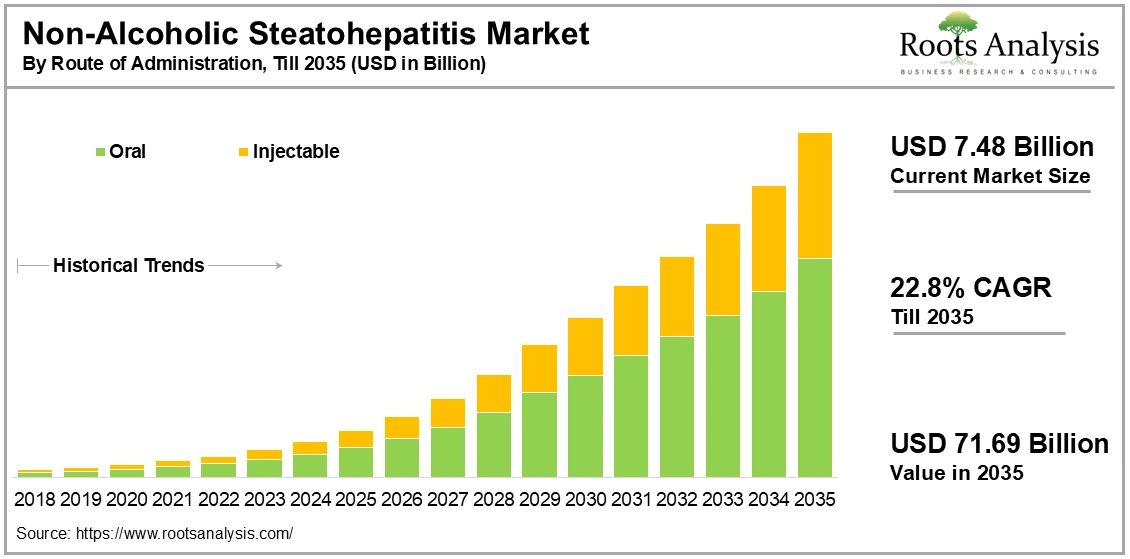
The global non-alcoholic steatohepatitis market, or NASH drugs market, is valued at USD 7.48 billion in 2024 and is poised to reach at USD 71.69 billion by 2035, representing a CAGR value of 22.8% during the forecast period.
To learn more about this report, request a free sample copy
Non-alcoholic steatohepatitis (NASH) is a chronic non-alcoholic fatty liver disease that is characterized by excessive fat deposition and inflammation. Patients with NASH can be symptomless or witness degeneration of hepatocytes along with inflammation. If the condition progresses, it can lead to cirrhosis (irreversible liver damage). Although the exact cause of NASH disease is still unknown, some research confirms that unhealthy eating habits and sedentary lifestyles have increased the chance of developing non-alcoholic fatty liver steatohepatitis. Furthermore, it may also occur due to metabolic syndromes such as high blood pressure, high cholesterol level, and high blood glucose level. More recently, the indication has been renamed to metabolic dysfunction-associated steatohepatitis, or MASH.
According to the National Institute of Health, NASH is one of the leading causes of liver disease globally. Evidently, NASH is currently the second most common factor that leads to liver transplantation in the United States. Driven by the growing incidence of non-alcoholic fatty liver disease, various advanced diagnostic tools and therapeutic treatments are currently being evaluated by the key market players. In order to develop an efficient treatment regimen for non-alcoholic steatohepatitis, researchers are investigating various options, such as off-label therapies, lifestyle modifications, and combinatorial approaches. It is worth highlighting here that patients with non-alcoholic steatohepatitis remain asymptomatic at an early stage, which creates difficulty in diagnosis and treatment. Currently, liver biopsy is considered the reliable option to diagnose non-alcoholic steatohepatitis and the presence of fibrosis. However, only a few patients agree to liver biopsy owing to its invasive nature. Considering the unmet medical requirements, various investigators and industry leaders are exploiting precision medicine to identify prognostic biomarkers, diagnostics biomarkers, and therapeutic drugs to treat patients of NASH on the basis of clinical trials. Owing to the aforementioned challenges and growing research for finding treatment for NASH, we believe that the global market for non-alcoholic steatohepatitis is likely to grow substantially during the forecast period.
The market report covers a comprehensive analysis of various players that are engaged in the industry across various segments, as mentioned in the table below.
| Key Report Attributes | Details | |
| Historical Trend | 2019-2023 | |
| Base Year | 2023 | |
| Forecast Period | 2024-2035 | |
| Market Size 2035 | USD 71.69 billion | |
| Market CAGR | ~22.8% | |
| Distribution by Drug Class |
|
|
| Route of Administration |
|
|
| Distribution by End User |
|
|
| Key Geographical Region |
|
|
| Key Companies Profiled |
|
|
| PowerPoint Presentation (Complimentary) |
Available | |
| Customization Scope | 15% Free Customization | |
| Excel Data Packs (Complimentary) |
Available | |
The key objective of the NASH drugs market report is to provide a detailed market analysis in order to estimate the existing non-alcoholic steatohepatitis market size, market share, market growth, market trends, market value, market forecast, market outlook, statistics, and future opportunity for non-alcoholic steatohepatitis treatment market during the forecast period. The research, analysis, and insights presented in this market research report include potential sales of the drugs in the late stages of development and are expected to launch in the near future. Our opinions and insights presented in this study, were influenced by the discussions that we conducted with experts in this area.
All actual figures have been sourced and analyzed from publicly available information and discussions with industry experts. The figures mentioned in this report are in USD unless otherwise specified.
Based on the type of drug, the NASH market is segmented into Aramchol™, Cenicriviroc®, Elafibranor (Iqirvo®), Lanifibranor™, Obeticholic Acid (Ocaliva®), Vitamin E and Pioglitazone®, Resmetirom (Rezdiffra™), Semaglutide (Ozempic®) and Others. According to our market study, presently obeticholic acid occupies the highest share of the market. This can be attributed to the fact that Vitamin E and Pioglitazone® has shown higher efficacy in reducing liver fibrosis, making it a strong drug candidate available for the treatment of patients with NASH. However, in the long run, semaglutide is expected to show lucrative growth potential as drugs containing this API has shown promising results in clinical trials to treat metabolic conditions.
Based on the route of administration, the global non-alcoholic steatohepatitis market is segmented into oral and injectable. According to our projection, currently oral segment accounts for the highest share of the market, capturing 63.3% of overall revenue share. This can be attributed to the oral therapeutic drugs are easy to administer which significantly improved patient compliance. Owing to the patient preference and growing approval of oral therapeutic drugs, this segment will continue to grow at a higher CAGR during the forecast period.
Based on the end user, the global market is segmented into hospital pharmacy, retail & specialty pharmacy, and others. According to our market study, hospital pharmacies accounts for the highest non-alcoholic steatohepatitis market share. This can be attributed to the fact that hospitals offer advanced diagnostics and treatment capabilities to treat patients with liver diseases. In the coming future, retail & specialty pharmacies will grow at a higher CAGR of 39.42%, which can be driven by the growing demand for NASH drugs for managing disease conditions in outpatient settings.
Based on the key geographical insight, the non-alcoholic steatohepatitis market is distributed across North America, Europe, Asia-Pacific, the Middle East and North Africa, and Latin America. According to our market study, currently North America accounts for the highest share of the market, capturing 79.62% share of the market. This can be attributed to the growing burden of patient with nonalcoholic fatty liver in North American region, which will increase the demand for novel treatment options. According to American Liver Foundation, Non-alcoholic Fatty Liver Disease (NAFLD), now known as metabolic dysfunction-associated steatotic liver disease or MASLD is the most common chronic liver condition in the US. As per their estimates, about 25% of adults in the U.S. have NAFLD, while 5% of adults in the U.S. suffer from NASH.
However, the market for NASH in Asia-Pacific will grow at a higher CAGR driven by the rising awareness of consequences associated with non-alcoholic fatty liver.
“The Global Non-alcoholic Steatohepatitis Market: Industry Trends and Global Forecasts, till 2035” market report features an extensive study of the current market landscape, market size, market share, market growth, market forecast, market outlook and future opportunities of the non-alcoholic steatohepatitis market. Further, the market research report underlines an in-depth analysis of players engaged in evaluating diagnostic procedures and therapeutics drugs to cure patients with NASH.
In March 2024, Rezdiffra (resmetirom), developed by Madrigal Pharmaceuticals, received approval from the FDA for the treatment of adults suffering from noncirrhotic non-alcoholic steatohepatitis (NASH) with moderate to advanced fibrosis (liver scarring). The drug is prescribed to be given along with diet and proper exercise. At the time of receiving approval, this was the first drug for a community of NASH / MASH patients, who have till now managed the indication with lifestyle modifications and off-label use of drugs.
The drug was launched in the US in April 2024 for once daily oral use. Madrigal Pharmaceuticals announced revenues of $14.6 million in 2Q 2024 from sales of Rezdiffra. The drug is currently under review by EMA and approval is expected by mid-2025.
One of the significant factors propelling the non-alcoholic steatohepatitis market is the growing prevalence of metabolic-related disorders such as obesity and diabetes. According to the World Health Organization, nearly 650 million adults, 39 million children, and 340 million teenagers are suffering from obesity. Owing to the unhealthy and sedentary lifestyle, the expected count of individuals with obesity is expected to increase during the upcoming years. These types of metabolic disorders increase the risk of developing non-alcoholic steatohepatitis in people.
The heightened risk of metabolic disorders that result in NASH has led to the development of proactive diagnosing and therapeutic treatment to treat patients with non-alcoholic fatty liver conditions. Driven by the recent approval and adoption of Rezdiffra and ongoing commitment towards identifying treatment of NASH, the non-alcoholic steatohepatitis market is estimated to grow at a steady pace during the forecast period.
The lack of approved therapeutic drugs and the complexity associated with disease pathogenesis create challenges in the identification and development of therapeutic drugs. Further, NASH has a multifactorial nature, which makes it further difficult to understand targeted therapeutics and screening methodologies for the diagnosis of non-alcoholic fatty liver disease. In addition, the high cost related to research on advanced drugs and diagnosis procedures is likely to hinder the market growth during the forecast period. Moreover, the complex guidelines associated with the approval for the NASH drugs and diagnostic procedures restrain the non-alcoholic steatohepatitis market growth.
Pharmaceutical companies and government organizations are engaged in research initiatives for the seamless development of NASH-targeting drugs and diagnostic procedures. It is worth noting here that companies such as Galectin Therapeutics, Inventiva Pharma, Galmed Pharmaceuticals, and Madrigal Pharmaceuticals are racing to develop a novel treatment for patients with non-alcoholic fatty liver disease. However, Madrigal Pharmaceuticals (a leading drug development company) is completely focused on the development of NASH drugs and successfully received approval for its recently developed Rezdiffra. Moreover, in March 2024, Galmed Pharmaceuticals (a clinical-stage biopharmaceutical company for fibrotic and liver diseases) announced the grant of a European patent associated with the utilization of a combination of Resmetirom (MGL-3196) and Aramchol for the treatment of liver fibrosis and NASH / MASH. With the grant of the latest patent, Galmed Pharmaceutical is aiming to extend and strengthen the patent protection of its Aramchol till 2039. Eli Lilly also announced success with its GLP-1 drug, tirzepatide (sold under the brand name Mounjaro and Zepbound for diabetes and obesity) in a mid-stage phase II SYNERGY-NASH trial. The drug helped MASH clearance in 74% of overweight or obese adults with MASH after 52 weeks of once a week subcutaneous injection.
In addition to therapeutic drug discovery, several companies are raising their research efforts to develop advanced NASH biomarkers that aid in accurate diagnosis efficiently. The focus will be on the development of non-invasive or minimally invasive procedures that help in diagnosing NASH without undergoing a biopsy procedure. Examples of diagnostic tools under development include, OWLiver and NIS4. OWLiver is a blood panel under development by OW Metabolomics. NIS4 is another blood-based biomarker test that has been licensed to Labcorp for use in clinical trials. In addition to the blood panels, France based E-Scopics has developed an ultrasound application Hepatoscope® to help with the identification of patients most suited to benefit from Redziffra. As the research on NASH continues, the non-alcoholic steatohepatitis market will grow substantially during the forecast period.
Examples of the key drug developers active in this industry (the complete list of the companies has also been included in the detailed market report) include Conatus Pharmaceuticals, Galmed Pharmaceuticals, Genfit, Gilead Sciences, Intercept Pharmaceuticals, Novo Nordisk, Raptor Pharmaceuticals and Zydus Cadila.
This market report includes an easily searchable excel database of the non-alcoholic steatohepatitis market and future investment opportunities worldwide.
The ‘NASH Drugs Market, Till 2035’ market report provides a comprehensive study of the current market landscape, NASH market size, market share, market growth, market trends, market value, market forecast, market outlook, statistics, and future opportunities of the NASH drugs market. With an expanding NAFLD and NASH population worldwide, there is a growing need for the development of therapeutics in this disease area. NASH is gradually emerging as the leading cause of liver transplants. While the field has garnered interest from several companies, there are no approved therapies to date. It is important to stress that the NASH development pipeline has several promising candidates that are likely to result in many commercial success stories in the foreseen future.
Amongst other elements, the market research report elaborates on the new diagnostic solutions being developed and the upcoming opportunities for different stakeholders. As pharmaceutical companies continue to initiate and expand their research programs in this area, one of the key objectives outlined for this market report is to understand the future potential of the non-alcoholic steatohepatitis treatment market. This is done by analyzing:
Several recent developments have taken place in the field of non-alcoholic steatohepatitis. We have outlined some of these recent initiatives below. These developments, even if they took place post the release of our market report, substantiate the overall market trends that have been outlined in our analysis.