Market Outlook
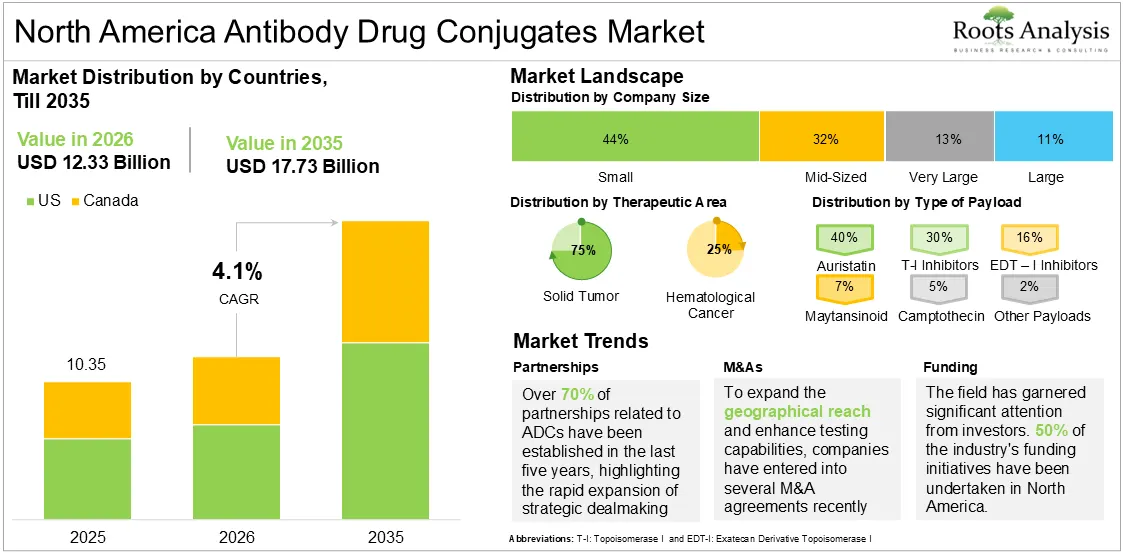
The North America antibody drug conjugates market, valued at USD 10.35 billion in 2025, is projected to reach USD 12.33 billion in 2026 and USD 17.73 billion by 2035, representing a CAGR of 4.1% during the forecast period 2026 to 2035.
To learn more about this report, request a free sample copy
Market Report: Key Takeaways
Market Size & Trends
- Breast cancer holds the largest share, accounting for more than 45% of the current market, while head and neck cancer is expected to register the fastest growth.
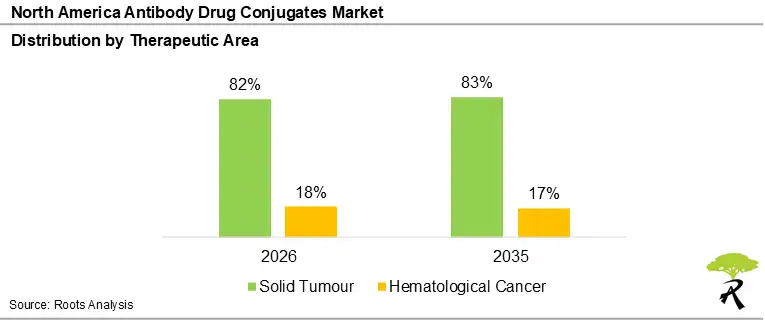
- Solid tumor currently represents the leading segment and is also expected to register the highest growth during the forecast period.
- HER-2 (ERBB2) currently leads the market, while B7-H4 (VTCN1) is expected to be the fastest-growing target segment.
- Valine-citrulline linkers account for around 40% of the current market, while peptide linkers are expected to expand at the highest rate.
- Monomethyl auristatin E (MMAE) holds the leading share, while monomethyl auristatin F (MMAF) is anticipated to register the fastest growth.
- The US accounts for the largest share of the North America antibody drug conjugates market, while Canada is expected to register the fastest growth during the forecast period.
Key Market Statistics
- Market Size in 2026: $12.33 Billion
- Estimated Market Size in 2035: $17.73 Billion
- CAGR (2026-2035): 4.1%
- US: Largest market in 2026
- Canada: Fastest growing region
Market Introduction
ADC (antibody-drug conjugate) therapies combine a target-specific monoclonal antibody, chemical linker and potent payload to selectively deliver cytotoxic agents to antigen-expressing cancer cells. Following target binding and internalization, the payload is released or activated within the cell, enabling more targeted cancer treatment.
Over the years, ADC applications have expanded beyond hematological cancers into breast, lung, ovarian, urothelial, cervical and other solid tumors, with development increasingly moving into earlier lines of treatment. More than 370 ADC candidates had entered clinical development by September 2025, reflecting the rapid expansion and increasing competition within the modality. Breast cancer remains a key area of opportunity, with the American Cancer Society projecting approximately 321,910 new invasive female breast cancer cases in the US in 2026.
Market growth is increasingly driven by advances in ADC design, including improved linkers, drug-to-antibody ratios, payload potency, bystander effects and antibody architecture. Daiichi Sankyo's DXd platform, for instance, uses an exatecan-derived topoisomerase I inhibitor and cleavable tetrapeptide linker, while recent approvals have expanded Enhertu into earlier HER2-positive breast cancer settings.
Despite strong development activity, challenges remain around payload-related toxicity, biomarker selection, manufacturing consistency and high-potency handling. Manufacturing scale-up and supply-chain complexity are also key constraints, with industry estimates suggesting that 70%–80% of ADC portfolios are outsourced. Continued market expansion will therefore depend on improving therapeutic windows, developing predictive biomarkers, enabling scalable manufacturing and navigating regulatory requirements effectively.
Market Segmentation
Based on the research, we have segmented the North America antibody drug conjugates market into target indication, therapeutic area, type of antibody, target antigen, linker, payload / cytotoxin / warhead, type of payload and geographical regions.
- By Target Indication: Breast Cancer, Non-Small Cell Lung Cancer, Ovarian Cancer, Multiple Myeloma, B-Cell Lymphoma, Renal Cancer, Gastric Cancer, Head and Neck Cancer, Hodgkin's Lymphoma, T-Cell Lymphoma, and Other Target Indications
- By Therapeutic Area: Solid Tumor and Hematological Cancer
- By Type of Antibody: Humanized, Human, and Chimeric
- By Target Antigen: HER-2 (ERBB2), FOLR1 (Folate receptor alpha), TROP-2, CD79b, BCMA (TNFRSF17 / BCM), Nectin 4, c-MET, PD-L1, CD30, and Other Antigens
- By Linker: Valine-citrulline, Tetrapeptide-based Linker, Maleimidocaproyl, Succinimidyl-4-(N-maleimidomethyl) cyclohexane-1-carboxylate, Dipeptide Linker, Peptide Linker, Valine-alanine, N-Succinimidyl 4-(2-pyridyldithio)-2-sulfobutanoate (Sulfo-SPDB), Maleimide, and Other Linkers
- By Payload / Cytotoxin / Warhead: Monomethyl auristatin E (MMAE), Camptothecin, Exatecan, Monomethyl auristatin F (MMAF), DM1, DM4, SN-38 / Irinotecan and Other Payloads / Cytotoxins
- By Type of Payload: Auristatin, Topoisomerase I Inhibitors, Exatecan Derivative Topoisomerase I Inhibitor, Maytansinoid, Camptothecin, and Other Types of Payloads
- By Countries: US and Canada
North America Antibody Drug Conjugates Market Key Insights
What Are the Key Drivers of Growth in the North America Antibody-Drug Conjugates Market?
- Expansion of ADCs into earlier lines of treatment is increasing the addressable patient pool: ADC use is expanding into first-line, early-stage and perioperative settings, broadening eligible patient populations and increasing potential treatment duration. Recent approvals of Enhertu, Trodelvy and Padcev are expected to further support market growth.
- Advances in ADC targets and biomarker coverage are expanding solid-tumor opportunities: The identification of actionable targets such as TROP2, HER3, EGFR, B7-H4 and c-Met is expanding ADC development across breast, lung, ovarian, head and neck, endometrial and other solid tumors. Broader biomarker coverage is increasing the number of addressable indications and creating opportunities for targeted therapies and companion diagnostics.
What are the Main Challenges for Market Growth?
- Narrow therapeutic windows and target-dependent toxicity remain key adoption barriers: ADC efficacy is closely linked to antigen expression, linker stability and payload properties, while off-target toxicity can lead to dose reductions or treatment discontinuation. Improving therapeutic windows will be critical for broader use in earlier treatment settings and combination therapies.
- Complex manufacturing creates scale-up and supply constraints: ADC production requires specialized biologic and chemical processes, high-potency containment and stringent quality controls. These requirements increase manufacturing complexity, scale-up challenges and reliance on specialized suppliers, potentially limiting the ability to meet growing commercial demand.
Recent Developments in North America Antibody Drug Conjugates Market
- In August 2026, DualityBio and Genentech entered a global collaboration and licensing agreement to develop next-generation ADCs using the DUPAC novel-payload platform.
- In August 2026, AstraZeneca and Daiichi Sankyo reported positive Phase III DESTINY-Lung04 results for Enhertu in first-line HER2-mutant unresectable or metastatic non-small cell lung cancer.
- In August 2026, Bristol Myers Squibb announced a USD 2.3 billion manufacturing campus in Houston, Texas, designed to manufacture small molecules, biologics and ADCs. The approximately 600,000 square-foot site adds flexible US production capacity for complex oncology medicines.
Industry Experts on North America Antibody Drug Conjugates Market
Driven by efforts to improve the therapeutic index and differentiate an increasingly competitive clinical pipeline, the North America antibody drug conjugates market is shifting toward more sophisticated ADC design and engineering.
Emphasizing the importance of optimizing the complete ADC architecture, Michael Torres (CEO and Co-founder of CrossBridge Bio), stated, "There has been quite a lot of trial and error over the years. It has taken a long time to figure out a way of putting the antibody, the linker and the payload together to achieve a better therapeutic index than chemotherapeutics."
Primary discussions with multiple stakeholders across the ADC value chain informed the qualitative insights presented in this study. The market report includes transcripts from the executives and specialists spanning biotechnology and pharmaceutical companies, CMOs/CDMOs, business development, chemistry, regulatory affairs, R&D and commercial functions, including the following roles:
- Founder and Chief Executive Officer, Mid-sized Company, UK
- Founder and Chief Executive Officer, Small Company, US
- Founder and Chief Executive Officer, Small Company, US
- Co-Founder and Chief Executive Officer, Small Company, France
- President and Chief Executive Officer, Large Company, Italy
- Chief Executive Officer, Leading CMO
- Former Chief Executive Officer, Large Company, US
- President and Executive Director, Very Large Company, Japan
- Executive Director and Chief Scientific Officer, Very Large Company, Japan
- Chief Business Officer and Head of Strategy, Mid-sized Company, US
- Chief Commercial Officer, Mid-sized Company, Switzerland
- Chief Business Officer, Small Company, South Korea
- Former Chief Business Officer, Mid-sized Company, Switzerland
- Vice President, Business Development, Small Company, Netherlands
- Former Vice President and Head of Chemistry, Mid-sized Company, US
- Director, Business Development, Leading CMO
- General Manager, Large Company, Japan
- Former Director of CDMO, Very Large Company, France
- Former Director, Very Large Company, US
- Former Group Product Manager, Very Large Company, US
- Former Head of Bioconjugates Commercial Development, Very Large Company, Switzerland
- Former Site Head, Large Company, US
- Professor, School of Medicine, Very Large Company, UK
In addition, the North America antibody drug conjugates market report includes transcripts of the following other third-party discussions:
- President and Chief Executive Officer, Small Organization, US
- Chief Executive Officer and Co-Founder, Mid-sized Organization, US
- Chief Executive Officer and Co-Founder, Mid-sized Organization, US
- Founder and Chief Technology Officer, Mid-sized Organization, Belgium
- Chief Executive Officer, Mid-sized Organization, Japan
- Chief Executive Officer, Small Organization, US
- President and Co-Founder, Small Organization, US
- Vice President of Cell Technology, Mid-sized Organization, Belgium
- Associate Director, Regulatory Affairs, Mid-sized Organization, US
- Team Leader, Research and Development, Mid-sized Organization, Germany
Market Share Insights
Which Target Indication Accounts for the Largest Share of the North America Antibody Drug Conjugates Market?
- The breast cancer segment currently holds the largest share, accounting for more than 45% due to the maturity of HER2-directed ADCs, expansion of TROP-2 therapies and movement of established ADCs into earlier breast cancer settings.
- The head and neck cancer segment is likely to register the highest growth during the forecast period. A 2026 study of 329 patients with head and neck squamous cell carcinoma found broad expression of ADC-relevant targets, including TROP2, HER3 and EGFR. Growing clinical development, high unmet need and multiple actionable targets could support the adoption of differentiated ADCs across recurrent, metastatic and earlier treatment settings.
Which Therapeutic Area Represents the Biggest Opportunity in the North America ADC Market?
- In 2035, the solid tumor segment is expected to account for the larger share of the North America ADC market, and this trend is unlikely to change during the forecast period.
- This is primarily driven by the segment's broad commercial footprint across breast, lung, ovarian, urothelial, cervical and other cancers. Regulatory activity is also expanding ADC use beyond late-line treatment, with Enhertu moving into earlier HER2-positive breast cancer, Trodelvy entering first-line triple-negative breast cancer, and Padcev expanding into perioperative muscle-invasive bladder cancer in 2026.
Which Target Antigen Accounts for the Largest Share of Market?
- HER-2 (ERBB2) segment currently accounts for the largest share as it benefits from an established diagnostic infrastructure, decades of biomarker-guided treatment and multiple clinically validated ADC products.
- The B7-H4 (VTCN1) segment is likely to register the highest growth during the forecast period. This is supported by its emerging clinical pipeline and relatively small commercial base. Positive early data for GSK's mocertatug rezetecan and BeOne's BG-C9074 in 2026 have further strengthened development activity across ovarian, endometrial and other B7-H4-expressing cancers.
What Makes Valine-Citrulline Linkers the Leading Choice in the North America ADC Market?
- The valine-citrulline linker is currently the leading choice in the market supported by its long commercial history in protease-cleavable ADC designs and established use in MMAE-based conjugates. Its clinical validation is reflected in continued pharmacokinetic research using vcMMAE ADCs as an established therapeutic design class.
- We anticipate the peptide linker to witness a higher CAGR during the forecast period. Growth is being supported by next-generation ADC platforms that require greater systemic stability while preserving efficient payload release within tumors.
Regional Analysis: Which Country Leads the North America Antibody Drug Conjugates Market?
US Market: Largest Market
- The US accounts for the largest share of the North America antibody drug conjugates market, supported by its large oncology patient pool, advanced biomarker-testing ecosystem and strong clinical-trial and regulatory infrastructure. Continued FDA approvals and label expansions are also supporting broader ADC adoption across major cancer indications.
- Canada is expected to register the fastest growth, driven by rising oncology demand, coordinated regulatory reviews and increasing access to innovative ADC therapies. Market expansion will further depend on reimbursement, biomarker-testing capacity and wider adoption beyond specialized oncology centers.
Key Players Profiled in North America Antibody Drug Conjugates Market
The key players covered in the North America antibody drug conjugates market include AbbVie, BeOne Medicines, Elevation Oncology, Eli Lilly and Company, Gilead Sciences, Immunome, Merck & Co., Mersana Therapeutics, Mythic Therapeutics, Pfizer, Sutro Biopharma, Zymeworks.
Report Deliverables and Customization
The report includes complimentary Excel data packs covering market landscape analysis, clinical trials analysis, partnerships and collaborations, funding and investment analysis, patent analysis, grants analysis and market sizing and forecast analysis. A complimentary PowerPoint presentation is available, and up to 15% customization can be requested subject to data availability.
Report Authorship
Author(s): Simriti Gupta and Pemba Lahmo. Both authors contribute to Roots Analysis's healthcare and pharma research practice, covering biologics discovery, development, and manufacturing market studies.
Independence and Non-Affiliation
This report is an independent work of market research and analysis published by Roots Analysis. It is not affiliated with, sponsored by, endorsed by, or reviewed by AbbVie, BeOne Medicines, Elevation Oncology, Eli Lilly and Company, or any other pharmaceutical company, drug brand, or regulatory body referenced within it. No content in this report should be construed as medical advice. Roots Analysis maintains its own proprietary primary research process, and does not receive compensation from any company profiled within the report, in exchange for inclusion or favorable characterization.
Frequently Asked Questions
What are antibody drug conjugates?
ADCs are targeted therapeutics that combine an antibody with a chemical linker and a potent payload, enabling cytotoxic activity to be directed toward cells expressing a selected antigen.How big is the North America antibody drug conjugates market?
The North America antibody drug conjugates market is estimated to be worth USD 12.33 billion in 2026.What is the projected growth of the North America antibody drug conjugates market?
The market is projected to grow at a CAGR of 4.1% during 2026-2035 and reach USD 17.73 billion by 2035.Which country leads the North America antibody drug conjugates market?
The US currently accounts for the largest share of the North America antibody drug conjugates market, while Canada is expected to register the fastest growth.Who are the leading companies in the North America antibody drug conjugates market?
Leading companies profiled in the report include AbbVie, ADC Therapeutics, Astellas Pharma, AstraZeneca, BeOne Medicines, BioNTech, Daiichi Sankyo, Duality Biologics, Elevation Oncology, Eli Lilly and Company, Genmab, Gilead Sciences, GSK, Immunome, Merck & Co., Mersana Therapeutics, Mythic Therapeutics, Pfizer, Roche / Genentech, Sutro Biopharma and Zymeworks.Which target indication accounts for the largest share of the market?
Breast cancer accounts for more than 45% of the current North America antibody drug conjugates market.Which linker currently leads the market?
Valine-citrulline linkers account for around 40% of the current market, while peptide linkers are expected to register the fastest growth.Is Roots Analysis affiliated with the companies profiled in this report?
No. Roots Analysis is an independent market research publisher and is not affiliated with, endorsed by or acting on behalf of the companies or organizations profiled in this report.