
Lowest Price Guaranteed
Pages
207
Last Updated
July 2026
View Count
9380
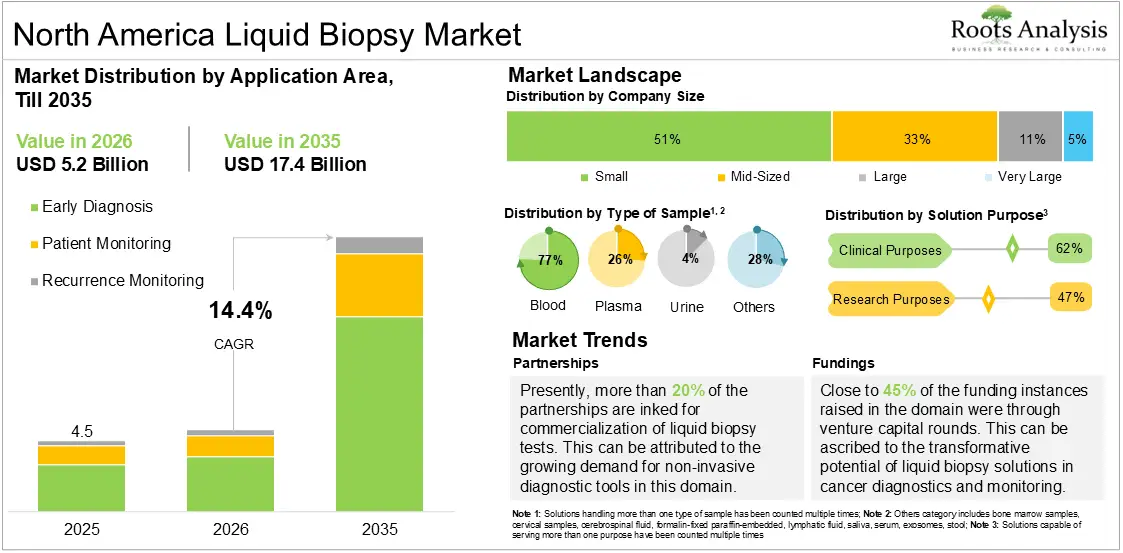
The North America liquid biopsy market, valued at USD 4.5 billion in 2025, is projected to reach USD 5.2 billion in 2026 and USD 17.4 billion by 2035, representing a CAGR of 14.4% during the forecast period 2026 to 2035.
To learn more about this report, request a free sample copy
Tissue biopsy has historically served as the standard approach for cancer diagnosis and molecular profiling, as it allows clinicians to directly examine tumor tissue and identify disease-specific characteristics. However, its invasive nature often creates challenges for patients, including pain, discomfort, procedural risk, and limited feasibility for repeated testing. These limitations become particularly important in oncology, where continuous monitoring is required to understand disease progression, treatment response, and the emergence of resistance. As a result, the industry has increasingly shifted its focus toward less invasive diagnostic approaches that can provide timely and clinically meaningful insights with lower patient burden.
Liquid biopsy has emerged as one of the most promising solutions to address this unmet need. By analyzing blood, plasma, urine, or other bodily fluids, liquid biopsy tests can detect circulating biomarkers such as circulating tumor DNA, cell-free DNA, circulating tumor cells, and extracellular vesicles. Since these tests are minimally invasive and can be repeated over time, they are increasingly being used to support early cancer detection, therapy selection, treatment monitoring, minimal residual disease assessment, and recurrence tracking. The National Cancer Institute has also highlighted that ctDNA-based liquid biopsies may be useful for monitoring treatment response because they are non-invasive and suitable for frequent repetition.
In North America, the adoption of liquid biopsy is gaining strong momentum, supported by the region's high cancer burden, advanced oncology infrastructure, strong reimbursement environment, and growing focus on precision medicine. Notably, in the US alone, around 2.11 million new cancer cases and 626,140 cancer deaths are projected in 2026, underscoring the need for scalable, accessible, and patient-friendly diagnostic solutions.
The region has also witnessed important regulatory milestones, including the FDA approval of Guardant360 CDx for comprehensive tumor mutation profiling across solid tumors and FoundationOne Liquid CDx as a liquid biopsy next-generation sequencing-based companion diagnostic. These approvals have strengthened clinical confidence in blood-based genomic profiling and have helped position liquid biopsy as an important tool in North America's oncology precision medicine ecosystem.
Leading Companies and Their Market Relevance in the North America Liquid Biopsy Market
| Company | YoE | Headquarters | Key Liquid Biopsy Product / Platform | Core Application Area | North America Market Relevance |
| Guardant Health | 2012 | California, US | Guardant360 Liquid CDx, Shield, Guardant Reveal | Comprehensive genomic profiling, companion diagnostics, CRC screening, MRD monitoring | Guardant360 CDx is approved by the FDA for comprehensive genomic profiling. Further, Shield has also been approved as an FDA-cleared blood-based colorectal cancer screening test. |
| Foundation Medicine / Roche | 2010 | Massachusetts, US | FoundationOne Liquid CDx | Comprehensive genomic profiling and companion diagnostics | FoundationOne Liquid CDx is FDA-approved as a companion diagnostic and analyzes more than 300 genes from a blood draw, bolstering Roche's presence in liquid biopsy-based precision oncology. |
| Natera | 2004 | Texas, US | Signatera | Molecular residual disease and recurrence monitoring | Signatera is a personalized ctDNA-based MRD assay designed to detect relapse earlier than standard tools, positioning Natera as a key player in recurrence monitoring. |
| Exact Sciences | 1995 | Wisconsin, US | Oncodetect, Freenome CRC blood-based screening rights | MRD testing and colorectal cancer blood-based screening | Exact Sciences launched Oncodetect in 2025 and also acquired exclusive US commercialization rights to Freenome's blood-based CRC screening tests. |
| GRAIL | 2016 | California, US | Galleri | Multi-cancer early detection | Galleri is positioned as a blood-based multi-cancer early detection test that can detect signals associated with more than 50 cancers, although multi-cancer detection tests are not yet FDA-approved. |
Based on our market research, we have segmented the North America liquid biopsy market forecast into type of technology, type of sample, type of circulating biomarker, type of cancer, application area and end-user.
By Type of Technology
By Type of Sample
By Type of Circulating Biomarker
By Type of Cancer
By Application Area
By End-user
Rising digitalization in pharmaceutical R&D is driving the North American liquid biopsy market as cloud-based drug-discovery platforms become the foundational infrastructure for integrating advanced technologies across discovery workflows.
Emphasizing the shift towards liquid biopsy, Suketu Shah (Sergio Figueiras Gómez, Innovation Director of Bahia Software), stated, "I believe liquid biopsy holds great potential. Its future evolution relies on establishing well-structured databases, information from diagnostic tools, technicians and the integration of symptoms with the recorder data reports. Creating a comprehensive database with organized data will pave the way for leveraging advanced technologies, such as machine learning and artificial intelligence in this domain, enabling us to extract valuable insights and aiding in treatment decisions and patient care. As a result, the integration of liquid biopsy into routine clinical practice will become more seamless and effective, driving better patient outcomes."
Discussions with multiple stakeholders in this domain influenced the opinions and insights presented in this study. The market report includes transcripts of the following third-party discussions:
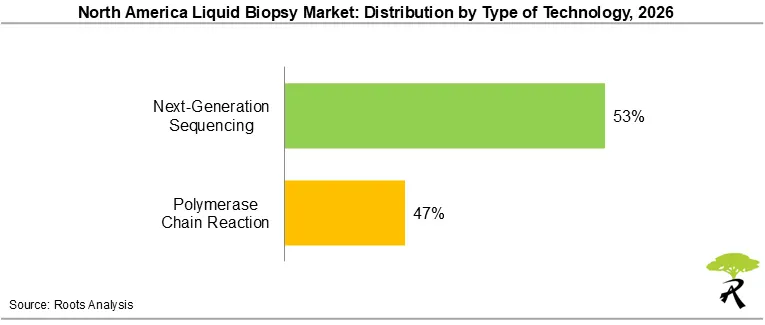
As per North America liquid biopsy market analysis, the next generation sequencing segment holds majority (nearly 50%) of the overall market share in the current year. This can be attributed to its ability to simultaneously analyze multiple genomic alterations with high sensitivity and specificity from a single liquid biopsy sample. Compared to conventional molecular diagnostic techniques, NGS enables comprehensive genomic profiling by detecting single nucleotide variants, insertions / deletions, copy number variations, and gene fusions, making it an essential tool for precision oncology. The widespread adoption of NGS in clinical practice for cancer diagnosis, treatment selection, minimal residual disease (MRD) monitoring, and therapy response assessment has significantly contributed to its market dominance.
Further, the next-generation sequencing (NGS) segment is expected to grow at a significant pace during the forecast period owing to continuous technological advancements that improve sequencing accuracy, reduce turnaround time, and lower testing costs. The expanding clinical applications of NGS, such as early cancer detection, multi-cancer screening, minimal residual disease monitoring, and longitudinal disease surveillance, are expected to drive widespread adoption.
Additionally, it is important to highlight that companies like Illumina continue to introduce next-generation sequencing platforms with higher throughput and improved workflow efficiency, while companies such as Guardant Health and Natera are expanding the clinical utility of NGS-based liquid biopsy assays for early cancer detection and disease monitoring. These developments are expected to drive robust growth in the NGS segment throughout the forecast period.
Currently, breast cancer holds the largest share of the North America liquid biopsy market owing to its high incidence, extensive use of biomarker-driven treatment strategies, and well-established integration of genomic testing into routine clinical practice. Compared to many other solid tumors, breast cancer management relies heavily on molecular profiling to identify actionable mutations, such as PIK3CA and ESR1, which guide targeted therapy selection in patients with advanced disease. This has significantly increased the clinical adoption of liquid biopsy for mutation detection, treatment monitoring, and identification of acquired therapeutic resistance.
Moreover, the availability of FDA-approved companion diagnostic tests, expanding reimbursement coverage, and strong participation in breast cancer clinical trials have further reinforced the segment's leading market position. For example, Guardant Health and Foundation Medicine offer NGS-based liquid biopsy assays capable of detecting clinically actionable alterations, including PIK3CA and ESR1 mutations, which support personalized treatment decisions in metastatic breast cancer.
The pancreatic cancer segment is expected to grow at a significant pace during the forecast period owing to the increasing need for minimally invasive diagnostic tools for a malignancy that is often detected at an advanced stage and is associated with poor survival outcomes. Tissue biopsy in pancreatic cancer can be technically challenging because of the tumor's anatomical location, making liquid biopsy an attractive alternative for molecular profiling, treatment selection, and disease monitoring. In addition, growing research on circulating tumor DNA (ctDNA), circulating tumor cells (CTCs), exosomes, and methylation biomarkers is accelerating the development of liquid biopsy assays for early detection and minimal residual disease (MRD) monitoring.
| Key Report Attribute | Details | |
| Historical Trend | Since 2021 | |
| Forecast Period | Till 2035 | |
| Market Size 2026 | $ 5.2 Billion | |
| Market Size 2035 | $ 17.4 Billion | |
| CAGR (Till 2035) | 14.4% | |
| Segments Covered |
|
|
| Key Players |
(A complete list of players captured is available in the report) |
|
| PowerPoint Presentation (Complimentary) |
Available | |
| Customization Scope | 15% Free Customization | |
| Excel Data Packs (Complimentary) |
Available | |