Market Outlook
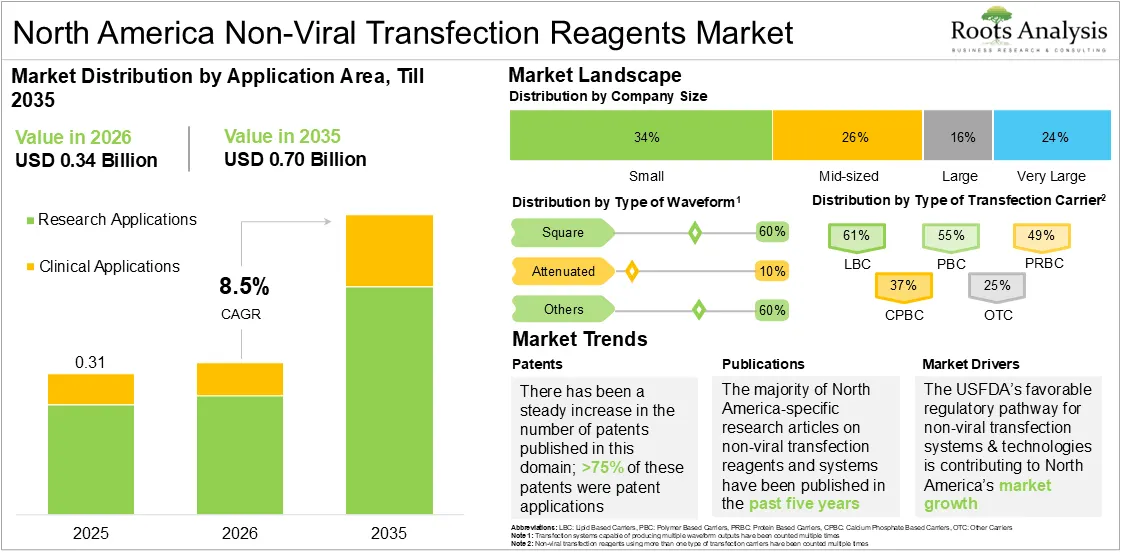
The North America non-viral transfection reagents market, valued at USD 0.31 billion in 2025, is projected to reach USD 0.34 billion in 2026 and USD 0.70 billion by 2035, representing a CAGR of 8.5% during the forecast period 2026 to 2035.
To learn more about this report, request a free sample copy
Market Report: Key Takeaways
Market Size & Trends
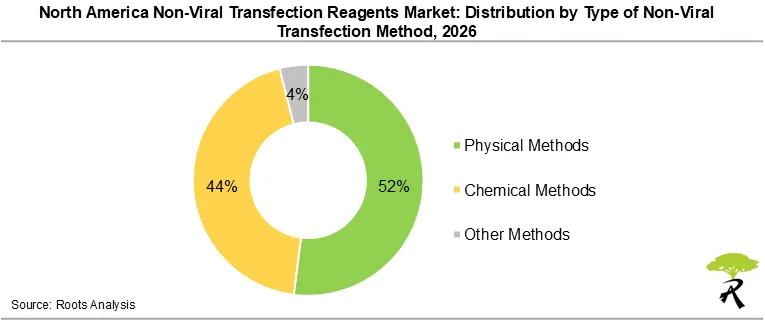
- In terms of type of non-viral transfection method, physical methods hold the highest share (more than 50%) of the current market.
- With respect to application area, research applications dominate the current market.
- Based on the end-user, academic and research institutions capture the largest share (around 50%) of the current market; this trend is unlikely to change in the future.
Key Market Statistics
- Market Size in 2026: $0.34 Billion
- Estimated Market Size in 2035: $0.70 Billion
- CAGR (2026-2035): 8.5%
Market Introduction
Non-viral transfection reagents have become integral to modern molecular biology and therapeutic development, offering reliable and scalable alternatives to viral vectors for delivering nucleic acids into cells. The chemical and physical transfection approaches are enabling gene expression studies, CRISPR editing, mRNA delivery, and cell engineering with greater control and lower biosafety constraints than viral systems. Examples include lipid-based reagents like Thermo Fisher's Lipofectamine MessengerMAX / CRISPRMAX, as well as electroporation systems like Lonza's 4D-Nucleofector and MaxCyte's ExPERT platform. Moreover, the growing demand for safer, reproducible, and cost-effective delivery methods has driven continuous innovation across reagent chemistry and formulations.
In North America, a robust ecosystem of academic research centers, biotechnology firms, and contract research organizations has accelerated adoption and commercialization of advanced non-viral transfection solutions. Significant investment in cell and gene research, expanding cell and RNA-based therapeutic pipelines, and strong translational infrastructure have created a large, sophisticated user base that favors high-efficiency, low-toxicity transfection reagents. Regulatory emphasis on product safety and scalable manufacturing further incentivizes non-viral approaches for preclinical and certain clinical applications.
Recent trends shaping the market include the rise of lipid nanoparticle (LNP) platforms driven by mRNA therapeutics, increasing demand for reagents optimized for hard-to-transfect primary cells and stem cells, and formulation advances that improve serum stability and transfection reproducibility. For example, Cytiva's NanoAssemblr Ignite / Ignite+ systems support reproducible LNP formulation for genomic medicine applications. Additionally, vendors are offering reagent kits tailored for CRISPR workflows, single-cell applications, and high-throughput automation, while partnerships between reagent suppliers and instrument manufacturers are streamlining end-to-end transfection workflows in laboratories and CDMOs.
In the coming future, the North America non-viral transfection reagents market is poised for steady growth as RNA-targeted therapeutics, cell engineering, and personalized medicine programs expand. Continued research and development toward lower-toxicity carriers, scalable manufacturing-friendly chemistries, and application-specific reagents will underpin adoption across academic and commercial users. For market participants, focusing on regulatory alignment, supply-chain resilience, and collaborations that validate performance in therapeutic-relevant cell types will be critical to capture opportunity in this evolving landscape.
Leading Companies and Flagship Non-Viral Transfection Reagents / Platforms
| Company |
HQ |
YoE |
Reagent / Platform |
Technology Type |
Key Application Area |
| Thermo Fisher Scientific |
US |
2006 |
Lipofectamine MessengerMAX, Lipofectamine CRISPRMAX, Lipofectamine RNAiMAX |
Lipid-based transfection |
mRNA delivery, CRISPR RNP delivery, siRNA / miRNA transfection |
| Revvity |
US |
2023 |
DharmaFECT reagents |
Lipid-based RNA delivery reagents |
siRNA, miRNA, plasmid transfection, functional genomics |
| Bio-Rad Laboratories |
US |
1952 |
TransFectin Lipid Reagent, Gene Pulser electroporation tools |
Cationic lipid reagent and electroporation |
Gene expression, RNAi studies, cell-based assays |
| Altogen Biosystems |
US |
2008 |
Cell line-specific transfection kits, in vivo transfection reagents |
Cell-specific and tissue-targeted delivery reagents |
Cancer cell lines, primary cells, in vivo delivery |
| Cytiva |
US |
2020 |
NanoAssemblr systems, GenVoy-ILM kits, RNA delivery LNP kits |
Lipid nanoparticle formulation / RNA delivery |
mRNA therapeutics, LNP screening, genomic medicine |
Market Segmentation
Based on the research, we have segmented the North America Non-Viral Transfection Reagents Market into type of non-viral transfection method, application area and end-user.
By Type of Non-Viral Transfection Method
- Chemical Methods
- Physical Methods
- Other Methods
By Application Area
- Research Applications
- Clinical Applications
By End-User
- Academic and Research Institutions
- Pharmaceutical and Biotechnological Companies
- Contract Manufacturers
- Other End-Users
North America Non-Viral Transfection Reagents Market Key Insights
What are the Key Drivers for North America Non-Viral Transfection Reagents Market Growth?
- Rising Prevalence of Chronic Diseases and Personalized Medicine: The burden of chronic and genetic diseases in North America continues to rise. For instance, according to the CDC, an estimated 129 million people in the United States live with at least one major chronic disease. This is increasing the demand for nucleic acid-based therapies, CRISPR gene editing, and other targeted treatment approaches. Non-viral transfection reagents play a critical role in advancing these innovations across both research and clinical applications.
- Expanding Cell and Gene Therapy Pipeline: North America has the world's largest pipeline of cell and gene therapies, many of which rely on efficient nucleic acid delivery during preclinical research, ex vivo cell engineering, and process development. Non-viral transfection reagents are increasingly preferred over viral vectors for applications requiring transient gene expression, lower immunogenicity, and simplified manufacturing. Moreover, the growing number of CRISPR-based therapies, CAR-T / NK cell programs, and mRNA therapeutics is driving the demand for advanced lipid-based, polymer-based, and nanoparticle-based transfection reagents.
What are the Main Challenges for Market Growth?
- Limited Transfection Efficiency in Difficult-to-Transfect Cells: Despite continuous technological improvements, many primary cells, stem cells, immune cells, and certain suspension cell lines remain challenging to transfect using non-viral reagents. Lower transfection efficiency compared with viral vectors can reduce experimental reproducibility and therapeutic development success, limiting broader adoption in advanced cell therapy applications.
- Cytotoxicity and Cell Viability Concerns: Many cationic lipid- and polymer-based transfection reagents can induce cellular toxicity, inflammatory responses, or reduced cell viability, particularly at higher reagent concentrations. Balancing transfection efficiency with minimal cytotoxicity remains a significant challenge for researchers developing sensitive cell-based assays and therapeutic products.
Recent Developments in North America Non-Viral Transfection Reagents Market
- In June 2026, VectorBuilder partnered with MaxCyte to co-develop a clinical-grade, ex vivo non-viral gene delivery platform. The solution combines VectorBuilder's MiniVec plasmid system with MaxCyte's Flow Electroporation technology, aiming to improve transfection efficiency and cell viability in CAR-T, iPSC and other engineered cell therapy workflows.
- In April 2026, Kytopen completed a Series B financing round led by Telegraph Hill Partners to accelerate commercial expansion of its Flowfect non-viral continuous-flow transfection platform across the US and Europe. The funding supports broader adoption of Flowfect Tx GMP and Flowfect Discover platforms for closed, scalable cell engineering workflows.
- In February 2026, MaxCyte launched ExPERT DTx, a 96-well high-throughput electroporation platform for research and drug discovery applications. The system can process up to 96 samples in a short run and enables optimized transfection workflows to be transferred to larger ExPERT instruments for scale-up toward cGMP manufacturing.
Industry Experts on North America Non-Viral Transfection Reagents Market
Driven by the growing demand for non-viral gene delivery solutions that offer improved safety, reduced immunogenicity, and greater manufacturing flexibility compared to viral vectors, the North America non-viral transfection reagents market is expected to witness substantial growth over the forecast period.
Emphasizing growing clinical activity in the domain, Ram Shankar (Chief Scientific Officer at PlasmidFactory), stated that: "Minicircles produced at PlasmidFactory have already entered multiple clinical trials, including CARAMBA, TranspoCART19, and LION-1. These programs explore virus-free CAR-T cell generation using transposon systems and hopefully demonstrate strong efficacy and favorable safety profiles."
Discussions with multiple stakeholders in this domain influenced the opinions and insights presented in this study. The North America non-viral transfection reagents market report includes detailed transcripts of interviews conducted with the following individuals:
- Former-Vice-President, Business Development and Partnerships, Small Company, US
- Former Global Business Development Manager, Clinical Operations, Mid-sized Company, France
- Researcher, Mid-sized Company, Chile
In addition, the market report includes transcripts of the following other third-party discussions:
- Chairman and Chief Executive Officer, Mid-sized Company, US
- Co-Founder and Chief Executive Officer, Small Company, US
- Chief Scientific Officer and Executive Vice President of R&D, Mid-sized Company, US
- Chief Scientific Officer, Mid-sized Company, US
- Chief Scientific Officer, Small Company, Germany
- Vice President, Cell Therapy Process Development, Large Company, US
- Group Leader, R&D Transfection, and Director and Senior Product Manager, Large Company, Switzerland
- Director, Senior Product Manager, Very Large Company, Switzerland
- Senior Vice President of Technical Applications, Mid-sized Company, US
- Head of Transfection R&D, Very Large Company, Switzerland
Market Share Insights
Which Type of Non-Viral Transfection Method Accounts for the Largest Share in the North America Non-Viral Transfection Reagents Market?
- In 2026, the physical methods segment occupies the highest market share (more than 50%), primarily due to the widespread adoption of electroporation and nucleofection technologies in cell and gene therapy research, ex vivo cell engineering, and biopharmaceutical manufacturing.
- The other methods segment is likely to grow at a higher CAGR (9.0%) during the forecast period. This is due to the increasing adoption of emerging physical and hybrid transfection technologies, such as mechanoporation, acoustic transfection, microfluidics-based delivery, and laser-assisted transfection. These approaches offer improved transfection efficiency, reduced cytotoxicity, and enhanced compatibility with hard-to-transfect primary cells and stem cells, making them increasingly attractive for advanced cell therapy, gene editing, and regenerative medicine applications.
Which Application Area Shows the Fastest Growth in North America Non-Viral Transfection Reagents Industry?
- In 2026, the research applications segment occupies a higher (around 80%) share of the North America non-viral transfection reagents market. This dominance is due to the extensive use of non-viral transfection reagents in basic research, functional genomics, gene expression studies, CRISPR-based gene editing, and drug discovery. The strong presence of leading academic institutions, research organizations, and biotechnology companies, coupled with substantial government funding for life sciences research, continues to drive the widespread adoption of these reagents across preclinical and translational research activities.
- It is worth highlighting that the market share for clinical applications is likely to grow at a relatively higher CAGR (8.9%) during the forecast period.
Amongst the End-Users, Which Segment Holds the Highest Share in the North America Non-Viral Transfection Reagents Market?
- Currently, the academic and research institutes segment is likely to occupy a higher (~50%) share of the North America non-viral transfection reagents market forecast size. This is primarily because academic and research institutes form the core demand base for non-viral transfection reagents. These products are routinely used in gene expression studies, RNAi / gene knockdown, and CRISPR-Cas9 delivery. The segment is further supported by North America's strong university-led biomedical research ecosystem.
- The pharmaceutical and biotechnological companies segment is likely to grow at a higher CAGR (9.0%) during the forecast period. This is primarily because pharma and biotech companies are increasingly using non-viral transfection reagents in high-value drug discovery and therapeutic development workflows.
Scope of North America Non-Viral Transfection Reagents Market Report
| Key Report Attribute |
Details |
| Historical Trend |
Since 2022 |
| Forecast Period |
Till 2035 |
| Market Size 2026 |
$ 0.34 Billion |
| Market Size 2035 |
$ 0.70 Billion |
| CAGR (Till 2035) |
8.5% |
| Segments Covered |
- Type of Non-Viral Transfection Method
- Application Area
- End-User
|
| Key Players |
(A complete list of players captured is available in the report)
|
PowerPoint Presentation
(Complimentary) |
Available |
| Customization Scope |
15% Free Customization |
Excel Data Packs
(Complimentary) |
Available |
Frequently Asked Questions
What is a non-viral method of transfection?
Non-viral transfection methods use physical or chemical approaches like electroporation and lipofection to deliver nucleic acids into the target cells.How big is the North America non-viral transfection reagents market?
The market for the North America non-viral transfection reagents is estimated to be around USD 0.34 billion in 2026.What is the projected growth of the North America non-viral transfection reagents market?
The market is likely to grow at a CAGR of 8.5% during the forecast period, from 2026 to 2035.Which end-user holds the highest market share in the North America non-viral transfection reagents industry?
Presently, academic and research institutions capture more than ~50% of the overall industry.Who are the leading players specializing in the North America non-viral transfection reagents market?
Altogen Biosystems, Bio-Rad Laboratories, Cytiva, Harvard Bioscience, MaxCyte, MilliporeSigma, Mirus Bio, Revvity and Thermo Fisher Scientific.