
Lowest Price Guaranteed
Pages
354
Last Updated
September 2026
View Count
3174
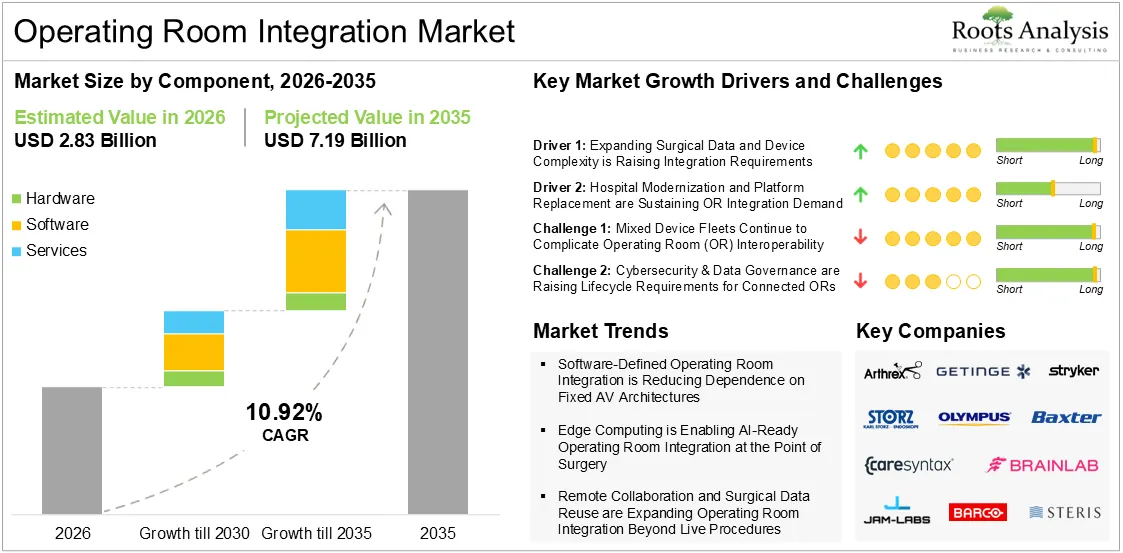
The global operating room integration market, valued at USD 2.55 billion in 2025, is projected to reach USD 2.83 billion in 2026 and USD 7.19 billion by 2035, representing a CAGR of 10.92% during the forecast period 2026 to 2035. Market expansion is increasingly extending beyond new operating room (OR) installations as hospitals upgrade existing integrated environments with software-defined routing, surgical data management, centralized device and room control, and lifecycle support capabilities. This combination of new-room modernization and recurring retrofit, interface and system-upgrade requirements are broadening demand across established hospital operating rooms as well as a wider range of surgical settings.
To learn more about this report, request a free sample copy
The operating room integration market exhibits distinct leadership and growth patterns across components, type of integration system, surgical application, end user and geographical regions. The table below summarizes the leading category within each market segment in current year and highlights the categories projected to record the fastest growth through 2035.
| Market Segments | Sub-segment Details | Leading in 2026 | Fastest Growing, Till 2035 |
| Component | Hardware, Software and Services | Software | Services |
| Type of Integration System | Audio, Video & Collaboration, Display & Visualization, Documentation & Data Management, Device & Room Control and Other Integration Systems | Documentation & Data Management | Device & Room Control |
| Surgical Application | General Surgery, Orthopedic Surgery, Neurosurgery, Cardiovascular Surgery, Urological & Gynecological Surgery, Thoracic Surgery and Other Surgical Specialties | General Surgery | Neurosurgery |
| End User | Hospitals, Ambulatory Surgical Centers and Other Surgical Facilities | Hospitals (68.0% share) | Ambulatory Surgical Centers |
| Geographical Regions | North America, Europe, Asia-Pacific, Latin America, and Middle East and Africa | North America (37.5% share) | Asia-Pacific (14.16% CAGR) |
Operating room integration has progressed from a primarily audiovisual connectivity function into a broader digital infrastructure layer supporting how surgical environments are configured, controlled and connected. Established systems already combine source routing, visualization, procedural documentation and hospital-system connectivity across operating rooms, while newer platforms are extending this foundation into software-based orchestration, centralized device control, remote collaboration and more structured use of surgical data. As a result, integration is becoming increasingly embedded in the way hospitals design and operate connected surgical environments rather than being treated as an isolated room-level AV installation.
Alongside this expansion in functionality, the underlying technologies of operating room integration systems are also changing, with newer platforms relying increasingly on software-defined control, IP-based connectivity and networked data exchange to coordinate devices, video, patient information and procedural content across the surgical environment. IP-based transport and software routing allow video, patient context, device information and procedural content to be distributed across multiple endpoints with greater flexibility than conventional fixed switching architectures. At the same time, interfaces with electronic health records (EHR), picture archiving and communication systems (PACS) and other hospital systems are making documentation, data association and retrieval more integral to the platform. Emerging edge-compute and AI-ready capabilities are extending this role further, positioning the integration layer as the environment through which synchronized surgical data can support workflow automation and advanced applications.
This evolution is also changing the market's commercial structure. Demand is no longer tied only to new operating-room construction, as hospitals are modernizing existing rooms, replacing aging integration infrastructure and standardizing platforms across multiple ORs and surgical sites. Retrofit-friendly and modular architecture allows these upgrades to be introduced without replacing the underlying surgical equipment, while software updates, interface management, cybersecurity support, remote monitoring and system upgrades create recurring requirements after installation. The market is therefore moving toward a more continuous platform-and-lifecycle model in which initial hardware deployment is increasingly complemented by software expansion, integration, maintenance and ongoing technical support across the installed base.
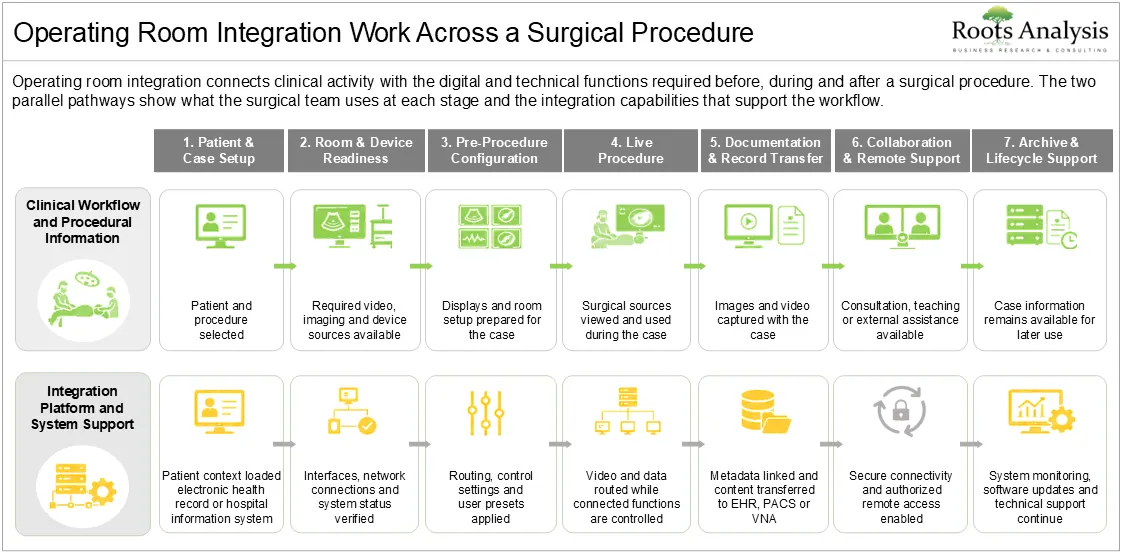
Operating room integration coordinates the movement of patient information, surgical media and control functions across the different stages of a procedure. Before surgery, patient and case information from the EHR or hospital information system is linked to the room, connected video and imaging sources are verified, and routing, display and control settings are configured. During the procedure, the integration platform directs high-resolution video and selected device information to the required displays while maintaining the correct patient context and centralized access to supported room functions. Reliable identity mapping, device interoperability, image fidelity and low-latency transmission are therefore fundamental to the workflow.
After the procedure, captured images, video and associated metadata can be transferred to EHR, PACS or VNA environments for documentation, retrieval and subsequent clinical use. These transfers depend on interfaces, such as DICOM and HL7, that help connect procedural content with the relevant hospital information and imaging systems, while they can also support authorized remote consultation and technical assistance where required. Beyond the clinical case, system monitoring, software updates, interface changes and cybersecurity maintenance remain necessary to preserve system availability and compatibility. OR integration therefore connects patient context, device connectivity, visualization, control and documentation with the longer-term technical lifecycle of the integrated room.
Operating room integration is shifting from fixed audiovisual routing toward software-defined platforms that coordinate video, device control, patient context, documentation and hospital-system connectivity within a common environment. IP-based transport and configurable software interfaces allow hospitals to modify routing, add connected functions and accommodate equipment changes without repeatedly redesigning room-level infrastructure. Current platforms from Stryker, STERIS, Getinge and Caresyntax reflect this broader architecture, where hardware remains essential, but software increasingly determines how devices, data and workflows interact. This transition is strengthening the role of integration software as the persistent operating layer across equipment upgrades, room modernization and changing clinical requirements.
Operating room integration platforms are beginning to incorporate edge-computing capacity as surgical workflows generate larger volumes of synchronized video, device and contextual data. Processing this data closer to the procedure can support low-latency workflow recognition, automation and AI applications while maintaining tighter control over clinical data and network performance. Barco's NexxisCompute and KARL STORZ's collaboration with Artisight reflect this transition toward integration platforms that support advanced applications in addition to connectivity and control. As this architecture develops, the integration layer is becoming an important foundation for surgical AI, although wider adoption will continue to depend on clinical validation, cybersecurity and data-governance requirements.
Operating room integration is increasingly supporting clinical and technical activity beyond the physical boundaries of the surgical suite. Secure distribution of live procedural video and case information can connect remote specialists, teaching teams and technical support personnel, while recorded surgical content can be retained for later review and education. Platforms from STERIS, Getinge and other integration providers increasingly incorporate these collaboration and content-sharing functions alongside conventional room control and visualization. This is extending OR integration from an infrastructure used primarily during surgery into a connected environment that can support consultation, knowledge sharing and continued use of procedural information after the case.
Operating room integration is becoming more closely associated with the consistency and coordination of activity inside the surgical environment, particularly as digital systems take on a greater role in supporting procedural execution. As integrated environments bring together room controls, procedural information and connected technologies, their value increasingly depends on whether these functions can be incorporated without disrupting established clinical workflows. Following the first OR1 X Pro procedures at University Hospital Tübingen, Prof. Sara Y. Brucker, Medical Director of the Women's Clinic, reflected this experience in a May 2026 KARL STORZ announcement, stating, "For us, the new operating room represents a true milestone. The highly integrated and digitally connected infrastructure significantly streamlines our workflows."
Primary research discussions with multiple stakeholders in this domain influenced the opinions and insights presented in this study. The operating room integration market report includes transcripts of the following third-party discussions:
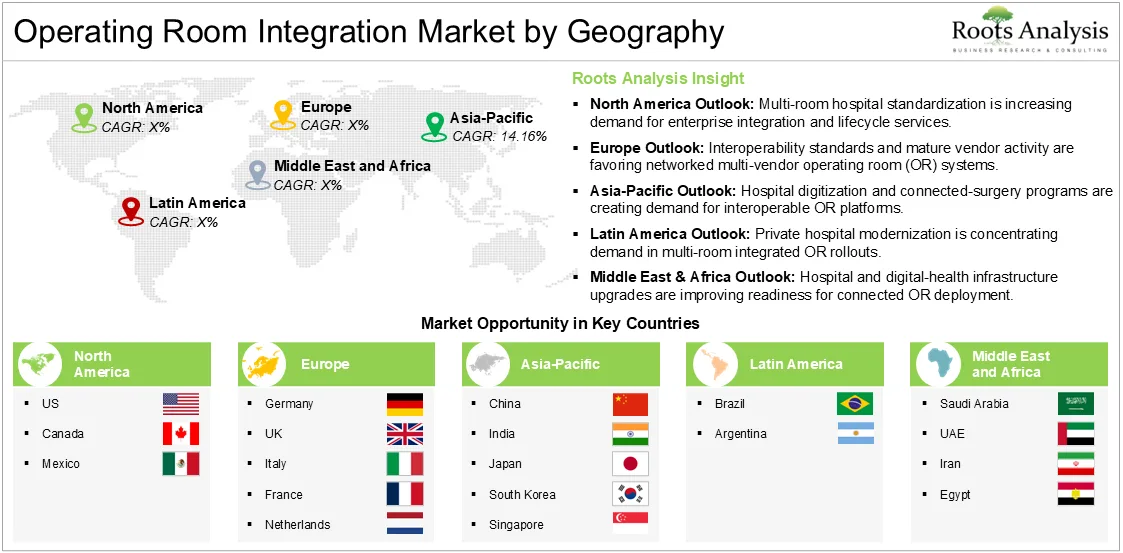
North America holds the largest regional share of the operating room integration market at 37.5% in 2026, supported by a mature hospital and ambulatory surgical infrastructure, established adoption of integrated surgical environments and continued investment in OR replacement, renovation and new-build programs. The region also has the hospital IT, clinical engineering and cybersecurity capabilities required to support increasingly network-dependent integration platforms. Current procurement illustrates the scale at which these systems are being deployed. For example, in March 2026, Harris Health documented a KARL STORZ operating-room integration and automation procurement covering 24 operating rooms and four conference rooms at the new Lyndon B. Johnson Hospital, with an estimated value of about USD 7.0 million. Such multi-room projects reinforce the region's established demand for coordinated rooms, system and service architecture.
Asia-Pacific is projected to grow fastest at a CAGR of 14.16% from 2026 to 2035 as hospital modernization and digital-health investment expand the technical foundations required for connected operating rooms. This development is taking different forms across the region; for example, Japan has advanced vendor-neutral operating-room information integration through initiatives such as OPeLiNK and the Smart Cyber Operating Theater, while connected-surgery deployments in India indicate growing adoption of digitally coordinated surgical environments. The WHO Western Pacific digital-health framework further emphasizes the need for stronger digital infrastructure, data governance and interoperable health-information systems, which support the reliable networks, secure data exchange and clinical-system connectivity required for connected OR deployment.
Software holds the largest share of the market by component because routing, centralized control, patient-context linkage, procedural documentation and EHR and PACS connectivity remain core functions throughout the operating life of an integrated room. These capabilities continue to be required when individual surgical devices, displays or other equipment are replaced, allowing the software layer to remain embedded across equipment refresh cycles and changes in clinical workflow. Its continuing role across room operation and system renewal supports a substantial recurring software requirement within integrated environments.
Services are projected to grow fastest through 2035. Integration work continues after commissioning through interface implementation, configuration, user training, remote technical support, software upgrades, cybersecurity maintenance and compatibility management as connected devices and hospital systems change. These requirements apply to operating rooms already in service as well as newly integrated rooms, increasing the technical and professional support associated with the installed base. Service activity can therefore extend across implementation, ongoing system operation and subsequent technology changes rather than being limited to the initial deployment.
Documentation and data management holds the largest share by integration system type because procedural media must remain clinically usable after capture in the operating room. Integrated systems associate surgical images and video with the correct patient and procedure, support storage and review, and transfer relevant content into EMR, PACS and DICOM-based archive environments. These functions create a continuous information pathway between the live procedure and the clinical record, giving documentation and data management an established role across multiple surgical specialties and procedural workflows.
Device and room control is expected to grow fastest through 2035 as more surgical devices and room functions become accessible through networked interfaces. Integration software can increasingly coordinate presets, room controls, device status and selected connected functions within a common environment. Commercial platforms are also incorporating connected-device control and workflow-state automation, extending the integration layer beyond information routing toward more coordinated procedural control. This broadens the range of room functions that can be managed through the integration environment as connected-device architectures develop.
General surgery remains the largest application segment because laparoscopic and endoscopic procedures create recurring requirements for surgical video routing, visualization, recording and procedural documentation across a broad range of cases. The same integration functions can support different procedures and be reused across multiple operating rooms, giving general surgery a broad installed workflow base for integrated video, display and documentation systems. The repeated use of these capabilities across routine minimally invasive surgical procedures reinforce integration as an established component of general surgical infrastructure.
Neurosurgery is projected to grow fastest through 2035 as navigation systems, surgical microscopy, three-dimensional imaging and physiologic and clinical data increasingly converge during the same procedure. These workflows require synchronized visualization and contextual information across several technologies, while digitally assisted and AI-enabled tools add further data streams and interfaces. The resulting increase in multimodal information requires closer coordination between imaging, navigation and procedural systems, raising the integration intensity of neurosurgical environments as the underlying technology becomes more interconnected.
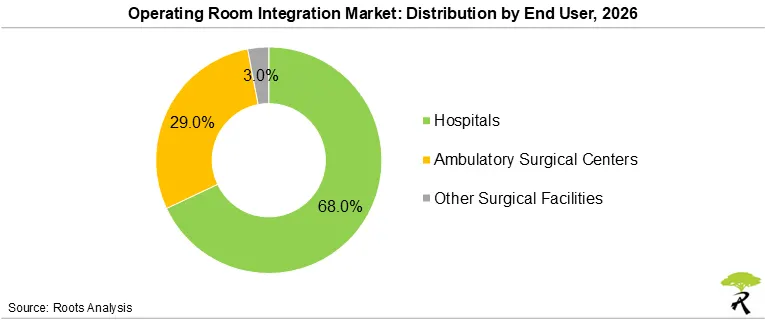
Hospitals hold the largest share by end user because their operating-room estates span multiple specialties and combine enterprise EHR and PACS infrastructure with teaching, collaboration and higher-complexity surgical environments. Integration can therefore extend across groups of rooms and facilities, where common interfaces, control environments and support arrangements help coordinate technologies replaced on different schedules. This makes OR integration relevant to broader hospital modernization and standardization programs as well as individual room installations, particularly where health systems seek consistent technology and support arrangements across surgical facilities.
Ambulatory surgical centers are projected to grow fastest through 2035 as outpatient surgical capacity and procedure eligibility continue to broaden, particularly in the US. Recent MedPAC reporting indicates continued expansion of the ASC sector, while CMS policy for CY2026 widened the range of procedures eligible for ambulatory settings. Modular and compact integration configurations can address video management, documentation and connectivity needs in facilities with tighter room and IT requirements. The underlying site-of-care mechanism remains strongest in the US and should not be generalized uniformly across international markets.
Modern operating rooms incorporate a wider combination of endoscopic video, intraoperative imaging, navigation, digital documentation and connected surgical technologies. As these systems generate more information during a procedure, hospitals need a coordinated environment that can route content to the appropriate displays, preserve patient and case context, support centralized control and transfer relevant media into clinical records. The requirement becomes more pronounced in technology-intensive specialties where several data sources may be used simultaneously. This increasing complexity is strengthening demand for OR integration platforms that can bring otherwise fragmented devices and information streams into a consistent clinical workflow without requiring surgical teams to manage multiple disconnected interfaces.
OR integration demand is increasingly tied to the modernization of existing surgical infrastructure as well as the development of new operating rooms. Hospitals periodically replace aging integration systems, introduce new imaging and surgical technologies, upgrade network infrastructure and adapt rooms to changing documentation or collaboration requirements. These changes can require the underlying integration environment to be reconfigured even when much of the existing clinical equipment remains in service. Larger health systems also standardize interfaces and integration platforms across multiple rooms and facilities to simplify training, support and future upgrades. This continuing renewal of installed OR infrastructure is creating demand for system replacement, interface implementation, software upgrades and lifecycle services alongside greenfield integration projects.
Integrated operating rooms commonly contain technologies from multiple manufacturers that were installed at different times and use different communication interfaces. Connecting these systems becomes more difficult when hospitals want a common control environment without replacing otherwise functional equipment. New device generations can require updated interfaces, testing and clinical validation before they are incorporated into an existing room configuration. Standards such as the ISO/IEEE 11073 Service-oriented Device Connectivity framework are improving the foundation for manufacturer-independent communication, but implementation remains uneven across installed surgical technologies. Interoperability therefore continues to influence platform selection, implementation timelines and long-term maintainability, particularly in hospitals with large and heterogeneous technology estates.
Greater connectivity is bringing operating room integration more deeply into the hospital's clinical IT environment. Integration platforms can exchange patient information, procedural images and device data while also supporting remote access, software maintenance and increasingly data-intensive applications. Hospitals must consequently manage network segmentation, user access, system logging, software patches and the handling of procedural data throughout the life of the installation. Cybersecurity updates also need to be introduced without disrupting validated device interfaces or compromising room availability. As connected surgical environments become more software-dependent, security and data governance are becoming continuing operational requirements that influence system architecture, vendor support arrangements and the resources required to maintain integrated rooms safely.
Vendor-neutral device control represents a distinct opportunity for operating room integration as hospitals seek to coordinate equipment from multiple manufacturers without replacing otherwise functional devices. ISO/IEEE 11073-10700:2024 and 11073-10701:2024 establish requirements for safe, effective and secure point-of-care device communication and data exchange, while IEEE P11073-20702 extends this framework toward distributed communication and safe remote control.
Broader adoption could reduce reliance on custom proprietary interfaces and make centralized control more repeatable across mixed technology fleets; however, the adoption scale depends on device-manufacturer support, validation of safety-critical functions and cybersecurity governance. The FDA's February 2026 medical-device cybersecurity guidance reinforces the need to manage security through product design and quality systems, making interface validation, software maintenance and lifecycle support integral to any expansion of networked device control.
The market landscape includes large integrated medtech companies alongside specialist connectivity, digital and software-led providers, with competition increasingly shaped by the extent of OR connectivity, device and room control, procedural data management, interoperability and lifecycle support. Companies such as Stryker, KARL STORZ, Getinge, STERIS and Olympus combine operating room integration with broader surgical technology portfolios, while providers such as Caresyntax compete through software-led and vendor-neutral architectures designed to connect heterogeneous devices and surgical data environments. This mix of operating models has created a market in which platform breadth, interoperability, deployment flexibility and ongoing technical support are important areas of competitive differentiation.
| Platform | Company | Platform Capabilities | Deployment Environment |
| Connected OR IP BRAVoE | Stryker | Visualization & Media Routing, Device & Room Control, Hospital IT Connectivity | Integrated ORs including zero-footprint and customizable installations |
| OR1 X Pro | KARL STORZ | Visualization & Media Routing, Device & Room Control, Data & Documentation, Hospital IT Connectivity, Remote Collaboration, AI / Analytics | General, robotic and hybrid ORs including advanced imaging suites |
| Tegris | Getinge | Visualization & Media Routing, Device & Room Control, Data & Documentation, Hospital IT Connectivity, Remote Collaboration | Ambulatory surgery centers through conventional and hybrid ORs |
| HexaVue IP Integration System | STERIS | Visualization & Media Routing, Device & Room Control, Data & Documentation, Hospital IT Connectivity, Remote Collaboration | Modern integrated ORs requiring networked video, device connectivity and collaboration |
| ES-IP iOR System | Olympus | Visualization & Media Routing, Device & Room Control, Data & Documentation, Hospital IT Connectivity, Remote Collaboration | ORs, procedure rooms and interventional environments across hospital systems |
| Caresyntax ORI | Caresyntax | Visualization & Media Routing, Device & Room Control, Data & Documentation, Hospital IT Connectivity | Existing and new ORs including vendor-neutral retrofit deployments |
| Nexxis | Barco | Visualization & Media Routing, Device & Room Control, Data & Documentation, Remote Collaboration | Digital ORs, hybrid ORs and interventional surgical environments |
| Buzz Digital O.R. | Brainlab | Visualization & Media Routing, Device & Room Control, Data & Documentation, Hospital IT Connectivity, Remote Collaboration | Digital ORs requiring centralized information, visualization and control |
Note: The companies and platforms presented in the table are representative examples selected to illustrate the competitive landscape of the operating room integration market. The table is not intended to provide an exhaustive list of market participants or a complete portfolio of operating room integration platforms offered by each company.
The study covers commercial revenue attributable to in-scope operating room integration hardware, software and associated technical and professional services used to connect, control, route, visualize, document and exchange information across operating-room devices and hospital information systems. The different analyses covered in the market report use the proprietary Roots Analysis research framework, supported by internal databases and repositories, company disclosures, hospital procurement documents, regulatory and standards publications, scientific and technical literature, and primary and secondary sources. For further details, see the complete research methodology adopted by Roots Analysis across its market reports.
The report provides annual market estimates from 2022 to 2035 and evaluates growth across Component, Integration System Type, Surgical Application, End User and Geography. These analyses compare current revenue concentration with faster-developing areas such as Services, Device and Room Control, Neurosurgery, Ambulatory Surgical Centers and Asia-Pacific. The assessment also examines how hospital modernization, replacement of installed integration systems, increasing surgical data complexity and rising lifecycle service requirements are influencing the development of the market.
Competitive analysis evaluates integrated medical-technology companies, visualization and connectivity specialists, and software-led integration providers according to their operating-room platforms, integration layers, deployment models and ability to connect with hospital information systems and third-party technologies. It also examines vendor-neutral positioning, remote collaboration, lifecycle support and recent partnerships, acquisitions and platform expansion. The assessment considers how interoperability, installed-base compatibility, software functionality, implementation capability and long-term support influence competitive positioning across new-build, retrofit and enterprise-standardization programs.
Technology analysis examines the transition from fixed audiovisual switching toward IP-based transport, software-defined routing, centralized device and room control, procedural data management and increasingly networked surgical environments. Coverage includes EHR and PACS connectivity, DICOM and HL7-based information exchange, edge-computing infrastructure, AI-ready operating environments, remote collaboration and medical-device interoperability. The report also evaluates ISO/IEEE Service-oriented Device Connectivity standards and cybersecurity requirements as connected OR architectures progress toward more coordinated exchange of device information and control functions.
Strategic analysis connects market development with hospital modernization, operating-room replacement cycles, multi-room standardization, ambulatory surgical-center expansion and regional digital-health infrastructure. It evaluates greenfield and retrofit deployment pathways together with interface implementation, cybersecurity maintenance, software upgrades and other lifecycle requirements that continue after initial installation. The analysis also considers procurement activity, partnerships, acquisitions and evolving interoperability models to assess platform-development priorities, service opportunities, deployment scalability and geographic expansion across connected surgical environments.
| Key Report Attributes | Details | |
| Historical Trends | Since 2022 | |
| Forecast Period | Till 2035 | |
| Market Size 2026 | USD 2.83 billion | |
| Market Size 2035 | USD 7.19 billion | |
| CAGR (till 2035) | 10.92% | |
| Key Companies Profiled | Arthrex, Barco, Baxter, Brainlab, Caresyntax, Getinge, JAM-Labs, KARL STORZ, Olympus, OPExPARK, Richard Wolf, Skytron, Sony, STERIS, Stryker | |
| PowerPoint Presentation (Complimentary) | Available | |
| Customization Scope | 15% Free Customization Available | |
| Excel Data Packs (Complimentary) |
|
|
The report was authored by Rupali Vadhera, who has over 10 years of industry expertise and is part of Roots Analysis's healthcare and pharma research practice, covering medical technology, digital surgery and operating room integration market studies.
This report is an independent work of market research and analysis published by Roots Analysis. It is not affiliated with, sponsored by, endorsed by, or reviewed by Stryker, KARL STORZ, Getinge, STERIS, Olympus, Caresyntax, Barco, Brainlab, or any other medical technology company, platform provider, healthcare organization, or regulatory body referenced within it. No content in this report should be construed as medical advice. Roots Analysis maintains its own proprietary primary research process and does not receive compensation from any company profiled within the report in exchange for inclusion or favorable characterization.