report-pricing-dollar

Organic Skin Care Market

Organic Skin Care Market: Industry Trends and Global Forecast, Till 2035- Distribution by Type of Product (Face Cream & Moisturizers, Face Cleanser, Face Serum, Body Cream & Moisturizers, Body Wash, and Others), Type of Consumer (Men, Women, Unisex and Baby), Distribution Channel (Supermarket / Hypermarket, Pharmacy & Drugstore, Online, and Others), Geographical Regions (North America, Europe, Asia-Pacific, Middle East and North Africa, and Latin America), and Leading Players

  • Lowest Price Guaranteed

  • Pages
    196

  • Last Updated
    July 2025

  • View Count
    5442

Organic Skin Care Market Overview

The global organic skin care market size, valued at USD 12.06 billion in 2024, is projected to reach USD 13.30 billion in 2025 and USD 30.08 billion by 2035, representing a CAGR of 8.5% during the forecast period.
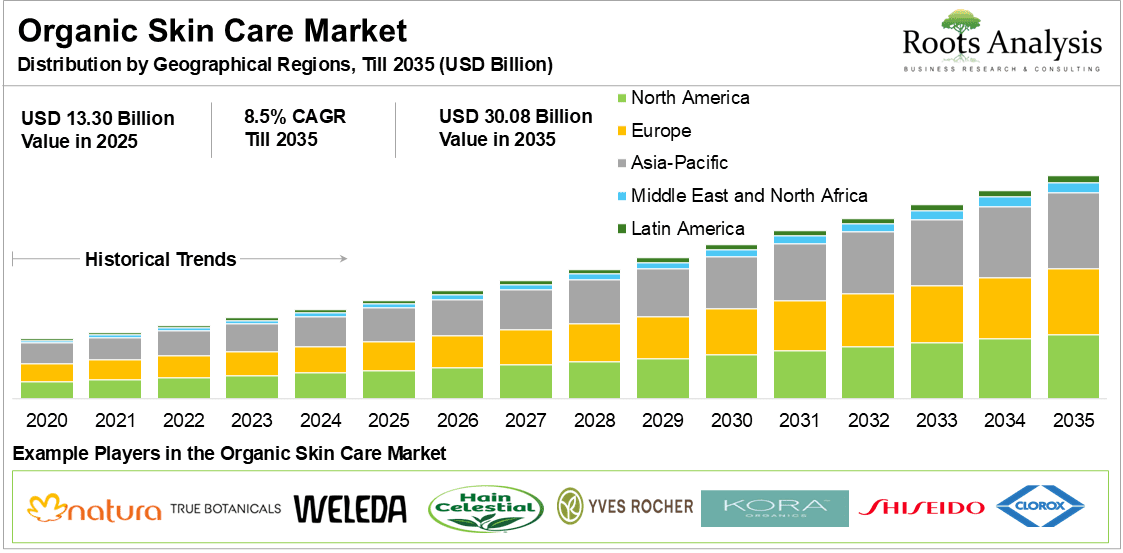
Organic Skin Care Market Distribution by Geographical Regions

To learn more about this report, request a free sample copy

Organic Skin Care Industry: In Summary

  • The demand for natural and organic skincare products has significantly increased, driven by the influence of social media, a growing desire to maintain youthful radiance, and increasing consumer awareness regarding the potential harm of synthetic ingredients.
  • Driven by the ongoing demand, the organic skin care market is projected to reach USD 30.08 billion by 2035, representing a CAGR of 8.5% during the forecast period.
  • The Asia-Pacific region is dominating the market due to the rising disposable income and shift towards organic product range to achieve youthful skin.
  • In terms of type of product, face cream & moisturizers segment is holding maximum share of the market. This is potentially due to the requirement of cruelty-free cream and moisturizers to maintain skin hydration.
  • The European region is expected to grow at a higher CAGR during the forecast period due to the growing popularity of natural and organic skin care products among the millennial generation.
  • Companies, such as TRUE BOTANICALS (US), and Shiseido (Japan) are presently manufacturing anti-aging serums, for instance, Chebula Active serum and Ultimune Power Infusing serum that helps to eliminate fine lines, wrinkles, and aging signs.

Organic skin care industry is witnessing remarkable progress and is likely to expand at a steady rate in the upcoming years. The allure of youthful skin, social media hype and shift towards natural products are key reasons for the heightened demand for organic skin care range. It is interesting to highlight here that modern consumers are highly aware of synthetic products that can potentially harm their skin. Therefore, consumers are actively seeking natural products that are free from sulfates, synthetic chemicals, parabens, and fragrances.

Additionally, concerns of environmental sustainability coupled with focus on herbal beauty products specifically among Gen Z and Millennials consumers are driving growth of this market. Several other factors, such as rising disposable income, consumer lifestyle and celebrity influence are driving interest of global population towards natural skin care range to meet aesthetic goals.

Furthermore, organic skincare products are typically featured as plant-based and clean-label ingredients with claims, such as being “organic,” “vegan,” “natural,” “chemical-free,” and “cruelty-free.” This focus on ingredient transparency extends beyond just ingredient lists; it also encompasses sustainability practices, ethical sourcing, and environmental impact considerations, all of which are increasingly vital to conscious consumers. Driven by the ongoing trend of organic skin care range, several companies, such as TRUE BOTANICALS (US), Shiseido (Japan), Natura (Brazil) and Loreal (France) are launching organic skin care products to meet global demand.

For instance, in January 2025, Shiseido (Japan) has launched refillable anti-aging serum “Ultimune Power Infusing Serum”. This serum consists of Japanese Camellia hails extract and the amino acid content has been amplified using bio-fermentation technology.  Similarly, several skin care product manfacturers are launching creams, moisturizers, and anti-aging serums, which are likely to maintain a long-term competitiveness in organic skin care market.

Organic Skin Care Market: Report Attributes

Key Report Attributes Details
Historical Trend Since 2020
Forecast Period Till 2035
Market Size 2025 USD 13.30 Billion
Market Size 2035 USD 30.08 Billion
CAGR (Till 2035) 8.5%

One of the key objectives of the organic skin care market report was to estimate the current size, opportunity, and the market growth potential, over the forecast period, till 2035. We have provided informed estimates on the likely evolution of the market for the forecast period.

The global organic skin care market analysis report also features the likely distribution of the current and forecasted opportunity within the market across various segments, such as type of product, type of consumer, distribution channel, geographical regions, and leading players.

In order to account for future uncertainties associated with some of the key parameters and to add robustness to our model, we have provided three market forecast scenarios, namely conservative, base, and optimistic scenarios, representing different tracks of industry’s evolution.

Recent Developments in Organic Skin Care Market

Several recent developments in the field of the organic skin care industry have occurred, and we outline some of these below.

  • In May 2025, Herbivore Botanical (US) launched TREMELLA silky hydration gel cream, which is made with natural ingredients, such as tremella mushroom, natural hydrator, and vegan silk. This hydration gel cream helps to refine pores and create a smooth, flawless base for makeup.
  • In April 2025, Vantage (New York) launched new personalized care ingredients at in-cosmetics global trade show in Amsterdam, The Netherlands. These products include LIPOVOL® ORIGIN CACAY (a premium cold pressed oil) also known as “Amazonian Gold”, NGEL-EYE EFX™ (naturally active ingredient) boosted by millenary herbal knowledge to treat wrinkles and fine lines around the eyes, and TUCUM-HA EFX™ features a unique blend of tucuma oil, jojoba esters and hyaluronic acids.
  • In January 2025, Hindorcare (India) announced its latest addition, “Luvmark Gram Flour Face Wash” in Karnataka, India.  The face wash contains natural ingredients, such as gram flour to remove impurities, promoting natural glow on the face.

Organic Skin Care Market Segmentation Insights

The market report provides comprehensive information on organic skincare products providers who are currently active across various segments of the industry as mentioned in the table below.

Organic Skin Care Market: Market Segmentation

Market Segmentations Details
Type of Product
  • Face Cream & Moisturizers
  • Face Cleanser
  • Face Serum
  • Body Cream & Moisturizers
  • Body Wash
  • Others
Type of Consumer
  • Men
  • Women
  • Unisex
  • Baby
Distribution Channel
  • Supermarket / Hypermarket
  • Pharmacy & Drugstore
  • Online
  • Others
Geographical Regions
  • North America
  • Europe
  • Asia-Pacific
  • Middle East and North Africa
  • Latin America
Market in North America
  • US
  • Canada
  • Mexico
Market in Europe
  • France
  • Germany
  • Italy
  • Spain
  • UK
  • Rest of Europe
Market in Asia-Pacific
  • China
  • India
  • Japan
  • South Korea
  • Rest of the Asia-Pacific
Market in Middle East and North Africa
  • Egypt
  • Saudi Arabia
  • United Arab Emirates
Market in Latin America
  • Argentina
  • Brazil

Organic Skin Care Market Share Insights

Market Share by Type of Product: Face Cream & Moisturizer Holds the Largest Share

  • Based on the type of product, the global market is segmented into face cream & moisturizer, face cleanser, face serum, body cream & moisturizers, body wash, and others. According to our organic skin care market analysis, currently, the face cream & moisturizer segment holds the highest share (53%) of the market. Notably, face cream & moisturizers are highly adopted to maintain skin hydration, fight against dryness and uneven skin texture. For instance, TRUE BOTANICALS (US) offer an exclusive Chebula Extreme Cream which is free from pore-clogging waxes and has anti-aging ingredients.
  • It is worth mentioning that face serum segment is anticipated to register the fastest CAGR during the forecast period. Due to rising skin-related issues, such as hyperpigmentation, uneven skin tone and dullness, the global population is shifting to an organic face serum for acne-prone skin which is expected to drive its demand in the future.

Market Share by Type of Consumer: Women Segment is Dominating the Market

  • This segment highlights the distribution of global market across different type of consumer, such as men, women, unisex and baby. Currently, women segment is dominating the industry by holding over 75% of the overall organic skin care market share. This can be attributed to the fact that women are the primary consumer of skin care products.
  • It is interesting to mention that women are likely to engage more in skin care routine to maintain youthful glow and treat aging signs. Owing to the high demand across women, this segment is likely to maintain dominating position, anticipated to register higher CAGR during the forecast period.

Market Share by Distribution Channel: Supermarket / Hypermarket Holds the Highest Share

  • The global market is further bifurcated across different distribution channel, such as supermarket / hypermarket, pharmacy & drugstore, online, and others. According to the organic skin care market report, currently supermarket / hypermarket segment is dominating the market, accounting for 43.95% share. This is potentially due to consumer preferences and easy accessibility to supermarkets / hypermarkets, and organic skincare store. Moreover, supermarkets / hypermarkets offers direct distribution benefits and allow consumers to compare products directly.
  • Interestingly, online segment is likely to grow at a higher CAGR during the forecast period. This is primarily due to the wider accessibility and ease of purchasing through online channels.

Market Share by Geographical Regions: Asia-Pacific is the Largest Share Holder

  • Based on the geographical regions, the global market is distributed across North America, Europe, Asia-Pacific, Middle East and North Africa, and Latin America. Based on organic skin care market forecast, presently Asia-Pacific region is dominating by holding nearly 35% share. Growing social media influence, rising disposable income and popularity of skincare products among youth are the key factors that are influencing growth of organic skin care market in India and other Asian countries.
  • In Europe and North America, the market for organic skin care products is expected to grow at a substantial CAGR during the forecast period. This is likely to be the result of growing shift towards cruelty free skincare products and rising demand for products across millennial females are contributing to the highest growth of market in this region.

Organic Skin Care Market: Report Deliverables

Report Deliverables Details
Excel Data Packs
(Complimentary)
Available
Key Organic Skin Care Companies Profiled
  • Avalon Organics(US)
  • Arbonne International (US)
  • Babylist (US)
  • Himalaya Drug (India)
  • Kora Organics (US)
  • L’Oréal (France)
  • Natura (Brazil)
  • Shiseido (Japan)
  • TRUE BOTANICALS (US)
  • Tata Harper (US)
  • The Hain Celestial Group (US)
  • The Estée Lauder Companies (US)
  • The Clorox (US)
  • The Honest (US)
  • Weleda (Switzerland)
  • Yves Rocher (France)
(A complete list of companies captured is available in the report)
PowerPoint Presentation
(Complimentary)
Available
Customization Scope 15% Free Customization

Organic Skin Care Market Major Takeaways

The “Organic Skin Care Market Report: Industry Trends and Global Forecasts, till 2035” market report features an extensive study of the current market landscape, market size, market share, market growth, market trends, market value, market forecast, market outlook, statistics, and future opportunities for organic skin care industry players. The market research report lays emphasizes on the organic skin care products that are being developed. Key takeaways of the market report are briefly discussed below.

Competitive Landscape Analysis: Is Organic Skin Care Market Competitive?

The natural skincare industry is moderately competitive, featuring a diverse range of small, mid-sized and large companies. Currently, major global market players are extending their product portfolio to establish a strong brand image in the industry. These industrial players greatly emphasize organic ingredient innovation, sustainability, and authenticity. The competitive landscape has been further influenced by the emerging brands, such as Love Earth (India), Biotique, Organic Harvest (India), and Mamaearth (India), who are focusing on vegan-friendly and organic skin care formulas.

Market Size Analysis: What are the Key Opportunities in Organ Skin Care Market?

The global organic skin care market size is valued at USD 13.30 billion in 2025 and is poised to reach USD 30.08 billion by 2035. Driven by the growing demand for natural skin care products, several industrial players are undertaking active initiatives to strengthen their product portfolio. Recently, Aroma Magic (India) launched a new “Blossom Kochhar Aroma Magic Skin Firming Comb,” which is prepared with blossom kochhar aroma magic beautiful skin oil, blossom kochhar aroma magic firming gel and blossom kochhar aroma magic firming glow pack. These newly launched skincare products help to keep skin firm and revitalized. As more market players continue to explore the new product range, we believe that industry will remain competitive for the long term.

Regional Analysis: Which Region is Showing Highest Growth Potential?

This regional organic skin care market analysis reveals particularly strong growth potential in emerging markets, with Asian countries, such as India providing a compelling illustration of rapid market expansion due to the growing demand for natural skin care range across millennial generation. The competitive dynamics in the Asian region are generally influenced by rising awareness about the concept of organic products, willingness to spend on skin care products for maintain youthful appearance and social media influence.

Furthermore, top skin care product brands are driving initiatives in the Asian market to make natural skin care products more personalized and effective. For instance, Hindustan Unilever Limited (HUL) India, has strengthened its position in the Indian market through new product developments and launches, including the introduction of personal care products under the brand name Love, Beauty, and Planet, featuring sustainably sourced ingredients with vegan-friendly formulations.

Market Drivers: What are the Major Organic Skin Care Market Drivers?

The heightened demand for skin care products that are free from toxic chemicals is the key driver for the organic skin care market. Additionally, the rising consumer awareness and social media influence create a dynamic requirement for safe skin care products in the upcoming years.

Environmental sustainability concerns and inclination towards herbal beauty products create favorable conditions for the organic personal care products market growth.

Market Challenges: What Factors are Impacting Organic Skin Care Market Growth?

High demand may create immense pressure on organic skin care products manufacturers to develop products to meet supply demand. This can lead to product quality inconsistency, and ingredient sources may differ, which may negatively affect product quality as well as performance. Moreover, the inconsistency in product quality can lead to reputation damage and customer dissatisfaction.

Furthermore, lack of standardized regulatory compliance and product standardization may affect market growth during the forecast period. In addition, greenwashing represents a significant challenge that undermines consumer trust and creates confusion in the marketplace. For instance, some brands may falsely advertise their products as green or natural without meeting these claims, misleading consumers, and undermining genuinely sustainable brands.

Market Trends: What are the Biggest Opportunities in Organic Skin Care Market?

The growing consumer preference for natural and personalized skin care products is likely to propel the market during the upcoming years. In order to develop personalized products, several cosmetic brands are leveraging data analytics tools, skin analysis technologies and AI technology to develop personalized organic skincare solutions that address individual skin concerns and preferences. This technological integration can enhance customer engagement, improve product efficacy, and create sustainable competitive advantages in an increasingly crowded marketplace.

Additionally, the growing shift towards organic edible skincare regime serves as a key growth factor for the organic skin care market. It is interesting to highlight here that in addition to creams and serums, industrial players are aiming to launch edible vitamins, and collagen-boosting superfoods which can help to maintain radiant glow.

Organic Skin Care Market Report Coverage

The market report presents an in-depth analysis, highlighting the capabilities of various stakeholders in the organic skin care industry, across different geographies. Among other elements, the market report includes:

  • An Infographic Executive Summary
  • Market Landscape of Organic Skin Care Product Providers
  • Competitive Landscape
  • Regulatory Scenario
  • Porter’s Five Forces Analysis
  • Company Competitiveness Analysis
  • Startup Ecosystem in Organic Skin Care Market
  • Company Profiles
  • Recent Developments
  • Market Impact Analysis
  • Market Opportunity Analysis
  • Market Forecast Analysis

From the Author’s Desk

Author’s View on Organic Skin Care Market

The organic skincare market is experiencing robust growth, fueled by increasing consumer awareness of health, wellness, and environmental sustainability. Several key trends are shaping the industry include a heightened demand for chemical-free and plant-based products, the integration of wellness and self-care into beauty routines, and the emergence of indie and niche brands offering innovative solutions. Furthermore, consumers are increasingly examining product labels and seeking transparency, driving brands to obtain clean beauty certifications and adopt sustainable sourcing and packaging practices.

As the industry evolves, continued innovation, enhanced transparency, and a holistic approach to beauty and wellness are expected to drive the organic anti-aging skin care market growth and competitiveness in the coming years.

Glossary

  • Organic Skin Care: It refers to the product range that is made with 100% natural organic or plant-based ingredients to improve skin texture and aging signs.
  • Chemical-Free Skin Care Products: These skin care products are intended to contain no synthetic chemicals or artificial additives.
  • Cruelty-Free: It indicates that a product and its ingredients were not tested on animals. This is important for ethical consumers in the organic skin care market.
  • Vegan Skin Care: These are skin care products that contain no animal-derived ingredients or by-products. Vegan skin care is a growing segment within the organic market.

Frequently Asked Questions

What is organic skin care?

It refers to the use of natural ingredients to boost skin glow. These organic skin care products are free from harsh chemicals.

What is the current market size of organic skin care?

The organic skin care market size is likely to be USD 13.30 billion in 2025.

What is the CAGR of organic skin care market analysis?

The global market for organic skin care is likely to grow at a CAGR of 8.5% till 2035.

Which geographical segment is likely to capture the majority share in the organic skin care industry, by 2035?

Asia-Pacific is currently capturing the highest share and is likely to remain dominant in the next decade.

How big is the organic skin care industry?

The global market size for organic skin care is likely to reach USD 30.08 billion in 2035.

Which are the top companies in the organic skin care market?

Avalon Organics(US), Arbonne International (US), Babylist (US), Himalaya Drug (India), Kora Organics (US), L’Oréal (France), Natura (Brazil), Shiseido (Japan), TRUE BOTANICALS (California), Tata Harper (US), The Hain Celestial Group (US), The Estée Lauder Companies (US), The Clorox (US), The Honest (US), Weleda (Switzerland), and Yves Rocher (France).

What are the factors driving the market for organic skin care?

Increasing hype of social media, celebrity influence and growing demand for personalized cruelty free products to maintain radiant glow.

Which skincare brand is most natural?

OSEA is one of the best skincare brands which offer an exclusive range of skincare products made with plant-derived ingredients.