
Lowest Price Guaranteed
Slides
237
Last Updated
August 2026
View Count
19039
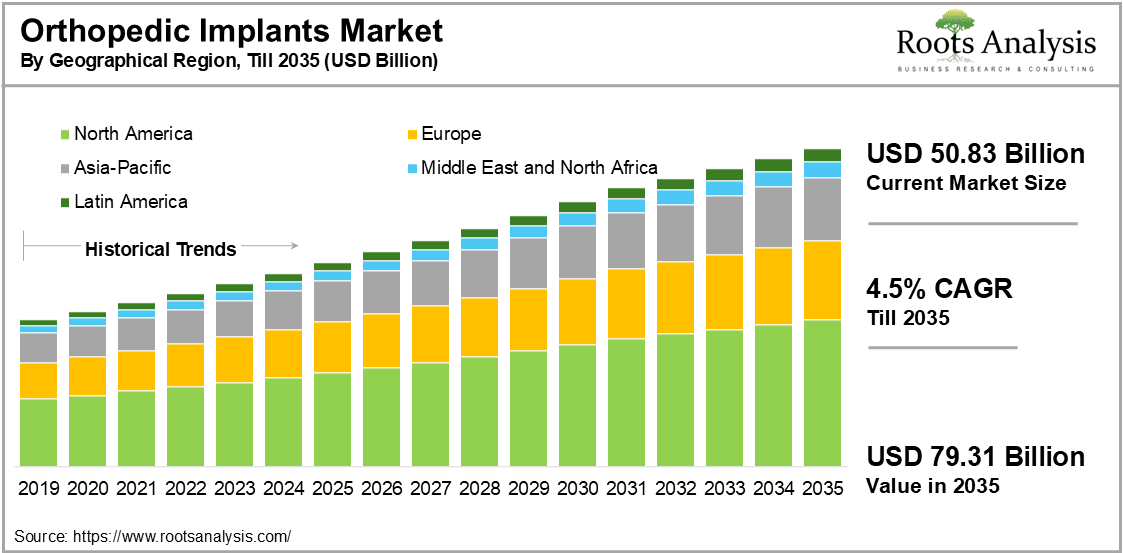
The global orthopedic implants market, valued at USD 48.11 billion in 2024, is expected to grow to USD 50.83 billion in 2025 and USD 79.31 billion by 2035, representing a CAGR of 4.5% during the forecast period.
 |
To learn more about this report, request a free sample copy
According to the report of American College of Rheumatology, every year nearly around 790,000 total knee replacements and 544,000 hip replacements are done the U.S. The high knee replacement or hip replacement surgeries is likely to be the result of excessive loss of bone mass, ligaments and fluid from the joints in geriatric population. With growing incidence of orthopedic conditions among geriatric populations, there has been a surge the demand for orthopedic implants. An orthopedic implant is a form of orthopedic devices used to support damaged bones or replace missing joints / bones. These types of medical implants are typically manufactured by using stainless steel, titanium alloys and other biomaterials.
It is worth noting here that orthopedic implants are also useful to replace damaged bones due to injuries, which further increases the demand for advanced orthopedic implants. Additionally, the increasing technological innovations, penetration of robot assisted surgeries and growing awareness about medical devices for treating musculoskeletal injuries and damaged bones has further bolstered the demand for orthopedic implants. Some of the notable trends that are anticipated to drive the industry include 3D printing, smart implants for real-time monitoring, nanosized structures and biodegradable materials.
It is worth noting that in July 2024, the Orthopaedic Implant Company launched latest the OIC Flex-Fix™ System (orthopedic care). This system is particularly designed to treat syndesmotic injuries (ankle injury) that occur due to extreme rotation of the ankle. Given the growing technological innovations, several industrial players are focusing on forging strategic initiatives followed by investments, partnerships and collaborations. For instance, in September 2024, SpineGuard announced 510k clearance for its latest PsiGuard cannulated probe by the FDA. This probe is specifically designed to secure sacroiliac implant placement. With growing innovations in the field, we believe that the orthopedic implants market is expected to grow at a substantial rate during the forecast period.
The market report highlights the invaluable information on the key players who are presently active across various segments of the orthopedic implants industry.
| Key Report Attributes | Details | |
| Historical Trend | Since 2019 | |
| Forecast Period | Till 2035 | |
| Market Size 2035 | USD 79.31 billion | |
| Market CAGR | ~4.5% | |
| Type of Product |
|
|
| Type of Material |
|
|
| Type of Procedures |
|
|
| Type of Devices |
|
|
| Type of Application |
|
|
| Type of End User |
|
|
| Key Geographical Region |
|
|
| Key Companies Profiled |
|
|
| PowerPoint Presentation (Complimentary) |
Available | |
| Customization Scope | 15% Free Customization | |
| Excel Data Packs (Complimentary) |
Available | |
One of the key objectives of the orthopedic implants market report was to estimate the current market size, opportunity and the market growth potential, over the forecast period, till 2035. We have provided informed estimates on the likely evolution of the market for the forecast period.
Additionally, the market report features the likely distribution of the current and forecasted opportunity within the market distributed across various segments such as type of product (lower extremity implants / reconstructive joint replacement, spinal implants, vertebral compression fracture (VCF) devices, motion preservation devices / non-fusion devices, dental, upper extremity implants, trauma, orthobiologics and other products), type of material (metallic material, ceramic biomaterials, polymeric biomaterials and other materials), type of procedure (open surgery, minimally invasive surgery (MIS), and other procedures), type of device (internal fixation devices and external fixation devices), type of application (neck fracture, spine fracture, hip replacement, shoulder replacement, knee replacement, ankle replacement, wrist & shoulder fracture and other applications), end users (hospitals, outpatient facilities and other end users), geographical region (North America, Europe, Asia-Pacific, Middle East and North Africa, and Latin America), and leading players.
To account for the uncertainties associated with the development of advanced orthopedic implants and to add robustness to our model, we have provided three market forecast scenarios, portraying the conservative, base and optimistic tracks of the market’s evolution.
All actual figures have been sourced and analyzed from publicly available information forums and primary research discussions. Financial figures mentioned in this market research report are in USD, unless otherwise specified.
Based on the type of product, the global orthopedic implants market is segmented into lower extremity implants (knee implants, hip implants and foot & ankle implants), spinal implants (spinal fusion implants (thoracolumbar devices, cervical fixation devices and interbody fusion devices), vertebral compression fracture (VCF) devices (balloon kyphoplasty devices and vertebroplasty devices), motion preservation devices / non-fusion devices (dynamic stabilization devices, artificial disc replacement devices, annulus repair devices and nuclear disc prostheses), dental (dental implants and craniomaxillofacial implants), upper extremity implants (elbow implants, hand & wrist implants and shoulder implants), trauma, orthobiologics (demineralized bone matrix (DBM), allograft, bone morphogenetic protein (BMP), viscosupplementation products, synthetic bone substitutes and others) and other products.
According to our projection, lower extremity implants account for the highest share (over 45%) of the market. This can be attributed to the growing geriatric population with knee, ankle and hip injuries due to decreasing bone biomass. Lower extremity implants in this instance helps to support knee and hip for accurate movement. Additionally, the growing research on advanced implants with higher biocompatibility to fix lower extremity issues has contributed to the highest share of the segment.
However, in the long run, dental implants segment is anticipated to grow at a higher CAGR during the forecast period. This is due to the growing demand for dental implants to fix malocclusion and other dental restorative treatments. Further, advanced dental implants have also been adopted to meet aesthetic appearance goals of the youth, which is anticipated to be a key reason for unprecedented growth.
This segment highlights the distribution of global market based on the type of material into metallic biomaterial (stainless steel, titanium, titanium alloy, cobalt alloy and other metallic materials), ceramic biomaterials, polymeric biomaterials and other materials. According to our projection, metallic biomaterials account for the highest orthopedic implants market share (nearly 60%). This can be attributed to the fact that metallic biomaterials offer better stimulation for bone healing as compared to other type of materials. Moreover, they are highly cost-effective and versatile designing different types of orthopedic implants including screws and plates.
However, it is worth noting that polymeric biomaterials and ceramic biomaterials are gaining traction during the projected period and are likely to grow at a higher CAGR during the forecast period. Several factors such as reduced toxicity, extended life and high biocompatibility of polymeric biomaterials has contributed to widespread adoption. On the other hand, ceramic biomaterials are also gaining popularity for the manufacturing of dental implants and other surgical equipment.
The global orthopedic implants market size is distributed across different type of procedure such as open surgery, minimally invasive surgery (MIS), and other procedures. According to our projection, presently minimally invasive surgery accounts for the highest share of the market. This can be attributed to the growing preferences for minimal invasive surgeries by the population suffering from orthopedic issues. Driven by the ongoing preference, it is estimated that minimal invasive surgery segment will continue to grow at a steady CAGR during the forecast period.
Based on the type of device, the global orthopedic implants market is segmented into internal fixation devices and external fixation devices. Among these, internal fixation devices accounts for the highest share of the market. This can be attributed to the fact that internal fixation devices such as plates, rods and screws are widely adopted for the stabilization of internal fractures, damaged bones and joints reconstruction. With growing incidence of orthopedic issues in geriatric population and increasing accidental injuries, the demand for internal fixation devices has significantly increased, which further supported the demand for internal fixation devices. Driven by the growing preferences for internal fixation devices, this segment will continue to grow at a higher CAGR during the forecast period.
On the basis of type of application, the global orthopedic implants market size is distributed across neck fracture, spine fracture, hip replacement, shoulder replacement, knee replacement, ankle replacement, wrist & shoulder fracture and other applications. According to our analysis, currently knee replacement occupies the highest share (nearly 40%) of the market. This can be attributed to the increasing incidence of knee associated orthopedic issues such as ligament injuries, osteoarthritis and knee fractures. Furthermore, the growing geriatric population with knee associated issues has necessitated the demand for advanced knee implants to restore mobility and reduce pain. As per the 2024 American Joint Replacement Registry Annual Report, majority of the procedure performed in the US from 2012-2023 include knee replacement, specifically primary knee arthroplasty.
It is important to highlight here that spine fracture segment is likely to grow at a higher CAGR during the forecast period. This can be attributed to the growing incidence of obesity and geriatric population with spinal disorders. People with obesity may experience tremendous pressure on the spine, thereby increasing the risk of spine fracture and injuries.
Based on the end user, the global market is segmented into hospitals, outpatient facilities and other end users. Currently, hospitals account for the highest orthopedic implants market share (nearly 45%). This can be attributed to the fact that hospitals provide special care and surgical facilities to perform implant surgery. Additionally, high number of patients with orthopedic conditions in hospitals has further contributed to the highest share of the hospitals segment.
It is important to highlight here that the outpatient facilities segment is likely to grow at a higher CAGR during the forecast period. This can be attributed to the growing preferences for orthopedic clinics and ambulatory surgery centers for orthopedic implants and surgical procedures. It is important to highlight here that outpatient facilities offer several benefits such as personalized care, low cost and minimal waiting time, which further contributed to the growth of this segment during the forecast period.
The global orthopedic implants market size is distributed across key geographical regions including North America, Europe, Asia-Pacific, Middle East and North Africa, and Latin America. According to our projection, presently North America is dominating the market with a share of 46%. This can be attributed to the growing incidence of orthopedic conditions among the population of US and increasing innovations for the development of smart orthopedic implants. The US has the highest prevalence of osteoarthritis at 806 per 100,000 people. Additionally, procedures including total joint replacement are reimbursed in the US under Medicare and Medicaid. Furthermore, the availability of advanced hospital infrastructure to perform minimal invasive surgical procedures to restore mobility in patients has further contributed to the highest share of this segment.
It is important to highlight here that in Asia-Pacific, the market for orthopedic implants is expected to register a higher CAGR during the forecast period. This is primarily due to the growing demand for innovative orthopedic implants to treat patients with spine injuries, knee and hip replacement specifically among geriatric patients. Additionally, regions like Japan and Korea claim to have a high number of hospital beds per 1,000 people, standing at 12.6 and 12.7, respectively. Furthermore, these countries also have high osteoarthritis rates, supporting the growth of orthopedic implants in Asia Pacific.
The “Orthopedic Implants Market: Industry Trends and Global Forecasts, till 2035” market research report features an extensive study of the focus on competitive landscape of strategic initiatives, emerging mega trends, big pharma initiatives, company profiles and key drivers and restraints. The market report highlights the efforts of several stakeholders engaged in this rapidly evolving segment of the orthopedic implants industry. Key takeaways of the market report are briefly discussed below.
Currently, the global market landscape of orthopedic implants is immensely competitive featuring well-established and new-entrants. A few startups in the field include Restor3D, which secured USD 70 million in venture and debt funding for advancing its 3D printed orthopedic implants in July 2024. The implants are manufactured using 3D printing. Another startup is US based OrthoPreserve (founded by Georgia Tech alumnus), which was established in 2021 and is developing meniscus implant using biocompatible hydrogel.
The primary aim of industrial players is on technological innovations and development of smart orthopedic implants. For instance, in June 2024, Biorectec (biodegradable orthopedic implants manufacturer) announced the positive outcomes of RemeOs™ technology and RemeOs™ screws in US for implantation and fracture healing. The significances of using advanced technology and screws of RemeOs™ includes high bioactivity and oestopromotion at the site of healing. Overall, the market features several small, mid-sized and large companies who are leveraging competitive edge to extend their product portfolio and maintain a robust position in the market.
Some of the notable drivers that are anticipated to propel the market includes high incidence of osteoporosis, accidental injuries and sports related injuries. It is important to highlight here that the World Health Organization (WHO) reported nearly 73% of the global population (older than 55 years and 60% female) is living with osteoarthritis. Additionally, the growing prevalence of obesity across the globe has underscored the demand for advanced orthopedic implants that helps to restore mobility and support the knees and hip. Additionally, the increasing risk of musculoskeletal disorders has further increased the demand for orthopedic implants.
Although the demand for orthopedic implants has significantly increased, there are still some challenges that needs to be addressed. Some of the notable challenges are stringent guidelines associated with the approval of orthopedic implants and high cost. Notably, medical device are required to surpass the regulatory guidelines to ensure that implants are safe to use for humans. These complex guidelines may create significant challenges for the market leaders for receiving approval.
It is important to highlight here that the average cost of knee implants may range from USD 1,797 to USD 12,093 in US. However, depending on the type of orthopedic implants such as knee replacement, hip and shoulder, the cost may vary. The high cost of treatment may impede the widespread adoption of the orthopedic implants by population.
Some of the potential trends that are shaping orthopedic implants industry growth includes smart implants, robot-assisted surgeries and augmented reality. Smart orthopedic implants are equipped with biosensors that helps to monitor load distribution, patient movement and implant performance. The information collected through smart implants helps surgeons to optimize the treatment to meet individual patient requirements.
Additionally, market players are focusing integrating augmented reality, robot-assisted surgeries and computer generated 3D printing that aid in performing orthopedic implants surgeries with higher precision. Moreover, the rising focus on digital templating that require advanced imaging technology and software to design orthopedic implants is another key trend of the market that is anticipated to drive the market at steady rate.
Currently, the global orthopedic implants market is expected to be valued at USD 50.83 billion and is poised to reach USD 79.31 billion by 2035. Driven by the ongoing incidence of osteoporosis, the demand for orthopedic implants has increased, which is expected to drive the market at a CAGR of 4.5% during the forecast period. It is important to highlight here that the industrial players are forging strategic partnerships to initiate the development of smart implants. For instance, in November 2024, Freemelt and OEM (Orthopedic Implant Original Equipment Manufacturer) enter into strategic partnership to demonstrate their serial product capabilities. This partnership is a strategic milestone to install the OEM’s production plant in Q2 2025, marking their beginning of the proof-of-concept phase.
Similarly, in June 2024, DEDIENNE SANTE stepping up for the expansion of its services by setting new sights in African market. The company aim to offer high-quality orthopedic solutions on global level. Therefore, the rising partnerships and industrial players initiatives are expected to drive the market during the forecast period.
Examples of key players engaged in this orthopedic implants industry (which have also been captured in this report) include Arthrex, Acumed, Aesculap Implant Systems (a subsidiary of B. Braun Melsungen), Alphatec Holdings, ConforMIS, Corin Group, DJO Global, DePuy Synthes (Johnson & Johnson), Exactech, FH Orthopedic, Globus Medical, Invibio Biomaterial Solutions, Integra LifeSciences Holdings, Lima, Medtronic, MicroPort Scientific, Medacta, NuVasive, Orthofix Medical, Pega Medical, Stryker, Smith & Nephew, Tornier (Acquired by Wright Medical Group), Wright Medical Group and Zimmer Biomet Holdings. This market report includes an easily searchable excel database of all the companies focusing on advanced orthopedic implants. In parallel, medical polymers provide biocompatible materials for implants, disposables, packaging and drug-delivery components.
The market report presents an in-depth analysis, highlighting the capabilities of various companies engaged in this domain across different segments. Amongst other elements, the market report includes:
Several recent developments have taken place in the field of orthopedic implants. We have outlined some of these recent initiatives below.