
Lowest Price Guaranteed
Pages
205
Last Updated
August 2026
View Count
14827
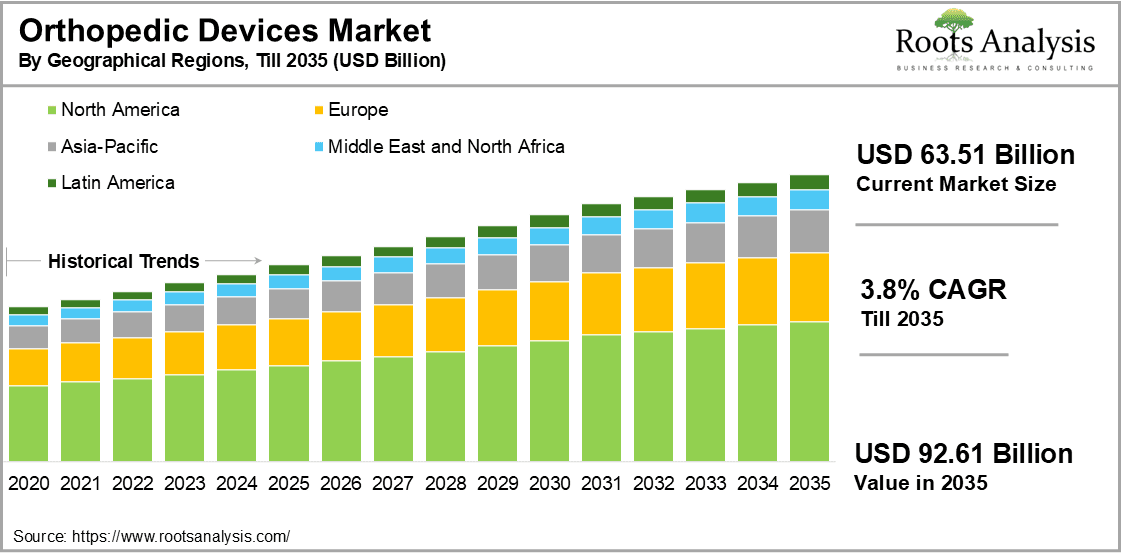
The global orthopedic devices market size, valued at USD 60.56 billion in 2024, is projected to reach USD 63.51 billion in 2025 and USD 92.61 billion by 2035, representing a CAGR of 3.8% during the forecast period.
 |
Orthopedic devices are a form of special equipment designed to correct by stabilizing the fracture bones, replace bones / joints to support musculoskeletal system. These devices play an important role in orthopedic medicines helping patients in regaining mobility and improving their quality of life. It is important to highlight here that after the age of 50, bone mass start decreasing along with micro-architectural deteriorating of tissues which makes bones more porous, ultimately increasing the risk of osteoporosis-associated fracture.
According to the report published by International Osteoporosis Foundation in 2024, nearly 200 million women across the global have osteoporosis. Furthermore, around 75 million people in Japan, Europe and USA are affected with osteoporosis. Considering the increasing incidence, healthcare experts use orthopedic implants to help patients regain mobility and improve quality of life. However, it is important to highlight here that orthopedic devices can also help in addressing problems such as osteoarthritis, spinal injuries, sports injuries, damaged ankles and joints.
Driven by the increasing adoption, several industrial players have shown active participation in this field to develop advanced orthopedic devices to meet unmet requirements of patients. However, the primary focus of industrial players will remain on technological innovations, wearable technologies and integrating artificial intelligence technologies to enhance patient outcomes.
For instance, in September 2024, Maxx Orthopedic announced that its Freedom® Titan PCK Revision Knee System received the USFDA clearance. Moreover, Maxx orthopedic also entered into the strategic partnership with Unik Orthopedics to develop advanced personalized medical devices and software for joint replacement procedures. Notably, the consist innovation and rising strategic partnership between industrial players are likely to maintain a competitive edge in the orthopedic devices industry, making this industry investible for a long time.
The market report on orthopedic devices provides comprehensive information on industrial players who are currently active across various segments of the industry as mentioned in the table below.
| Key Report Attributes | Details | |
| Historical Trend | Since 2020 | |
| Forecast Period | Till 2035 | |
| Current Market Size | USD 63.51 Billion | |
| Market Size 2035 | USD 92.61 Billion | |
| CAGR (Till 2035) | ~3.8% | |
| Type of Product |
|
|
| Type of Injury Site |
|
|
| Type of Application Area |
|
|
| End User |
|
|
| Geographical Regions |
|
|
| Key Companies Profiled |
|
|
| PowerPoint Presentation (Complimentary) |
Available | |
| Customization Scope | 10% Free Customization | |
| Excel Data Packs (Complimentary) |
Available | |
One of the key objectives of the orthopedic devices market report was to estimate the current size, opportunity and the market growth potential, over the forecast period, till 2035. We have provided informed estimates on the likely evolution of the orthopedic devices industry for the forecast period.
The global orthopedic devices market analysis report also features the likely distribution of the current and forecasted opportunity within the market across various segments, such type of product (joint reconstruction (knee replacement (revision knee replacement implants, total knee replacement implant and partial knee replacement implant), elbow & shoulder replacement, hip replacement (hip resurfacing implant, total hip replacement implant, partial hip replacement implant, revision hip replacement implant and others)), orthopedic prosthetics (upper extremity orthopedic prosthetics and lower extremity orthopedic prosthetics), spinal devices (spinal non-fusion devices and spinal fusion devices), trauma fixation (nails and rods, metal plates & screws, pins / wires and others), arthroscopy devices, orthopedic accessories (removal systems, bone cement and casting system), orthopedic braces and supports (upper extremity braces and supports and low extremity braces and supports), sports medicine (body reconstruction & repair, accessories, body monitoring & evaluation and body support & recovery), orthobiologics (viscosupplementation, demineralized bone matrix, synthetic bone substitutes, bone morphogenetic protein (bmp), stem cell therapy and allograft) and other products), type of injury site (foot and ankle, knee and thigh, hip and pelvis, hand and wrist, shoulder, arm and elbow, spine and craniomaxillofacial), type of application area (fracture treatment and recovery, rheumatoid arthritis and osteoarthritis, neurological disorders, ligament injuries, diabetic foot diseases, spinal fusion, fixation, and decompression), end user (hospitals, ambulatory care center, specialized clinics, orthopedic centers, home care settings, and other end users), geographical regions (North America, Europe, Asia-Pacific, Middle East and North Africa, and Latin America) and leading players.
In order to account for future uncertainties associated with some of the key parameters and to add robustness to our model, we have provided three market forecast scenarios, namely conservative, base, and optimistic scenarios, representing different tracks of industry’s evolution.
All actual figures have been sourced and analyzed from publicly available information forums and primary research discussions. The financial figures mentioned in this market report are in USD, unless otherwise specified.
Based on the type of product, the global orthopedic implants market is segmented into joint reconstruction, orthopedic, trauma fixation, arthroscopy devices, orthopedic accessories, orthopedic braces and supports, sports medicine, orthobiologics, and other products.
According to our projection, presently joint replacement / orthopedic implants market segment accounts for the highest orthopedic devices market share (46%). This is likely to be the result of increasing incidence of knee replacement surgeries for improving the mobility. The availability of advanced robotic-assisted joint replacement surgeries and orthopedic implants has further contributed to the highest share of this segment.
However, in the long run, orthobiologics market segment is expected to grow at a higher CAGR during the forecast period. This is primarily due to the growing adoption of orthobiologics solutions, such as synthetic bone substitutes, stem cell therapy and bone morphogenetic protein to promote tissue regeneration. Additionally, growing preferences for minimal invasive procedures for the treatment of musculoskeletal conditions, such as joint injuries and tissue / ligament damage has further bolstered the demand for orthobiologics solutions.
On the basis of injury site, the global orthopedic devices market size is distributed into foot and ankle, knee and thigh, hip and pelvis, hand and wrist, shoulder, arm and elbow, spine and craniomaxillofacial. According to our projection, currently foot and ankle accounts for the highest share (nearly 25%) of the market. This can be attributed to the high incidence of foot and ankle injuries during intense activities, such as running or playing sports.
However, in the long run, the spine segment is likely to register a higher CAGR during the forecast period. This is likely to be the result of growing incidence of spine injuries and diseases, such as degenerative disc disease and scoliosis.
The global market is further categorized based on the type of application area into fracture treatment and recovery, rheumatoid arthritis and osteoarthritis, neurological disorders, ligament injuries, diabetic foot diseases, spinal fusion, fixation, and decompression. According to our orthopedic devices market analysis, fracture treatment and recovery account for the largest share of the market. This is likely to be the result of the high prevalence of osteoarthritis among aging populations and increasing accidental injuries potentially bone fractures. Notably, plates, screws and rods are the most widely adopted orthopedic devices to treat fracture treatment.
It is worth mentioning that with the rising risk of spinal disorders, there has been a surge in the demand for minimal invasive orthopedic devices for spinal fusion and fixation. Considering the ongoing risk, these segments are likely to grow at higher CAGR during the forecast period.
Based on the end user, the orthopedic devices industry is segmented into hospitals, ambulatory care centers, specialized clinics, orthopedic centers, home care settings, and other end users. Currently, hospitals segment holds the highest orthopedic devices market share (44%). This can be attributed to the availability of highly experienced surgeons to perform orthopedic surgeries and advanced orthopedic device-based treatment in hospitals. Furthermore, patients also prefer to have orthopedic treatment in hospital settings due to the availability of skilled healthcare experts.
However, in the future, it is expected that home care settings and specialized clinics are likely to grow at a higher CAGR during the forecast period. This is likely to be the result of the growing geriatric population of orthopedic disorders that underscore the demand for advanced orthopedic devices to provide treatment at home and rising patients’ preferences in receiving personalized care in specialized clinics.
The global market is distributed across different geographical regions, such as North America, Europe, Asia-Pacific, Middle East and North Africa, and Latin America. Currently, North America occupies the dominating position in the orthopedic devices market (holding 49% share). This dominance is due to increasing geriatric population with musculoskeletal issues, such as osteoarthritis and bone mass generation that significantly impact mobility. Furthermore, the adoption of advanced technologies to treat orthopedic problems and rising strategic initiatives by industrial players in this region to develop innovative devices for improving mobility has contributed to the highest share.
The market for orthopedic devices in Asia-Pacific is expected to grow at a higher CAGR during the forecast period. This is potentially due to large patient pool of osteoarthritis and other musculoskeletal conditions. Additionally, there is high demand for orthobiologics solutions in Asian countries to treat patients with massive bone mass degeneration that impact their mobility.
The “Orthopedic Devices Market: Industry Trends and Global Forecasts, till 2035” market report features an extensive study of the current market landscape, market size, market share, market growth, market trends, market value, market forecast, market outlook, statistics and future opportunities for orthopedic devices industrial players. The market research report lays emphasis on the orthopedic devices products that are being developed for the treatment of orthopedic conditions. Key takeaways of the market report are briefly discussed below.
Currently, the market for orthopedic devices is highly competitive, featuring the presence of several small, mid-sized and large industrial players. These industrial players are presently emphasizing the technological innovations to develop advanced orthopedic devices for improving mobility.
In order to leverage the competitive edge, various industrial players are undergoing strategic partnerships and collaborations. For instance, in October 2024, Qwadra (digital division of Eqwal) and create it REAL entered into a strategic partnership to incorporate Create it REAL’s multi-patented programmable foam technology into Qwadra’s Sona Flex and Sona Edge 3D printers. The integration of technology helps to develop customized orthopedic devices with higher speed, material efficiency and precision.
Similarly, several industrial players are also emphasizing partnerships to expand product portfolio, which is expected to maintain a competitive edge in the market.
Some of the top drivers of the orthopedic devices market include rising incidence of orthopedic disorders and sports injuries. It is important to highlight here that osteoarthritis, rheumatoid arthritis and osteoporosis can cause intense pain and physical disability which impact quality of life. These conditions require advanced orthopedic devices and surgical treatments for joint replacement and mobility fixation.
In addition, rising sports injuries, such as ankle twist, wrist fracture and ligament damage has further necessitated the demand for fracture fixation devices, tissue repair devices and arthroscopic devices.
Orthopedic devices have been adopted on a large scale to improve the mobility of patients. However, there are several challenges that still need to be addressed for unprecedented growth. Some of the notable challenges are the high cost of orthopedic devices, post-surgical complications and complex regulatory guidelines for the approval of devices. It is important to highlight here that the average cost of orthopedic devices specifically for hip and knee replacement may ranges from USD 5000 or above. The high cost may limit the adoption across low- and middle-income population, thereby hindering the orthopedic devices market growth. In addition, risk of complications, such as implant failure, infection and revised surgery may limit the widespread adoption of these devices.
Despite challenges, the global orthopedic devices industry is witnessing significant growth driven by the growing technological advancements. It is worth noting that industrial players are focusing on the development of personalized orthopedic implants and devices by leveraging 3D printing technology. These custom designed orthopedic devices will help in providing patient-specific devices to improve fitness and function.
In addition, high demand for minimal invasive surgery and robot-assisted surgeries to enhance precision, faster recovery and smaller incision are the key trends of the market. Furthermore, the growing demand for orthobiologics and regenerative medicine for tissue repair and spinal fusion are offering lucrative opportunities to drive innovation in this field.
Currently, the orthopedic devices industry is expected to be valued at USD 63.51 billion and is poised to reach USD 92.61 billion by 2035, representing a CAGR of 3.8% during the forecast period. This can be attributed to the increasing incidence of orthopedic disorders among geriatric patients and sports injuries.
It is important to highlight here that market players are consistently focusing on technological innovations to meet the unmet requirements of the patients with orthopedic conditions and expanding global reach to provide advance treatment to patients. For instance, in September 2024, SpineGuard announced that the company has received authorization under 510K from the USFDA to commercialize its Posterior sacroiliac fusion (PsiFGuard) surgical procedure in the United States. Owing to the increasing initiatives by industrial players, this market will remain investible for the long term.
Examples of key players engaged in the orthopedic devices market (which have also been captured in this report) include Aesculap (B. Braun Company), Arthrex, CONMED, DePuy Synthes, Enovis (formerly known as DJO), Globus Medical, Medtronic, NuVasive (merged with Globus Medical), Stryker, Smith+Nephew and Zimmer Biomet. This market report includes an easily searchable excel database of all the companies focusing on the development of orthopedic devices.
The market report presents an in-depth analysis, highlighting the capabilities of various companies engaged in this domain across different segments. Amongst other elements, the market report includes:
Several recent developments have taken place in the field of orthopedic devices. We have outlined some of these recent initiatives below.