
Lowest Price Guaranteed
Slides
118
Last Updated
September 2026
View Count
3159
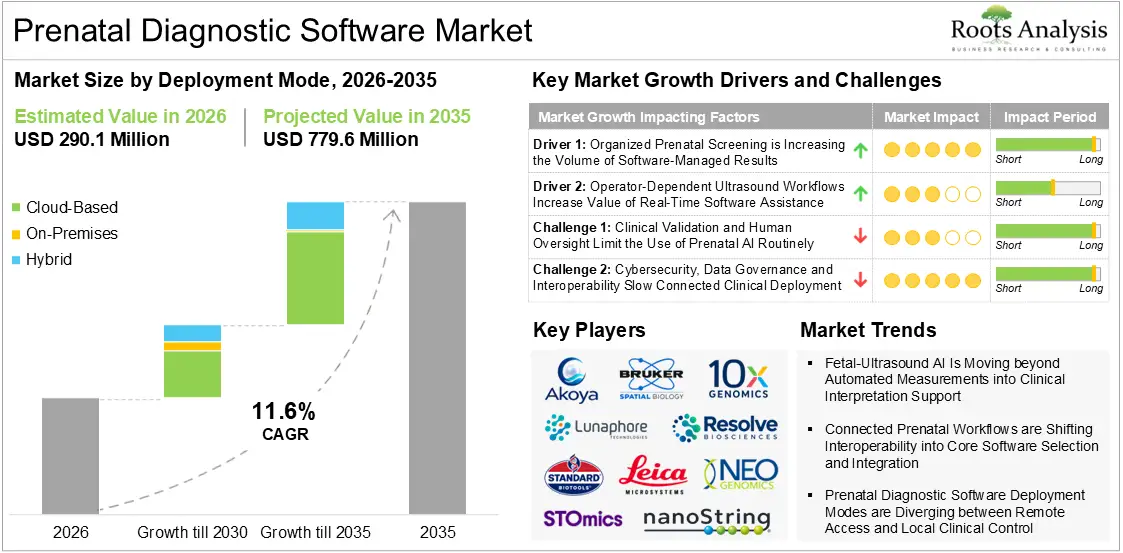
The global prenatal diagnostic software market is estimated at USD 290.1 million in 2026 and is projected to reach USD 779.6 million by 2035, expanding at a CAGR of 11.6% during 2026-2035. Growth is being supported by broader prenatal screening, increasing use of software-assisted fetal imaging, and greater integration of risk assessment, reporting and clinical workflow tools.
Prenatal screening and diagnostic workflows increasingly depend on software to convert laboratory and imaging data into information that can be reviewed and acted upon within pregnancy care. Genetic screening programs use dedicated applications to calculate risk, manage quality controls and structure reports, while fetal-ultrasound software is extending beyond measurements toward exam-completeness assessment, image interpretation and abnormality detection. This software layer does not replace the underlying test, ultrasound system or clinician; its role is to make the information generated by those activities more consistent, traceable and clinically usable.
The market is consequently broadening from specialist calculators and departmental reporting applications toward connected products that sit across laboratory, ultrasound and maternal-fetal medicine workflows. Prenatal risk platforms increasingly exchange information with laboratory systems, ultrasound devices and enterprise health records, while newer AI-enabled applications are positioned directly within imaging workflows. The result is a more software-intensive pathway in which value is created not only by an algorithm, but by the ability to move a result from acquisition or screening through interpretation, documentation and referral without breaking clinical context.
Adoption remains closely tied to clinical responsibility and health-system infrastructure. Screening software can estimate risk but does not establish a definitive diagnosis, and AI-assisted ultrasound findings still require professional review. Hospitals and laboratories must also reconcile deployment architecture with cybersecurity, data governance and interface requirements. These constraints are slowing indiscriminate automation, but they are also increasing demand for validated software that fits established clinical pathways. Over the forecast period, differentiation is expected to shift toward products that combine analytical performance with interoperability, auditable workflows and practical deployment across both centralized and distributed care settings.
Prenatal diagnostic software connects the different stages of screening, assessment and follow-up during pregnancy. Screening laboratories produce biochemical and genetic results, while ultrasound services generate fetal images, measurements and structured observations. Hospitals, maternal-fetal medicine centers and obstetrics / gynecology (OB / GYN) clinics then interpret these findings alongside maternal history and other clinical information. Software supports this flow by performing risk calculations, reviewing data quality, assisting image assessment, organizing documentation and reporting, and transferring clinically relevant information between laboratory, imaging and hospital systems.
These functions become particularly important when an initial finding changes the course of care. A higher-risk cfDNA or biochemical screening result may prompt counseling, detailed ultrasound or invasive diagnostic testing, while a suspected ultrasound abnormality can lead to specialist review and further investigation. Prenatal software helps maintain continuity across these steps by keeping results, calculations and reports available as the patient moves through the pathway. The market therefore centers on paid software products and services, including licenses, subscriptions, per-analysis fees, implementation, support and separable prenatal AI modules, while ultrasound equipment, laboratory tests, reagents and counseling remain outside the software market itself.
| Company | Prenatal Software | Type of Software | Application | Primary End User | Deployment / Integration / Regulatory Positioning |
| Revvity | LifeCycle Prenatal Screening | Genetic Analysis Software, Clinical Decision Support Software | Aneuploidy Screening, Maternal-Fetal Risk Assessment | Diagnostic Laboratories, Public Health Programs | Browser-based interface with configurable laboratory information management systems and ultrasound connectivity, including HL7 options |
| GE HealthCare | ViewPoint 6 for Women's Health | Workflow Software | Fetal Anomaly Detection, Pregnancy Monitoring & Dating | Hospitals & Health Systems, Maternal-Fetal Medicine Centers | Connects ultrasound reporting with PACS / EMR environments and supports browser access within enterprise infrastructure |
| Sonio (Samsung Medison) | Sonio Detect; Sonio Suspect | Ultrasound Analysis Software | Fetal Anomaly Detection | Maternal-Fetal Medicine Centers, Hospitals & Health Systems | FDA decisions in March and June 2026 support current regulated use of exam-quality and anomaly-detection software functions |
| NEXUS / ASTRAIA | ASTRAIA prenatal modules | Integrated Platforms, Clinical Decision Support Software | Aneuploidy Screening, Maternal-Fetal Risk Assessment | Hospitals & Health Systems, Maternal-Fetal Medicine Centers, OB / GYN Clinics | Interfaces include HIS, laboratory, PACS / VNA and DICOM ultrasound environments |
AI applications in prenatal ultrasound now cover a wider set of clinical tasks than automated measurements alone. Recent software can check whether required views have been captured, assess fetal anatomy and identify findings that warrant closer review. FDA decisions in 2026 for Sonio Detect v3, Sonio Suspect and Delivery Date AI demonstrate regulatory progress across examination quality, anomaly detection and pregnancy dating. This broadening of clinical functionality is raising expectations for AI-enabled medical imaging and prenatal imaging software, with vendors competing on how effectively AI can assist different stages of an ultrasound examination while keeping interpretation and final clinical judgment with trained specialists.
Over the years, prenatal diagnostic software design has evolved to work across laboratory, ultrasound and hospital information systems rather than remain confined to a single analytical task. Current products support connections with LIMS, PACS, EMR, HIS and DICOM environments, allowing risk calculations, measurements, images and reports to pass between the systems used during screening and specialist assessment. This is making integration capability more important in product selection because software output must enter established clinical workflows without adding manual transfer steps. The European Health Data Space adds further relevance to this trend by placing laboratory results and medical images among priority categories for future cross-border health-data exchange
Prenatal software vendors are serving a wider mix of centralized laboratories, hospital departments and distributed clinical sites, each with different requirements for access, connectivity and data control. Screening networks and distributed clinical teams can benefit from remote access and centrally managed applications, while hospitals and ultrasound departments may require local processing because of latency, connectivity, data-location policies or integration with installed imaging systems. Diagnoly, for example, supports local operation without dependence on cloud connectivity, while other prenatal systems provide browser-based access within controlled enterprise environments. The market is therefore developing around a spectrum of deployment choices. Vendors that can accommodate both scalable access and local clinical requirements are better positioned to serve heterogeneous laboratory and health-system environments.
The decentralization of prenatal screening is creating demand for software that can preserve standardized risk assessment and reporting outside large, centralized laboratories. In August 2026, Revvity launched SuperFlex for smaller and mid-sized laboratories and clinics and positioned LifeCycle integration as part of the workflow. Anna Godenhjelm, Vice President and General Manager of Reproductive Health at Revvity, stated "By removing the financial and operational barriers to in-house prenatal screening, we are giving more women access to potentially life-saving testing."
The prenatal diagnostic software market report includes transcripts of the following third-party discussions:
The prenatal diagnostic software market is segmented by software type, application, deployment mode, end user and geography. Each dimension represents an independent view of the same global software revenue pool.
| Market Segments | Sub-segment Details | |
| Software Type | Genetic Analysis Software, Ultrasound Analysis Software, Laboratory Management Software, Clinical Decision Support Software, Workflow Software, Integrated Platforms | |
| Application | Aneuploidy Screening, Genetic Disorder Screening, Fetal Anomaly Detection, Maternal-Fetal Risk Assessment, Pregnancy Monitoring & Dating, Other Applications | |
| Deployment Mode | Cloud-Based, On-Premises, Hybrid | |
| End User | Diagnostic Laboratories, Hospitals & Health Systems, Maternal-Fetal Medicine Centers, OB/GYN Clinics, Public Health Programs, Other End Users | |
| Geography | North America, Europe, Asia-Pacific, Latin America, Middle East & Africa | |
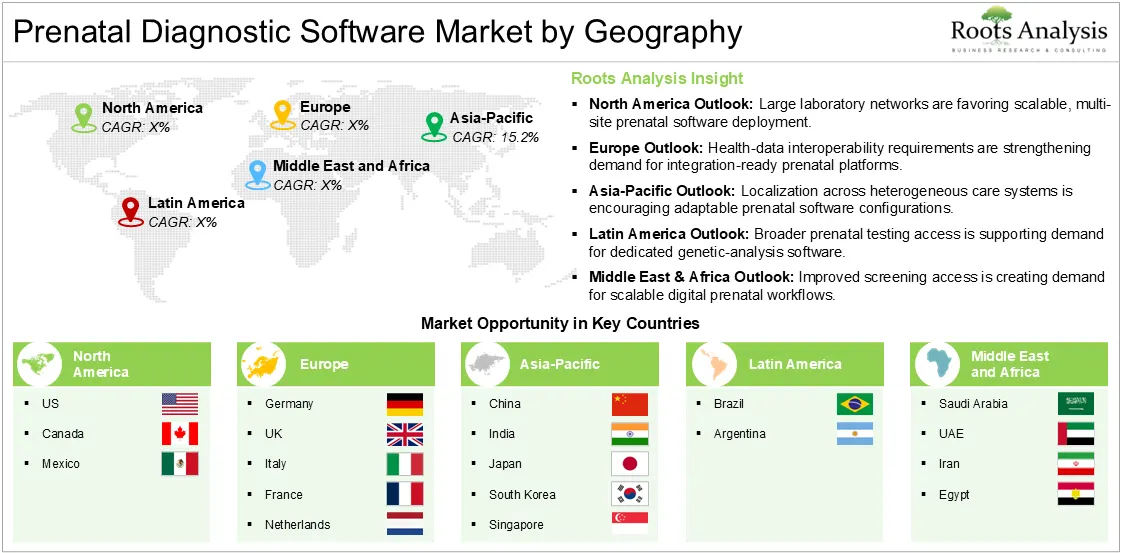
North America accounts for close to 40% of global prenatal diagnostic software revenue in current year. The region combines mature diagnostic-laboratory and hospital infrastructure with broad prenatal genetic screening and an active regulatory route for emerging software functions. US guidance supports routine availability of cfDNA screening, and recent FDA decisions have expanded the visible set of regulated prenatal ultrasound applications across exam quality, anomaly detection and pregnancy dating. These conditions create a comparatively large regional installed base for paid software spanning laboratories, health systems and maternal-fetal medicine services.
Asia-Pacific is projected to record the fastest regional growth, at a CAGR of 15.2% through 2035. Expansion is being supported by the formalization of screening networks and specialist prenatal services in major markets rather than by a low starting base alone. China reported a prenatal screening rate of 91.3% for 2023 while strengthening service-management requirements, and Japan maintains a certified NIPT delivery network. Regional conditions remain uneven, but continued growth in organized testing, specialist imaging and digital health infrastructure gives software providers more opportunities to serve standardized screening, reporting and referral workflows across a larger number of sites.
Genetic analysis software accounts for the largest share (26%) by software type in the current market. Its leading position reflects the established role of prenatal genetic screening in routine care, as prenatal genetic screening creates a recurring software requirement each time results move from laboratory testing to clinical interpretation. cfDNA and other screening workflows rely on risk calculation, quality checks, interpretation and standardized reporting before results can be communicated or referred for further assessment. That repeatable laboratory workflow gives genetic-analysis software a broad and relatively established base across diagnostic laboratories and organized screening programs.
Ultrasound analysis software is projected to record the fastest CAGR from 2026 to 2035, driven by the use of software for a broader range of tasks during fetal ultrasound examinations that extends beyond automated measurements to image-quality assessment, examination completeness, fetal anomaly detection and pregnancy dating. FDA decisions during 2026 across several of these applications show that regulated software is reaching more stages of fetal imaging, giving hospitals and maternal-fetal medicine services additional reasons to add dedicated analytical tools to established ultrasound workflows. Adoption will nevertheless depend on consistent performance across equipment, operators and patient populations, together with continued specialist oversight.
Aneuploidy screening accounts for the largest prenatal diagnostic software market share in current year, supported by its established place in routine prenatal screening. cfDNA and biochemical screening generate large volumes of patient-specific information that must be translated into consistent risk assessments before results can guide counseling, follow-up imaging or confirmatory testing. Software has consequently become embedded in these pathways for risk calculation, quality control, interpretation and structured reporting. The increasing standardization of prenatal screening programs further reinforces this requirement by placing greater emphasis on reproducible analysis, traceable results and timely communication across laboratories and obstetric care teams.
Fetal anomaly detection is projected to grow at a relatively higher CAGR through 2035. Its growth momentum reflects the increasing clinical utility of software during fetal ultrasound, where newer applications can assess examination completeness, evaluate anatomical structures and flag suspected abnormalities for specialist review. Regulatory activity in 2026 across anomaly detection, fetal-heart assessment and related prenatal imaging functions indicates that these capabilities are progressing into regulated clinical use. As software becomes useful at more points during detailed fetal assessment, adoption is gaining a stronger clinical basis, although performance validation and specialist oversight remain essential to routine implementation.
Cloud-based deployment holds the maximum share within the current market, reflecting the way prenatal diagnostic information is handled across laboratories, obstetric practices and specialist care settings. Screening results, risk assessments, ultrasound findings and reports often need to be accessed by different users during the same pregnancy pathway. Centrally managed software makes these workflows easier to coordinate by providing consistent access to applications and patient information while allowing software updates, maintenance and support to be managed across multiple locations. This combination of clinical accessibility and centralized administration has established cloud delivery as the dominant deployment model.
Cloud-based platforms are also projected to record the fastest CAGR through 2035. Demand is being reinforced as prenatal screening and specialist services are delivered across broader provider networks, increasing the need for software that can be accessed without maintaining separate installations at every site. Cloud delivery is particularly suited to applications that require frequent software updates, remote specialist access and consistent functionality across geographically dispersed users. These advantages are strengthening its role in newly implemented prenatal software environments, while cybersecurity, data residency and integration requirements continue to influence how cloud systems are configured within clinical settings.
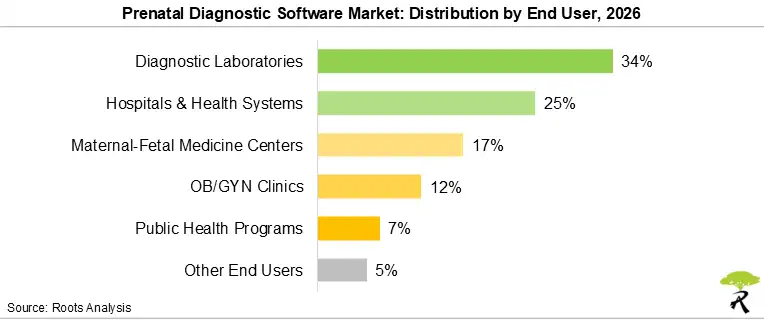
Diagnostic laboratories account for 34% of the market in the current year, reflecting their central role in the operational delivery of prenatal screening. These facilities require software across several stages of the testing process, from managing patient and assay data to risk calculation, quality review, result validation and final reporting. The concentration of these functions within the laboratory gives prenatal software a broad operational footprint rather than limiting its use to a single analytical task. Established screening platforms are also designed specifically around laboratory data management and configurable prenatal risk protocols, reinforcing the laboratory as the principal end-user setting for dedicated prenatal diagnostic software.
Maternal-fetal medicine centers are projected to grow at a faster pace from 2026 to 2035. Their growth is being supported by the increasing amount of specialized software that can be applied during high-risk pregnancy assessment. MFM care brings together detailed fetal ultrasound, prior screening results, maternal clinical information and follow-up decisions, creating several points where image analysis, structured reporting and clinical decision support can assist specialists. Recent FDA clearances for fetal ultrasound software covering examination quality and anomaly detection add further clinical functions that can be incorporated into these settings. As these tools become applicable to more parts of specialist assessment, software use within MFM centers is becoming broader and more frequent across the care pathway.
Prenatal screening creates a recurring information-management burden that grows with testing intensity even when birth volumes are stable. cfDNA, biochemical screening and population programs generate results that must be checked, interpreted, risk-stratified, reported and linked to follow-up pathways. As eligibility for screening broadens and programs become more standardized, manual processes become harder to sustain without compromising timeliness or consistency. Dedicated software addresses this bottleneck by structuring calculations, quality controls and reporting across large numbers of cases. The driver is therefore the expanding volume and complexity of results moving through prenatal pathways, rather than demographic growth alone.
Fetal ultrasound can be technically demanding because image quality is influenced by fetal position, movement, maternal anatomy, equipment and operator experience. Software that recognizes standard views, checks examination completeness, assists measurements or highlights suspected abnormalities can reduce variation and help clinicians direct attention to images requiring closer review. GE HealthCare's 2026 collaboration with Diagnoly explicitly addresses examination complexity and operator variability, while current regulatory activity shows a widening range of software-assisted functions. This demand driver is distinct from screening volume: it arises from the need to make imaging-led prenatal assessment more consistent without removing clinical responsibility from the specialist.
Prenatal AI operates in a high-consequence setting where performance must remain dependable across populations, ultrasound systems, acquisition protocols and operator skill levels. A model that performs well in a controlled dataset may not reproduce the same benefit after deployment in a different hospital or patient group. ISUOG has therefore emphasized representative datasets, technical and clinical evaluation, local governance, training, human oversight and post-implementation surveillance. Clinician research published in 2026 also shows strong support for AI alongside a clear preference to retain final clinical authority. These requirements raise the evidence threshold for routine use and make local validation an important part of implementation.
Prenatal software increasingly depends on access to laboratory results, ultrasound images and enterprise health records, which makes deployment an IT and governance project as well as a clinical one. Interfaces must preserve patient identity, data integrity, audit trails and access controls without disrupting established laboratory or imaging operations. FDA guidance issued in 2026 increases the emphasis on cybersecurity and intended-use documentation for relevant device software, while the European Health Data Space is creating a phased framework for interoperable health information in Europe. These requirements favor vendors with stronger integration capabilities, but they also lengthen implementation and validation cycles for health systems adopting new software.
Prenatal assessment still relies on information that is generated in different clinical settings and interpreted at different stages of pregnancy. Genetic screening may identify elevated chromosomal risk early, biochemical markers can refine maternal or fetal risk, and ultrasound provides anatomical and developmental evidence later in the pathway. Today, much of this information is reviewed through separate software environments. A credible opportunity therefore exists for platforms that can bring these signals together and present clinicians with a more complete risk picture as the pregnancy progresses. Such systems could improve continuity between screening, specialist referral and follow-up by helping clinicians interpret how findings from one modality alter the significance of another, rather than treating each result in isolation.
The value of this opportunity will depend on whether combined data produces better clinical decisions, not simply whether multiple datasets can be displayed on the same screen. Current prenatal risk platforms already combine maternal characteristics and biochemical or genetic inputs, while newer ultrasound software is generating more structured imaging findings that can be incorporated into downstream assessment. Together, these capabilities create a practical foundation for broader multimodal decision support. The next stage will require prospective evidence that integrated models improve risk stratification, referral decisions or diagnostic prioritization across defined patient groups. Regulatory classification, model transparency, patient-level data matching, interoperability and clinical accountability will remain significant hurdles, but successful validation could allow prenatal software to support a larger proportion of the diagnostic pathway and create a differentiated category beyond single-modality risk calculators or imaging tools.
Revvity, in August 2026, launched the SuperFlex prenatal screening system for smaller and mid-sized laboratories and clinics, with LifeCycle integration for risk assessment and LIMS data transfer. The development extends software-supported prenatal screening into lower-volume settings that have historically relied more heavily on centralized testing infrastructure.
The US FDA, in June 2026, cleared Sonio Suspect (K261519), an AI-assisted software tool designed to support fetal anomaly detection during ultrasound examinations. The decision marks an important step in bringing advanced anomaly-detection capabilities into regulated prenatal imaging workflows, strengthening the clinical availability of software that can assist specialists during detailed fetal assessment.
GE HealthCare, in February 2026, announced a collaboration with Diagnoly to integrate Fetoly with Voluson ultrasound systems. The agreement brings fetal heart and brain analysis and examination-completeness support closer to the imaging workflow used by obstetric and maternal-fetal medicine teams.
Ultrasound AI, in February 2026, received De Novo classification for Delivery Date AI (DEN250007). The decision broadens the regulated software landscape beyond anomaly detection and illustrates commercial development in pregnancy monitoring and dating applications.
The study examines dedicated software products, modules and platforms used during pregnancy to analyze, interpret, risk-stratify, document or report prenatal screening and diagnostic information. The analysis uses the proprietary Roots Analysis research framework, supported by internal databases repositories, company disclosures, regulatory publications, product information, industry literature, company disclosures and other authoritative industry sources. Market estimates and forecasts are triangulated against screening activity, installed clinical workflows, software adoption, product deployment, regulatory activity and regional healthcare infrastructure, while excluding non-attributable hardware, testing-service and generic enterprise-software revenue. For further details, see the complete research methodology adopted by Roots Analysis across its market reports.
| Key Report Attribute | Details | |
| Historical Trends | Since 2022 | |
| Forecast Period | Till 2035 | |
| Market Size 2026 | USD 290.1 million | |
| Market Size 2035 | USD 779.6 million | |
| CAGR (till 2035) | 11.6% | |
| Market Scope | Dedicated prenatal software products, modules and platforms used during pregnancy for analysis, interpretation, risk stratification, documentation or reporting. Hardware, kits/reagents, testing services and generic enterprise software are excluded unless separable prenatal software revenue is attributable. | |
| Key Companies Profiled | Revvity, GE HealthCare, Samsung Medison / Sonio, NEXUS / ASTRAIA, Diagnoly, BrightHeart, Ultrasound AI, Robert Maciel Associates, Thermo Fisher Scientific / B·R·A·H·M·S, Benetech Clinical Software | |
| PowerPoint Presentation (Complimentary) | Available | |
| Customization Scope | 15% Free Customization Available | |
| Excel Data Packs (Complimentary) |
|
|
This report is an independent work of market research and analysis published by Roots Analysis. It is not affiliated with, sponsored by, endorsed by, or reviewed by Revvity, GE HealthCare, Thermo Fisher Scientific / B·R·A·H·M·S, or any other pharmaceutical company, product / brand, or regulatory body referenced within it. No content in this report should be construed as medical advice. Roots Analysis maintains its own proprietary primary research process, and does not receive compensation from any company profiled within the report, in exchange for inclusion or favorable characterization.