


 Download Free Sample
 Buy Now
Market Size
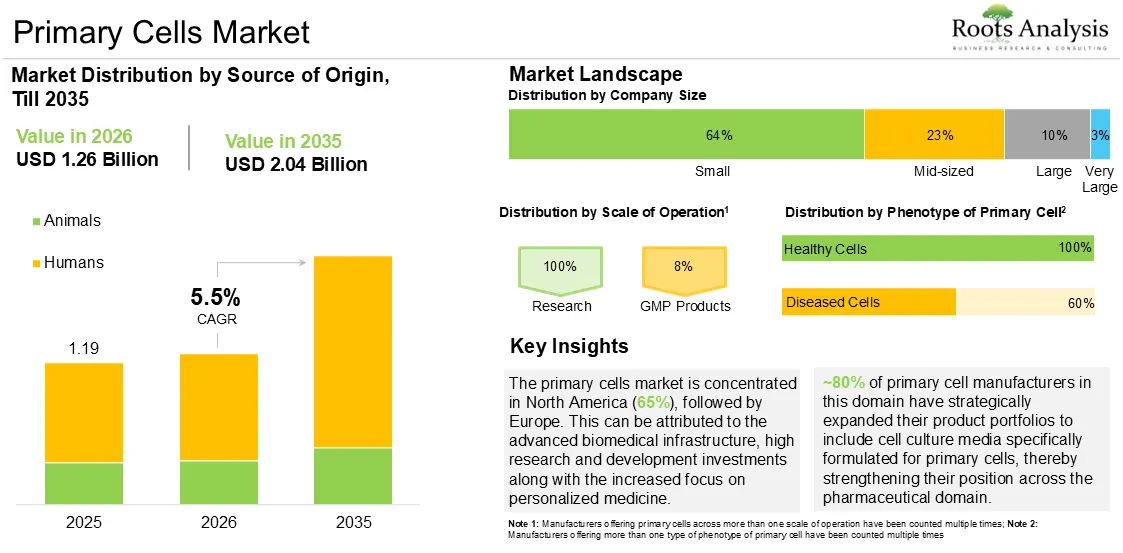
The global primary cells market, valued at USD 1.19 billion in 2025, is projected to reach USD 1.26 billion in 2026 and USD 2.04 billion by 2035, representing a CAGR of 5.5% during the forecast period 2026 to 2035.
See What’s in the Full Report – Request Your Complimentary Insights!
Market Report: Key Takeaways
Market Size & Trends
- In terms of source of origin, cells sourced from humans hold the highest share (nearly 75%) of the current market.
- With respect to type of organ system, cells sourced from the nervous system dominate the current market.
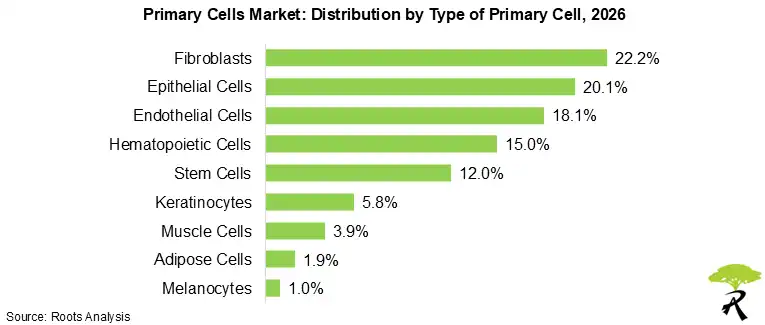
- Based on the type of primary cells, fibroblasts account for the largest share of the current market; this trend is unlikely to change in the future.
- With respect to application areas, therapeutics account for the largest share (about 95%) of the current market.
- In terms of therapeutic area, oncological disorders hold the highest share (more than 40%) of the current market.
- Based on the scale of operation, preclinical research dominates the current market.
- Among end-users, industry players account for majority of the current market; this trend is unlikely to change in the future.
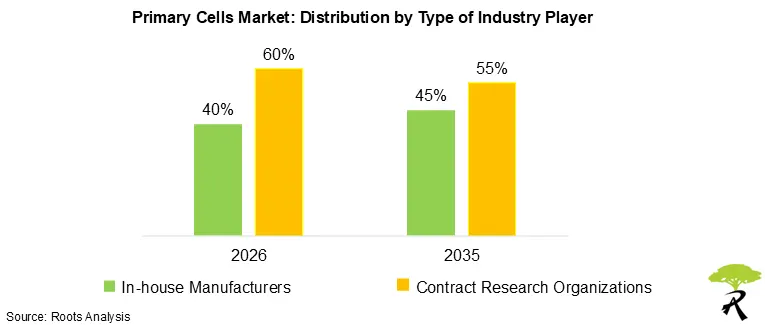
- With respect to type of industry player, in-house manufacturers dominate the current market.
- In terms of geographical regions, North America currently holds the highest market share (around 50%).
Key Market Statistics
- Market Size in 2026: $1.26 Billion
- Estimated Market Size in 2035: $2.04 Billion
- CAGR (2026-2035): 5.5%
- North America: Largest market in 2026
Market Introduction
One of the persistent challenges in biomedical research is the limited ability of conventional in vitro models to accurately replicate native human tissue physiology which limits progress in drug development. This gap significantly hampers translational success as it reduces the predictive value of preclinical studies, contributing to high failure rates in clinical development.
Researchers have long favored traditional approaches, including immortalized cell lines and animal models, for their scalability, reproducibility, and experimental convenience. However, these systems frequently fail to replicate the physiology of human tissue accurately. Notably, immortalized cell lines are particularly susceptible to genetic drift and oncogenic transformations, whereas animal models introduce significant interspecies differences in metabolism, immune responses, and disease progression. As a result, a large proportion of drug candidates that show promising efficacy in these models ultimately fail in human clinical trials.
In response to these limitations, research companies have shifted their focus towards primary cells. Scientists isolate primary cells directly from living tissues and maintain them in vitro for a limited number of population doublings. These cells more accurately represent the functional characteristics of donor tissues than continuous cell lines because they retain the native phenotypic and functional properties of their tissue of origin. Their limited proliferative capacity and retention of donor-specific characteristics make them invaluable for modeling inter-individual variability, genetic backgrounds, and age-related phenotypes. Additionally, these cells reduce reliance on animal models for certain translational studies by providing ethically preferable, species-relevant in vitro systems for mechanistic research and preclinical testing.
Market Segmentation
Based on our research, we have segmented the Primary Cells Market into source of origin, type of organ system, type of primary cell, application area, therapeutic area, scale of operation, end-user, type of industry player and geographical regions.
By Source of Origin
- Humans
- Animals
By Type of Organ System
- Nervous System
- Immune System
- Cardiovascular / Circulatory System
- Hepatic System
- Musculoskeletal System
- Respiratory System
- Endocrine System
- Integumentary System
- Reproductive System
- Digestive System
- Ocular System
- Urinary System
By Type of Primary Cell
- Fibroblasts
- Epithelial Cells
- Endothelial Cells
- Hematopoietic Cells
- Stem Cells
- Keratinocytes
- Muscle Cells
- Adipose Cells
- Melanocytes
By Application Area
- Therapeutics
- Diagnostics
By Therapeutic Area
- Oncological Disorders
- Infectious Disorders
- Central Nervous System Disorders
- Metabolic Disorders
- Immunological Disorders
- Cardiovascular Disorders
- Other Disorders
By Scale of Operation
- Preclinical Research
- GMP Products
By End-user
- Industry Players
- Academic Players
By Type of Industry Player
- In-house Manufacturers
- Contract Research Organizations
By Geographical Regions
- North America
- US
- Canada
- Europe
- UK
- Germany
- France
- Italy
- Spain
- Rest of Europe
- Asia Pacific
- China
- Japan
- South Korea
- Australia
- India
- Middle East and North Africa
- Saudi Arabia
- United Arab Emirates
- Egypt
- Latin America
- Brazil
- Mexico
- Argentina
Your Business is Unique – Why Shouldn’t Your Report Be?
Primary Cells Market Key Insights
What are the Key Drivers for Primary Cells Market Growth?
- Increasing Burden of Chronic Diseases: The global surge in chronic diseases, such as cancer and diabetes, is driving demand for advanced preclinical platforms. Notably, primary human cells allow researchers to study disease pathology at the cellular level and identify new therapeutic targets. These cells mimic in vivo tissue behavior, making them critical for preclinical safety and efficacy testing, leading to increased adoption in pharmaceutical research and development, regulatory-grade toxicology studies and regenerative medicine.
- Rapid Expansion of Gene and CAR-T Cell Therapy Development: The rapid expansion of gene therapy and cell therapy development is driving growth in the primary cells market. Many gene and cell therapies rely on primary immune cells and require large quantities of high-quality cell inputs. As research and clinical pipelines continue to accelerate, pharmaceutical and biotechnology companies are increasingly investing in reliable sources of human-derived primary cells to support manufacturing processes and meet stringent regulatory standards.
What are the Main Challenges for Market Growth?
- Limited and Variable Supply of Source Tissue: Despite strong market demand, the primary cells sector faces challenges associated with the donor-to-donor variability and batch-to-batch inconsistency in cell quality and performance.
- Contamination Risk: Primary cells are highly sensitive to microbial contamination, serum-batch variability, and suboptimal culture conditions, resulting in experimental variability, increased costs, and the heightened complexity of maintaining reproducible cultures.
Recent Developments in Primary Cells Market
- In May 2026, Cloud-Clone announced the expansion of its primary cell platform to support global research, including standardized animal tissue acquisition, tissue isolation workflows, cell purification and quality control protocols.
- In April 2026, Applied Biological Materials participated in the American Association for Cancer Research conference in San Diego, US. Notably, the conference featured more than 100 scientific sessions, close to 7,400 abstract presentations, and extensive industry networking opportunities.
- In March 2026, Lonza launched a Media Development Lab at its Singapore site designed to optimize cell culture media formulations for bioprocessing customers, facilitating a smooth transition to GMP manufacturing.
Industry Experts on Primary Cells Market
The primary cell market is projected to expand rapidly, driven by its diverse applications in life science research, drug discovery, and personalized therapies.
Susan Benjamin (Business Developer, DIVA Expertise), stated that, “The primary growth drivers in primary cells domain are the increasing demand for predictive, human relevant results and the superior translational value that primary human cells offer compared to traditional immortalized cell lines or animal models. These cells better preserve native tissue-specific functions, donor variability, and disease phenotypes, leading to more accurate data in drug discovery, toxicity testing, and disease modeling.”
Discussions with multiple stakeholders in this domain influenced the opinions and insights presented in this study. The market report includes transcripts of the following third-party discussions:
- Business Developer, Small Company, France
- Senior Director Marketing and Product Management, Large Company, Switzerland
- Director of the Immunity and Cancer Department, Public University, France
- President and Chief Executive Officer, Mid-sized Player, US
- Co-Founder and Chief Scientific Officer, Mid-sized Player, US
- Principal Scientist, Research and Development, Large Company, Switzerland
Pay Only for What You Need – The Best Way to Optimize
Market Share Insights
Which Type of Primary Cells Accounts for the Largest Share in the Primary Cells Market?
- In 2026, the fibroblasts segment accounts for the highest market share (around 25%) and is likely to grow at a CAGR of 5.8% during the forecast period
- This growth stems from the fact that these cells have the capability to synthesize their own extracellular matrix and establish biophysical and biochemical signaling niches, making them highly valued in contemporary 3D organoid and tissue-engineering research.
Regional Analysis: Which Regions are Showing the Fastest Growth in Primary Cells Industry?
North America: Dominating the Market with the Largest Share
According to our projections, North America is likely to capture majority (~50%) of the primary cells market share in 2026. Numerous factors contribute to the region’s dominance in the industry, including technological advancements and the presence of established players in this region. Moreover, the advanced healthcare infrastructure and research capabilities in North America enable pharmaceutical companies to conduct extensive preclinical research, which is necessary to meet the required regulatory guidelines established by regulatory authorities.
Among Therapeutic Areas, Which Segment Holds the Highest Share in the Primary Cells Market?
- In 2026, the oncological disorders segment is likely to capture the largest share (more than 40%) of the primary cells market. Further, this segment is expected to grow at a significant rate during the forecast period.
- This rapid expansion is primarily driven by the demand for high-fidelity physiological insights. Primary cells play a pivotal role in screening novel chemotherapeutics, targeted therapies, and chimeric antigen receptor (CAR)-T cell constructs, effectively overcoming the limitations of traditional, non-human cell lines in cancer research.
Which Scale of Operation Accounts for the Largest Market Share?
- In 2026, the preclinical research segment occupies the largest market share (85%), owing to the fact that human and animal primary cells provide physiologically relevant models that outperform immortalized cell lines in predicting human responses, making them indispensable for efficacy screening, toxicity testing, and target validation in pharmaceutical research and development.
- The GMP products segment is likely to grow at a higher CAGR (9.0%) during the forecast period. This can be attributed to the rising demand for clinical-grade primary cells in advanced drug development, including cell and gene therapy and personalized treatment approaches.
What is the Market Opportunity for Contract Research Organizations?
- Based on the primary cells market forecast, the contract research organizations are expected to account for approximately 45% of the market share by 2035. This dominance can be attributed to their specialized expertise in primary cell isolation and scalability through global networks.
- In addition, the CRO segment is expected to witness a higher CAGR of 6.5% during the forecast period. Notably, these organizations offer rapid turnaround for custom cell panels and integrated assay services, positioning them to capture a growing market share amid rising preclinical outsourcing trends.
Scope of Primary Cells Market Report
| Key Report Attribute | Details | |
| Historical Trend | Since 2023 | |
| Forecast Period | Till 2035 | |
| Market Size 2026 | $ 1.26 Billion | |
| Market Size 2035 | $ 2.04 Billion | |
| CAGR (Till 2035) | 5.5% | |
| Segments Covered |
|
|
| Key Players |
(A complete list of players captured is available in the report) |
|
| PowerPoint Presentation (Complimentary) |
Available | |
| Customization Scope | 15% Free Customization | |
| Excel Data Packs (Complimentary) |
Available | |


