
Lowest Price Guaranteed
Slides
216
Last Updated
July 2026
View Count
17059
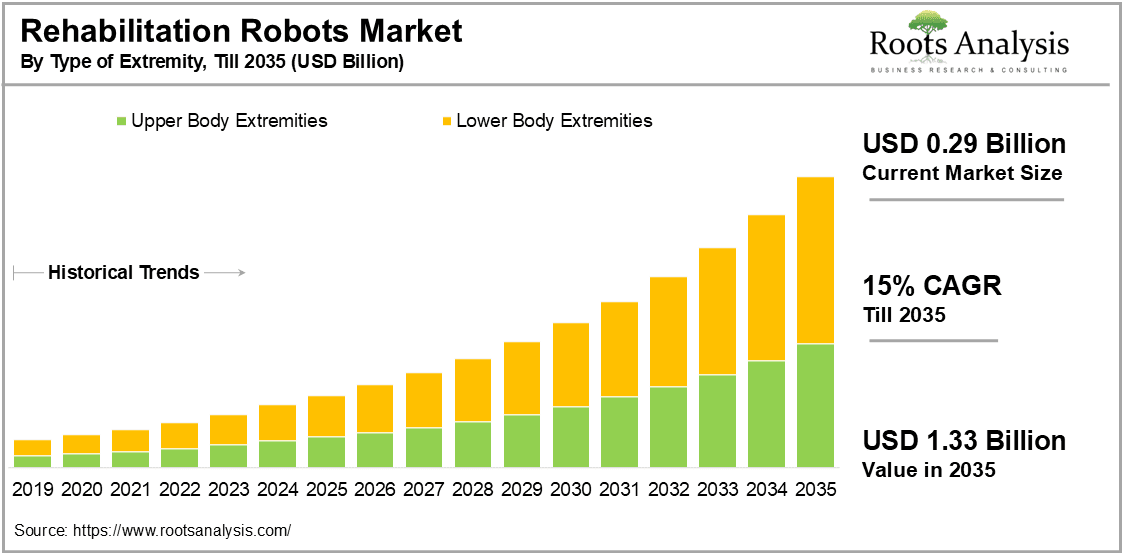
The global rehabilitation robots market size is estimated to grow from USD 0.29 billion in 2024 to USD 1.33 billion by 2035, representing a CAGR of 15% during the forecast period.
 |
To learn more about this report, request a free sample copy
Rehabilitation robots refer to the sub-class of robotics that solely focus on the development of robots that help to recover from physical trauma and regain motor functions. There are several types of rehabilitation robots available, some key classes include assistive robots and therapy robots. Assistive rehabilitation robots act as a substitute for individuals with lost limb movements and therapy robots also known as rehabilitators are designed to allow patients to perform body movements. With the growing prevalence of chronic conditions and spinal cord injuries, there is a rapid increase in physical disabilities. It is important to highlight here that patients with specific brain related disorders such as Alzheimer’s disease, stroke, Parkinson’s diseases, epilepsy, spinal cord injuries and certain degenerative disorders require frequent rehabilitation therapies to regain muscle function for better mobility.
Rehabilitation robots have been designed to offer standardized therapies to the patients and improve mobility. These robots have the potential to deliver high-intensity training with higher precision and control to the patients with motor dysfunction, which may have occurred due to spinal cord injury or stroke.
In 2024, the World Health Organization reported that more than 15 million people are living with spinal cord injuries and the majority of these causes are due to accidental falls, road accidents and trauma. This rising incidence of spinal cord injuries has underscored the demand for rehabilitation robots, specifically exoskeleton robots to improve muscle function, allowing patients to stand and walk with minimal effort and energy expenditure. Driven by the advantages offered, numerous healthcare providers and therapy providers have started using rehabilitation robots to offer precise care and optimized therapies. For instance, recently Kindred Hospital Rehabilitation Services has installed InMotion Arm robotic system developed by Bionik Laboratories in its inpatient rehabilitation hospitals in the U.S.
Owing to the growing adoption across the healthcare sector, various robotics companies are showing keen interest in rehabilitation robots research and development activities. However, the primary focus will be on technological innovations, such as integration of AI technology, VR technology and advanced biosensors to offer precision, control and real-time feedback so healthcare professional can tailor therapies according to the patients requirement. For instance, in December 2023, ReWalk Robotics (leading provider of rehabilitation robots) announced the successful demonstration of its proof-of-concept next generation exoskeleton rehabilitation robots integrated with advanced sensors-based technologies to enable autonomous decision making within this prototype. As the market players continue to innovate in the area of robot assisted technologies to deliver optimal performance, it will drive the growth of rehabilitation robots market during the forecast period.
The market report provide a comprehensive overview of the key players who are active across various segments of the growing industry as mentioned in the table below.
| Key Report Attributes | Details | |
| Historical Trend | Since 2019 | |
| Forecast Period | Till 2035 | |
| Market Size 2035 | $1.33 Billion | |
| CAGR (Till 2035) | 15% | |
| Type of Robot |
|
|
| Type of Robotic Structure |
|
|
| Type of Extremity |
|
|
| Type of Patient |
|
|
| Type of Application |
|
|
| Type of End User |
|
|
| Geographical Regions |
|
|
| Key Companies Profiled |
|
|
| PowerPoint Presentation (Complimentary) |
Available | |
| Customization Scope | 15% Free Customization | |
| Excel Data Packs (Complimentary) |
Available | |
One of the key objectives of rehabilitation robots market report was to estimate the current market size, opportunity and the market growth potential, over the forecast period, till 2035. We have provided informed estimates on the likely evolution of the market for the forecast period. The rehabilitation robotics industry analysis also features the likely distribution of the current and forecasted opportunity within the market across various segments, such as distribution by type of robot (therapy robots, exoskeleton robots, assisted robots and other type of robots), type of robotic structure (end-effector robots and exoskeleton robots), type of extremity (upper body extremities, and lower body extremities), type of patient (adults and pediatrics), type of application (acquired brain injuries, spinal cord injuries and other applications), type of end user (hospitals & clinics, senior care facilities, and homecare settings), and geography (North America, Europe, Asia-Pacific, Middle East and North Africa, and Latin America) and leading players. In order to account for future uncertainties associated with some of the key parameters and to add robustness to our model, we have provided three market forecast scenarios, namely conservative, base, and optimistic scenarios, representing different tracks of industry’s evolution.
All actual figures have been sourced and analyzed from publicly available information forums and primary research discussions. The financial figures mentioned in this market report are in USD, unless otherwise specified.
Based on the type of robot, the global rehabilitation robots market is segmented into therapy robots, exoskeleton robots, assisted robots and other types of robots. According to our projection, the therapy robots market segment accounts for the highest share (30%) of the market. Therapy robots offer precise rehabilitation sessions and reduce the requirement of one-to-one therapy sessions. Furthermore, therapy robots reduce the overall expenditure of rehabilitation services specifically in cases where patients require longer and frequent sessions for faster recovery. In addition, these therapy robots have a versatile structure that makes them eligible to use for a variety of medical conditions such as traumatic brain injuries, spinal cord injuries and orthopedic conditions.
However, it is interesting to highlight here that exoskeleton robots will grow at a higher CAGR during the forecast period. This can be attributed to the fact that exoskeleton robots have been designed to accelerate human mobilities and strength after physical injuries. Furthermore, the increasing population with physical movement issues such as stroke and spinal cord injuries are the primary factors behind unprecedented growth of this segment.
The segment highlights the distribution of global rehabilitation robots market on the basis of robotic structure into end-effector robots and exoskeleton robots. According to our projection, by 2035, end-effector robots is likely to account for the highest share (nearly 65%) of the market.
These robots have been designed to support a broad range of motions of patients body parts specifically hand and foot. These end-effector robots are attached with the distal segments of the limbs and generate force to help with muscular movement. Further, the versatile design allows end effector robots to be used for various types of rehabilitation exercises and address different muscle issues. However, in the long run, exoskeleton robots will show substantial growth and is estimated to grow at a higher CAGR during the forecast period. This can be attributed to the fact that exoskeleton robots are widely used to support physical movements in patients.
On the basis of extremity, the rehabilitation robots market is segmented into upper body extremities and lower body extremities. Currently, the lower body extremities account for the highest share (nearly 60%) of the market. This can be attributed to the fact that geriatric population generally experience lower body disabilities and an increase in the number of paralyzed patients has contributed to the high demand for rehabilitation robots for lower body extremities.
Additionally, the growing R&D activities on rehabilitation robots for treating lower limb disabilities is another robust reason for highest share. However, in the long run, upper body extremities will show lucrative growth potential and is likely to grow at a higher CAGR during the forecast period. This can be attributed to the growing awareness about the benefits associated with the usage of robot-based rehabilitation therapies for upper limbs such as post-stroke rehabilitation, neurological impairments and musculoskeletal issues. Additionally, exoskeleton rehabilitation robots support individual with physical disabilities to perform daily activities and growing funding for the technological advances in rehabilitation robots is likely to propel the rehabilitation robots market growth.
The market for rehabilitation robots is categorized on the basis of type of patient into adults and pediatrics. Currently, adults occupy the highest share (nearly 90%) of the market. This can be attributed to the fact that adult patients generally experience a broad range of medical conditions such as stroke, spinal injuries and other mobility issues that demand rehabilitation services.
Furthermore, these rehabilitation robots have been designed for adult users who have physical disabilities. Driven by the growing demand for rehabilitation robots for adult users, this segment will continue to grow at a higher CAGR during the forecast period.
The global market is segmented across various types of application, such as acquired brain injuries, spinal cord injuries and other applications. According to our projection, presently acquired brain injuries account for the highest rehabilitation robots market share (nearly 65%). This can be attributed to the fact that acquired brain injuries may result into physical impairments such as speech, motor deficits, cognitive deficits, language impairments and functional limitations. These rehabilitation robots have shown significant potential in addressing these complexities and different types of rehabilitation requirements. Furthermore, healthcare systems are adopting rehabilitation robots for delivering therapies to individuals with acquired brain injuries, which is anticipated to be the key driver for this segment. Driven by the growing adoption, this segment will continue to grow at a higher CAGR during the forecast period.
The global rehabilitation robots market is segmented on the basis of end user into hospitals & clinics, senior care facilities, and homecare settings. Among these, hospitals & clinics currently account for the largest share (nearly 50%) of the market. This highest share is attributed to the growing healthcare spending and increasing acceptance of technological advancements in healthcare centers. Furthermore, the increasing incidence of spinal cord injuries and musculoskeletal disorders that require rehabilitation services within hospitals & clinics has further contributed to the largest share of this region.
It is important to highlight here that senior care facilities segment will grow at a substantial CAGR due to significant rise in the geriatric population with physical disability. In July 2024, a new elderly care rehabilitation center, St Luke’s ElderCare Day Rehabilitation Centre, opened in Singapore with the aim to help avoid hospital visit. In addition, the rising government initiatives for the enhancement of healthcare services for elder population is likely to bolster the growth of senior care facilities segment during the forecast period.
Based on the key geographical region, the global market is distributed across various geographical regions, such as North America, Europe, Asia-Pacific, Middle East and North Africa and Latin America. According to our projection, presently North America accounts for the highest rehabilitation robots market share (nearly 50%). This dominance is primarily due to the surge in disabled population and growing incidence of spinal cord injury in this region. In 2024, the Center for Disease Control and Prevention reported that approximately 1 out of 4 adults in the United States has some type of physical disability. Thus, the increasing demographic of physical disabilities has underscored the requirement of advanced rehabilitation robots for tailored therapies to regain mobility and supportive assistance. Additionally, the supportive guidelines for the approval of exoskeleton rehabilitation robots and growing technological innovations has further supported the market growth in this region.
However, in Asia-Pacific, the market for rehabilitation robots is estimated to grow at a higher CAGR during the forecast period. This can be attributed to the growing geriatric population in Asian countries such as China and Japan that require mobility assistance, has necessitated the demand for rehabilitation robots. Furthermore, the opening of new rehabilitation centers in this region and growing adoption of medical devices has further supported the growth of this market in Asian region. In November 2024, IHH Healthcare Singapore opened a robotics focused rehabilitation centre, called Parkway Rehab Robotics Centre. Developing nations like India have also witnessed the opening of rehabilitation centres, latest of which was opened by Narayana Health in Bengaluru in February 2024.
The “Global Rehabilitation Market: Industry Trends and Global Forecast, Till 2035” market report features an extensive study of the current market landscape, market size and future opportunities within the rehabilitation robot’s industry, during the given forecast period. The rehabilitation robots industry analysis highlights the efforts of several stakeholders engaged in this rapidly emerging market. Key takeaways of the market report have been briefly discussed below.
Currently, the market landscape features the presence of several well-established and new entrants who are focusing on the development of rehabilitation robots. The key companies who are currently active in the market are focusing on the development of advanced rehabilitation robots integrated with high-tech features and AI for personalized therapies. In order to maintain a competitive edge in the market, the leading rehabilitation robots’ developers are taking strategic initiatives such as collaborations, partnerships and investments to enhance their product portfolios and collaborate towards technological innovations. For instance, in December 2023, Motusium announced a strategic partnership with Harmonic Bionics to combine the advanced rehabilitation technology of both companies and create innovative pathways for the treatment and recovery process of patients who required rehabilitative care. As more industry leaders focus on innovation, we believe that the rehabilitation robots market will remain competitive throughout the forecast period.
Some of the potential drivers that are propelling the growth of the rehabilitation robots include rising prevalence of chronic conditions that result into physical disabilities such as neurological disorders, stroke and spinal cord injuries. These rehabilitation robots have been designed to help patients regain their mobility and movement by therapies. The market for rehabilitation robots is further influenced by the growing geriatric populations with age-related disorders such as arthritis, Parkinson’s disease and restricted mobilities. Driven by the growing incidence of physical disabilities due to chronic conditions, there has been a surge in the demand for personalized rehabilitation therapies. Rehabilitation robots are playing a significant role in delivering customized therapy program that aids in regaining mobility. Furthermore, the growing focus on function recovery and general well-being has further increased the demand for rehabilitation robots.
Several factors that are also posing a restrain to the market growth during the forecast period include high cost, technical complexities, limited access in developing countries and regulatory challenges. It is worth noting that the initial purchase cost of rehabilitation robots is high which may limit its adoption in middle to low-income countries. Furthermore, rehabilitation robots require calibration and maintenance on a regular basis for optimal performance, which may enhance the overall cost of these robots. Additionally, the lack of standardization and complex regulatory guidelines for the approval of rehabilitation robots may delay the approval of rehabilitation robots. Moreover, restricted access in developing countries and limited reimbursement policies are some of the key challenges that may impede market growth during the forecast period.
The global rehabilitation robots market is experiencing continuous growth due to several factors. Some of the significant growth factors include growing focus on the integration of AI and VR technologies into rehabilitation robots and devices for personalized exercises, and real-time feedback. For instance, Breathment recently developed AI-powered program that provide data-driven feedback in real-time, allowing remote patient monitoring and designing of personalized rehabilitation exercises . Furthermore, the increasing shift towards remote health and teleradiology services has further increased the adoption of rehabilitation robots to facilitate remote physical exercises to regain mobility. Additionally, the growing usage of photo and electric therapy for rehabilitation treatment for muscle regeneration and stimulation of blood flow has further prompted the demand for rehabilitation robots.
The integration of rehabilitation robots reduces the therapy times and enhance muscle recovery, making blood flow stimulation more accessible and efficient for patients. Moreover, the growing usage of collaborative robots are gaining popularity in rehabilitation therapy sessions.
The global rehabilitation robots market is currently valued at USD 0.29 billion and is estimated to reach USD 1.33 billion by 2035. Driven by the growing demand for robotic assisted therapies to improve mobility in patients with disabilities, the market is expected to grow at a CAGR of 15% during the forecast period.
Currently, North America is dominating the rehabilitation robots market and is likely to remain dominant during the projected period. The increasing incidence of spinal cord injuries and increasing strategic initiatives by industrial players to drive innovation in this industry has contributed to the highest share of this region. It is worth highlighting here that the US hold the major share of the North American market driven by the growing research, investment and supportive guidelines for the approval of rehabilitation robots. For instance, in August 2024, Procept BioRobotics obtained clearance from the FDA for its advanced Hydros robotic surgery system. As more market players continue to explore tech-driven rehabilitation robots, we believe the North American market will remain dominant during the forecast period.
Examples of leading rehabilitation robots manufacturing companies (which have also been profiled in this market report; the complete list of companies is available in the full report) include AlterG, Bionik Laboratories, Bioxtreme, Cyberdyne, DIH Medical, Ekso Bionics, Fourier Intelligence, HIWIN Technologies, InMotion Robotics, Leaders Rehab Robot, MediTouch, Rehab-Robotics, Reha-Stim Medtec, ReWalk Robotics, Rex Bionics and TYROMOTION. This market report includes an easily searchable excel database of all the companies developing rehabilitation robots.
Several recent developments have taken place in the market, some of which have been outlined below. These developments, even though they took place post the release of our market report, substantiate the overall market trends that we have outlined in our analyses.