
Lowest Price Guaranteed
Slides
243
Last Updated
June 2025
View Count
11690
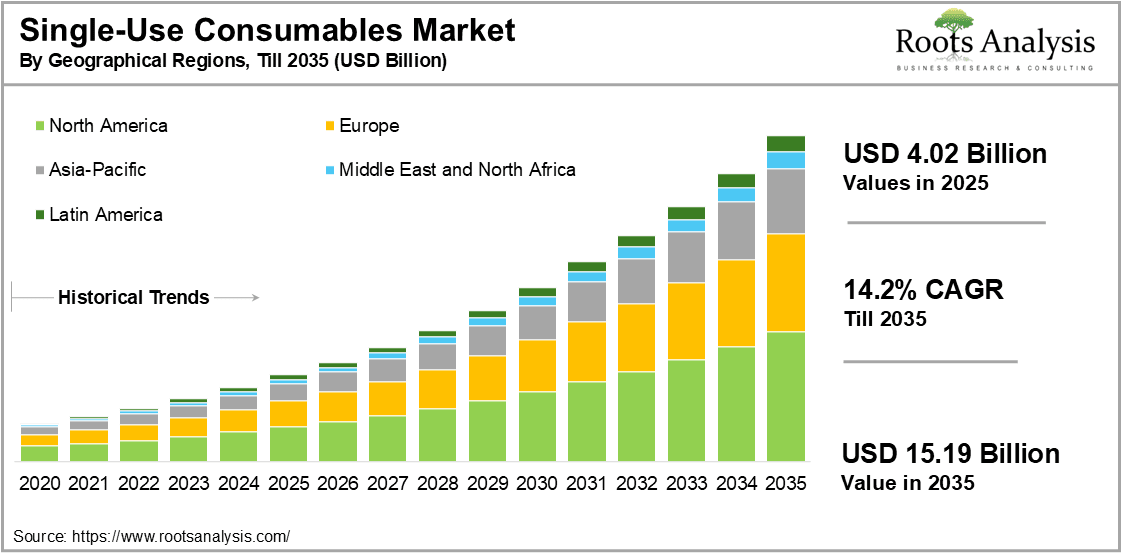
The global single-use consumables market, valued at USD 3.42 billion in 2024, is projected to reach USD 4.02 billion in 2025 and USD 15.19 billion by 2035, representing a CAGR of 14.2% during the forecast period.
 |
To learn more about this report, request a free sample copy
Given by the growing shift towards single-use bioprocessing manufacturing, there has been a surge in the demand for single-use consumables. It is worth mentioning that single-use consumables refer to the disposable products, such as sampling bags, filters, cell culture media, media bags sample collectors, chromatography and connectors that are specifically used in bioprocessing. These disposable consumables help to maintain a sterile manufacturing environment, eliminate the sterilization requirement and reduce contamination chances, which are otherwise hard to maintain in traditional bioprocessing manufacturing systems.
Contrastingly, the single-use technologies offer flexibility, cost-effective and faster processing time, which further increased its acceptance across biopharmaceutical industry to manufacture biologics-based drugs, such as monoclonal antibodies, vaccines, and cell-and gene therapies. Owing to the ongoing demand, presently industrial players are actively engaged in the development of innovative single-use consumables.
Additionally, the market players are also focusing on incorporating smart single use sensors that help in maintaining optimal processing conditions for biologics production. For instance, in April 2025, Biotech Fluidics announced the launch of QuickStart (a digital in-line single-use pressure sensors) that can be incorporated with bioprocessing systems fluidic pathway to manage flow rates and avoid overpressure risk. Furthermore, in November 2024, Freudenberg launched new range of single-use assemblies and PharmaFocus® Premium ASTC UV-shield tubing at CPHL & PMEC India 2024. This latest range of products has been designed for healthcare and pharmaceutical industries for critical photosensitive material handling. Driven by the increasing initiatives of industrial players, we believe that the single-use consumables market will continue to gain momentum at a steady pace during the forecast period.
The market report provides comprehensive information on industrial players who are currently active across various segments of the industry as mentioned in the table below.
| Key Report Attributes | Details | |
| Historical Trend | Since 2020 | |
| Forecast Period | Till 2035 | |
| Market Size 2025 | USD 4.02 Billion | |
| Market Size 2035 | USD 15.19 Billion | |
| CAGR (Till 2035) | 14.2% | |
| Type of Product |
|
|
| Type of Material |
|
|
| Type of Sterilization Method |
|
|
| Application Area |
|
|
| End User |
|
|
| Geographical Regions |
|
|
| Key Companies Profiled |
|
|
| PowerPoint Presentation (Complimentary) |
Available | |
| Customization Scope | 15% Free Customization | |
| Excel Data Packs (Complimentary) |
Available | |
One of the key objectives of the single-use consumables market report was to estimate the current size, opportunity, and the market growth potential, over the forecast period, till 2035. We have provided informed estimates on the likely evolution of the market for the forecast period.
The global single-use consumables market analysis report also features the likely distribution of the current and forecasted opportunity within the market across various segments, such as type of product (tubings (silicon tubings, PVC tubings, and polyethylene tubings), connectors (luer connectors, bayonet connectors and quick connectors), disconnector (single-use disconnectors and multi-use disconnectors), adapters (luer adaptors, hose adaptors and screw adaptors), valves (check valves, pressure relief valves and control valves), disposable capsule filter (filter sizes, filter membrane types and filter retention ratings) and single use sensors (flow sensors, pressure sensors and temperature sensors)), type of material (metals, plastics, glass, biodegradable materials and other materials), type of sterilization method (ethylene oxide, gamma radiation, electron beam, steam and other sterilization methods), application area (filtration, cell culture & mixing, storage, sampling, and other application), end user (biopharmaceutical & pharmaceutical companies, OEMS (original equipment manufacturers), contract research organizations & contract manufacturing organizations, academic & research institutes), geographical regions (North America, Europe, Asia-Pacific, Middle East and North Africa, and Latin America) and leading players.
In order to account for future uncertainties associated with some of the key parameters and to add robustness to our model, we have provided three market forecast scenarios, namely conservative, base, and optimistic scenarios, representing different tracks of industry’s evolution.
All actual figures have been sourced and analyzed from publicly available information forums and primary research discussions. The financial figures mentioned in this market report are in USD, unless otherwise specified.
Based on the type of product, the global market is segmented into tubings (silicon tubings, PVC tubings, and polyethylene tubings), connectors (luer connectors, bayonet connectors and quick connectors), disconnector (single-use disconnectors and multi-use disconnectors), adapters (luer adaptors, hose adaptors and screw adaptors), valves (check valves, pressure relief valves and control valves), disposable capsule filter (filter sizes, filter membrane types and filter retention ratings) and single use sensors (flow sensors, pressure sensors and temperature sensors). According to our single-use consumables market analysis, presently the disposable capsule filter segment occupies the highest share of the market. This can be attributed to fact that single use / disposable capsule filters help to filter all the impurities at final production stage, ensuring the quality standards. Furthermore, disposable capsule filters are widely adopted across bioprocessing applications to control the fluids flow, which further increases its demand. Driven by the high demand, this segment will continue to grow at a higher CAGR during the forecast period.
The global market is categorized across different types of materials, such as metals, plastics, glass, biodegradable materials and other materials. Currently, plastics segment holds the highest share (65%) of the market. Plastic is highly versatile, it can easily mold into different shapes and sizes, making it suitable for diverse applications in pharmaceuticals and healthcare industry. Moreover, plastic supply chain efficiency further makes it primary choice for designing single-use consumables.
However, it is worth mentioning that biodegradable materials are gaining traction in this single-use consumers market, anticipated to grow at a higher CAGR during the forecast period. This is potentially due to the growing environmental awareness and demand for eco-friendly and sustainable materials.
On the basis of sterilization method, this segment is bifurcated into ethylene oxide, gamma radiation, electron beam, steam and other sterilization methods. Among these, ethylene oxide segment accounts for the highest share (nearly 55%) of the single-use consumables market report. This can be attributed to the fact that ethylene oxide is highly effective in sterilization of single-use consumables, including syringes, and single-use tubes. Ethylene oxide is highly beneficial in sterilization of temperature sensitive single use consumables. Owing to its high preferences, this segment is likely to remain dominant and continue to grow at a higher CAGR during the forecast period.
This segment highlights the distribution of global market across different application areas, such as filtration, cell culture & mixing, storage, sampling, and other applications. According to single-use consumables market growth, the sampling segment occupies the highest share of the market. This is primarily attributed to the increasing usage of single use consumables, such as sampling bags, syringes, containers and needles for the collection of samples for testing and analysis. Furthermore, single use sample collection consumables eliminate the requirement of sterilization and maintain the integrity of samples for an extended period of time, which further contributes to the high demand for single use consumables for sampling purpose. Driven by the ongoing demand, this segment will continue to register a higher CAGR during the forecast period.
Based on the end user, the global market is segmented into biopharmaceutical & pharmaceutical companies, OEMS (original equipment manufacturers), contract research organizations & contract manufacturing organizations, academic & research institutes. According to our single-use consumables market trends, currently the biopharmaceutical & pharmaceutical companies segment holds the dominating position in the market. This dominance is due to the growing demand for single use downstream bioprocessing systems and consumables to improve production flexibility, reduce cost and sterilization requirement.
However, in the long run, contract research organizations & contract manufacturing organizations segment is likely to register a substantial CAGR during the forecast period. This lucrative growth is due to the growing shift towards third-party manufacturing organizations to minimize the equipment installation cost and time for manufacturing biologics.
The global market is distributed across North America, Europe, Asia-Pacific, Middle East and North Africa, and Latin America. Presently, North America is dominating the market by holding a 40% share of the market for single-use consumables. This can be attributed to the growing shift towards single-use bioprocessing technologies to reduce the risk of contamination during biologics production.
Notably, in Asia-Pacific, the market is expected to grow at a higher CAGR during the forecast period. The growing shift towards biopharmaceuticals to treat wide range of disease indication and rising expenditure on single use technologies to enhance flexibility and streamlining development process is likely to fuel its demand in Asian countries.
The “Single-Use Consumables Market Report: Industry Trends and Global Forecasts, till 2035” market report features an extensive study of the current market landscape, market size, market share, market growth, market trends, market value, market forecast, market outlook, statistics, and future opportunities for single-use consumables industrial players. The market research report lays emphasis on the single-use consumables products that are being developed. Key takeaways of the market report are briefly discussed below.
The market landscape for single-use consumables is highly competitive, witnessing the presence of several small, mid-sized and large industrial players. Majority of the industrial players, such as Baxter, Medtronic and Thermo Fisher Scientific are striving for innovation and strategic partnerships to enhance product portfolio. For instance, in July 2024, Thermo Fisher Scientific launched biobased films for single-use bioprocessing containers and earned ISCC Plus certification for supporting sustainability goals within bioproduction by utilizing plant-based materials. With consistent initiatives by market players, we believe that single-use consumables industry will remain competitive during the forecast period.
With growing demand for advanced biologics to treat wide range of diseases, there has been a surge in the requirement of single use consumables. Notably, single-use bioprocessing technologies provide safe and contamination free environment to develop biopharmaceuticals. Moreover, it reduces the time required for material transfer and sterilization, which further bolstered the demand for single-use consumables in biopharmaceutical industries. Additionally, the cost-effectiveness of single use consumables has further fueled the demand across pharmaceutical industries.
Single-use consumables generate enormous amount of waste which create a negative impact on environment. Moreover, single-use consumables can also release greenhouse gases which affect environment. Additionally, single-use consumables made with non-biodegradable materials can pollute the environment and contribute to the landfills, thereby limiting the adoption in pharmaceutical industry due to environmental concerns. Furthermore, government organizations have a stringent policy for environment protection, which may create challenges for the market players for successful approval and commercialization.
The market for single-use consumables is gaining momentum driven by the growing technological innovations and heightened demand for biodegradable materials. Currently, the industrial players are focused on the development of advanced biomaterials to develop single-use consumable products in a sustainable manner. Additionally, the industrial players are leveraging 3D printing technology to develop customized single-use consumables to meet specific biopharmaceutical manufacturing. Furthermore, smart single-use technologies and automation within single-use consumable manufacturing to reduce lead times are the key trends that are shaping the market during the forecast period.
The global Single-use consumables market is valued at USD 4.02 billion in 2025 and is expected to reach USD 15.19 billion by 2035, representing a CAGR of 14.2% during the forecast period. Notably, the market growth is primarily fueled by the increasing preferences for single-use bioprocessing technologies for the development of biologics. Several market players are forging strategic partnerships to strengthen their product portfolio. For instance, in March 2025, Qosina announced collaboration with AdvantaPure™ (high-purity products division of NewAge™ industries). Under this collaboration, as an official distributor partner for AdvantaPure, Qosina is ready to expand its tubing portfolio with more than 60 new tubing options designed for single use applications and enhance extensive selection of high-quality solutions for manufacturers.
Examples of key players engaged in this domain (which have also been captured in this report) include Avantor, Boehringer Ingelheim, Corning, Danaher, Entegris, Eppendorf, Infors, Kuhner, Lonza, Merck, Meissner Filtration Products, PBS Biotech, Rentschler Biopharma, Sartorius and Thermo Fisher Scientific. This market report includes an easily searchable excel database of all the companies focusing on the development of single-use consumable products.
The market report presents an in-depth analysis, highlighting the capabilities of various companies engaged in this domain across different segments. Amongst other elements, the market report includes:
Several recent developments have taken place in the field of single-use consumables. We have outlined some of these recent initiatives below.