
Lowest Price Guaranteed
Pages
197
Last Updated
September 2026
View Count
9797
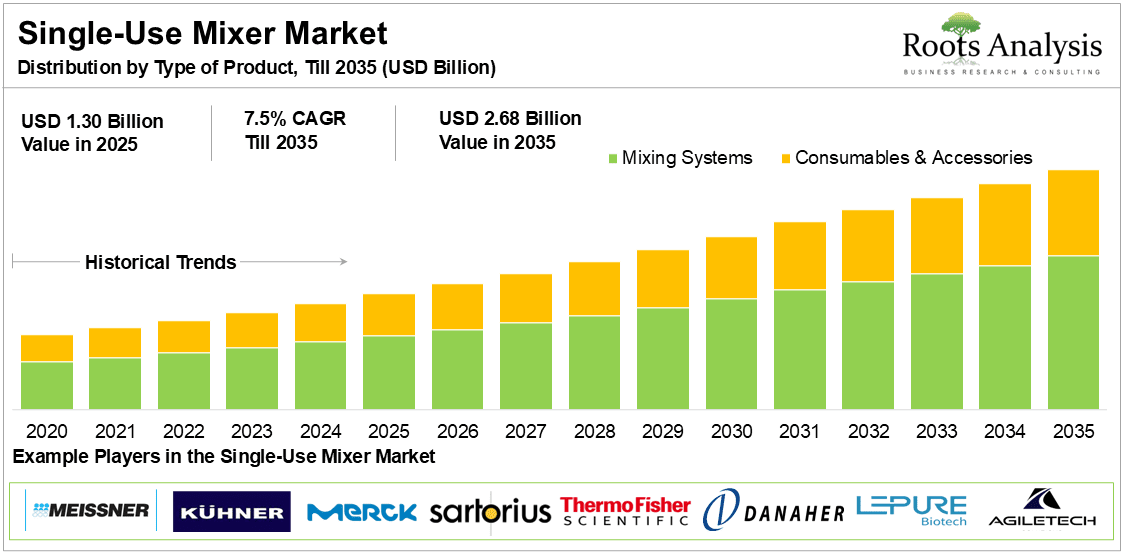
The global single-use mixer market size, valued at USD 1.19 billion in 2024, is projected to reach USD 1.30 billion in 2025 and USD 2.68 billion by 2035, representing a CAGR of 7.5% during the forecast period.
 |
To learn more about this report, request a free sample copy
The single-use mixers industry is currently experiencing a dynamic and progressive trajectory, a trend expected to continue into the future. These are disposable devices specifically designed for efficiently mixing and preparing solutions in bioprocesses. Unlike conventional mixers, which pose a high risk of contamination, single-use mixers offer significant advantages in controlling contamination during buffer and media preparation, as well as liquid formulation. Their single-use design also substantially reduces sterilization downtime and cleaning requirements, ultimately accelerating the biomanufacturing process. A key application is buffer preparation, where controlled mixing supports consistent composition before use in manufacturing operations.
Owing to these significant benefits, the biopharmaceutical industry is increasingly preferring single-use mixers. This adoption helps reduce contamination chances and accelerates drug development processes while ensuring compliance with stringent regulatory standards.
Furthermore, the convergence of several pharmaceutical shifts, such as personalized medicine, targeted therapies (including RNA targeted therapeutics and BCMA targeted therapies), and cost pressures, creates a compelling value proposition for single-use mixing technology. Currently, this technology offers a diverse range of mixing solutions, from small-scale laboratory applications (as low as 0.5 liters) to large-scale production systems capable of handling up to 5,000 liters.
Notably, the continuous adoption of disposable mixer for bioreactor feed preparation offers a competitive advantage to market players to meet future demands and requirement of technological innovations. It is worth mentioning that the current focus will be on advanced sensor integration for real-time process optimization. In addition, numerous industrial players are emphasizing integrating artificial intelligence with single-use mixer for quality control and process optimization.
For instance, in March 2025, Repligen (US) launched ProConnex® MixOne RG-X mixer (a single-use mixer) powered with Metenova® Zero Gravity mixing technology to offer consistent predictable performance across vessel sizes. Likewise, several other market players are focusing on technological innovations, which is expected to maintain a long term competitiveness in single-use mixer market.
| Key Report Attributes | Details | |
| Historical Trend | Since 2020 | |
| Forecast Period | Till 2035 | |
| Market Size 2025 | USD 1.30 Billion | |
| Market Size 2035 | USD 2.68 Billion | |
| CAGR (Till 2035) | 7.5% | |
One of the key objectives of the single-use mixer market report was to estimate the current size, opportunity, and the market growth potential, over the forecast period, till 2035. We have provided informed estimates on the likely evolution of the market for the forecast period.
The global single-use mixer market analysis also features the likely distribution of the current and forecasted opportunity within the market across various segments, such as type of product, scale of operation, end user, geographical regions, and leading players.
In order to account for future uncertainties associated with some of the key parameters and to add robustness to our model, we have provided three market forecast scenarios, namely conservative, base, and optimistic scenarios, representing different tracks of industry’s evolution.
Several recent developments in the field of single-use mixer industry have occurred, and we outlined some of these below.
The market report provides comprehensive information on single-use mixer product developers who are currently active across various segments of the industry as mentioned in the table below.
| Market Segmentations | Details | |
| Type of Product |
|
|
| Scale of Operation |
|
|
| End User |
|
|
| Geographical Regions |
|
|
| Market in North America |
|
|
| Market in Europe |
|
|
| Market in Asia-Pacific |
|
|
| Market in Middle East and North Africa |
|
|
| Market in Latin America |
|
|
| Report Deliverables | Details | |
| Excel Data Packs (Complimentary) |
Available | |
| Key Single-Use Mixer Companies Profiled | (A complete list of companies captured is available in the report) | |
| PowerPoint Presentation (Complimentary) |
Available | |
| Customization Scope | 15% Free Customization | |
The “Single-Use Mixer Market Report: Industry Trends and Global Forecasts, till 2035” market report features an extensive study of the current market landscape, market size, market share, market growth, market trends, market value, market forecast, market outlook, statistics, and future opportunities for single-use mixer industry players. The market research report lays emphasis on the single-use mixer products that are being developed by the pharmaceutical companies. Key takeaways of the market report are briefly discussed below.
The single-use mixer market competitive landscape features numerous established companies and startups. These industry leaders are prioritizing strategic partnerships between equipment manufacturers and biopharmaceutical companies. Such collaborations are crucial for driving technological development and market adoption, ensuring single-use mixer solutions continuously meet evolving industry requirements. A significant current emphasis in this landscape is the integration of smart sensors for real-time process optimization.
Vaccine production trends will greatly influence the single-use mixers industry through multiple pathways that extend beyond conventional manufacturing. The growing demand for vaccines to treat various viral diseases has necessitated the demand for flexible manufacturing infrastructure that can be quickly adapted to new vaccine candidates. Single-use mixers provide the operational flexibility and reduced changeover times essential for rapid response manufacturing, making them critical components of modern vaccine production facilities.
Furthermore, the growing shift toward mRNA vaccine and therapeutics, and other novel vaccine technologies creates specific requirements for aseptic single-use mixers for vaccine manufacturing while maintaining strict quality control.
Currently, biopharmaceutical industry uses single-use mixer. This dominance is due to the growing emphasis on the biologics that require sterile conditions. Beyond biopharmaceuticals, single-use mixers serve food processing, cosmetics, and chemical manufacturing sectors where sterility and contamination prevention are essential. These applications expand market reach beyond traditional pharmaceutical boundaries, creating diversified revenue streams and reduced dependency on single industry cycles.
The dominance of North America stems from highly consolidated biotechnology infrastructure, rising research initiatives by the industrial players and increasing regulatory support for the adoption of single-use technologies. In addition, the region's innovation ecosystem facilitates rapid technological development and commercialization, maintaining competitive advantages in next generation mixing systems.
The primary reason for single-use mixer market growth is the expanding biopharmaceutical industry, to meet the demand for personalized medicine and vaccines. Single use jet mixers for high-viscosity bioprocesses offer higher flexibility and scalable manufacturing solutions, which is likely to bolster its demand. This demand is further amplified by the growing focus on cell therapies and other biological products that require sterile manufacturing environments.
Innovative improvements in single-use mixing technology have made these systems less susceptible to failure and capable of producing better results consistent with stirred-tank bioreactors. These technological advancements include innovative disc mixing technology, configurable high-end controls, and integrated sensor monitoring systems. The development of bottom-mounted mixing disc technology and top-down stirred-tank mixing systems provide manufacturers with multiple options to meet specific application requirements. Notably, the increasing focus on single-use mixing systems with integrated sensor is likely to fuel the growth of the market in the future.
Environmental concerns are currently favoring the single-use mixer industry through multiple sustainability benefits that align with corporate responsibility initiatives and regulatory trends. The reduction in water consumption, chemical usage, and energy requirements associated with cleaning and sterilization procedures creates measurable environmental benefits that support adoption decisions.
Additionally, life cycle assessment studies demonstrate that single-use mixers exhibit lower overall environmental impacts compared to traditional systems when considering the full range of environmental factors including resource consumption, waste generation, and carbon emissions. These findings support adoption by companies seeking to reduce their environmental footprint while maintaining operational efficiency.
Notably, the market expansion from USD 1.30 billion in 2025 to USD 2.68 billion in 2035 will positively influence the investment pattern in the next generation mixing systems. It is interesting to note here that large pharmaceutical and biotechnology companies are increasing capital investments in single-use powder-liquid mixers for biopharmaceutical R&D to support future growth and competitive positioning.
These investments create demand for advanced mixing systems with enhanced capabilities and integrated control systems. Furthermore, the industrial players are focusing on innovations that include advanced materials, smart sensor integration, and improved mixing efficiency to address current market limitations and expand application opportunities.
The continuous focus on personalized medicine creates substantial demand for single-use mixers. Owing to the increasing emphasis on target specific drugs, market players are focusing on developing single-use mixers for personalized medicine manufacturing that can efficiently handle multiple products with rapid changeovers and minimal cross-contamination risks. In addition, the targeted therapies, such as cell therapy and gene therapy, which signifies a crucial component of personalized medicine require specialized mixing capabilities for sensitive biological materials. Single-use mixers provide the gentle mixing action and sterile conditions essential for these advanced therapeutic approaches while enabling the small-scale production runs typical of personalized treatments.
The increasing complexity of personalized medicine products requires sophisticated process development and optimization capabilities that single-use mixers support through reduced validation requirements and enhanced flexibility. Companies developing personalized therapies benefit from the ability to rapidly iterate and optimize processes without extensive cleaning and revalidation procedures.
Despite the cost benefits, single-use mixer industry witness several challenges, such as high initial setup cost and environmental disposable concerns. It is important to highlight here that traditional manufacturers accustomed to stainless steel systems often exhibit hesitance toward transitioning to single-use technologies. This resistance requires strategic advocacy and educational initiatives to demonstrate long-term value propositions.
Furthermore, the overall impact is comparatively less, however disposal concerns related to single-use plastic components present ongoing challenges. The industry requires continued advancement in biodegradable materials and sustainable disposal methods to address these environmental considerations.
Adhering to the complex and evolving regulatory landscape for biopharmaceutical production poses a significant challenge. Notably, the single-use systems must rigorously meet industry standards, ensure product quality, and guarantee safety of the solutions while mixing. Manufacturers therefore need not only navigating these stringent requirements but also consistently demonstrating the reliability and consistency of their systems.
The main cost benefits driving global adoption of single-use technology include substantial reductions in cleaning and validation expenses, which can represent significant operational cost savings over traditional systems. Contrastingly, the elimination of clean in place and sterilization in place procedures reduces utility consumption, chemical usage, and labor requirements while improving facility utilization through faster changeovers.
Furthermore, reduced facility infrastructure requirements create capital cost advantages for new manufacturing installations, as single-use systems require less complex utility systems and simplified facility designs. These advantages are particularly significant for companies establishing manufacturing capabilities in new markets or expanding existing capacity.
In addition, lower validation and regulatory compliance costs result from simplified system designs and reduced complexity compared to traditional mixing systems. The disposable nature of single-use components eliminates many of the validation requirements associated with cleaning and sterilization procedures, reducing both time and cost for regulatory submissions.
The single-use mixer market features several leading manufacturers who drive innovation and market development through advanced technology offerings and comprehensive support services.
Additional notable manufacturers include specialized technology providers such as REVOLMIX (UK) with their HPCD technology offering energy-efficient mixing solutions, and various regional manufacturers developing innovative approaches to single-use mixing applications. In addition, the single-use mixer market opportunities further lies in mergers, acquisitions, and technology partnerships that reshape market dynamics and technology offerings.
In 2025, the global single-use mixer market is valued at USD at 1.30 billion and is poised to reach USD 2.68 billion by 2035. The significant growth is propelled by the increasing usage of single-use mixers in the pharmaceutical industry. It is important to highlight that the market for single-user mixer is expected to grow at a higher CAGR in Asian region. The increasing research on drugs and diseases along with government initiatives to strengthen technological infrastructure for research are the key reasons for lucrative growth of market in this region.
The market report presents an in-depth analysis, highlighting the capabilities of various stakeholders in the single-user mixer industry, across different geographies. Amongst other elements, the market report includes:
The single-use mixer industry analysis represents a fundamental shift in bioprocessing technology that extends beyond simple equipment substitution to encompass new approaches to manufacturing flexibility, risk management, and operational efficiency. Additionally, the convergence of multiple industry trends including personalized medicine, pandemic preparedness, environmental sustainability, and cost pressure further creates a compelling value proposition for single-use mixing technology that transcends traditional cost-benefit analyses. Companies adopting these technologies position themselves for competitive advantages that extend beyond immediate operational benefits to include strategic capabilities for responding to future market demands and regulatory requirements.