


 Download Free Sample
 Buy Now
Market Size
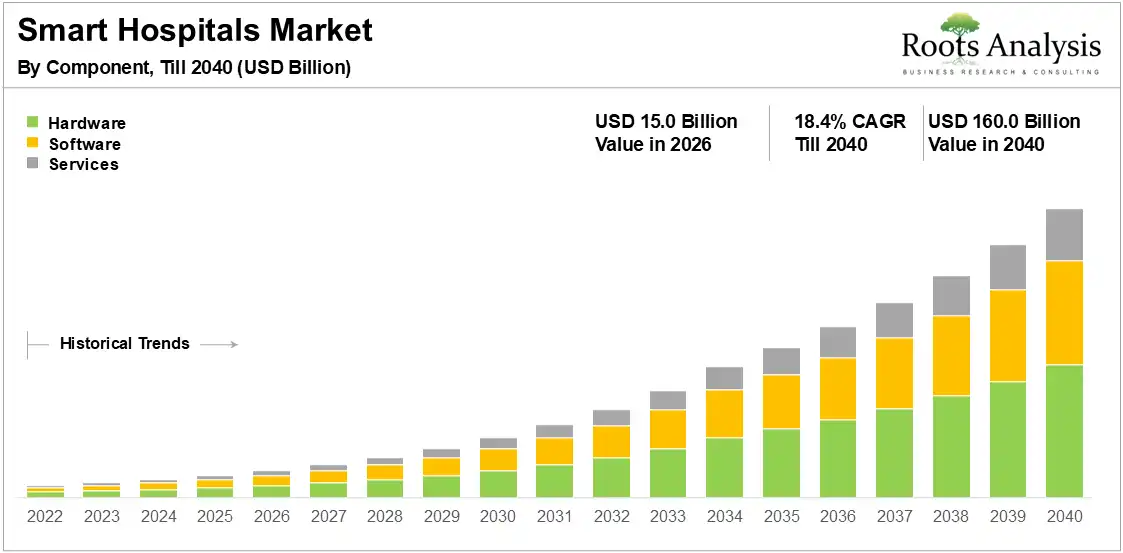
The global Smart Hospitals market is expected to rise from USD 15 billion in 2026 to reach USD 160 billion by 2040, growing at a CAGR of 18.4% over the forecast period 2026 to 2040, driven by rise in connected inpatient-room modernization.
See What’s in the Full Report – Request Your Complimentary Insights!
Market Report: Key Takeaways
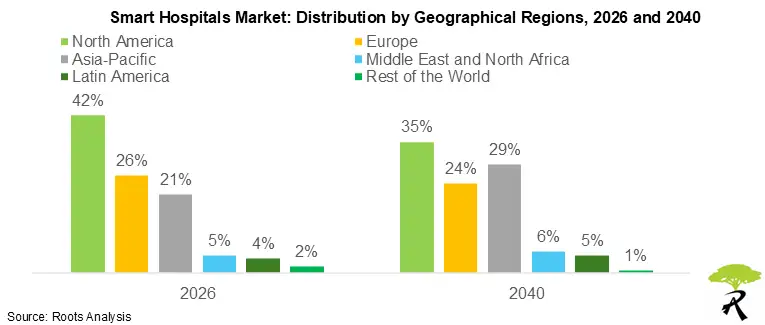
- Based on geography, North America captures 42.0% market share in 2026, whereas Asia-Pacific registers a 21.2% CAGR through 2040, driven by smart-ward localization and digital hospital expansion.
- Based on solution type, digital patient whiteboards and in-room displays capture 21.0% market share in 2026, whereas ambient AI and computer vision monitoring registers a 24.9% CAGR through 2040, driven by passive safety monitoring and automated documentation.
- Based on component, hardware captures 46.0% market share in 2026, whereas software registers a 20.1% CAGR through 2040, driven by orchestration, AI analytics, and EHR workflow integration.
- Based on technology / integration layer, EHR-integrated room systems capture 24.0% market share in 2026, whereas AI and computer vision analytics register a 24.4% CAGR through 2040, driven by real-time sensing and autonomous clinical documentation.
- Based on application, patient engagement and education captures 24.0% market share in 2026, whereas patient safety and fall prevention registers a 21.5% CAGR through 2040, driven by AI observation and sitter-cost reduction.
Smart Hospitals Market Outlook
Enterprise room modernization now moves from isolated digital whiteboards into connected care environments. Hospitals no longer buy smart patient room technology as bedside hardware alone. Demand now centers on EHR-integrated patient engagement, virtual nursing, AI-assisted observation, and connected nurse call systems. Staffing pressure, fall-prevention needs, and retrofit economics push buyers toward room-level platforms that combine displays, cameras, microphones, sensors, workflow software, routing, and clinical alerts.
Current growth comes from hospitals linking smart-room investments to nurse workload, patient safety, and care-team coordination. Digital patient whiteboards and in-room displays hold 21.0% share in 2026, while ambient AI and computer vision monitoring grows at 24.9% CAGR through 2040. In May 2026, Symtech Solutions added room controls for temperature, privacy glass, and lighting to patient whiteboard systems, tying comfort automation to operational cost reduction.
The smart hospital rooms market stays high-growth through 2040 as software, AI analytics, and enterprise rollouts gain share. Retrofit smart-room upgrades remain the largest implementation model, while enterprise-wide inpatient rollouts grow at 22.2% CAGR. In June 2026, AdventHealth advanced a 13,000-room retrofit across 57 hospitals using computer-vision cameras, digital whiteboards, and door signs. The outlook remains positive, with competition shifting toward integrated platforms and measurable inpatient workflow improvement.
Smart Hospitals Market Dynamics
Smart Hospitals Market Drivers
Hospitals are prioritizing connected room technologies because staffing pressure makes manual rounding, observation, and documentation harder to scale. Patient engagement and education holds 24.0% application share in 2026, while patient safety and fall prevention grows at 21.5% CAGR through 2040. EHR-integrated room systems, connected nurse call systems, and digital patient whiteboards help hospitals align care plans, safety alerts, and bedside communication.
Smart Hospitals Market Restraints
Integration complexity slows adoption because each patient room connects clinical workflows, facilities systems, patient entertainment, and safety infrastructure. Hardware still holds 46.0% component share in 2026, which signals high upfront costs for cameras, microphones, displays, badges, and sensor networks. Hospitals also face change-management friction when smart beds, RTLS, virtual care endpoints, and whiteboards must fit existing EHR workflows and departmental procurement cycles.
Smart Hospitals Market Opportunities
Enterprise-wide inpatient rollouts create the strongest expansion opportunity because health systems want consistent virtual nursing and safety workflows. This implementation model grows at 22.2% CAGR through 2040, outpacing unit-level deployments and mobile virtual care rooms across large acute-care networks nationwide. In June 2026, OSF HealthCare expanded its hellocare.ai partnership to deploy intelligent hospital room capabilities enterprise-wide across inpatient environments.
Smart Hospitals Market Challenges
AI monitoring raises adoption challenges because hospitals must balance passive observation, clinical escalation, patient privacy, and workflow accountability. Ambient AI and computer vision analytics grows quickly, but buyers need proof that fall prevention, virtual sitting, and documentation automation improve outcomes. Vendor differentiation now depends on EHR documentation, alert quality, and implementation support rather than camera counts or display specifications alone.
Smart Hospitals Market Size Estimation Methodology
- As a starting point, the forecast used room-specific industry data as the primary anchor and broader smart-hospital estimates as boundary checks. The model reconciled 2025, 2026, and 2034 reference points with the supplied annual forecast path. This avoided overstating the smart hospital rooms market with full smart-hospital infrastructure spending, including enterprise networks and non-room facility systems.
- Moving forward, the segmentation model mapped demand across geography, solution type, component, technology layer, application, end user, and implementation model. Each split used supplier evidence from digital patient whiteboards, nurse call, virtual care endpoints, RTLS, patient monitoring, and connected beds. This structure separated parent markets from child technologies and kept hardware, software, and services mutually exclusive.
- Building on this, the team weighted hospital adoption using acute-care room counts, inpatient bed exposure, EHR integration needs, and enterprise rollout behavior. Retrofit upgrades received higher near-term weight because hospitals can modernize legacy rooms without new-build capital cycles. Unit-level deployments received lower long-term weight as health systems standardize enterprise workflows across nursing, safety, and patient engagement.
- Drawing upon these, segment shares were cross-checked against technology-specific signals, including hardware bill-of-materials requirements, software orchestration value, AI analytics adoption, and virtual nursing workflows. Dated deployments from UCHealth, Ardent Health, AdventHealth, OSF HealthCare, and WVU Health System supported the enterprise rollout curve. Funding and acquisition signals supported vendor consolidation assumptions, especially around clinical communication and smart-room platform bundling.
- The projected value was then converted into annual segment trajectories using CAGR logic rather than flat allocation. Faster growth was assigned to ambient AI and computer vision monitoring, software, AI analytics, virtual nursing, and patient safety. Slower growth was assigned to digital door signage, fixed endpoints, and unit-level deployments because these areas face substitution from integrated platforms and centralized operating models.
- Finally, the forecast was tested against access constraints that shape commercialization speed, including EHR integration, retrofit execution, privacy-sensitive monitoring, facilities controls, and hospital procurement cycles. Regional assumptions reflected North American maturity, European interoperability pressure, and Asia-Pacific smart-ward localization. The final model favors scalable platforms over single-purpose room devices and links share gains to measurable clinical workflow impact.
Smart Hospitals Market Share Insights
Market Share by Solution Type
According to our analysis, digital patient whiteboards and in-room displays lead because hospitals can retrofit them around EHR, safety, and communication workflows. In August 2025, Symtech launched EHR-integrated digital whiteboards for patient rooms, hallway boards, and nurse stations.
On the other hand, ambient AI and computer vision monitoring will expand fastest as hospitals automate documentation, observation, and fall-risk workflows. In October 2025, Artisight introduced smart hospital rooms using ambient documentation and touchless authentication.
Market Share by Technology / Integration Layer
EHR-integrated room systems lead because hospitals prioritize data consistency, safety alerts, and clinical-context display. In August 2025, Symtech launched whiteboards that automatically display updated patient information from hospital EHRs.
Further, AI and computer vision analytics will grow fastest as hospitals seek passive monitoring and automated documentation. In August 2025, Artisight announced EHR documentation of operating-room procedures using AI and computer vision.
Want Information on Specific Region / Segment?
Regional Analysis: North America Leads the Market and Asia-Pacific is Likely to Register Higher CAGR
Presently, North America holds 42.0% share in 2026. The region leads because hospitals have mature EHR infrastructure, strong reimbursement-linked quality incentives, and deep digital-health vendor ecosystems. Capital access also supports enterprise deployments, especially among large integrated delivery networks. In April 2026, UCHealth detailed AI hospital-room upgrades across 15 hospitals.
On the contrary, Asia-Pacific registers a 21.2% CAGR from 2026 to 2040. Growth accelerates as regional hospitals localize smart-ward models, reduce documentation burden, and expand digital patient-facing infrastructure. Private hospital groups will move from pilots to scalable ward-level deployments. In November 2025, Regency Specialist Hospital reported smart-ward gains in documentation and critical-alert response.
Market Ecosystem Analysis
Within the scoped ecosystem, nine Tier 1 leaders control the bulk of commercial activity, flanked by 11 specialists and five emerging entrants. Platform convergence defines behavior now, reinforced by acquisition-driven consolidation and hardware-software bundling. Vendors are attaching nurse call, engagement, virtual care, RTLS, monitoring, and bedside endpoints to one operating layer. Nurse-capacity pressure now shifts advantage toward EHR-integrated AI orchestration that releases measurable clinical time.
- TigerConnect acquired eVideon in August 2025, adding smart-room and digital engagement assets to clinical communication. The deal strengthens nurse call, virtual care, patient education, and real-time patient updates. It pressures standalone engagement vendors by bundling workflow routing with room-level patient interfaces.
- Get Well announced in February 2025 that 58 health systems renewed, expanded, or launched collaborations. UCI Medical Center selected Get Well for SmartRooms, post-discharge navigation, and procedural care plans. This strengthens point-of-care engagement and connects smart rooms with journey management.
- Ascom’s December 2025 National Rehabilitation Centre deployment adds speech nurse call, mobile sensors, unified alerts, staff safety, and patient terminals. This raises the smart-room bar for rehabilitation and single-occupancy rooms. Baxter’s March 2025 Voalte Linq launch adds voice-activated workflows across Voalte Mobile and Voalte Nurse Call. It pressures connected-bed and endpoint vendors to support hands-free clinical communication.
- hellocare.ai raised $47 million in April 2025 to expand AI-assisted virtual care and smart connected hospital rooms. The round strengthens virtual nursing, virtual sitting, ambient documentation, digital whiteboards, room signage, and patient engagement. It pressures slower incumbents because hospitals can retrofit rooms without full infrastructure replacement.
- Artisight demonstrated in August 2025 that computer vision can document operating-room milestones directly into the EHR. The capability strengthens ambient AI, computer vision analytics, and clinical workflow optimization. It raises the evidence bar for room-aware platforms competing beyond bedside observation.
- Caregility raised $25.1 million in September 2025 to advance AI, computer vision, ambient listening, and sensor-based solutions. This expands virtual nursing, e-sitting, hospital-at-home, and operating-room telehealth. It pressures telehealth endpoint suppliers to prove configurable room intelligence, not only video connectivity.
- Zebra agreed to buy Elo Touch Solutions for $1.3 billion in August 2025. The deal consolidates mobility and touchscreen endpoint scale. It raises hardware-software bundling pressure across in-room displays, kiosks, and mobile clinical interfaces.
- Oneview and NEXA developed a 22-inch Google-certified patient engagement endpoint for hospital rooms in November 2025. It strengthens fixed bedside deployments by replacing aging Windows terminals with Android-based device management. Samsung’s July 2025 Xealth acquisition brings patient-linked digital-health infrastructure across more than 500 U.S. hospitals. This pressures display vendors to connect patient-room hardware with longitudinal engagement software.
Startup Companies and their Key Highlights
- hellocare.ai
- Event type and funding amount: Oversubscribed growth funding round, $47 million
- Month and year: April 2025
- Lead investor or strategic partner name: HealthQuest Capital
- Stated purpose of the event: Accelerate AI-assisted virtual care and transform hospital rooms into smart connected care environments.
- Market implication: Accelerates virtual nursing, virtual sitting, digital whiteboards, room signage, ambient documentation, and patient engagement in North America.
- Artisight
- Event type and funding amount: Investment, $40 million
- Month and year: August 2025
- Stated purpose of the event: Build AI into its smart hospital platform.
- Market implication: Accelerates ambient AI and computer vision monitoring because hospitals gain scalable room-aware safety and workflow tools.
- Caregility
- Event type and funding amount: Series A-2 Preferred Stock and Series C rounds, $25.1 million
- Month and year: September 2025
- Lead investor or strategic partner name: Star Mountain Capital
- Stated purpose of the event: Advance AI, computer vision, ambient listening, and sensor-based virtual-care solutions.
- Market implication: Strengthens virtual care endpoints, e-sitting, hospital-at-home, and operating-room telehealth deployments.
- Kontakt.io
- Event type: Product launch, Kio Agents
- Month and year: February 2025
- Stated purpose of the event: Use agentic AI for care orchestration across patient flow, assets, and nurse staffing.
- Market implication: Accelerates RTLS, AI analytics, and operational workflow automation for inpatient rooms and care units.
- Aiva Health
- Event type: Hospital pilot with Cedars-Sinai
- Month and year: February 2025
- Lead investor or strategic partner name: Cedars-Sinai
- Stated purpose of the event: Test voice-based nursing documentation and Epic field mapping on a 48-bed surgical unit.
- Market implication: Accelerates voice assistants, natural-language interfaces, and EHR-integrated clinical workflows inside patient rooms.
Smart Hospitals Market Trends / Opportunities
Enterprise Retrofit Rollouts Turning Smart Hospital Rooms Market Competition Toward Scaled Integration
Large health systems now favor standardized room technology over isolated pilots. In June 2026, AdventHealth advanced a 13,000-room retrofit across 57 hospitals using computer-vision cameras, digital whiteboards, digital door signs, patient records, and care plans. Vendors with deployment capacity gain an advantage over point-solution suppliers.
Enterprise adoption shifts purchasing toward platforms that can support virtual nursing, patient observation, and safety workflows across many sites. In February 2026, Ardent Health partnered with hellocare.ai across more than 2,000 patient rooms. These favor suppliers that can combine hardware rollout, software routing, and implementation services.
Ambient AI Monitoring Moving Smart Hospital Rooms Market Value Toward Safety Analytics
AI-assisted observation now expands the commercial value of smart rooms beyond communication and infotainment. In July 2026, Saint Peter’s Healthcare System expanded its hellocare.ai initiative for virtual nurse rounding, virtual sitting, and AI fall-prevention capabilities. Safety analytics creates recurring software value for vendors.
Computer vision increasingly supports automated clinical documentation and workflow capture. In August 2025, Artisight’s AI and computer-vision smart hospital platform automated operating-room documentation into EHR workflows. This moves competition toward analytics accuracy, clinical workflow fit, and integration depth.
EHR-Integrated Whiteboards Shifting Competition From Displays to Workflow Platforms
Digital patient whiteboards now compete on clinical-context integration rather than screen replacement alone. In August 2025, Symtech Solutions launched EHR-integrated digital whiteboards with care coordination, clinical safety, telehealth, education, entertainment, and room-control features. Display suppliers must prove workflow value to defend share.
Room controls add facilities automation to the smart patient room value proposition. In May 2026, Symtech Solutions and Siemens added temperature, privacy glass, and lighting controls to patient whiteboard and TV combo boards. This broadens procurement influence from clinical IT into facilities and patient experience.
Clinical Communication Consolidation Expanding Platform Control Across Patient Rooms
Clinical communication vendors increasingly use acquisitions to control more of the smart-room workflow stack. In September 2025, TigerConnect acquired eVideon to combine clinical communications with smart-room technology for virtual care, nurse call, education, and real-time patient updates. Consolidation raises pressure on smaller specialists.
Bundled smart-room suites strengthen account control because hospitals prefer fewer integration points. TigerConnect’s smart-room positioning covers connected room technologies, virtual care, nurse call, patient education, and real-time patient updates. This gives broader platform vendors more cross-sell routes than single-purpose digital signage or endpoint providers.
Your Business is Unique – Why Shouldn’t Your Report Be?
Market Access Considerations
EHR Integration and Interoperability Depth
EHR integration determines access because hospitals expect smart rooms to show current care plans, safety alerts, schedules, and clinical context. EHR-integrated room systems hold 24.0% technology-layer share in 2026, which makes middleware capability commercially important. Vendors that cannot connect whiteboards, cameras, nurse call, and virtual care endpoints into existing records face longer pilots, weaker enterprise conversion, and higher support costs. This factor also shapes renewal risk and long-term account control.
Retrofit Execution Across Live Inpatient Rooms
Retrofit capability shapes commercialization speed because most hospitals cannot wait for new-build cycles. Retrofit smart-room upgrades hold the largest implementation share in 2026, and enterprise-wide inpatient rollouts grow faster through 2040. Vendors need installation playbooks for cameras, microphones, door signs, room displays, and networked devices while hospitals keep acute-care rooms operational and protect bed availability during phased implementation across many nursing units. Scale also requires post-installation training across shifts.
Privacy-Sensitive AI Observation Governance
AI observation creates market access risk because cameras, microphones, and computer vision operate inside sensitive care environments. Hospitals must define escalation rules, sitter workflows, data access, and patient-facing communication before scaling virtual sitting or fall prevention. Suppliers with clear governance, auditability, and clinical validation will compete better than vendors selling analytics without workflow accountability, especially in multi-hospital rollouts and academic medical centers with innovation governance.
Facilities, Clinical IT, and Nursing Procurement Alignment
Smart-room sales require multi-stakeholder procurement because room controls, patient engagement, safety monitoring, and nurse communication sit across departments. Environmental comfort features link facilities teams with bedside technology decisions, as shown by smart whiteboards adding temperature, privacy glass, and lighting control. Vendors that sell only to clinical IT may lose ground when room automation affects patient experience, energy use, operating cost, and nursing acceptance. Procurement alignment therefore becomes a defensible sales capability during enterprise standardization.
How Stakeholders Benefit from the Key Focus Areas of Our Smart Hospitals Market Report
Staffing pressure, safety risk, and enterprise room retrofits make this market commercially urgent now. The report supports capital allocation, vendor selection, partnership targeting, and technology-roadmap decisions across connected inpatient-room modernization.
- Unmet Needs and Market Gaps in Smart Hospital Rooms Market: The report identifies gaps between bedside digitization and full clinical workflow integration. Hospital leaders can use gap analysis to decide whether to prioritize whiteboards, virtual nursing, AI fall prevention, or RTLS. Product teams can assess where single-purpose displays lose value against integrated room platforms.
- Funding and Venture Investment Opportunities in Smart Hospital Rooms Market: The report highlights funding and consolidation signals that indicate where venture-backed platforms can scale. In April 2025, hellocare.ai raised USD 47 million to expand AI-assisted virtual care and smart connected hospital-room technology. Investors can use this evidence to screen companies with enterprise deployment traction rather than early pilots.
- Technology Innovation and Adoption Trends: The report tracks adoption across EHR-integrated room systems, ambient AI, computer vision, voice assistants, RTLS, and cloud or edge platforms. Technology leaders can compare which layers gain share through 2040 and where legacy hardware loses influence. This supports build, buy, and partnership decisions for clinical workflow modernization.
- Smart Hospital Rooms Market Competitive Landscape and Industry Analysis: The report maps Tier 1 leaders, Tier 2 specialists, and emerging suppliers across smart-room suites, nurse call, patient displays, RTLS, monitoring, and smart beds. Commercial teams can identify where TigerConnect, Get Well, hellocare.ai, Artisight, Ascom, Baxter, Philips, GE HealthCare, and Zebra compete. This supports account targeting and positioning by solution depth.
- Mapping Strategic Partnerships and Ecosystem Synergies: The report explains how partnerships join virtual care, patient engagement, safety analytics, and facilities automation into larger room ecosystems. Business development teams can use this view to identify channel partners, integration targets, and cross-sell opportunities. The hellocare.ai deployments with OSF HealthCare, One Brooklyn Health, and Saint Peter’s show how enterprise relationships shape demand.
- Smart Hospital Rooms Market CAGR and Growth Trends: The report quantifies the overall CAGR, segment-level growth rates, and share shifts from 2026 through 2040. Strategy teams can prioritize ambient AI, software, virtual nursing, patient safety, Asia-Pacific, and enterprise rollouts because these segments gain share. This supports market-entry timing, resource allocation, and long-term portfolio planning.
Smart Hospitals Market: Scope of the Report
| Key Report Attributes | Details | |
| Forecast Period | Till 2040 | |
| Market Size 2026 | USD 15.0 Billion | |
| Market Size 2040 | USD 160.0 Billion | |
| CAGR (Till 2040) | 18.4% | |
| Segments Covered |
|
|
| Geographical Regions Covered |
|
|
| Key Sections Covered |
|
|
Market Segmentation
The Smart Hospitals market report presents an in-depth analysis, highlighting the capabilities of various stakeholders, based on different segments, such as solution type, component, technology / integration layer, application, end user, implementation model, geographical regions, and leading players.
By Solution Type
- Digital Patient Whiteboards and In-Room Displays
- Digital Door Signage
- Interactive Patient Engagement and Infotainment Platforms
- Nurse Call and Clinical Communication Systems
- Virtual Care and Telehealth Endpoints
- Ambient AI and Computer Vision Monitoring
- Smart Beds and Connected Patient Monitoring
By Component
- Hardware
- Software
- Services
By Technology / Integration Layer
- EHR-Integrated Room Systems
- IoT Sensor Networks
- AI and Computer Vision Analytics
- Real-Time Location Systems
- Voice Assistants and Natural-Language Interfaces
- Cloud and Edge Computing Platforms
- Interoperability APIs and Middleware
By Application
- Patient Engagement and Education
- Clinical Workflow Optimization
- Virtual Nursing and Remote Rounding
- Patient Safety and Fall Prevention
- Care Team Communication and Coordination
- Environmental Comfort and Room Control
- Asset, Patient, and Staff Location Awareness
By End User
- Acute-Care Hospitals
- Academic Medical Centers
- Specialty Hospitals
- Ambulatory Surgery Centers and Outpatient Facilities
- Long-Term Acute Care and Rehabilitation Facilities
- Senior Care and Skilled Nursing Facilities
By Implementation Model
- New-Build Smart Rooms
- Retrofit Smart-Room Upgrades
- Enterprise-Wide Inpatient Rollouts
- Unit-Level or Departmental Deployments
- Fixed In-Wall or Bedside Endpoint Deployments
- Mobile or Cart-Based Virtual Care Rooms
By Geographical Regions
- North America
- US
- Canada
- Mexico
- Rest of North America
- Europe
- Austria
- Belgium
- Denmark
- France
- Germany
- Ireland
- Italy
- Netherlands
- Norway
- Russia
- Spain
- Sweden
- Switzerland
- UK
- Rest of Europe
- Asia-Pacific
- China
- India
- Japan
- Singapore
- South Korea
- Rest of Asia-Pacific
- Latin America
- Argentina
- Brazil
- Chile
- Colombia
- Venezuela
- Rest of Latin America
- Middle East and Africa (MEA)
- Egypt
- Iran
- Iraq
- Israel
- Kuwait
- Saudi Arabia
- UAE
- Rest of MEA
- Rest of the World


