Stem Cell Banking Market Overview
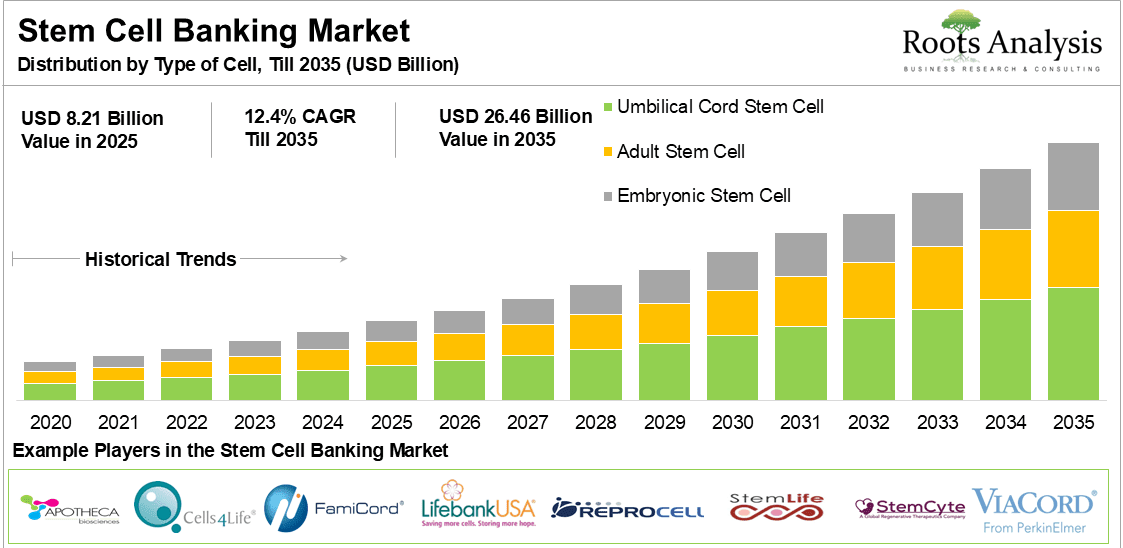
The global stem cell banking market is estimated to grow from USD 7.12 billion in 2024 to reach USD 8.21 billion in 2025 and USD 26.46 billion by 2035, representing a higher CAGR of 12.4% during the forecast period.
To learn more about this report, request a free sample copy
The global stem cell banking industry has demonstrated remarkable momentum driven by the growing awareness of its promising role in disease treatment. Stem cells refer to the undifferentiated cells possessing ability to develop into specialized body cell types. These stem cells can be used to repair damaged tissues and organs due to injuries and disease conditions. Notably, stem cells hold immense potential in regenerative medicine, tissue regeneration and personalized medicine.
Interestingly, stems cells, such as umbilical cord stem cell, adult stem cell, and embryonic stem cell are generally collected by the both private and government healthcare sectors from the donor and preserved in the stem cell banks. Contrastingly, stem cell banking is generally a practice of preserving blood cell, umbilical cord stem cell and embryonic stem cell from adults and newborn babies for future applications.
It is worth mentioning that stem cells have been utilized in the treatment of a wide range of disease conditions, such as lymphoma, leukemia, neuroblastoma, multiple myeloma and genetic disorders. In 2025, the researchers are focusing on using wide range of stem cells, including embryonic stem cells, mesenchymal stem cells and induced pluripotent stem cells to treat various neurodegenerative disorders, such as Parkinson’s disease and Huntington’s diseases.
For instance, in April 2025, BlueRock Therapeutics (a clinical-stage cell therapy company) announced its plan to initiate a phase III clinical trial for bemdaneprocel (an investigational stem cell therapy) for Parkinson’s disease. Bemdaneprocel uses pluripotent stem cells to generate dopaminergic neuron precursors. These are implanted inside the brain of Parkinson’s disease patient. This phase III trial represents a significant milestone in the development of allogeneic cell-based therapies to treat neurodegenerative disorders.
As more market players and researchers continue to expand their research on stem cells, we believe that the stem cell banking market will continue to grow at a steady pace in the upcoming years.
Stem Cell Banking Market: Report Attributes
| Key Report Attributes |
Details |
| Historical Trend |
Since 2020 |
| Forecast Period |
Till 2035 |
| Market Size 2025 |
USD 8.21 Billion |
| Market Size 2035 |
USD 26.46 Billion |
| CAGR (Till 2035) |
12.4% |
One of the key objectives of the stem cell banking market report was to estimate the current size, opportunity, and the market growth potential, over the forecast period, till 2035. We have provided informed estimates on the likely evolution of the market for the forecast period.
The global market analysis report also features the likely distribution of the current and forecasted opportunity within the market across various segments, such as type of service, type of utilization, type of cell, application area, type of source, type of bank, end users, geographical regions and leading players.
In order to account for future uncertainties associated with some of the key parameters and to add robustness to our model, we have provided three stem cell banking market forecast scenarios, namely conservative, base, and optimistic scenarios, representing different tracks of industry’s evolution.
Recent Developments in Stem Cell Banking Market
Several recent developments have occurred in the field of stem cell banking, and we outline some of these below.
- In April 2025, Abu Dhabi Biobank launched an affordable private cord blood banking which offers an affordable and accessible way to preserve their newborns stem cells.
- In February 2025, CellBank Australia operated by Children’s Medical Research Institute announced its partnership with European Bank for induced pluripotent stem cells. This partnership enable Oceania-based researchers to access more than 950 induced pluripotent stem cell lines that represent over 45 different diseases. Furthermore, the partnership also provide access to numerous tools to Australian scientists for studying diseases, such as neurological, cardiovascular and metabolic disorders.
- In January 2025, VectorBuilder’s partner Ucello announced that its newly launched (UC101), CD19-targeting umbilical cord blood-derived allogenic CAR-T cell therapy received Investigational New Drug (IBD) approval from the FDA.
Stem Cell Banking Market Segmentation Insights
The market report provides comprehensive information on stem cell banking companies who are currently active across various segments of the industry as mentioned in the table below.
Stem Cell Banking Market: Market Segmentation
| Market Segmentations |
Details |
| Type of Service |
- Collection & Transportation
- Processing
- Analysis
- Storage
|
| Type of Utilization |
|
| Type of Cell |
- Umbilical Cord Stem Cell
- Adult Stem Cell
- Embryonic Stem Cell
|
| Application Area |
- Personalized Banking Applications
- Research Applications (Disease Treatment Studies, Life Science Research, and Drug Discovery)
- Clinical Application (Hematopoietic Disorders, Autoimmune Disorders, and Other Diseases)
|
| Type of Source |
- Placental Stem Cells (PSCs)
- Human Embryo-Derived Stem Cells (hESCs)
- Bone Marrow-Derived Stem Cells (BMSCs)
- Dental Pulp-Derived Stem Cells (DPSCS)
- Adipose Tissue-Derived Stem Cells (ADSCs)
- Other Stem Cell Sources
|
| Type of Bank |
|
| End User |
- Hospitals
- Research Institutions
- Biotechnology Companies
- Pharmaceutical Companies
|
| Geographical Regions |
- North America
- Europe
- Asia-Pacific
- Middle East and North Africa
- Latin America
|
| Market in North America |
|
| Market in Europe |
- France
- Germany
- Italy
- Spain
- UK
- Rest of Europe
|
| Market in Asia-Pacific |
- China
- India
- Japan
- South Korea
- Rest of the Asia-Pacific
|
| Market in Middle East and North Africa |
- Egypt
- Saudi Arabia
- United Arab Emirates
|
| Market in Latin America |
|
Industry Experts on Stem Cell Banking Market
Stem cell banking is rapidly growing and is expected to remain progressive in the upcoming years due to the growing awareness among global population about its significances in disease treatment.
“We aren’t made of drugs; we’re made of cells. Stem cells, or stem cells in combination with pharmaceuticals, will be the future of medicine.” –Cade Hildreth, President/CEO of BioInformant.
Stem Cell Banking Market Share Insights
Market Share by Type of Service: Collection & Transportation Holds the Maximum Share
- Based on the type of service, the global market is segmented into collection & transportation, processing, analysis, and storage. According to the stem cell banking market report, presently storage segment holds the maximum share of the market. This is potentially due to the rising number of stem cell banks and significant shift towards clinical studies on stem cells and their role in disease prevention.
- However, it is worth mentioning that collection & transportation segment is likely to experience a substantial CAGR during the forecast period. With increasing focus on stem cell collection, there is a high demand for transportation logistics and collection containers for efficient transportation to the stem cell banking center.
Market Share by Type of Utilization: Unused Segment Holds the Largest Share
- This segment highlights the distribution of global market across type of utilization, such as used and unused. Currently, unused segment is holding the maximum share of stem cell banking market size. This dominance is due to a number of factors, such as low probability of patient requiring stem cell transplant, and high cost.
- However, in the long run, used segment is expected to register a higher CAGR during the forecast period. This can be attributed to the growing usage of stem cells in various clinical applications.
Market Share by Type of Cell: Umbilical Cord Stem Cell Holds the Maximum Share
- The market for stem cell banking is bifurcated across different type of cell, such as umbilical cord stem cell, adult stem cell, and embryonic stem cell. According to the stem cell banking market analysis, currently umbilical cord stem cell segment holds 44% share of the market. This is likely to be the result of increasing preferences of parents to store umbilical cord of their newborn babies for future use.
- It is worth mentioning that umbilical cord stem cells has the potential to treat, wide range of diseases and is highly acceptable by public. Moreover, storage of umbilical cord is a non-invasive procedure and immediately taken out after childbirth. With growth awareness about its importance in disease treatment, this segment will continue to grow at a higher CAGR during the forecast period.
Market Share by Application Area: Personalized Banking Application Accounts for Highest Share
- Based on the application area, the global market is segmented into personalized banking applications, research applications (disease treatment studies, life science research, and drug discovery), clinical application (hematopoietic disorders, autoimmune disorders, and other diseases). Currently, personalized banking applications hold the majority of the stem cell banking market share. This dominance is likely to be the result of continuous research on the stem cell and many stem cell therapies are currently under clinical studies.
- It is worth noting that, clinical applications segment is expected to show a lucrative growth, registering a higher CAGR over the forecasted period. This lucrative growth is due to the growing usage of stem cell therapies for the treatment of patients with autoimmune disorders and hematopoietic disorders.
Market Share by Type of Source: Placenta Stem Cell is Dominating the Market
- The global market is distributed across different type of source, such as placental stem cells (PSCs), human embryo-derived stem cells (hESCs), bone marrow-derived stem cells (BMSCs), dental pulp-derived stem cells (DPSCS), adipose tissue-derived stem cells (ADSCs), other stem cell sources. According to our stem cell banking market forecast, presently the placenta stem cells segment holds the largest share (nearly 75%) of the market. This is potentially due to the growing storage of placenta stem cells and increasing number of cord blood bank to store stem cells.
- Driven by the high demand for placental stem cells, this segment will continue to grow at a higher CAGR during the forecast period.
Market Share by Type of Bank: Private Bank Occupies the Highest Share
- The global market is segmented across public and private banks. Presently, the private bank is dominating industry by holding maximum share of the stem cell banking market size. This dominance is due to the fact that private stem cell banks offer wide services for collection, processing and storage of stem cells. Furthermore, many families prefer individuals or personalized stem cell storage options, which is expected to be the key reason for highest share.
- However, in the long run, public bank segment is expected to register a substantial CAGR during the forecast period. The growing number of public stem cell storage facilities to store stem cells at minimal or no cost to the stem cell donor is likely to fuel its adoption during the forecast period.
Market Share by End User: Hospitals Holds the Largest Share of the Market
- Based on the end user, the global market is segmented into hospitals, research institutions, biotechnology companies and pharmaceutical companies. Presently, hospitals hold the largest share of the stem cell banking industry value. This can be attributed to the fact that hospitals are the primary area for collecting stem cells and delivering stem cell therapies to the needed patients.
- However, in the long run, research institutions may show lucrative growth, expecting to register a higher CAGR during the forecast period. This is likely to be the result of growing research on stem cells across wide range of healthcare applications.
Market Share by Geographical Regions: North America Holds the Dominating Position
- The global market is distributed into North America, Europe, Asia-Pacific, Middle East and North Africa, and Latin America. Currently, North America occupies the largest share (39%) of the market for stem cell banking. Several factors, such as rising disposable income, increasing prevalence of chronic conditions and availability of well-established stem cell banking infrastructure along with patient’s willingness to store stem cells are the key factors for highest share.
- In Asia-Pacific, the market for stem cell banking is expected to grow at a higher CAGR during the forecast period. The growing research on stem cells, government support, rising number of stem cell banks and awareness among population about stem cells potential in treating diseases are the key reason for lucrative growth of market in this region.
Stem Cell Banking Market: Report Deliverables
| Report Deliverables |
Details |
Excel Data Packs
(Complimentary) |
Available |
| Key Stem Cell Banking Companies Profiled |
(A complete list of companies captured is available in the report) |
PowerPoint Presentation
(Complimentary) |
Available |
| Customization Scope |
15% Free Customization |
Stem Cell Banking Market Major Takeaways
The “Stem Cell Banking Market: Industry Trends and Global Forecasts, till 2035” market report features an extensive study of the current market landscape, market size, market share, market growth, market trends, market value, market forecast, market outlook, statistics, and future opportunities for stem cell banking companies. The market research report lays emphasis on the stem cell banking solutions that are being developed. Key takeaways of the market report are briefly discussed below.
Stem Cell Banking Market Competitive Landscape
Currently, the market landscape of stem cell banking is highly competitive, featuring the presence of several well-established and new entrants. Market players, such as Cells4life, Global Stem Cells, and BioEden are seamlessly focusing on the development of advanced stem cell banking facilities.
It is worth mentioning that StemCyte India that operate “Hybrid Model” by combining public and private banking for cord blood unit at no extra cost stand out as a most prominent player in the Indian cord blood banking market. As more market players continue to focus on advanced approaches for stem cell collection, processing and transportation of cord stem cells, the market will remain immensely competitive.
Market Driver: What are the Key Drivers for Stem Cell Banking Industry?
Increasing Incidence of Chronic Diseases
It is worth mentioning that the growing incidence of chronic conditions, such as cardiovascular diseases, diabetes and autoimmune diseases are necessitating the demand for stem cell therapies.
Rising Awareness About Stem Cell Therapies
Notably, the growing awareness about differentiating ability of stem into any functional cell to restore damaged tissue and organ is the key stem cell banking market driver. Additionally, increasing willingness to spend on stem cell storage during childbirth is another key growth factor for the market.
Market Challenges: What are the Factors Hindering Stem Cell Banking Market Growth?
Economic Challenges in the Adoption of Stem Cell Banking
Collection, Processing and Storage of stem cells is an expensive process. Therefore, despite growing awareness, the expenses associated with stem cell storage may limit its adoption specifically in low to middle income countries.
Complex Regulatory Landscape
Stem cell therapies are still under clinical stages and limited availability of results due to complex regulatory landscape may create challenges for the market players. Furthermore, due to its limited long-term efficacy, several government organizations have banned the storage of specific types of stem cells, which further limits market expansion.
Market Trends: What Will be the Future Opportunities in Stem Cell Banking Industry?
Stem Cell Banking for Personalized Medicine / Regenerative Medicine
Currently, researchers are focusing on expanding usage of stem cells for the development of personalized and regenerative medicine. Additionally, the industrial players such as Merck, Thermo Fisher Scientific and STEMCELL Technologies are increasingly emphasizing adult stem cells specifically those collected from adipose tissues / bone marrow to repair tissue damage and development of stem cell therapies for targeting wide range of diseases.
Expanding Cord Blood Banking Services
With rising awareness about stem cells, young parents are focusing on storing umbilical cord stem cells / placental stem cells. Considering the increasing focus on stem cell storage, numerous market players are expanding their cord blood banking services to meet the ongoing demand.
Focus on Technological Innovations
With growing interest in personalized stem cell banking numerous market players are aiming for advancing their cryopreservation technology so people can store stem cells for an extended period of time.
Stem Cell Banking Market Report Coverage
The market report presents an in-depth analysis, highlighting the capabilities of various stakeholders in the stem cell banking industry, across different geographies. Amongst other elements, the market report includes:
- An Infographic Executive Summary
- Market Landscape of Stem Cell Banking Providers
- Company Competitiveness Analysis
- Company Profiles
- SWOT Analysis
- Market Impact Analysis
- Market Forecast Analysis
From the Author’s Desk
Author’s View on Stem Cell Banking Market
With growing focus on stem cell therapies to treat wide range of diseases and rising awareness about preserving stem cells is shaping this industrial growth. Furthermore, industrial players are continually focusing on technological innovations and expanding their stem cell banking services, which is expected to be a key driver for the market.
Glossary
- Umbilical Cord Blood Banking: It refers to the collection and storage of stem cells from newborns' umbilical cords and use for research and stem cell therapies development.
- Cell Therapy: It refers to a form of cell therapy designed using stem cell therapies to replace or repair damaged tissue.
- Biological Insurance: It refers to the concept of preserving stem cells for potential future medical needs
- Hematopoietic Stem Cell Transplantation (HSCT): A procedure involving the infusion of stem cells to establish new, healthy blood cell production.
Frequently Asked Questions
What do you mean by the stem cell banking?
Stem cell banking refers to the process of collection, processing and storage of stem cells for future research use.What is the current market size of stem cell banking?
Currently, the global stem cell banking market size is valued at USD 8.21 billion.What is the future outlook for stem cell banking industry?
The market for stem cell banking is expected to reach USD 26.46 billion by 2035.What is the CAGR of market for stem cell banking?
The global market for stem cell banking is forecasted to grow at a CAGR of 12.4% during the forecast period. What regions hold the highest stem cell banking market share?
Currently, North America holds the highest share of the market, and the trend of dominance is likely to remain unchanged during the forecast period.What are the top stem cell banking market growth factors?
Rising incidence of chronic conditions, growing awareness about stem cells and expanding research on stem cell therapies across various healthcare conditions.Who are the leading stem cell banking companies?
Apotheca Biosciences, BioEden, Cells4Life, CryoCell International, Cellebration, Cord Blood Registry, FamiCord, Global Stem Cells, LifebankUSA, ReproCELL, StemLife, StemCyte, and Viacord.