
Lowest Price Guaranteed
Slides
226
Last Updated
August 2026
View Count
15264
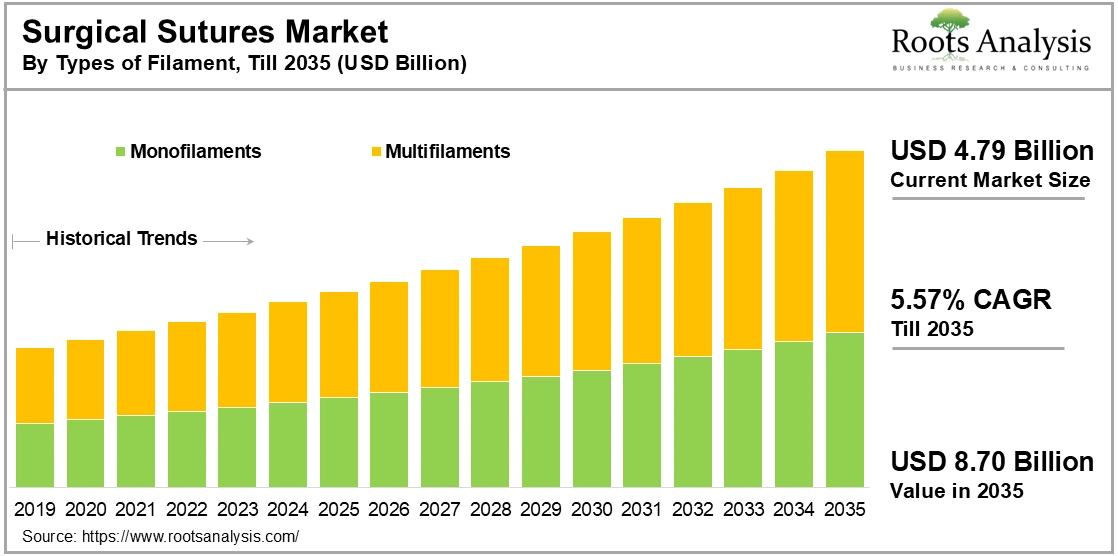
The global surgical sutures market is estimated to grow from $4.79 billion in 2024 to $8.70 billion by 2035, at a steady CAGR of 5.57% during the forecast period.
Surgical suture, also known as stitches, refers to a form of medical device used to hold damaged tissues and ligate blood vessels after an injury to initiate the healing process. Sutures are available in various types based on the material used (which includes natural, polypropylene and stainless steel). These threads are generally applied with the help of a needle. The selection of surgical sutures is determined by the characteristics and location of the wound or the specific body tissues being approximated. Factors, such as tensile strength, elasticity, and adaptability to different tissues are considered when choosing the appropriate suture thread and technique for a specific patient. These factors are considered by medical care providers in order to ensure efficient wound closure and healing. Additionally, sutures (including dental sutures) bring together the wound edges without causing indenting or blanching of the skin to prevent impeding the blood supply, which could lead to increased infection and scarring. Driven by the rising risk of chronic wounds in patients suffering from chronic diseases, the market for surgical suture is continually expanding. Material selection is increasingly influenced by the availability of biopolymers, including bio-based and biodegradable polymers that can support absorbable sutures and other temporary medical products.
This segment highlights the distribution of global surgical sutures market on the basis of filament type into microfilament and multifilament. It is worth mentioning that, currently, multifilament segment accounts for 54% share of the market. However, in the future, monofilaments segment has shown lucrative growth potential and is poised to grow at a higher CAGR during the forecast period. This can be attributed to its single-strand design that offers better handling and minimizes tissue trauma during surgeries.
 |
Based on the type of product, the global surgical sutures market is segmented into absorbable and non-absorbable products. According to our projection, currently absorbable products occupy 55% market share. This highest share is primarily attributed to the high demand for naturally degradable sutures that can provide optimal support to wounds and poses the ability to withstand under normal stress. Additionally, absorbable products have been designed with antibacterial protection which reduces the risk of infection and enhance the healing process. However, in the long run, it is anticipated that non-absorbable products will show lucrative growth potential driven by the ability to stand last longer and high demand for durable suture for surgical procedures.
Based on the type of material used, the global market is segmented into natural, polypropylene, stainless steel and other materials. Currently, natural surgical sutures segment accounts for the highest share of the market. This can be attributed to the fact that natural materials, such as collagen are easily absorbed and does not require post-treatment to remove the threads. Furthermore, the growing usage of absorbable sutures has surged the demand for natural materials, which is expected to be a key reason for its higher adoption rate. However, in the long run, polypropylene sutures will grow at a higher CAGR during the forecast period owing to the increasing requirement of advanced sutures with high strength and low reactivity with tissues.
Based on the type of coating, the global market is segmented into non-coated, antimicrobial and other coatings. Presently, non-coated sutures occupy the highest surgical sutures market share. This dominance is primarily due to the fact that non-coated sutures are conventional to use and cost-effective. However, owing to the growing risk of infection at wound site, antimicrobial coating-based sutures have been adopted on a large scale to prevent microbial infection. Moreover, polypropylene sutures are widely adopted in orthopedic and cardiovascular surgeries as they offer high tensile strength and are coated with antimicrobial layer to prevent microbial infection near wound sites. Driven by the growing preferences, antimicrobial suture market segment will grow at a higher CAGR during the forecast period.
Based on the applications, the global market is segmented into ophthalmic surgery, cardiovascular surgery, orthopedic surgery, neurological surgery, general surgery, dental surgery, gastroenterology, gynecology, plastic surgery, veterinary surgery and other applications. Based on our surgical sutures market forecast, currently cardiovascular surgery segment occupies the highest market share. This can be attributed to the growing incidence of cardiac diseases across the globe, supportive reimbursement policies and advanced diagnostic procedures for the treatment of patients with heart diseases that demands innovative sutures. However, in the long run, orthopedic surgery segment is anticipated to grow at a higher CAGR during the forecast period. This lucrative growth potential is primarily due to the rising concern of orthopedic conditions in geriatric population that require advanced orthopedic surgical procedures. The growing risk of orthopedic conditions has surged the demand for advanced sutures that are specifically tailored for surgeries.
The global market is distributed on the basis of end user into hospitals, surgical centers, and clinics / physician offices. Currently, hospitals occupy the highest surgical sutures market share, with more than 47% revenues contributed by this segment. This dominance is primarily due to the fact that surgical procedures have been performed in the hospitals on a large scale. Moreover, hospitals are the primary users of advanced surgical procedures that demand surgical sutures. However, in the long run, special clinics / physician offices will grow at a lucrative CAGR during the forecast period. This highest growth potential is due to the fact that physicians are beginning to offer specialized surgical in clinical settings and increasing number of specialized clinics across the globe. Moreover, in clinical settings patients can get personalized treatment and immediate attention instead of waiting for hours in the hospitals.
Based on the geographical region, the global market is distributed into North America, Europe, Asia-Pacific, Middle East and North Africa, and Latin America. As per our surgical sutures market analysis, currently North America occupies the highest share of the market, capturing close to 50% of the overall market share. This can be attributed to the growing number of surgical treatment plans to treat patients with chronic conditions in this region. Furthermore, the expanding research for the development of advanced automated surgical suture device and supportive reimbursement policies further contributed to the growth of this region during the forecast period.
However, Asia-Pacific is likely to grow at a higher CAGR during the forecast period. Several factors that have contributed to the lucrative growth potential includes increasing incidence of cardiovascular diseases and growing awareness about advanced surgical devices. Furthermore, significant improvement in the healthcare infrastructure is likely to be the robust reason for the highest growth rate, during the forecast period. Additionally, Asia pacific based suture manufacturers are also entering and expanding their geographical reach. In March 2024, India based Dolphin Sutures announced a strategic partnership with US based Novo Integrated Sciences to enter the US market.
The "Global Surgical Sutures Market: Industry Trends and Global Forecasts till 2035" market report features an extensive study of the current market landscape, market size and future opportunities within the surgical sutures industry, during the given forecast period. The market report highlights the efforts of several stakeholders engaged in this rapidly emerging surgical suture industry. Key takeaways of the market report have been briefly discussed below.
The market for surgical sutures has been propelled by several factors, such as increasing risk of lifestyle-associated diseases and rise in the surgical procedures. It is important to highlight here that lifestyle-associated diseases such as cerebrovascular diseases, ischemic heart disease, and orthopedic illnesses may require surgical treatments which has significantly raised the requirement for biocompatible surgical devices. The market has been further fueled by the growing number of surgical procedures (including surgeries conducted using surgical robots across the globe for a broad range of treatments. According to the World Health Organization, about 300 million surgical procedures are conducted globally each year. The rise in awareness about novel surgeries, surge in geriatric population, and demand for better healthcare facilities are expected to provide lucrative opportunities for the surgical sutures market growth during the forecast period.
One of the potential market restraints that may impact this market is the availability of advanced wound care solutions. Currently, the players are focused towards development of innovative dressing solutions, such as foam dressing, alginate dressing, composite dressings and hydrocolloid dressings. In addition, insurance companies' erratic rules on suturing supplies have been shown to be a market restraint. Further, the overall cost of surgical treatment, which increases dramatically when advanced instruments and materials are used, is another obstacle to the market's growth.
The market is expected to increase as a result of a rising trend of less invasive cosmetic plastic operations, which is expected to rise, owing to the high-income level of people residing in developed regions and the people becoming more mindful of their physical appearances. This will provide beneficial opportunities for the surgical sutures market growth. Moreover, increase in the number of R&D initiatives and technological advancement so as to optimize the healing process and decrease the risk of wound separation. A team of researchers based at Donghua University, China have developed electrical suture which provides electrical stimulation at the wound site and helps in faster healing of muscle wounds. Preclinical results of healing ability of BioES-suture were presented in an article in Nature Communications in October 2024. Further, the multi-disciplinary approach which includes materials science, biomedicine and engineering technology, have unfolded plenty of beneficial opportunities that will propel the surgical suture market forward.
The market opportunities are not limited to developed countries, as low and middle-income countries are also expected to contribute to the growth of this market. This is specifically driven by the improved healthcare infrastructure in these regions as well as increased healthcare spending and elective procedures. These factors collectively indicate a positive outlook for market opportunities in the surgical sutures industry.
Currently, the global surgical sutures market witnesses the presence of well-established and new entrants who are currently holding the required expertise to develop sutures for a broad range of surgeries. In order to leverage a competitive edge, various industry stakeholders are presently increasing their research and development activities for innovative, multi-functionalized surgical sutures. Certain strategic initiatives are also undertaken by companies to design, fabricate and market the products across varied demographics. Overall, the market outlook features a highly fragmented state, which include small, mid-sized and large players.
Based on filament, the market is analyzed across monofilament and multifilament. The multifilament segment is expected to dominate the market and witness the fastest growth owing to several advantages associated with it, such as better pliability, high tensile strength, and flexibility. In contrast, monofilament sutures are difficult to handle and may cause crushing or crimping of the suture, leading to undesirable and premature suture failure during surgery attributing to their memory. However, these sutures have a lower risk of infection. In October 2024, researchers of an Iran-based company announced the production of surgical stainless steel and biocompatible suture wire, that can be used for sternal closure post open heart surgeries. Notably, the suture is commercially available in any of the filament format (monofilament or multifilament). As mentioned by Hojjat Mirzayee, Production Manager at the company, “This product remains inside the patient's body like implant equipment for life, that's why they should be biocompatible and meet the necessary standards in terms of mechanical properties like penetration, connection force, bending and other parameters”.
Key market players that are engaged in surgical sutures industry are (in alphabetical order) Apollo Endosurgery, Boston Scientific, DemeTECH, Ethicon, Internacional Farmacéutica, Medtronic, Mellon Medical, Peters Surgical, Smith & Nephew, and Sutures India. This market report includes an easily searchable excel database of all the surgical sutures companies worldwide.
The market study report covers an in-depth analysis of leading players who are currently active across different segments of this growing industry as mentioned in the table below.
| Key Report Attributes | Details | |
| Historical Trend | Since 2019 | |
| Forecast Period | Till 2035 | |
| Market Size 2035 | USD 8.70 Billion | |
| CAGR | 5.57% | |
| Product Type |
|
|
| Type of Material Used |
|
|
| Type of Coating |
|
|
| Type of Filament |
|
|
| Application |
|
|
| End User |
|
|
| Key Geographical Region |
|
|
| Key Companies Profiled |
|
|
| PowerPoint Presentation (Complimentary) |
Available | |
| Customization Scope | 15% Free Customization | |
| Excel Data Packs (Complimentary) |
Available | |
One of the key objectives of the market report was to estimate the current surgical sutures market size, opportunity and the market growth potential, over the forecast period, till 2035. We have provided informed estimates on the likely evolution of the market for the forecast period. Additionally, the market report features the likely distribution by product type (absorbable sutures and non absorbable sutures), type of material used (natural, polypropylene, stainless steel, and other materials), type of coating (non-coated, antimicrobial and other coatings), type of filament (monofilaments and multifilament’s), application (ophthalmic surgery, cardiovascular surgery, orthopedic surgery, neurological surgery, general surgery, dental surgery, gastroenterology, gynecology, plastic surgery, veterinary surgery and other applications), end user (hospitals, surgical centers, and clinics / physician offices) and geographical regions (North America, Europe, Asia-Pacific, Middle East and North Africa and Latin America) and key players.
To account for future uncertainties and to add robustness to our model, we have provided three market forecast scenarios, namely conservative, base, and optimistic scenarios, representing different tracks of the industry's growth.
All actual figures have been sourced and analyzed from publicly available information forums and primary research discussions. The financial figures mentioned in this market research report are in USD, unless otherwise specified.
There has been recent activity in the surgical sutures industry and some of the key developments have been mentioned below. These developments, even if they took place post the release of our market report, substantiate the overall surgical sutures market trends that have been outlined in our analysis.