
Lowest Price Guaranteed
Slides
243
Last Updated
April 2025
View Count
11640
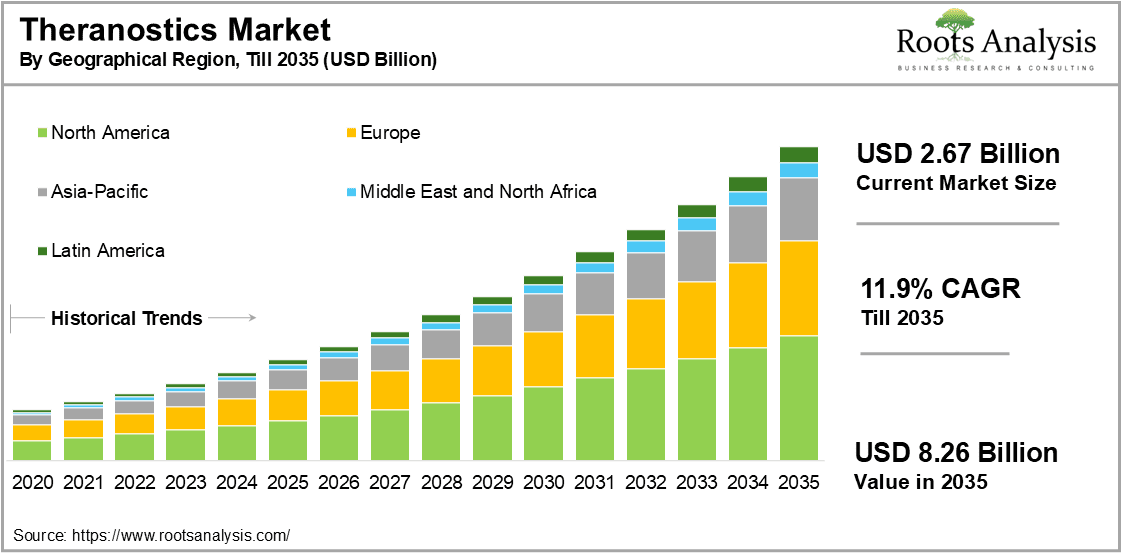
The global theranostics market, valued at USD 2.33 billion in 2024, is projected to reach USD 2.67 billion in 2025 and USD 8.26 billion by 2035, representing a CAGR of 11.9% during the forecast period.
 |
Theranostics industry is recently gaining traction driven by the growing adoption of targeted therapies to treat wide range of disease indication. It refers to the combination of diagnostic imaging technologies and radioactive medicine / targeted therapies. This combinational approach allows healthcare practitioners to identify biomarkers, diagnose and treat diseases with higher precision while minimizing the risk of side effects.
As per the American Cancer Society cancer statistics published in 2025, over 2 million new cancer cases will be diagnosed in the United States this year and over 6,18,000 people will die with the disease. In addition to cancer, growing prevalence of chronic conditions has necessitated the demand for modern treatment approach to treat patients with different forms of cancer. Owing to growing concern, theranostics has given a new dimension to treat patients with a combination of radiopharmaceuticals.
It is important to highlight here that in October 2024, Curicum entered into a partnership with PDRadiopharma (a subsidiary of PpetiDrream) to advance the regulatory filing, clinical development and commercialization of the investigational PSMA-targeting theranostics 177Lu-PSMA-I&T and 64Cu-PSMA-I&T in Japan.
Similarly, several industrial players are taking strategic initiatives to increase their research on theranostics beyond cancer treatment. Driven by the increasing initiatives and rising awareness among healthcare experts, we believe theranostics industry will remain progressive during the forecast period.
The market report provides comprehensive information on theranostics companies who are currently active across various segments of the industry as mentioned in the table below.
| Key Report Attributes | Details | |
| Historical Trend | Since 2020 | |
| Forecast Period | Till 2035 | |
| Market Size 2025 | USD 2.67 Billion | |
| Market Size 2035 | USD 8.26 Billion | |
| CAGR (Till 2035) | 11.9% | |
| Type of Product |
|
|
| Application Area |
|
|
| End User |
|
|
| Geographical Regions |
|
|
| Key Companies Profiled |
|
|
| PowerPoint Presentation (Complimentary) |
Available | |
| Customization Scope | 15% Free Customization | |
| Excel Data Packs (Complimentary) |
Available | |
One of the key objectives of the theranostics market report was to estimate the current size, opportunity, and the market growth potential, over the forecast period, till 2035. We have provided informed estimates on the likely evolution of the market for the forecast period.
The global theranostics market analysis report also features the likely distribution of the current and forecasted opportunity within the market across various segments, such as type of product (diagnostic imaging (MRI, PET imaging, nuclear imaging, CT scan, molecular imaging and other diagnostic imaging), radiopharmaceuticals (lutetium-177, samarium-153, radium-223, iodine-131, yttrium-90, gallium-68, fluorine-18 and other radiopharmaceuticals), IVD / biomarker screening (polymerase chain reaction, next-generation sequencing and fluorescence in-situ hybridization), and software and services), Application Area (prostate cancer, bone metastasis, neuroendocrine tumors, lymphoma, cardiovascular diseases and other applications), end user (hospitals, diagnostics centers, specialty clinics and other end users), geographical regions (North America, Europe, Asia-Pacific, Middle East and North Africa, and Latin America) and leading players.
In order to account for future uncertainties associated with some of the key parameters and to add robustness to our model, we have provided three market forecast scenarios, namely conservative, base, and optimistic scenarios, representing different tracks of industry’s evolution.
All actual figures have been sourced and analyzed from publicly available information forums and primary research discussions. The financial figures mentioned in this market report are in USD, unless otherwise specified.
Based on the type of product, the global market is distributed into diagnostic imaging (MRI, PET imaging, nuclear imaging, CT scan, molecular imaging and other diagnostic imaging), radiopharmaceuticals (lutetium-177, samarium-153, radium-223, iodine-131, yttrium-90, gallium-68, fluorine-18 and other radiopharmaceuticals), IVD / biomarker screening (polymerase chain reaction, next generation sequencing and fluorescence in-situ hybridization), and software and services.
According to theranostics market analysis, presently diagnostics imaging segment occupies 34% of the overall revenue share. This dominance is primarily due to the fact that diagnostic imaging technologies such as PET imaging, MRI, nuclear imaging, molecular imaging and CT scan play a pivotal role in early diagnosis of disease. Owing to the extensive usage of diagnostic medical imaging, this segment is likely to remain dominant and is expected to grow at a higher CAGR during the forecast period.
This segment highlights the distribution of global market across different application areas, such as prostate cancer, bone metastasis, neuroendocrine tumors, lymphoma, cardiovascular diseases and other applications. According to our market study, currently prostate cancer segment accounts for the highest theranostics market share (30%). This is likely to be the result of increasing prevalence of prostate cancer across the globe and the availability of well-established diagnostics and treatment pathways such as PSA (prostate-specific antigen) screening tests and biopsies. Additionally, there are several targeted theranostics agents, such as PSMA (prostate-specific membrane antigens)-targeting radiopharmaceuticals. These agents selective bind to the prostate cancerous cells, allowing more accurate imaging and targeted therapy.
However, the neuroendocrine tumors segment also holds a substantial share of the market and is expected to grow at a higher CAGR during the forecast period. This is potentially due to the increasing incidence of neuroendocrine incidence and expanding usage of peptide receptor radionucleotide therapy, a theranostics approach for targeting neuroendocrine tumors.
This segment highlights the distribution of global market across different end users, such as hospitals, diagnostics centers, specialty clinics and other end users. Currently, hospitals account for the largest share (42%) of the theranostics industry. This is potentially due to the advanced medical services, such as laboratory testing diagnostic imaging and therapeutic interventions to provide integrate theranostics solutions to treat broad range of diseases.
Additionally, hospitals also provide cutting-edge diagnostic imaging technologies / equipment, such as MRI machines and PET / CT scans that are necessary for accurate diagnosis and theranostics procedures. Driven by the widespread availability of modern medical infrastructure, this segment is likely to remain dominant, expecting to grow at a higher CAGR during the forecast period.
The global theranostics market size is distributed to across different geographical regions, such as North America, Europe, Asia-Pacific, Middle East and North Africa, and Latin America. According to our market analysis, North America currently dominates the market with a share of 40%. This dominance is likely to be the result of the high prevalence of cancer in this region and increasing expenditure on state-of-the-art medical diagnostics technologies and targeted therapies.
However, in Asia-Pacific, the market for theranostics is likely to grow at a higher CAGR during the forecast period. This is likely to be the result of growing incidence of chronic conditions, such as cardiovascular diseases and diabetes. Driven by the growing demand for advanced therapeutic solutions, such as diagnostics, therapeutics and theranostics purposes, the market holds to show lucrative growth potential in this region.
The “Theranostics Market: Industry Trends and Global Forecasts, till 2035” market report features an extensive study of the current market landscape, market size, market share, market growth, market trends, market value, market forecast, market outlook, statistics, and future opportunities for theranostics companies. The market research report lays emphasis on the theranostics that are being developed. Key takeaways of the market report are briefly discussed below.
Currently, the theranostics companies market landscape is immensely competitive, featuring a wide array of small, mid-sized and large companies. In order to leverage competitive edge, these industrial players are emphasizing on the development of advanced theranostics and diagnostics solutions.
Notably, several market players are entering into strategic partnerships and collaborations to strengthen their product portfolio, accelerate clinical studies and development of advanced theranostics solutions. For instance, in October 2024, GE HealthCare is publicizing its leading role in an around USD 27.8 million initiative to expand the usage of theranostics. This project draws together 29 partners from leading European academic and clinical sites, patient advocacy groups and businesses. The aim of breakthrough approach is to expand the theranostics delivery that integrate targeted therapeutics and imaging diagnostics for tailored treatment to treat patients with late-stage prostate and neuroendocrine cancers.
As more market leaders continue to accelerate their efforts in this field, we believe that the market will remain competitive during the projected period.
The global market for theranostics is driven by the rising prevalence of chronic diseases and growing acceptance of companion diagnostics (CDx). It is important to highlight here that chronic diseases and neurological conditions have necessitated the demand for modern treatment modalities that aid in early disease diagnostics and enable the treatment of personalized treatment strategies.
Theranostics in this instance emerged as a potential solution as it combines diagnostic imaging and potential to treat a broad range of disease indications. This approach involves the use of radioactive compounds to treat tumors at targeted sites. Additionally, the growing acceptance of companion diagnostics to optimize the treatment selection, predicting treatment response and side effects of treatment in patients has significantly raised the adoption of theranostics which is expected to be a key driver for the market.
Some of the potential challenges that may impede theranostics market growth includes high cost associated with the treatment and regulatory challenges. It is worth mentioning here that theranostics involves advanced technologies and tailored treatments which enhance the overall cost of treatment, thereby limiting its adoption by low to middle income patients.
Additionally, the stringent guidelines associated with the approval of theoretical techniques may create significant challenges for the market players. Furthermore, the short half-life of radiopharmaceuticals may require rapid high dosage for effective treatment and radioactive waste generated during treatment also creates challenges in waste management.
The market is witnessing an upward trajectory owing to the growing adoption of personalized medicine. Some other notable trends include increasing advancements in diagnostic imaging techniques such as, SPECT-CT, PET-MRI and multimodal imaging to offer detailed diagnosis and monitoring of treatment.
Additionally, the growing focus on specific cancer targets, such as prostate-specific membrane antigen and increasing application beyond cancer treatment are the key theranostics market growth factors. It is important to highlight here that the industrial players are focusing on nanomedicine integration with theranostics for targeted treatments to enhance treatment outcomes. These key trends collectively offer enormous opportunities to industrial players to drive innovations in this field.
Currently, the global market for theranostics is estimated to be valued at USD 2.67 billion and is expected to reach USD 8.26 billion by 2035. Driven by the growing shift towards a personalized treatment approach, the market is expected to grow at a CAGR of 11.9% during the forecast period.
In order to drive innovation in this field, several industrial players are taking collaborative initiatives. For instance, in October 2024, University Medical center Groningen and SHINE Europe announced a grant of EUR 10.5 million from the Dutch government. The grant has been provided to advance the Terbium for life project (a strategic initiative to enhance Europe’s cancer treatment capacity and increase supply chain of Terbium isotopes for cancer theranostics). As more market players continue to explore theranostics for a wide range of medical applications, we believe that market will remain competitive throughout the projected period.
Examples of key theranostics companies engaged in this domain (which have also been captured in this report) include Agilent Technologies, AmeriPath, Abbott Laboratories, Beckman Coulter, Foundation Medicine, Focus Diagnostics, GE Healthcare, Illumina, Leica Biosystems, Myriad Genetics, Nussloch, Pfizer, Qiagen, Roche and Thermo Fisher Scientific. This market report includes an easily searchable excel database of all the companies focusing on the development of theranostics.
The market report presents an in-depth analysis, highlighting the capabilities of various companies engaged in this domain across different segments. Amongst other elements, the market report includes:
Several recent developments have taken place in the field of theranostics. We have outlined some of these recent initiatives below.