


 Download Free Sample
 Buy Now
Market Outlook
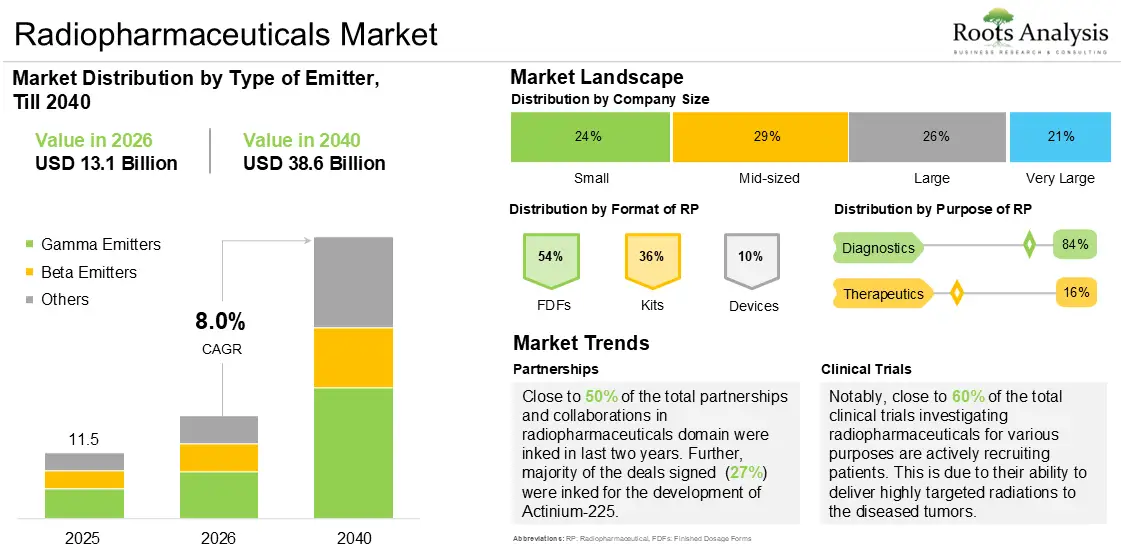
The global radiopharmaceuticals market, valued at USD 11.5 billion in 2025, is projected to reach USD 13.1 billion in 2026 and USD 38.6 billion by 2040, representing a CAGR of 8.0% during the forecast period 2026 to 2040.
See What’s in the Full Report – Request Your Complimentary Insights!
Market Report: Key Takeaways
Market Size & Trends
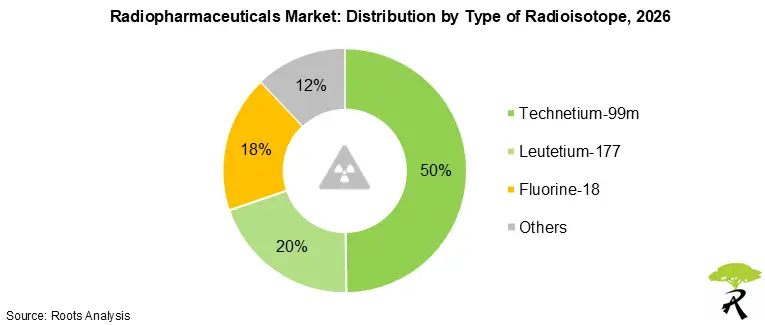
- Amongst the type of radioisotope, Technetium-99m captures the most (close to 50%) of the current market.
- Based on the type of emitter, gamma emitters capture the largest share (around 65%) of the current market; this trend is unlikely to change in the future.
- In terms of the purpose of radiopharmaceuticals, diagnostics hold the highest share of the current market.
- With respect to diagnostic radiopharmaceuticals, SPECT imaging agents dominate the current market.
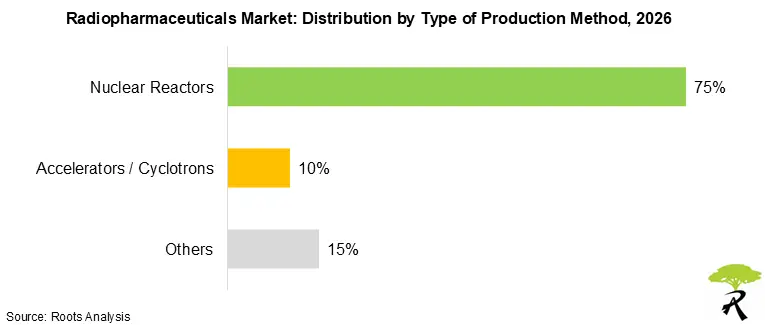
- Amongst the type of production method, nuclear reactors dominate the current market.
- Oncological disorders hold the highest share (around 40%), among therapeutic areas, of the current market.
- With respect to end-user, hospitals dominate (more than 45%) the current market.
- In terms of geographical regions, North America currently holds the highest market share.
Key Market Statistics
- Market Size in 2026: $13.1 Billion
- Estimated Market Size in 2040: $38.6 Billion
- CAGR (2026-2040): 8.0%
- North America: Largest market in 2026
- Asia-Pacific: Fastest growing region
What are Radiopharmaceuticals?
Radiopharmaceuticals, also known as radioactive drugs or radioisotope-conjugated drugs, are radioactive compounds used to diagnose and treat a range of disorders, particularly oncological, cardiovascular, and neurovascular disorders. They deliver radiation directly to specific tissues, enabling precise imaging or treatment of affected areas while minimizing damage to healthy cells.
Over the years, there has been a continued rise in the global burden of cancer, driven by factors such as an aging population, changing lifestyles, and increased exposure to environmental risk factors. According to the American Cancer Society, the US expects over 2 million new cancer cases alone. This growing incidence is driving demand for more innovative and effective treatment options. Radiopharmaceuticals have emerged as a potential alternative and are well-positioned to offer targeted solutions for both detecting and treating primary and metastatic cancers, including those resistant to conventional therapies.
Considering the ongoing necessity, several industry leaders have accelerated their research on radiopharmaceuticals that can aid in the management of diseases beyond cancer. It is imperative to state that key players have made significant investments in the field of nuclear medicine to drive innovations. As more drug developers expand their radiopharmaceutical capabilities and portfolios, we believe that the radiopharmaceuticals market will experience robust growth, offering significant opportunities for stakeholders in the coming years.
Market Segmentation
Based on research, we have segmented the radiopharmaceuticals market into type of radioisotope, type of emitter, purpose of radiopharmaceutical, type of diagnostic radiopharmaceutical, type of production method, therapeutic area, end-user, and geographical regions.
By Type of Radioisotope
- Technetium-99m, Lutetium-177, Fluorine-18, Others
By Type of Emitter
- Gamma Emitters, Beta Emitters, Others
By Purpose of Radiopharmaceutical
- Diagnostics, Therapeutics
By Type of Diagnostic Radiopharmaceutical
- PET Imaging Agents, SPECT Imaging Agents
By Type of Production Method
- Nuclear Reactors, Accelerators / Cyclotrons, Others
By Therapeutic Area
- Oncological Disorders, Cardiovascular Disorders, Neurological Disorders, Hormonal Disorders, Gastrointestinal Disorders, Others
By End-user
- Hospitals, Diagnostic Centers, Research Institutes
By Geographical Regions
- North America: US, Canada
- Europe: Germany, France, Spain, Italy, UK, Rest of Europe
- Asia-Pacific: Australia, China, Japan, India, South Korea, Rest of Asia-Pacific
- MENA: Israel, South Africa, Rest of Middle East and Africa
- Latin America: Brazil, Rest of Latin America
Your Business is Unique – Why Shouldn’t Your Report Be?
Radiopharmaceuticals Market Key Insights
What are the Key Drivers for Radiopharmaceuticals Market Growth?
- Technological Progress and Support Driving Market Growth: The increasing prevalence of chronic diseases, coupled with ongoing technological advancements in nuclear medicine, drives the market for radiopharmaceuticals, positioning it for steady growth in the foreseeable future. Additionally, increased funding activity and support from governments is fostering further innovation; specifically, the U.S. Department of Energy supports radionuclide production, while the IAEA promotes global access to radiopharmaceuticals.
- Capacity Expansions and Emerging Regional Opportunities: The rising demand for radiopharmaceuticals is also creating opportunities for radiopharmaceutical manufacturing companies, wherein a number of players have announced capacity expansions at existing facilities or the setting up of new facilities. Government-funded programs are also helping set up nuclear reactors and cyclotron facilities for radiopharmaceutical manufacturing. The increasing preference for personalized medicine, strategic alliances and rapid healthcare infrastructure development in regions such as Asia-Pacific are opening new market avenues for radiopharmaceuticals.
What are the Main Challenges for Market Growth?
- Supply Chain Disruption: The radiopharmaceutical supply chain faces critical challenges because nuclear reactors and cyclotrons, which are essential for producing radioisotopes, are limited worldwide. The short half-lives of radioisotopes complicate inventory storage and require precise "just-in-time" delivery, which can lead to wasted doses and disrupted patient care.
- Operational and Regulatory Constraints: In addition to the above challenge, mandatory facility downtimes, high costs of specialized infrastructure, the need for skilled personnel, and evolving regulatory requirements frequently cause isotope shortages. These challenges significantly impact the market’s ability to meet growing demand and maintain consistent patient care.
Recent Developments in Radiopharmaceuticals Market
- In June 2026, Curium announced an investment of EUR 32 million to establish a new European production line at its Saclay facility. This strategic investment aims to supply 177Lu-PSMA-I&T, a targeted radiotherapy for patients with metastatic castration-resistant prostate cancer (mCRPC) to the European market.
- In June 2026, Telix Pharmaceuticals entered into a collaboration with United Imaging to evaluate the combination of Telix's molecular imaging products with United Imaging’s scanner, software, and AI platforms, with an initial focus on TLX101-Px (Pixclara) for glioma patients in the US.
- In April 2026, Sinotau Pharmaceutical announced that the National Medical Products Administration (NMPA) has accepted the Investigational New Drug (IND) application for XTR021. Further, its preclinical studies demonstrate that, owing to its novel molecular design, this 177Lu-labeled, PSMA-targeted radioligand exhibits excellent anti-tumor efficacy and safety profiles for the treatment of prostate cancer.
Methodology and Industry Experts Interviews
Driven by the surging prevalence of cancer and neurodegenerative diseases, breakthroughs in oncology precision medicine, and the rise of theranostics, the radiopharmaceuticals domain is going to grow in the near future.
Nicholas Richardson (Vice President of clinical development, Precision for Medicine), stated that, “A differentiator in radiopharmaceutical development is the theranostic model, which is the co-development of diagnostic and therapeutic agents. This approach is patient-centric, allowing real-time biodistribution imaging specific to the individual, which in turn enables personalized therapeutic dosing. For manufacturers, this represents both a scientific and logistical opportunity to align production capabilities with precision medicine demands”
The findings in this report were developed through a structured methodology combining secondary research, proprietary databases and primary interviews. Secondary research included company disclosures, regulatory databases, clinical-trial registries, peer-reviewed publications, patent records, pricing and reimbursement sources, and relevant market-access information. The resulting assumptions were triangulated against product approvals, pipeline progress, sales trends, formulation mix, regional access conditions and stakeholder interviews. The market report includes third-party transcripts of the following discussions:
- Chief Executive Officer, Small Company, Canada
- Chief Executive Officer, Small Company, Australia
- Chief Executive Officer, Mid-sized Company, US
- Chief Executive Officer, Large Company, Germany
- Chair, Department of Radiology, Large Organization, US
- President, Mid-sized Company, US
- Vice President, Clinical Development, Large Organization, US
- Director and Medical Director, Large Organization, US
- Radiation Oncologist and Co-director, Very Large Organization, US
- Doctor of Medicine, Very Large Organization, US
Pay Only for What You Need – The Best Way to Optimize
Market Share Insights
Which Type of Radioisotope Accounts for the Largest Share in the Radiopharmaceuticals Market?
Technetium-99m occupies the highest (~50%) market share in 2026 and is likely to grow at a relatively faster pace (7.4%) till 2040. This highest share is fueled by the increasing use of these radioisotopes in oncology. For market players, Technetium-99m (Tc-99m) offer a balanced infrastructure strategy. Tc-99m provides a stable, high-volume baseline which presents a scarcity-driven opportunity to the market players as clinical demand is exceeding the current production capacity, significant valuation premiums are being concentrated in companies that control proprietary accelerator-based production or long-term supply agreements for these next-generation isotopes. Further, Fluorine-18 is likely to witness a higher CAGR (9.8%) during the forecast period.
Which Type of Emitter Accounts for the Largest Share of Market?
Gamma emitters occupy the largest share of radiopharmaceuticals market (with around 65% share) due to the surging demand for radiopharmaceuticals as a successful treatment option for various disorders, such as autoimmune disorders, neurological disorders, and oncological disorders.
Which Production Method Accounts for the Largest Share in the Radiopharmaceuticals Market?
Nuclear reactors occupy the highest (around 75%) radiopharmaceuticals market share. Nuclear reactors serve as a primary source for the production of longer-lived radioisotopes, such as technetium-99m and molybdenum-99, which are extensively used in SPECT imaging and therapeutic radiopharmaceutical applications. In addition, we anticipate accelerators / cyclotrons to witness a relatively higher CAGR (11.5%) during the forecast period.
Which Therapeutic Area Accounts for the Largest Share of Market?
Oncological disorders occupy the highest radiopharmaceuticals market share (around 40%). The neurological disorders segment, on the other hand, is likely to grow at a higher CAGR (9.0%) during the forecast period, owing to the surging demand for targeted molecular radiopharmaceuticals as a successful diagnostic and staging option for various progressive conditions, such as Alzheimer’s disease, Parkinson’s disease, and brain tumors.
Regional Analysis: Which Regions are Showing the Fastest Growth in the Radiopharmaceuticals Market?
North America Dominates the Market
North America is likely to capture the majority (close to 45%) of the radiopharmaceuticals market share and will likely grow at a relatively faster pace (7.1%) till 2040. Within the radiopharmaceuticals market segment, the US has emerged as a hub for radiopharmaceutical manufacturers, supported by its innovation-friendly regulatory policies, and a highly skilled workforce. This regional concentration facilitates efficient scaling of radiopharmaceutical production, from early-stage development to commercial supply.
Get an Instant Quote in 10 Minutes. Lowest Price Guaranteed
Key Players Profiled in Radiopharmaceuticals Market
The key players profiled in this report include 3B Pharmaceuticals, Curium, ITM Radiopharma, Jubilant Radiopharma, Lantheus, Yantai LNC Biotechnology, Norroy Biosciences, Sinotau Pharmaceutical, and Telix Pharmaceuticals.
Report Deliverables and Customization
Alongside the core market report, clients receive complimentary Excel data packs covering market landscape analysis, partnerships and collaborations analysis, clinical trial analysis, and market size and opportunity analysis. A complimentary PowerPoint presentation summarizing the full report is also included, and 15% free customization scope is available on request.
Report Authorship
This report was co-authored by Nancy Kapila and Aanchal Chaudhary, members of the Roots Analysis healthcare and pharmaceutical research practice. Their work focuses on competitive intelligence, clinical-pipeline analysis and market forecasting.
Independence and Non-Affiliation
This report is an independent work of market research and analysis published by Roots Analysis. It is not affiliated with, sponsored by, endorsed by, or reviewed by 3B Pharmaceuticals, Curium, ITM Radiopharma, Jubilant Radiopharma, Lantheus, Yantai LNC Biotechnology, Norroy Biosciences, Sinotau Pharmaceutical, and Telix Pharmaceuticals or any other pharmaceutical company, drug brand, or regulatory body referenced within it. No content in this report should be construed as medical advice. Roots Analysis maintains its own proprietary primary research process, and does not receive compensation from any company profiled within the report, in exchange for inclusion or favorable characterization.


