
Lowest Price Guaranteed
Slides
247
Last Updated
August 2026
View Count
12593
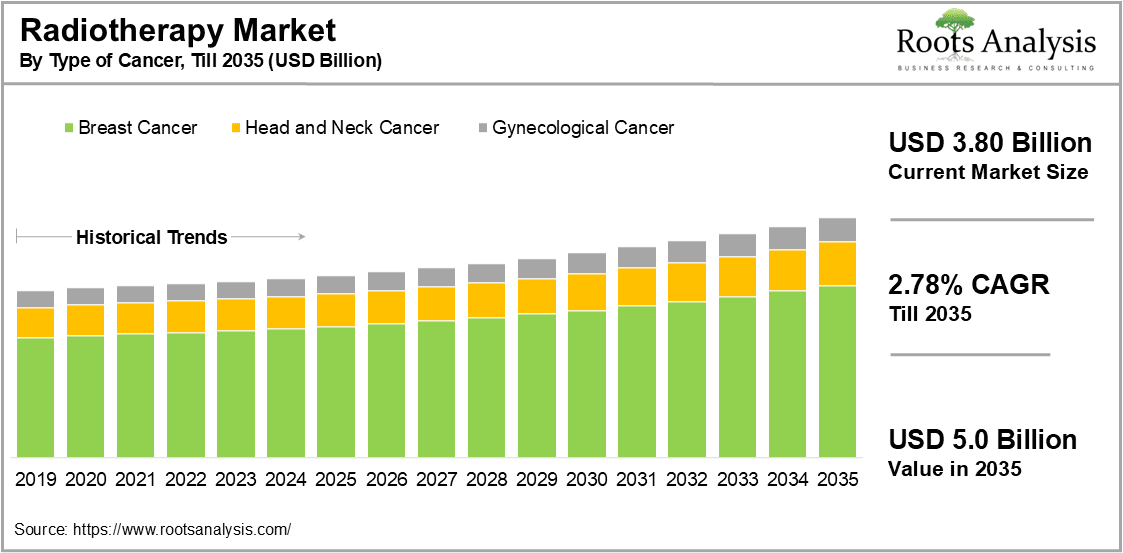
The global radiotherapy market size, valued at USD 3.69 billion in 2024, is expected to reach USD 3.80 billion in 2025 and USD 5.0 billion by 2035, representing a CAGR of 2.78% during the forecast period.
 |
To learn more about this report, request a free sample copy
Given the growing incidence of cancer globally, radiotherapy or radiation therapy has emerged as a promising solution to eradicate cancerous cells. Radiotherapy involves high-energy radiation such as electron beam, gamma rays, and X-rays to kill cancerous cells. Unlike chemotherapies that cause side effects such as anemia, radiotherapy is a form of localized treatment with limited off-target effects.
This means radiations only kill cancer cells without causing damage to nearby cells. It is important to highlight here that radiotherapies are also given to cancer patient in combination with chemotherapies or therapeutic drugs to make treatment more effective. Owing to the significances such as minimal side effects, radiotherapy for cancer treatment is gaining momentum on global level.
In a recent report of WHO, nearly 2.3 million women has been diagnosed with breast cancer and around 6,70,000 deaths occurred globally due to breast cancer. This increasing prevalence of cancer has underscored the requirement for advanced radiotherapy treatment with higher efficacy rate and minimal side effects.
Considering the ongoing demand for advanced non-invasive procedures, key industrial players are taking strategic initiatives to develop innovative radiotherapies. For instance, in May 2024, Elekta has introduced Elekta Evo (next generation linear accelerator) that features high-definition AI imaging quality and online adaptive capabilities to treat cancer. This highly image-guided radiation therapy with CT-linac help clinicians in real-time imaging and selecting optimal radiation therapy technique on the basis of patient’s requirement.
Moreover, in March 2024, AstraZeneca forged a definitive agreement for the acquisition of Fusion Pharmaceutical (a leading biopharmaceutical company) developing radioimmunoconjugates, which belong to a class of next generation antibody therapeutics. The aim of acquisition to transform cancer treatment and improve patient outcomes by replacing conventional therapeutic approach.
Owing to the ongoing collaborations and innovations in the industry, we believe that radiotherapy market will grow significantly and remain investible for the long term. However, the future focus will be on the next generation radiation therapy such as proton therapy, adaptive radiation therapy and stereotactic body radiation therapy that helps to deliver accurate dosage of radiation with minimal impact on healthy cells / tissues. Furthermore, the leading industrialists are emphasizing leveraging artificial intelligence to make radiotherapies more efficient and accurate. As more industrial leaders continue to bring innovative approaches to the emerging market, the field continues to gain momentum during the forecast period. Within this workflow, photodynamic therapy combines photosensitizers with controlled light activation to produce localized therapeutic effects.
The research report provides invaluable information about the key industrial players who are presently active across various segments of the industry as mentioned in the table below.
| Key Report Attributes | Details | |
| Historical Trend | Since 2019 | |
| Forecast Period | Till 2035 | |
| Current Market Size | USD 3.80 Billion | |
| Market Size 2035 | USD 5.0 Billion | |
| CAGR (Till 2035) | 2.78% | |
| Type of Technology |
|
|
| Type of Procedures |
|
|
| Type of Cancer |
|
|
| End User |
|
|
| Geographical Regions |
|
|
| Key Companies Profiled |
|
|
| PowerPoint Presentation (Complimentary) |
Available | |
| Customization Scope | 15% Free Customization | |
| Excel Data Packs (Complimentary) |
Available | |
The key objective of radiotherapy market report is to provide a detailed market analysis in order to estimate the existing market size, market share, market growth, market trends, market value, market forecast, market outlook, statistics and future opportunity for players during the forecast period.
Based on various segments, distribution by type of technology (external beam radiation technology and internal beam technology), type of procedure (external procedure and internal procedure), cancer type (breast cancer, head and neck cancer and gynecological cancer), and end user (hospitals, cancer research institutes, ambulatory and radiotherapy centers) and geographical region (North America, Europe, Asia-Pacific, Middle East and North Africa, and Latin America), we have provided an informed estimate on the likely evolution of the market in the long term, for the forecast period till 2035.
To add robustness to our model, we have provided three market forecast scenarios, portraying the conservative, base and optimistic tracks of the market’s evolution.
The opinions and insights presented in the market research report were also influenced by discussions held with senior stakeholders in the market. All actual figures have been sourced and analyzed from publicly available information forums and primary research discussions. The financial figures mentioned in this market research report are in USD, unless otherwise specified.
Based on the technology type, the global radiotherapy market size is segmented into external beam radiation technology (linear accelerator, conventional Cobalt-60 teletherapy units, particle therapy systems and others), and internal technology / brachytherapy. According to our projection, currently external beam radiation technology accounts for the highest share of the market and is likely to capture 84% of the overall revenue share by 2035. This can be attributed to the highest efficacy in eradicating tumor cells with minimal damage to the surrounding tissues. External beam radiation technology such as intensity-guided radiation therapy enhanced precision and control in treating patients with cancer. Furthermore, the increasing risk of cancer has necessitated advanced technologies such as external beam radiation technology.
However, in the long run, internal beam technology will grow at a higher CAGR of 6.6% during the forecast period, owing to the technological advancements within this type of technology to reduce side effects, shorter time duration.
Based on the type of procedure, the global market is categorized into internal procedure and external procedure. According to our projection, external procedure accounts for the highest radiotherapy market share, capturing 61% of overall revenue share by 2035. External beam radiation therapy procedures have been widely adopted to treat a variety of cancers. Furthermore, external beam radiation therapy has become a standards treatment option in clinical practices which has further contributed to the higher share of the market.
However, in the long run, internal radiation therapy procedures or brachytherapy will show lucrative growth potential and are likely to grow at a CAGR of 4.8% during the forecast period. This can be attributed to the fact that brachytherapy allows localized delivery of radiations at the target tumor sites which minimized the damage to the surrounding cells. Owing to the target efficiency, internal procedures has been adopted on the large scale to treat patients with cancer specifically gynecological cancer.
Based on the type of cancer, the global radiotherapy market size is segmented into breast cancer, head and neck cancer, and gynecological cancer. According to our projection, currently breast cancer is dominating the market and is poised to capture 73% of overall revenue share by 2035. This highest growth share is due to the fact that radiotherapies has shown higher efficacy in the treatment of breast cancer. Moreover, radiotherapies have also reduced the risk of recurrence of breast cancer, which is expected to be a key reason for the highest growth share.
While breast cancer holds the highest share, gynecological cancer will grow at a higher CAGR of 3.5% during the forecast period. This can be attributed to the growing awareness about leading consequences of gynecological cancer among people. Moreover, the availability of advanced radiotherapy techniques such as image-guided radiotherapy and intensity modulated radiotherapy have significantly improved the patient outcomes.
Based on the end user, the global radiotherapy market report distributes the market across hospitals, cancer research institutes, and independent radiotherapy centers. According to our projection, currently hospitals accounts for the highest share of the market and is anticipated to capture 52% of the overall revenue share by 2035. This dominance is attributed to the fact that hospitals offer comprehensive treatment and diagnostics services to patients with cancer. Furthermore, the availability of advanced cancer therapies including personalized treatment and radiotherapies to treat a broad range of cancers in hospital is the key reason for highest growth share.
In the long run, independent radiotherapy centers will show lucrative growth potential and is poised to grow at a higher CAGR of 4.3% during the forecast period. This lucrative growth rate is due to the increasing demand for specialized care, and personalized treatment by the patients. Independent radiotherapy centers are solely focus on offering advanced cutting-edge radiotherapies and cost-effective treatment solutions which is likely to be the key reason or unprecedented growth.
Based on the key geographical region, the global radiotherapy market is distributed into North America, Europe, Asia-Pacific, Middle East and North Africa and Latin America. According to our analysis, currently North America dominate the market and is estimated to capture 49% of overall revenue share by 2035. North America has a network of well-established hospitals and cancer treatment centers along with advanced healthcare infrastructure. Furthermore, the highest rate of cancer diagnostics, screening test and treatment through radiotherapies has contributed to the growth of this region.
However, in Asia-Pacific, the market for radiotherapy is expected to grow at a higher CAGR of 3.2% during the forecast period. This can be attributed to the increasing incidence of cancer and rising healthcare expenditure in Asian countries.
The “Radiotherapy Market: Industry Trends and Global Forecasts, till 2035” market report features an extensive study on current market landscape, market size, market share, market growth, market forecast, market outlook and future opportunities. In addition, it features an elaborate discussion on the likely future opportunity associated with next generation radiotherapies during the forecast period.
The market for radiotherapy for breast cancer, head and neck cancer and gynecological cancer is witnessing the presence of several well-established and new entrants. These industrial leaders are emphasizing on finding advanced radiation therapies integrated with latest linear accelerator and CT-linac for real time imaging. Overall, the market seems highly competitive, featuring the presence of several small, medium-size and large entrepreneurs.
In order to maintain a competitive edge, various industrial leaders are focusing on the product portfolio enhancement and taking strategic initiatives such as development, partnerships, collaborations and acquisitions. For instance, in June 2024, Leo Cancer Care and TibaRay signed a partnership agreement for the development of first-of-its upright linear accelerator. The partnership aims to involve integration of TibaRay’s X-ray generation system with Leo’s future photon therapy solution. This technology also includes FLASH** within photon therapy space for rapid dosage delivery, offering targeted treatment of individuals with cancer.
As more market leaders continue to accelerate their efforts for the advancements in radiotherapy, we believe the field remain competitive offering various opportunities to industrial stakeholders for considerable investments.
The radiotherapy market is driven by several factors including rising incidence of cancer globally. It is worth noting here that breast cancer is the most prevalent form of cancer affecting people across the globe. According to the National Breast Cancer Foundation, in 2024, around 310,720 women will be diagnosed with an invasive breast cancer.
The primary reason behind growing incidence of breast cancer includes unhealthy lifestyle such as alcohol consumption, obesity and prolong exposure to chemicals. Furthermore, the inherited changes in the DNA such as BRCA1 and BRCA2 can also increase the risk of developing cancer. Additionally, high exposure to radiation can enhance the risk of breast cancer in women.
Driven by the growing concern, several industrial leaders are developing radiotherapies such as FLASH electron beam therapy, proton beam therapy, radiosensitization therapy, image-guided ablation therapy and adaptive radiation therapy. Furthermore, several government organizations and industrial leaders are making massive investments in this field for research and development of advance therapies.
Some of the potential challenges that may hinder radiotherapy market growth include high cost and limited market penetration. It is worth noting here that the development of radiotherapy requires high initial cost investment which can be a challenge for the small industrial leaders. Furthermore, complex regulatory guidelines may create challenges in the approval of latest technologies which is costly and time-consuming. In addition, there is a limited availability of skilled personnel, which may restraint the adoption of advanced radiation therapy treatment.
Despite of the challenges, the radiotherapy market is witnessing an upward trajectory owing to the increasing investment by industrial and non-industrial leaders for the development of advanced cancer treatment and cancer diagnostics solutions. Moreover, the growing technological advancements such as image-guided radiation therapy, intensity modulated radiation therapy and laser accelerators for accurate analysis of targeted tumor sites and higher efficacy is likely to offer enormous opportunities to the industrial leaders.
For instance, intensity modulated radiotherapy (IMRT) employs a wide variety of intensities in the radiation doses. This innovative technology enables oncologists to coincide the radiation beams as per the share of tumor. Additionally, the researchers are emphasizing the development of proton therapy that administer radiation with high-energy, allowing maximum dose concentration within minimal off-target effects.
The global radiotherapy market is currently expected to be valued at USD 3.80 billion. Driven by the growing demand for advanced therapies to eradicated cancer cells, the market is expected to reach USD 5.0 billion by 2035, anticipated to grow at a higher CAGR of 2.78% during the forecast period. It is important to highlight here that North America is dominating industry and the trend is likely to remain unchanged during the projected period. The key players established in this region are working on technological innovations to deliver radiotherapy with higher precisions.
For instance, in September 2024, GE Healthcare announced launch of Revolution™ RT therapy that enabled precision radiation therapy stimulation and features high-performance radiation therapy stimulation and wide-bore CT (computed tomography) platform. Moreover, GE Healthcare also designed iRT (Intelligent Radiation Therapy) to enable connectivity, multi-vendor system interoperability and efficiency during radiation oncology care.
Some of the key players operating in the industry are Accuray Incorporated, Becton Dickinson and Company, Canon, Elekta, Hitachi, Icad, Ion Beam Applications, Isoray, Mevion Medical Systems, Nordion, (Sotera Health), P-Cure, Varian Medical Systems, and ViewRay. The leading players in radiotherapy industry are focusing on growth strategies, such as innovations with radiotherapy, product launches, and R&D investments.
There has been recent activity in the radiotherapy industry and some of the key developments have been mentioned below: