
Lowest Price Guaranteed
Pages
235
Last Updated
September 2026
View Count
15101
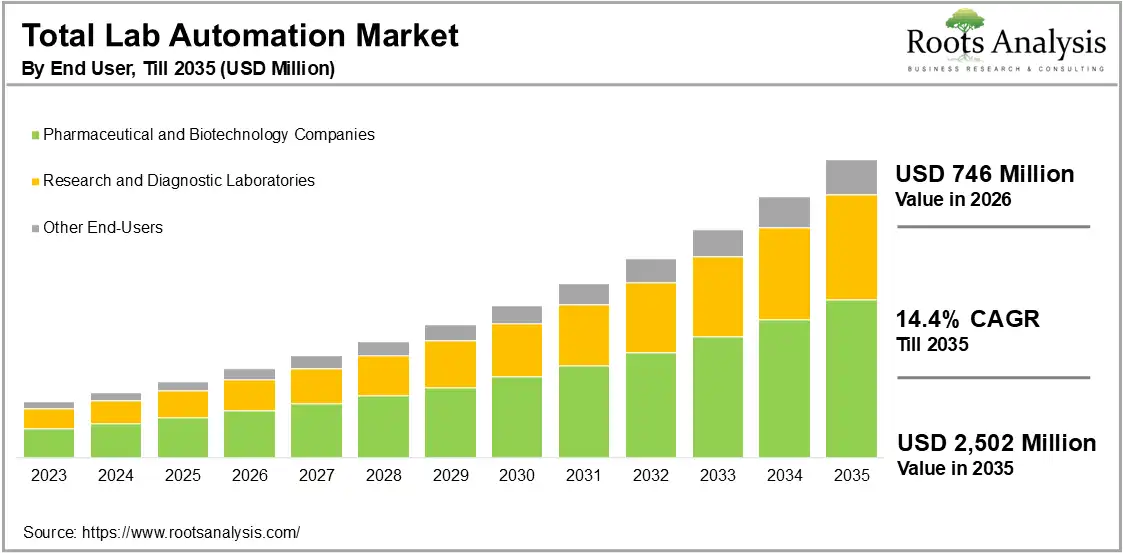
The global total lab automation market, valued at USD 670 million in 2025, is projected to reach USD 746 million in 2026 and USD 2,502 million by 2035, with a 14.4% CAGR during the forecast period 2026 to 2035.
 |
To learn more about this report, request a free sample copy
Total lab automation is an advanced approach that aims to streamline and optimize laboratory processes by integrating various instruments, devices and software into a unified system. This includes automating activities, such as sample preparation, analysis and data management. By automating these tasks, total lab automation can significantly improve the efficiency, accuracy and throughput of laboratory operations, while reducing the potential for human error. Total lab automation systems are often designed to operate around the clock, allowing for continuous processing of samples and rapid turnaround times, which is particularly beneficial in high-throughput environments such as clinical diagnostics, pharmaceutical research and industrial quality control.
Total lab automation offers significant advantages by standardizing and maintaining consistency in laboratory processes. With the automation of the routine tasks, total lab automation systems ensure that all samples undergo the same processing, reducing variability and improving the reliability of results. Additionally, total lab automation liberates the laboratory staff from repetitive and time-consuming activities, allowing them to focus on more complex tasks that require human expertise, such as data interpretation and troubleshooting. Further, total lab automation has the potential to revolutionize the field of laboratory medicine and research, leading to faster, more accurate and more cost-effective testing, while also paving the way for advancements in personalized medicines and diagnostics. Total lab automation is a part of the broader lab automation market.
The total lab automation market report presents an in-depth analysis of various companies that are engaged in the total lab automation industry, across different segments, as defined in the table below:
| Key Report Attribute | Details | |
| Historical Trend | Since 2023 | |
| Base Year | 2025 | |
| Forecast Period | 2026-2035 | |
| Market Size 2026 | $746 Million | |
| CAGR | 14.4% | |
| Application |
|
|
| End User |
|
|
| Key Geographical Regions |
|
|
| Key Companies Profiled |
|
|
|
PowerPoint Presentation |
Available |
|
| Customization Scope | 15% Free Customization | |
| Excel Data Packs (Complimentary) |
|
|
One of the key objectives of this market report was to estimate the current market size, opportunity and the future growth potential of the total lab automation market, over the forecast period. Based on multiple parameters, likely adoption trends and through primary validations, we have provided an informed estimate on the market evolution during the forecast period till 2035. The market report also features the likely distribution of the current and forecasted opportunity within the total lab automation market across various segments, such as application (diagnostics, genomic solutions, microbiology, drug discovery, proteomic solutions and other applications), end user (pharmaceutical and biotechnology companies, research and diagnostic laboratories and other end users) and key geographical regions (North America, Europe, Asia-Pacific, Middle East and North Africa, and Latin America). In order to account for future uncertainties and to add robustness to our model, we have provided three market forecast scenarios, namely conservative, base and optimistic scenarios, representing different tracks of the industry’s growth.
All actual figures have been sourced and analyzed from publicly available information forums and primary research discussions. Financial figures mentioned in this report are in USD, unless otherwise specified.
Based on application, the total lab automation market is segmented across diagnostics, genomic solutions, microbiology, drug discovery, proteomic solutions and other applications.
According to our projection, diagnostics segment holds the largest share (45%) of the market and is likely to remain dominant in the future. This can be attributed to the high-throughput demand of automated lab solutions for routine patient testing across hematology, biochemistry, immunology, and urinalysis across clinical laboratories and hospital-based diagnostic centers. Further, lab directors and operators in large hospital networks are prioritizing automation to reduce turnaround times, minimize manual errors, and manage increasing test volumes amid workforce constraints. This adoption is further accelerated by stringent regulatory requirements for accuracy and traceability. Additionally, the well-established reimbursement frameworks in developed regions provide the financial stability necessary for continuous technological upgrades.
On the other hand, drug discovery segment is likely to grow at a higher CAGR during the forecast period. This lucrative growth is likely to be the result of growing need for high-throughput screening and data analysis in the development of new drugs.
The total lab automation market is categorized into pharmaceutical and biotechnology companies, research and diagnostic laboratories, and other end users.
According to our analysis, pharmaceutical and biotechnology companies holds the largest market share. The intensifying pressure to accelerate drug discovery timelines, reduce research and development costs, and improve experimental reproducibility is compelling pharma and biotech firms to invest heavily in advanced laboratory automation platforms. Moreover, research heads and lab automation staff within these organizations are prioritizing high-throughput screening, automated compound management, and integrated workflow solutions to maximize the efficiency of their drug development pipelines. Further, the rapid growth of biologics, cell and gene therapy research, and personalized medicine has further expanded the scope of automation within this end user category.
In contrast, the other end users, mainly consisting of hospitals and diagnostic labs, forensic laboratories and veterinary diagnostics centers, is anticipated to grow at a stable pace in the future. This lucrative growth is due to the increasing adoption of moderate to high level lab automation solutions to manage the laboratories workflows.
Based on the key geographical regions, the global market is distributed across North America, Europe, Asia-Pacific, MENA and Latin America.
According to our projection, North America is likely to capture about 40% of the total lab automations market share and this trend is unlikely to change in the future. This highest share is due to the highly advanced laboratory infrastructure, strong presence of leading automation technology manufacturers, and a well-established culture of early technology adoption across clinical, pharmaceutical, and research settings. Lab directors, procurement heads, and research administrators in the US and Canada operate within a regulatory environment that strongly encourages standardization, accuracy, and traceability in laboratory operations, driving consistent investment in automation solutions.
Moreover, the presence of established pharmaceutical and biotechnology companies, academic research institutions, and large hospital networks across the region creates a broad and diversified buyer base for total lab automation products and services. Significant public and private funding directed toward life sciences research and diagnostic infrastructure further reinforces North America's highest share in the global market.
The “Total Lab Automation Market: Industry Trends and Global Forecasts, Till 2035 - Application (Diagnostics, Genomic Solutions, Microbiology, Drug Discovery, Proteomic Solutions and Other Applications), End User (Pharmaceutical and Biotechnology Companies, Research and Diagnostic Laboratories and Other End Users) and Key Geographical Regions (North America, Europe, Asia-Pacific, Middle East and North Africa and Latin America)” market report features an extensive study of the current market landscape, market size, market share, market analysis, market forecast and future opportunities for the companies involved in the manufacturing of total lab automation systems. The total lab automation market research report highlights the efforts of several companies manufacturing total lab automation instruments for this rapidly emerging market segment of the pharmaceutical industry. Key takeaways of the market research report are briefly discussed below.
The total lab automation market is highly fragmented, with the presence of international as well as regional players. Presently, more than 45 total lab automation companies are engaged in offering various automated instruments to fulfill the requirements of clients. Additionally, mid-sized firms constitute about 30% of the total companies engaged in this industry. It is worth mentioning that 39% of the total lab automation companies are based in Europe.
In recent years, several partnerships have been inked by various stakeholders in order to consolidate their presence in this field and enhance their capabilities and product portfolio to meet the growing demand for total lab automation. Acquisitions, product development agreements and distribution agreements are the most common types of partnerships inked by stakeholders in the lab automation industry. Further, majority of such partnerships are focused on various automation instruments, including automated data analysis, automated liquid handling systems and total lab automation.
The total lab automation market is driven by several key factors. One such factor is the increasing standardization of processes in laboratories, which has led to a growing need for automation to improve efficiency and accuracy. Tight regulatory requirements in the healthcare and life sciences industries have also contributed to the adoption of laboratory automation solutions. Moreover, the market is propelled by the rising R&D spending in healthcare settings, the growing demand for clinical workflow management, and the need for scientific data integration solutions. Additionally, the introduction of automation techniques has led to increased demand for automated devices, improved software, and services. Other contributing factors include the increasing use of automated workstations, the growing prevalence of chronic diseases, and the need for sophisticated testing to provide effective diagnosis and treatment for various ailments.
The total lab automation market presents several promising opportunities for growth. Technological advancements and the increasing pressure to deliver results are driving the adoption of automated systems in laboratories. These systems offer customization and flexibility, making them well suited for labs with high volume and stringent quality control requirements. Additionally, the increasing demand in the healthcare sector, with the hospital and diagnostic laboratories segment growing at the fastest rate, is contributing to market expansion.
The total lab automation industry faces several restraints that may impede its growth. One significant challenge is the high initial investment required for the implementation of automation systems, including the purchase of equipment and software. Moreover, integrating these systems with existing laboratory infrastructure and processes can be complex and time-consuming, posing a barrier to adoption. Security and data privacy concerns also arise given to the storage and management of large volumes of sensitive data. Additionally, the lack of skilled professionals, resistance to change among laboratory staff, and regulatory challenges related to compliance with industry standards and guidelines further contribute to the restraints in the total lab automation market. Addressing these challenges will be crucial for industry players to fully realize the market's potential.
Total lab automation systems have seen increased adoption in not only the pharma and biotech laboratories, but also hospital laboratories. With this, the technology is constantly improving and players are integrating the advanced features. Recently, hospitals in India such as AIIMS and Kokilaben Dhirubhai Ambani Hospital, and LHSC’s Victoria Hospital in London were in the news for adoption of total laboratory automation systems. LHSC has installed Becton Dickinson’s Kiestra 3rd Generation System.
Examples of key companies in total lab automation industry (the complete list of companies is available in the full report) include Abbott, Anton Paar, BD, Beckman Coulter, ERWEKA, Leuze, Ortho Clinical Diagnostics, Pall Corporation, PerkinElmer, Roche Diagnostics, Siemens Healthineers and SYSTAG. This market report includes an easily searchable excel database of all the total lab automation companies worldwide.
The market report presents an in-depth analysis, highlighting the capabilities of various stakeholders engaged in this industry, across different geographies. Amongst other elements, the market report includes:
Several recent developments have taken place in the total lab automation industry, some of which have been outlined below. These developments, even if they took place post the release of our market report, substantiate the overall market trends that we have outlined in our analysis.
Author(s): Nancy Kapila, Shreeya Agrawal