


 Download Free Sample
 Buy Now
Market Size
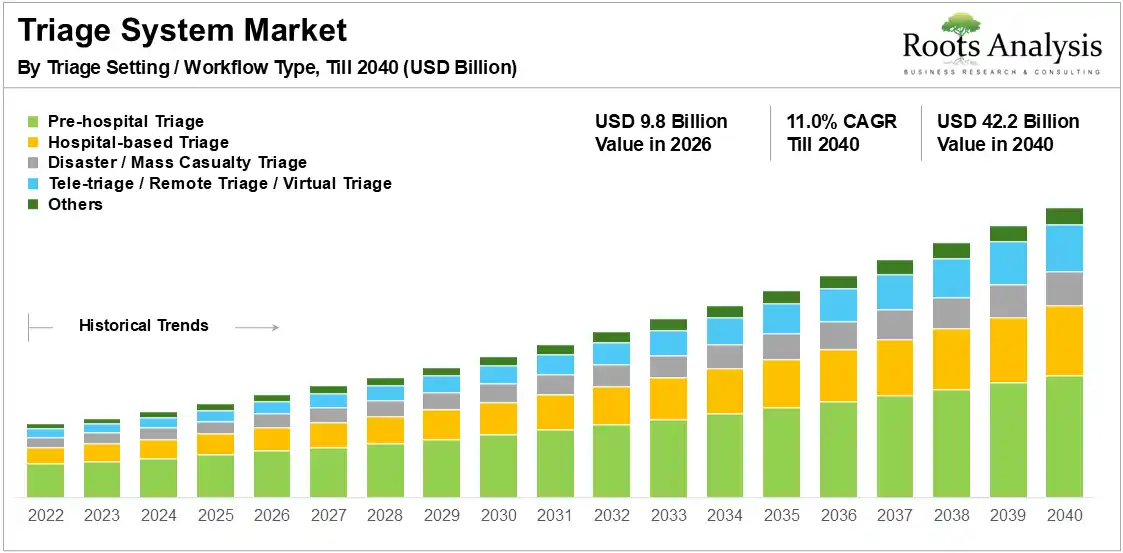
The global triage system market is estimated at USD 9.8 billion in 2026 and is projected to reach USD 42.2 billion by 2040, growing at a CAGR of 11.0% over the forecast period 2026 to 2040, driven by AI-enabled emergency department prioritization, virtual front-door triage, and EHR-integrated decision-support tools.
See What’s in the Full Report – Request Your Complimentary Insights!
Market Report: Key Takeaways
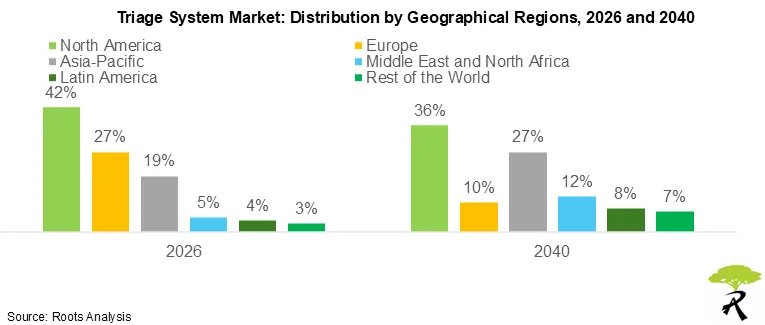
- Based on geography, North America captures 42.0% market share in 2026, whereas Asia-Pacific registers a 13.8% CAGR through 2040, driven by public digital-health scaling.
- Based on system type, Electronic Triage Systems is both the dominant and fastest-growing category, holding 60.0% share in 2026 and expanding at 12.2% CAGR through 2040, driven by AI-supported acuity scoring.
- Based on offering type, Software is both the dominant and fastest-growing category, holding 52.0% share in 2026 and expanding at 12.3% CAGR through 2040, driven by EHR-native workflow automation.
- Based on triage setting / workflow type, Hospital-based Triage captures 48.0% market share in 2026, whereas Tele-triage / Remote Triage / Virtual Triage registers a 13.2% CAGR through 2040, driven by digital front-door adoption.
- Based on deployment mode, On-premises Deployment captures 38.0% market share in 2026, whereas Cloud-based Deployment registers a 14.2% CAGR through 2040, driven by scalable AI model updates.
Triage System Market Outlook
AI-enabled triage is shifting the triage system market from queue documentation toward real-time clinical prioritization. Hospitals still anchor demand through emergency department triage system upgrades, but virtual triage systems and AI symptom checker workflows now pull decisions upstream. Buyers increasingly want EHR-integrated triage workflow, acuity scoring, nurse escalation, and patient flow management in one operating layer. This shift favors software platforms that coordinate intake, decision support, and escalation.
Current growth comes from overcrowded emergency departments, public digital-health programs, and regulated AI decision support. Policy pressure is visible in Ireland, where RCSI and HSE introduced the National Emergency Department Triage Quality Improvement Framework 2025-2027 in September 2025 to standardize prioritization and supporting infrastructure. These programs raise demand for clinical decision support triage and auditable workflows. They also give procurement teams clearer criteria for comparing digital triage software.
Through 2040, the market remains high-growth as cloud-based deployment, electronic triage systems, and tele-triage gain share. Healthdirect Australia’s June 2026 work with Infermedica, Skin Analytics, AWS, and DEPT shows how public platforms can connect AI guidance with nurse-backed escalation. Hospitals, government agencies, and virtual-care operators will buy systems that reduce avoidable acute-care demand. Long-term competition will center on validated algorithms, workflow integration, and trust.
Triage System Market Dynamics
Triage System Market Drivers
Electronic triage systems are gaining share because hospitals need acuity ranking, escalation, and documentation inside emergency workflows. Hospital-based triage holds 48.0% share in 2026, while software captures 52.0% of offering revenue. Oracle expanded Oracle Health Clinical AI Agent for emergency and inpatient doctors in March 2026, using ED triage notes, labs, exams, and imaging to draft documentation.
Triage System Market Restraints
Regulatory classification and workflow validation slow adoption because triage tools influence patient routing and clinical prioritization. Infermedica’s September 2025 MDR Class IIb certification for triage modules shows that AI symptom checker platforms need medical-device controls, evidence, and post-market discipline. Smaller providers also face integration costs when connecting nurse triage protocols, EHR integration software, and patient-flow dashboards.
Triage System Market Opportunities
Digital front-door triage creates the clearest expansion route because virtual care navigation can redirect demand before emergency arrival. Tele-triage grows at 13.2% CAGR through 2040, outpacing hospital-based triage. Ubie announced a February 2026 collaboration with Mayo Clinic to develop Smart Support, combining symptom assessment, triage, booking, chat, and voice workflows. This model broadens access points for platform vendors.
Triage System Market Challenges
Operational redesign remains difficult because digital triage changes queue ownership, nurse escalation, and alternative-care routing. NHS pilots across 18 hospitals in England used digital triage assessment in June 2026 to prioritize A&E patients and redirect lower-acuity cases. Commercial scaling depends on proving safe deflection, staff acceptance, clear liability, and measurable reductions in avoidable emergency load.
Triage System Market Size Estimation Methodology
- As a starting point, the triage system market baseline used the latest verified industry data for digital triage software, emergency department information systems, nurse triage software, AI symptom checker tools, and virtual care navigation. We normalized overlapping categories into one healthcare triage scope to avoid double counting hospital, remote, and imaging triage workflows. Historical annual values from 2022 to 2025 set the adoption curve before the current 2026 baseline.
- Moving forward, segment allocation used evidence from validated company product pages, recent deployments, and named public health programs. We mapped demand across geography, system type, offering type, workflow type, deployment mode, software function, and end user. Segment shares were cross-checked against known adoption patterns for EHR-integrated triage workflow, cloud-based deployment, and hospital-based triage.
- Building on this, forecast growth rates reflected regulatory submission counts, FDA 510(k) clearances, medical-device certification activity, and public emergency-care modernization programs. These signals helped separate regulated clinical decision support software from lighter intake, booking, and call-center tools. Higher growth was assigned to cloud-based deployment, tele-triage, and AI-supported clinical decision support. We also weighted post-January 2025 funding and deployment signals when estimating near-term acceleration.
- Drawing upon these, competitive evidence was grouped by operating role rather than company size alone. Enterprise EHR vendors, virtual urgent-care platforms, EDIS specialists, nurse triage service providers, symptom-assessment engines, and imaging triage companies were assessed separately. This structure captured the market share split between incumbents controlling workflows and specialists adding point-solution intelligence.
- The projected value was then extended annually through 2040 using consensus growth logic and segment-level CAGR assumptions. We applied faster growth to Asia-Pacific, cloud-based deployment, electronic triage systems, software, and tele-triage because each segment gains share through the forecast period. Slower growth was applied to paper-based systems and on-premises deployment because share shifts toward digital and cloud workflows.
- Finally, we reviewed internal consistency across the forecast table, segment share movements, and calculated market CAGR. The 2026 to 2040 forecast implies 11.0% CAGR, while individual segments move within commercially realistic ranges. The final triage system market forecast prioritizes auditable sourcing, no duplicated category revenue, and clear links between technology adoption and buyer demand. Each calculation was checked so segment totals reconcile with the annual market forecast.
Triage System Market Share Insights
Market Share by Triage Setting / Workflow Type
According to our analysis, hospital-based triage leads because emergency departments remain the highest-acuity and highest-volume decision point. In January 2025, ERTRIAGE was tested at Nikaia General Hospital to prioritize emergency department cases by severity.
Tele-triage will expand fastest as digital front doors shift triage upstream before physical care visits. In June 2026, Healthdirect Australia announced a ChatGPT pilot that connects users to validated triage questions and nurses.
Market Share by End User
Hospitals and clinics lead because triage sits inside emergency, urgent-care, imaging, and outpatient access workflows. In March 2025, Oracle Health reported Clinical AI Agent availability across many specialties and EHR-integrated workflows.
Government agencies grow fast as public health systems scale virtual access and emergency department modernization. In June 2026, Healthdirect Australia advanced a nationally localized AI health-service pilot with nurse escalation pathways.
Want Information on Specific Region / Segment?
Regional Analysis: North America Leads the Market and Asia-Pacific is Likely to Register Higher CAGR
Presently, North America leads because U.S. hospitals have mature EHR penetration, capital access, and clearer AI-device authorization pathways. FDA-cleared triage tools also support procurement confidence across emergency departments and imaging networks. In January 2026, Aidoc secured additional FDA indications for a comprehensive CT triage solution.
On the contrary, Asia-Pacific will grow fastest as public health platforms, consumer AI usage, and digital front-door models converge. Australia shows this pattern through nationally localized AI triage, nurse escalation, and service-navigation integration. In June 2026, Healthdirect Australia announced a ChatGPT health-service pilot with Infermedica, AWS, Skin Analytics, and DEPT.
Market Ecosystem Analysis
Seven Tier 1 leaders anchor the bulk of commercial activity across EHR, virtual urgent care, and imaging triage. Twelve specialists defend ED systems, nurse protocols, and managed services, while seven emerging entrants attack AI intake. Platform convergence is the dominant dynamic, with acquisition-driven scale appearing mainly in digital front-door and virtual care. Capacity pressure now shifts advantage toward vendors combining clinical content, EHR interoperability, workflow AI, and validated escalation pathways.
- Epic used HIMSS 2025 in March 2025 to showcase AI agents across clinical, administrative, and patient-facing workflows. That raises integration barriers for standalone triage tools needing records, scheduling, and task context inside hospital workflows.
- Oracle Health made Clinical AI Agent available in March 2025 for 30+ specialties, including urgent care. Its EHR integration and next-step recommendations strengthen urgent-care triage and reduce demand for detached documentation add-ons.
- MEDHOST released EDIS 2024 R1 in November 2025 with workflow, reporting, HTI-1, and USCDI v3 enhancements. This helps EDIS specialists defend hospital-based triage by owning ED-specific compliance and interoperability requirements.
- Aidoc secured 11 FDA indications in January 2026 for a comprehensive body CT triage solution. This strengthens AI-based ED triage and raises validation breadth requirements for narrower imaging challengers.
- RapidAI secured five FDA clearances in November 2025 across neurovascular, radiology, and vascular modules. Qure.ai added qER-CTA clearance in October 2025 for LVO triage and specialist notification. Together, they pressure stroke-only tools to prove breadth beyond initial acute alerts.
- Viz.ai announced February 2025 ISC data showing real-world impact in acute LVO workflows. That sustains Tier 1 positioning through clinical validation, hospital economics, and care-coordination evidence.
- TriageLogic launched TriageIntelligence in January 2025 to support AI-assisted telephone triage, documentation, and enhanced 911 assessment. ClearTriage published September 2025 protocol updates covering April after-hours and July office-hours clinical releases. These moves make content currency and nurse safety governance central tele-triage barriers.
- Assort Health closed USD 76 million Series B in October 2025, bringing total funding to USD 102 million. Assort OS handles voice, text, and web interactions across scheduling, navigation, referrals, and lab coordination. This pressures nurse access lines by automating intake and routing before clinician escalation.
- Fabric acquired UCM Digital Health in November 2025, adding 400 payer and employer customers and one million covered lives. K Health’s November 2025 Northwell deployment used AI intake to route patients to virtual or in-person care. Together, they strengthen cloud-based virtual triage and pressure legacy call centers to match omnichannel access.
Startup Companies and their Key Highlights
- Assort Health
- Event type and funding amount: USD 76 million Series B.
- Month and year: October 2025.
- Lead investor or strategic partner name: Lightspeed Venture Partners.
- Stated purpose: Expand workforce and accelerate development of Assort OS.
- Market implication: Accelerates tele-triage and digital front-door automation through AI agents for scheduling, navigation, referrals, and lab coordination.
- Fabric Health
- Event type and funding amount: Acquisition of UCM Digital Health.
- Month and year: November 2025.
- Stated purpose: Integrate Fabric’s AI-enabled virtual care technology and nationwide clinical network with UCM’s payer and employer expertise.
- Market implication: Accelerates services and cloud-based virtual triage for payer and employer populations across all 50 U.S. states.
- K Health
- Event type: Partnership with Northwell Health.
- Month and year: November 2025.
- Lead investor or strategic partner name: Northwell Health.
- Stated purpose: Power Northwell Primary Care Now with AI-led intake and virtual or in-person routing.
- Market implication: Accelerates virtual triage for North American health systems through EMR-linked intake and same-day routing.
- Mediktor
- Event type: Product launch, AI Medical Agent.
- Month and year: October 2025.
- Stated purpose: Combine Mediktor’s clinical engine with LLM fluency through Amazon Bedrock.
- Market implication: Accelerates AI symptom assessment and care navigation for providers, insurers, and public health buyers.
Triage System Market Trends / Opportunities
AI-Enabled Triage System Market Workflows Shifting Value Toward Software Platforms
Software platforms now capture more incremental triage value than hardware because models, rules, and dashboards drive prioritization. Oracle expanded Oracle Health Clinical AI Agent for emergency and inpatient doctors in March 2026, using ED triage notes, labs, exams, and imaging to draft notes. This raises the competitive value of EHR integration and clinical documentation automation.
Voice AI is moving triage into intake, scheduling, and referral workflows before the care visit. Funding momentum favors vendors that combine access automation with clinically governed escalation.
Virtual Front Doors Expanding Triage System Market Access Beyond Hospitals
Public digital-health platforms are turning triage into a consumer access layer. The NHS App AI triage plan was reported in July 2026 as part of a GBP 10 billion technology overhaul, with routing toward GP, pharmacy, or A&E services. This expands commercial demand beyond hospital emergency departments.
Nurse-backed AI triage is becoming a trust model for population-scale virtual guidance. Healthdirect Australia announced June 2026 work with Infermedica, Skin Analytics, AWS, and DEPT to bring a nurse-backed AI health assistant into ChatGPT. This positions public platforms as high-volume buyers of validated triage engines.
Regulated Imaging Triage Creating Specialty Entry Points for Emergency AI Vendors
Imaging triage gives AI vendors a regulated route into emergency prioritization. Qure.ai announced six new FDA-cleared qXR-Detect indications in February 2026 for chest X-ray detection and triage support. Clearances help vendors convert clinical validation into procurement confidence.
Multimodal emergency AI is broadening from single-condition alerts into broader acute-care routing. Aidoc secured additional FDA-cleared indications in January 2026 for a comprehensive body CT triage solution for emergency departments. Broader indication coverage strengthens platform differentiation against single-use tools.
Public Emergency-Care Modernization Raising Procurement Standards and Implementation Costs
National triage programs are making standardization a procurement requirement. RCSI and HSE introduced Ireland’s National Emergency Department Triage Quality Improvement Framework 2025-2027 in September 2025 to standardize prioritization and infrastructure. Vendors must align product claims with auditable emergency-care operating models.
Hospital pilots are testing whether digital triage can reduce overcrowding without weakening clinical safety. NHS pilots across 18 hospitals used digital triage assessment in June 2026 to prioritize A&E patients and redirect lower-acuity cases. Demonstrated deflection outcomes will shape buyer shortlists and renewal decisions.
Your Business is Unique – Why Shouldn’t Your Report Be?
Market Access Considerations
Medical-Device Evidence and Regulatory Classification
Regulated triage claims require evidence because routing decisions affect escalation, imaging priority, and clinician workload. FDA 510(k) clearances for qER-CTA and qXR-Detect, plus Infermedica’s MDR Class IIb certification, show that clinical decision support triage faces device-grade scrutiny. Vendors with documented safety, post-market controls, and indication-specific validation can enter hospital procurement faster than lighter digital intake tools, especially in emergency imaging. This raises entry costs for newer AI vendors and smaller specialists.
EHR and Emergency Workflow Integration
Hospital access depends on integration with triage notes, labs, imaging, queue management, and patient-flow dashboards. Oracle Health Clinical AI Agent uses ED triage notes, exams, labs, and imaging, while Wellsoft supports emergency-grade documentation and urgent-care triage workflows. Platforms that reduce duplicate documentation, preserve clinician review, and fit existing EDIS workflows gain stronger positioning than standalone symptom checkers inside high-volume sites. Integration depth directly affects renewal risk and enterprise expansion potential.
Public Health Governance and Nurse Escalation Pathways
Government programs favor systems that pair automated triage with accountable human escalation. Healthdirect Australia’s nurse-backed AI health assistant model and the NHS App routing plan show that public buyers want safety controls, service navigation, and clinician escalation. Vendors that localize protocols, manage privacy expectations, and operate under public governance can scale faster across national access channels. This favors partners with credible clinical oversight and trusted cloud infrastructure.
Emergency Department Change Management and Deflection Proof
Implementation of access depends on proving that digital triage improves patient flow without unsafe diversion. NHS pilots across 18 hospitals tested prioritization and redirection of lower-acuity A&E cases in June 2026, creating a practical benchmark for buyer evidence. Vendors must show staff adoption, measurable queue impact, liability controls, and alternative-care routing before broad commercialization. Operational proof will shape pricing power, renewal rates, and buyer confidence across health systems.
How Stakeholders Benefit from the Key Focus Areas of Our Triage System Market Report
Overcrowded emergency departments, AI-enabled access tools, and public digital-health programs now make triage commercially urgent. The report connects market dynamics, segment priorities, and technology adoption to concrete decisions on product strategy, capital allocation, partnerships, and compliance planning.
- Unmet Needs and Market Gaps in Triage System Market: The report identifies gaps between hospital-based triage, tele-triage, and imaging triage workflows. It shows where providers still need EHR-integrated triage workflow, nurse escalation, and patient flow management rather than isolated symptom assessment. Leaders can use this view to prioritize product modules, clinical integration work, and buyer messaging.
- Funding and Venture Investment Opportunities in Triage System Market: The report separates durable venture signals from short-lived AI hype by tracking funded platforms with intake, triage, scheduling, and referral use cases. Assort Health raised USD 120 million in June 2026, while Doctronic raised USD 40 million in March 2026.
- Technology Innovation and Adoption Trends: The report tracks which technologies gain share, including electronic triage systems, clinical decision support software, cloud-based deployment, and mobile triage applications. Cloud-based deployment grows at 14.2% CAGR, while electronic triage systems grow at 12.2% CAGR through 2040. Technology leaders can use these benchmarks to decide where to build, buy, or partner.
- Triage System Market Competitive Landscape and Industry Analysis: The report maps enterprise EHR providers, virtual urgent-care platforms, EDIS specialists, nurse triage providers, AI symptom checker companies, and imaging triage vendors. It distinguishes workflow owners such as Epic Systems Corporation and Oracle Health from specialists such as Infermedica, Ubie, TriageLogic, Aidoc, Viz.ai, RapidAI, and Qure.ai. Commercial teams can use this structure to target competitors, channel partners, and acquisition candidates.
- Mapping Strategic Partnerships and Ecosystem Synergies: The report explains how partnerships connect AI engines, public access channels, cloud infrastructure, and clinical escalation. Ubie announced a February 2026 collaboration with Mayo Clinic, while Sword Health partnered with the Greek government in November 2025 for national triage and care coordination. Business development teams can identify partners that control access volume, clinical trust, or integration depth.
- Triage System Market CAGR and Growth Trends: The report quantifies where growth concentrates across geography, workflow, deployment, offering, and software function. Asia-Pacific grows at 13.8% CAGR, tele-triage grows at 13.2% CAGR, and clinical decision support software grows at 12.7% CAGR through 2040. Buyers can use these growth maps to prioritize regions, segments, and commercialization timing.
Triage System Market: Scope of the Report
| Key Report Attributes | Details | |
| Forecast Period | Till 2040 | |
| Market Size 2026 | USD 9.8 Billion | |
| Market Size 2040 | USD 42.2 Billion | |
| CAGR (Till 2040) | 11.0% | |
| Segments Covered |
|
|
| Geographical Regions Covered |
|
|
| Key Sections Covered |
|
|
Market Segmentation
The Triage System Market report presents an in-depth analysis, highlighting the capabilities of various stakeholders, based on different segments, such as system type, offering type, triage setting / workflow type, deployment mode, software function, end user, geographical regions, and leading players.
By System Type
- Electronic Triage Systems
- Paper-based Triage Systems
- Hybrid Triage Systems
By Offering Type
- Software
- Hardware
- Services
By Triage Setting / Workflow Type
- Pre-hospital Triage
- Hospital-based Triage
- Disaster / Mass Casualty Triage
- Tele-triage / Remote Triage / Virtual Triage
- Others
By Deployment Mode
- On-premises Deployment
- Cloud-based Deployment
- Web-based Deployment
- Mobile / App-based Deployment
By Software Function
- Triage Management Software
- Clinical Decision Support Software
- EHR Integration Software
- Mobile Triage Applications
By End User
- Hospitals and Clinics
- Government Agencies
- Non-governmental Organizations
- Others
By Geographical Regions
- North America
- US
- Canada
- Mexico
- Rest of North America
- Europe
- Austria
- Belgium
- Denmark
- France
- Germany
- Ireland
- Italy
- Netherlands
- Norway
- Russia
- Spain
- Sweden
- Switzerland
- UK
- Rest of Europe
- Asia-Pacific
- China
- India
- Japan
- Singapore
- South Korea
- Rest of Asia-Pacific
- Latin America
- Argentina
- Brazil
- Chile
- Colombia
- Venezuela
- Rest of Latin America
- Middle East and Africa (MEA)
- Egypt
- Iran
- Iraq
- Israel
- Kuwait
- Saudi Arabia
- UAE
- Rest of MEA
- Rest of the World


