


 Download Free Sample
 Buy Now
Market Outlook
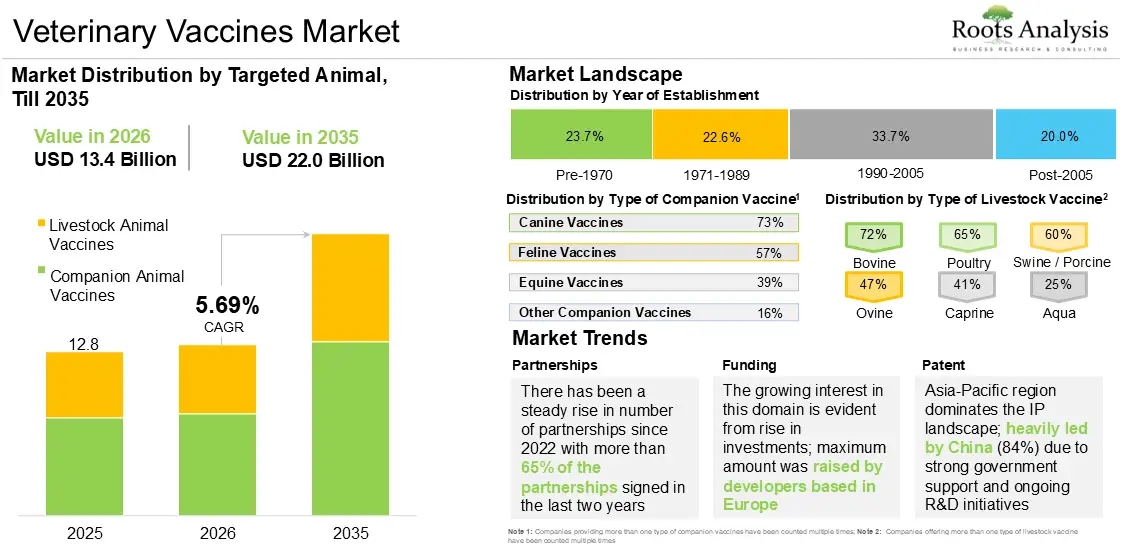
The global veterinary vaccines market, valued at USD 12.8 billion in 2025, is projected to reach USD 13.4 billion in 2026 and USD 22.0 billion by 2035, representing a CAGR of 5.69% during the forecast period 2026 to 2035.
See What’s in the Full Report – Request Your Complimentary Insights!
Market Report: Key Takeaways
Market Size & Trends
- In terms of the type of targeted animal, the companion animal vaccine segment is anticipated to capture the largest share (60%) in the current market.
- The parenteral route segment is estimated to capture majority of the market share, and this trend is unlikely to change in the future as well.
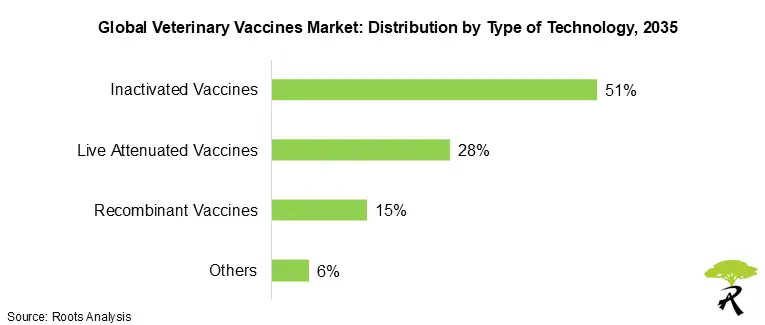
- In terms of the technology, the inactivated vaccine segment is anticipated to capture the largest share (more than 50%) in the current market.
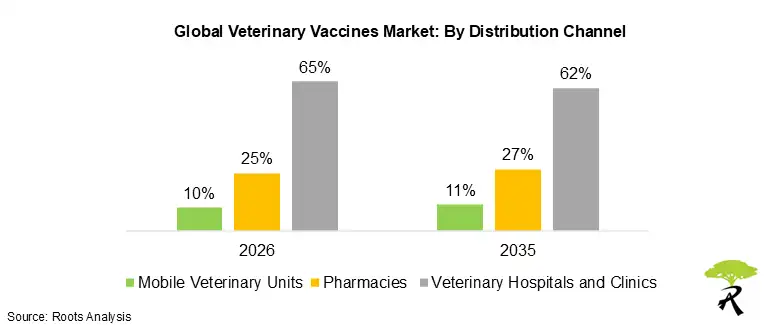
- In terms of the distribution channel, the veterinary hospitals and clinics segment occupies the highest share in the overall market.
- North America captures the majority of the veterinary vaccines market share, and this trend is unlikely to change in the future as well.
Key Market Statistics
- Market Size in 2026: $13.4 Billion
- Estimated Market Size in 2035: $22.0 Billion
- CAGR (2026-2035): 5.69%
- North America: Largest market in 2026
- Asia-Pacific: Fastest-growing region
Market Introduction
The global expenditure on veterinary healthcare has been increasing, driven by factors such as rising pet ownership, higher disposable incomes, and the growing willingness of pet owners to invest in their pets' well-being. As a result, the veterinary healthcare industry has witnessed significant growth worldwide.
Veterinary vaccines have evolved from an experimental endeavor to a routine and relatively safe practice in veterinary medicine. The primary objective of veterinary vaccines is to enhance companion animal health and to increase the cost-effective production of livestock. The use of veterinary vaccines is on the rise, with a significant impact on both animal health and public health. Vaccination is the most widely used tool in veterinary medicine to prevent and control animal diseases, representing the most cost-effective and sustainable method of managing infectious diseases. The field has seen successful applications of recombinant vaccines, with ongoing developments in rationally designed vaccine innovations to benefit animals, animal owners, and ultimately humans. Vaccination is considered the most effective way of preventing viral diseases in veterinary medicine, with attenuated and inactivated virus vaccines being the mainstay.
The increasing expenditure on pet health and veterinary services, along with the growing adoption of pet insurance, is expected to drive the utilization of routine vaccinations, presenting an opportunity for the players to capitalize on the rising demand for companion animal vaccines.
Market Segmentation
We have segmented the veterinary vaccines market into the type of targeted animal, route of administration, technology, distribution channel, and geography.
By Type of Targeted Animal
- Companion Animal Vaccines, Livestock Animal Vaccines
By Route of Administration
- Parenteral Routes, Oral Routes, Intranasal and Other Routes
By Vaccine Technology
- Inactivated Vaccines, Live Attenuated Vaccines, Recombinant Vaccines, Other Vaccines
By Distribution Channel
- Veterinary Hospitals and Clinics, Pharmacies, Mobile Veterinary Units
By Geographical Regions
- North America: US, Canada
- Europe: Germany, UK, France, Spain, Italy, Rest of Europe
- Asia-Pacific: Australia, China, India, Japan, Philippines, Rest of Asia-Pacific
- Latin America: Argentina, Brazil, Mexico, Rest of Latin America
- Middle East and Africa: Chad, Ethiopia, Nigeria, Rest of Middle East and Africa
Your Business is Unique – Why Shouldn’t Your Report Be?
Veterinary Vaccines Market Key Insights
What are the Key Drivers for Veterinary Vaccines Market Growth?
- Rising Demand for Animal-based Food Products: The current rise in the global population is fueling an increase in the demand for animal-based products, such as eggs, milk, and meat. Increasing awareness related to the nutritional value and associated health benefits of animal-based food products has prompted various people to consciously prefer protein-rich food obtained from animals. Vaccination of animals is important to maintain their health, secure the food supply for humans, prevent the transmission of zoonotic diseases to humans, and control disease outbreaks.
- Increasing Incidence of Zoonotic Diseases: Around 60% of the known infectious diseases are zoonotic in origin (transmitted from animals to humans), responsible for 2.5 billion disease cases and 2.7 million human deaths every year, across the globe. Vaccination of animals helps protect animals as well as human population.
- Ongoing Technological Advancements: The market for veterinary vaccines is expanding owing to the innovations in vaccine technology, including DNA vaccines, mRNA vaccines, nanoparticle subunit vaccines and recombinant viral-vector vaccines. Artificial intelligence and big data analytics have revolutionized the vaccine development field by reducing the timeline of the production process, supporting scale-up initiatives, and decreasing production expenses. These developments enhance the effectiveness and safety of vaccines, thereby allowing the veterinary vaccines market to flourish in the coming future.
What are the Main Challenges for Market Growth?
- Climate Change and Evolving Pathogen Threats: Increasing pollution in the environment has led to climate change and environmental modifications. As a result, the vectors and pathogens have evolved and gained resistance against the existing vaccines and medications. These pathogens have the potential to cause outbreaks of several emerging infectious diseases in animals. One of the major challenges for research scientists is to develop broad-spectrum vaccines that provide protection against the evolving pathogens.
- Lack of Reporting and Adequate Surveillance: Appropriate surveillance and reporting of animal diseases is important for their early diagnosis, control and eradication. Developing countries (with large populations and poor economies) lack well-defined resources and infrastructure for livestock disease surveillance and monitoring. Various livestock farmers are reluctant to perform diagnostic tests due to their high costs, thus leading to late diagnosis and reporting of the disease outbreak. Lack of data also complicates the decisions about the areas where the vaccines are needed urgently, resulting in a hindrance to their large-scale use.
- Shortage of Adequate Veterinary Services: Inadequate veterinary services impact the pace of preventive vaccination and early diagnosis of diseases, leading to disease outbreaks and loss of livestock. The shortage of veterinary professionals in both developed and developing countries results in less guidance being provided to animal owners regarding vaccination programs, thereby affecting the market.
Recent Developments in Veterinary Vaccines Market
- In May 2026, Merck’s vaccine for chicken against bronchitis received approval from Chinese agriculture ministry.
- In April 2026, EMA recommended the market authorization of first veterinary vaccine using RNA technology.
- In February 2026, Onderstepoort Biological Products SOC raised a grant worth USD 34.81 million from the South African Department of Agriculture / National Treasury for the production of its foot-and-mouth disease (FMD) vaccine.
- In February 2026, Vaccine and Infectious Disease Organization received a grant worth USD 1 million from the Canadian Institutes of Health Research.
- In January 2026, HIPRA entered into an agreement with Elanco Animal Health to distribute aMPV vaccines in the US poultry market.
Methodology and Industry Experts Interviews
The findings in this report were developed through a structured methodology combining secondary research, proprietary databases and primary interviews. Secondary research included company disclosures, regulatory databases, clinical-trial registries, peer-reviewed publications, patent records, pricing and reimbursement sources, and relevant market-access information. The resulting assumptions were triangulated against product approvals, pipeline progress, sales trends, formulation mix, regional access conditions and stakeholder interviews. The market report includes transcripts of the following third-party discussions:
- Co-Founder, Company, Uganda
- CEO, Company, Canada
- Director, Large Hospital, US
- Professor, Large University, US
- Secretary, Department of Animal Husbandry & Dairying, Government of India
- Secretary of US Department of Agriculture
- Marketing Manager, Mid-Sized Company, Spain; Director, Large Company, France; Director, Large Company, Germany and Veterinarian, Small Company, UK
- Veterinarian, Small Company, UK; Partner, Small Company, UK; Cattle Veterinary Lead, Large Company, UK and Representative, Mid-Sized Company, UK
- Veterinarian, Large Company, US
- Independent Veterinarian
- Head of Bioscience, Mid-Sized Council in the UK and Animal Health Science Oversight, Department in the UK
Commenting on this, Dr Marissa Rothenbaum (Director of Veterinary Field Programs, Banfield Pet Hospital), stated that, “vaccines are one of the most powerful tools in preventive care, and advances such as mRNA and multi-variant vaccine technologies are enabling the broader protection in animal health while strengthening disease prevention at the community level.”
Pay Only for What You Need – The Best Way to Optimize
Market Share Insights
Companion Animal Vaccines Dominate the Veterinary Vaccines Market
Companion animal vaccines currently occupy the highest share (60%) in the veterinary vaccines market and are likely to grow at a relatively higher CAGR (6.1%), during the forecast period. This is due to the increasing prevalence of zoonotic diseases, as well as the rise in expenditure by pet owners as preventive measures to avoid the deadly transmissions.
Parenteral Route Holds the Largest Market Share of Veterinary Vaccines Market
The parenteral route segment holds the highest share (82%) of the veterinary vaccines market, owing to the fact that injections remain the primary dependable method for veterinarians to ensure that individual companion and livestock animals receive exact therapeutic volumes without degradation in the digestive tract.
Inactivated Vaccines Dominate the Veterinary Vaccines Market
Inactivated vaccines currently capture the maximum share (more than 50%) of the overall market. The market for recombinant vaccines is likely to grow at a relatively higher CAGR (7.6%) during the forecast period. This can be attributed to the fact that inactivated vaccines remain the foundational choice for mass-immunization programs because they eliminate the risk of horizontal transmission between animals, making them highly preferred by livestock managers and companion animal owners.
Veterinary Hospitals and Clinics Hold the Largest Market Share in Veterinary Vaccines Market
Veterinary hospitals and clinics hold the highest share of the veterinary vaccines market (65%) due to the presence of established cold-chain storage infrastructure, and the ability to administer vaccines in controlled clinical settings, making these facilities the preferred channel for vaccine distribution and administration. The mobile veterinary units, though, are likely to grow at a relatively higher CAGR (7.2%), owing to their convenience and rural point-of-care accessibility.
Market Regional Insights
North America Dominates the Veterinary Vaccines Market
- North America is likely to capture the majority (41%) of the veterinary vaccines market share in 2026. This can be attributed to the fact that there are large number of vaccine providers based in North America, along with significant demand for veterinary vaccines within this region.
- The market in Asia-Pacific is likely to grow at a relatively higher CAGR (7.1%) during the forecast period. This is attributed by initiatives launched by governments, such as Indonesia’s agriculture ministry aims to distribute four million doses of foot-and-mouth disease (FMD) vaccine nationwide in 2026.
Get an Instant Quote in 10 Minutes. Lowest Price Guaranteed
Scope of Veterinary Vaccines Market Report
| Key Report Attributes | Details | |
| Key Players |
|
|
| Segments Covered |
|
|
| Excel Data Packs (Complimentary) |
|
|
| PowerPoint Presentation (Complimentary) |
|
|
| Customization Scope |
|
|
Report Authorship
This report was co-authored by Simriti Gupta and Nancy Kapila, members of the Roots Analysis healthcare and pharmaceutical research practice. Their work focuses on drug discovery and development, therapeutic-market assessment, competitive intelligence, clinical-pipeline analysis and market forecasting.
Independence and Non-Affiliation
This report is an independent work of market research and analysis published by Roots Analysis. It is not affiliated with, sponsored by, endorsed by, or reviewed by Boehringer Ingelheim, Ceva Santé Animale, Haid Group, MSD Animal Health, Tecon Biology, Virbac, Zoetis or any other pharmaceutical company, drug brand, or regulatory body referenced within it. No content in this report should be construed as medical advice. Roots Analysis maintains its own proprietary primary research process, and does not receive compensation from any company profiled within the report, in exchange for inclusion or favorable characterization.


