ADC Contract Manufacturing Market (7th Edition) Forecast 2026 to 2035
Global ADC Contract Manufacturing Market, Distribution by Scale of Operation (Clinical and Commercial), Process Component (Antibody, HPAPI / Cytotoxic Payload, Conjugation / Linker and Fill / Finish), Type of Payload (Tubulin Inhibitors, Topoisomerase Inhibitors, DNA Damaging Agents, and Others), Antibody Isotype (IgG1, IgG4, and Others), Target Indication, Antibody Origin, Type of Linker, and Key Geographical Regions
-
Lowest Price Guaranteed
-
Pages
451 -
Last Updated
October 2026 -
View Count
33803 -
A $3,212 Million Opportunity by 2035
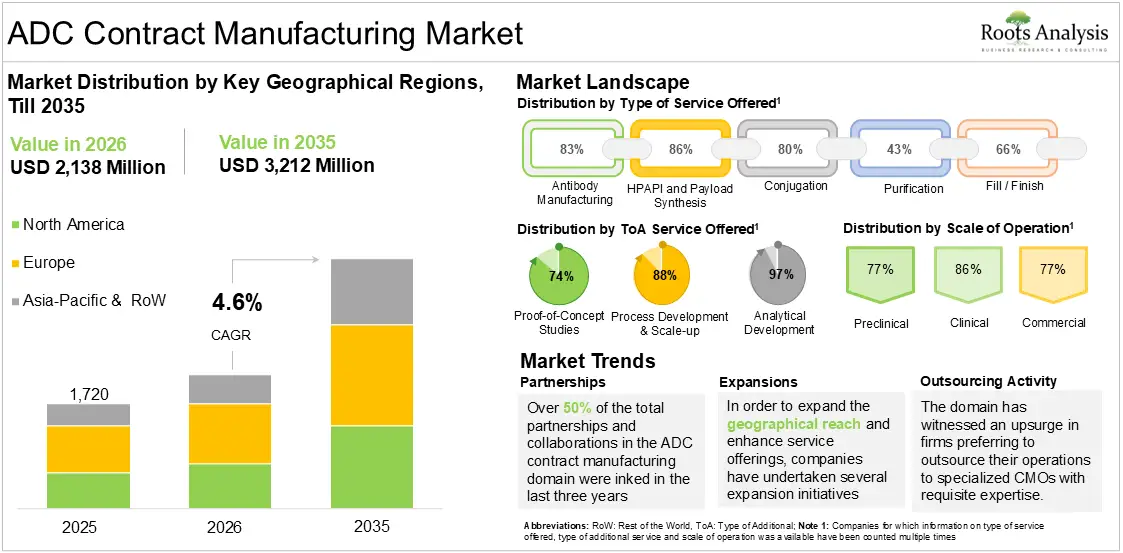
The global ADC contract manufacturing market, valued at USD 1,720 million in 2025, is projected to reach USD 2,138 million in 2026 and USD 3,212 million by 2035, representing a CAGR of 4.6% during the forecast period. An expanding oncology pipeline of over 600 ADC candidates and 28 approved ADC therapeutic programs is increasing demand for outsourced bioconjugation, cGMP manufacturing, high-potency handling, and commercial-scale supply.
To learn more about this report, request a free sample copy
Key Takeaways
Market Size & Trends
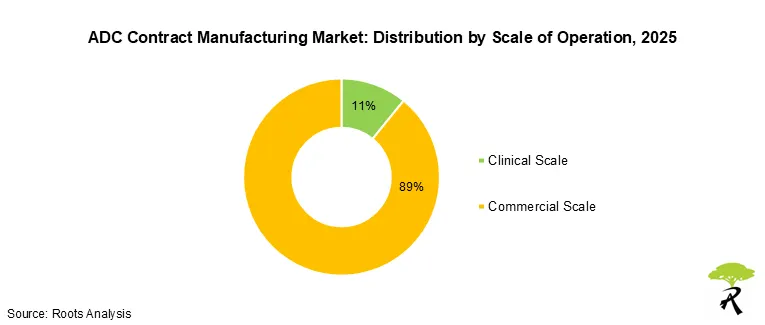
- Commercial scale holds the largest share, accounting for nearly 90% of the market by scale of operation.
- Antibody manufacturing dominates the current market by process component, reflecting the specialized cell-line, protein-engineering, purification, and analytical capabilities it requires.
- Solid tumors capture the largest share of the ADC contract manufacturing market, a trend expected to persist through the forecast period.
- Europe currently captures more than 40% of the market, while Asia-Pacific is expected to grow at the fastest CAGR of 8.5%.
Key Market Statistics
- Market Size in 2026: $2,138 Million
- Estimated Market Size in 2035: $3,212 Million
- CAGR (2026-2035): 4.6%
- Europe: Largest market in 2026
- Asia Pacific: Fastest growing region
Scope and Methodology
This report defines the ADC contract manufacturing market by process-component service revenue (antibody manufacturing, HPAPI/cytotoxic payload, conjugation/linker, and fill/finish services purchased from CDMOs). Some published estimates use a broader definition that captures total CDMO revenue attributable to ADC programs; therefore, those figures are not directly comparable with this report.
Roots Analysis based the study on secondary sources and 15 structured interviews with senior industry stakeholders. Prepared by the Roots Analysis biopharmaceutical research team. The report supports biopharmaceutical companies, business and commercial development leaders, procurement and sourcing teams, and investors as they compare CDMO capabilities, assess manufacturing risk, evaluate capacity, and identify partnership opportunities.
Why Biopharmaceutical Companies Outsource ADC and mAb-based Manufacturing?
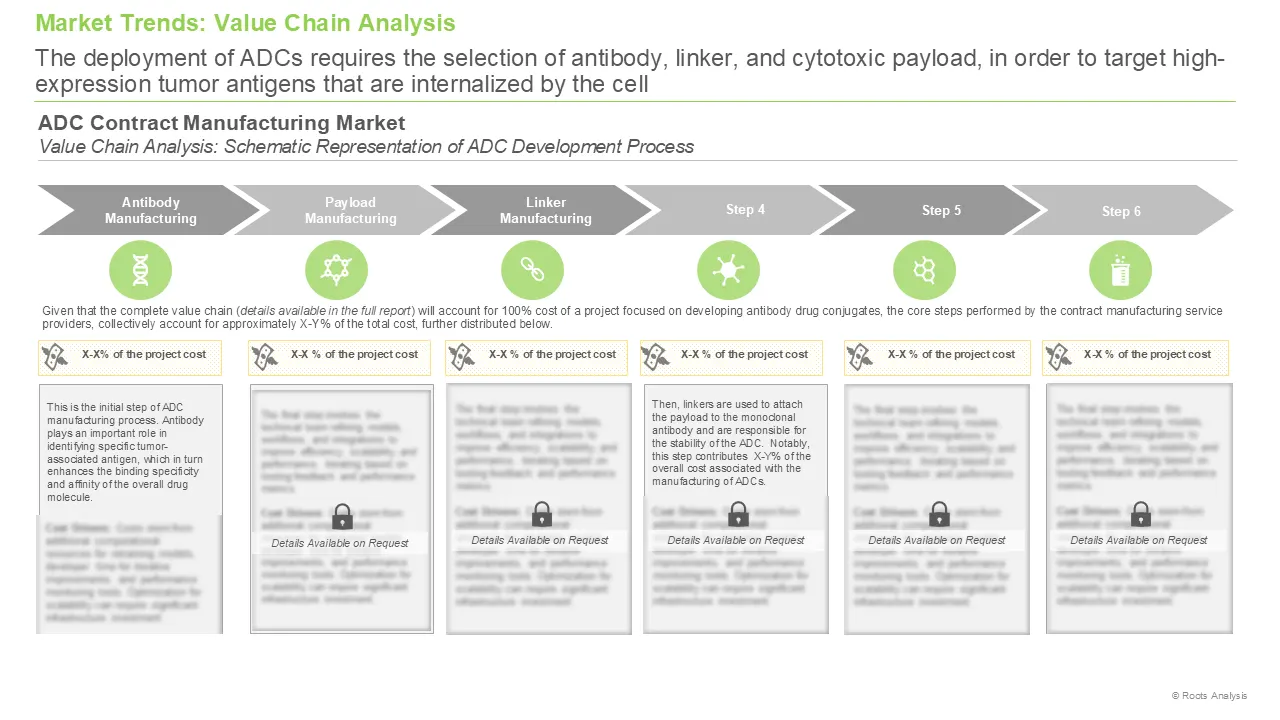
Antibody drug conjugates (ADCs) combine monoclonal antibody (mAb) with a potent cytotoxic payload through a chemical linker, enabling targeted oncology treatment across solid tumors and hematological malignancies. Manufacturers must control antibody quality, linker chemistry, drug-to-antibody ratio, payload potency, and product stability throughout the production process.
ADC manufacturing requires specialized expertise in cGMP-compliant bioconjugation, HPAPI handling, containment and analytical characterization, while access to advanced ADC technologies is essential for controlling conjugation sites, product homogeneity and drug-to-antibody ratios. Because these capabilities require substantial capital and technical expertise, biopharmaceutical companies increasingly partner with CDMOs to reduce fixed costs, accelerate development, support technology transfer, and scale production from clinical to commercial volumes.
Market Segmentation
The report segments the ADC Contract Manufacturing Market by scale of operation, process component, type of payload, antibody origin, antibody isotype, target indication, type of linker and key geographical regions, covering more than 20 countries across North America, Europe and Asia-Pacific and Rest of the World.
By Scale of Operation
- Clinical Scale, Commercial Scale
By Process Component
- Antibody, Conjugation / Linker, HPAPI / Cytotoxic Payload, Fill / Finish
By Type of Payload
- Tubulin Inhibitors, Topoisomerase Inhibitors, DNA Damaging Agents, Others
By Antibody Isotype
- IgG1, IgG4, Others
By Target Indication
- Solid Tumors, Hematological Malignancies
By Type of Linker
- Valine-citrulline, SMCC, Hydrazone, Maleimide, Maleimidocaproyl, Tetrapeptide-based linker, Peptide Linker, Others
By Antibody Origin
- Humanized, Chimeric, Human, Others
By Key Geographical Regions
- North America: US, Canada, Rest of North America
- Europe: UK, Spain, Italy, Germany, France, Rest of Europe
- Asia-Pacific and Rest of the World: China, Japan, India, South Korea, Australia, Argentina, Brazil, Chile, Columbia, Israel, Kenya, Peru, South Africa, Turkey, Saudi Arabia, Rest of Asia-Pacific and rest of the world
ADC Contract Manufacturing Market: Key Insights
What Factors Contribute to ADC Contract Manufacturing Market Trends?
The primary factors driving the demand for contract manufacturing of ADCs include rising global incidence of cancer, necessitating the need for innovative and more effective targeted treatments such as ADCs. At the same time, the expanding research and development efforts and increasing number of approvals for ADCs from regulatory bodies such as the FDA and EMA are generating strong demand for specialized, cGMP-compliant bioconjugation and HPAPI manufacturing services. The intricate nature and substantial costs associated with in-house ADC production play a crucial role, leading biopharmaceutical companies to seek the expertise and specialized infrastructure of CDMOs.
What are the Main Challenges for Market Growth?
Although propelled by robust demand, the ADC contract manufacturing sector faces various challenges, including technical and operational intricacies involved in the development of ADCs This requires specialized knowledge in antibody generation and the synthesis of HPAPIs in the bioconjugation process.
North America: Role of Trump Administration Tariffs on Domestic Production
Due to tariffs imposed on pharmaceuticals by the current administration, there has been an increase in agreements and investments aimed at expanding manufacturing operations in the US. Additionally, there is an increase in ADC demand for oncological indications, clinical and commercial manufacturing contracts.
Recent Developments in ADC Contract Manufacturing Market
- In October 2026, Fujifilm announced the installation of linker-payload manufacturing equipment at its Hirono Plant in Japan. The investment expands its ADC contract development and manufacturing organization business, enabling contract process development and manufacturing of ADC components.
- In September 2026, Axplora launched Axotecan, an independent European source of exatecan intended to strengthen ADC supply. The program combines Farmabios’ HPAPI expertise with Novasep CDMO’s integrated ADC capabilities.
- In August 2026, Fujifilm collaborated with Taiho Pharmaceutical to develop manufacturing technologies for next-generation sequencing. The companies will optimize processes for Taiho ADC candidates using Araris’ AraLinQ technology, combining Taiho’s ADC discovery capabilities with Fujifilm’s biologics CDMO expertise to enable stable, high-quality production and strengthen global manufacturing competitiveness.
Built on Interviews With 15 Named Industry Stakeholders
This study includes transcripts of 15 structured stakeholder interviews with senior commercial, business development, scientific, and executive leaders from large, mid-sized, and small ADC-focused organizations across Europe, North America, and Asia. Participants included current and former CDMO site heads, bioconjugates commercial-development leaders, chief executives, chief business officers, directors of business development, and scientific specialists.
- Senior Director, Commercial Development, Large company, Europe
- Business Development Manager, Mid-sized company, Europe
- Chief Executive Officer, Large company, Europe
- Chief Executive Officer and Founder, Small Company, UK
- Chief Executive Officer and Co-Founder, Small Company, France
- Former Chief Executive Officer, Large Company, US
- Chief Commercial Officer, Mid-sized Company, Switzerland
- Chief Business Officer, Small Company, Switzerland
- Executive Director, Large Company, Japan and Chief Innovation Officer, Large Company, Japan
- Director, Business Development, Small Company, Netherlands
- Director Corporate Development, Mid-sized Company, US
- Director, Business Development, Large Company, US and Former Group Product Manager, Large Company, US
- Former Director of CDMO, Large Organization, France
- Business Development Manager, Mid-sized Company, Switzerland
- Former Head of Bioconjugates Commercial Development, Large Company, Switzerland
- Former Site Head, Large Company, US
- Associate Scientist, Large Company, US
The market for ADC contract manufacturing has a transformative future and is likely to remain progressive in the coming years.
Hiroki Imai (Associate General Manager, Ajinomoto), stated that, "In my opinion, ADCs have already been established as a potent treatment option for various types of cancers. With fourteen approved products, the opportunity in this domain looks promising. Further, a recent study conducted by our company suggested that ADCs are better therapeutic options, when compared to other available anticancer therapies, such as antibodies and small molecule drugs. In fact, experts believe the chances of an ADC (15%) product being approved exceed that of nascent antibody therapies (10%) and small molecule drugs (5%). This observation clearly highlights the fact that the overall size of the ADCs and affiliated technologies market is likely to increase in future."
Market Share Insights
Which Scale of Operation Accounts for the Largest Share of the ADC Contract Manufacturing Market?
The commercial scale segment occupies a very high market share (around 90%); this is a result of many ADC drug candidates approved by regulatory bodies since 2021. The clinical segment, though, is likely to grow at a higher CAGR (7.6%) during the forecast period.
Which Target Indication Holds the Largest Share of the ADC Contract Manufacturing Market?
Solid tumors segment captures majority of the ADC contract manufacturing market (with a share of 80%), a trend that is unlikely to change in the future. This dominance is a result of the fact that most commercialized ADC therapeutics and those in late-stage clinical trials actively target solid tumors. The market for hematologic malignancies is likely to grow at a higher CAGR of 8.7% during the forecast period.
Among Process Component, Which Segment Accounts for the Largest Market Share?
The antibody segment occupies the highest share (~40%) in the overall ADC CMO market. The higher share of antibodies is due to the complex cellular or protein engineering requirements, making antibody manufacturing a time and cost-intensive process, thus prompting the need for more specialized antibody manufacturing expertise.
Which Regions are Showing the Fastest Growth?
Europe: Dominating the Market by Securing Highest Share
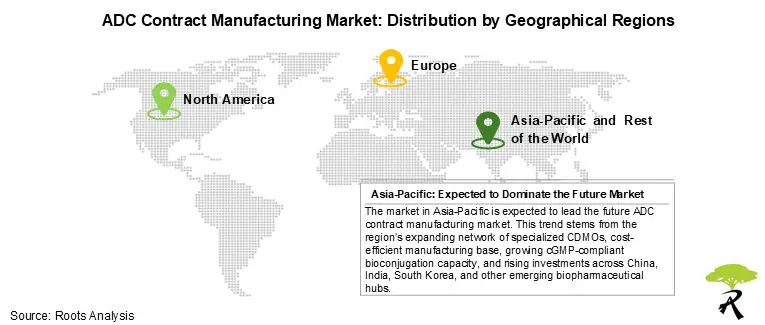
According to our projections, Europe is likely to capture majority (~45%) of the ADC contract manufacturing market share in the current year. Within Europe, Switzerland has emerged as a dedicated CDMO hub. This regional concentration enables efficient scaling of ADC production, from early-stage development to commercial supply.
Asia-Pacific: An Emerging Growth Spot
The market in Asia-Pacific and rest of the world is likely to grow at a relatively higher CAGR (8.5%). This is a result of significant cost advantage offered by countries such as China and India, where lower labor costs and operational expenses provide favorable manufacturing environment as compared to traditional hubs in North America and Europe. Examples of ADC contract manufacturing companies based in Asia-Pacific include Shilpa Biologics, WuXi Biologics, Formosa Laboratories, Syngene and Samsung Biologics.
Key Players in the ADC Contract Manufacturing Market
Examples of key companies profiled in this market report, arranged in alphabetical order, include AbbVie Contract Manufacturing, Abzena, CARBOGEN AMCIS, Catalent Pharma Solutions, Cerbios-Pharma, MabPlex, Millipore Sigma, Lonza, WuXi Biologics. The complete list of companies is available in the full report, which also includes an easily searchable Excel database of ADC contract manufacturers worldwide. Additional named organizations referenced elsewhere in this report's underlying data, reflect funding and partnership activity tracked across the broader ADC contract manufacturing ecosystem, not an endorsement relationship with Roots Analysis. Across related applications, China biologics contract manufacturing expands regional capacity for outsourced biologics, vaccines and complex therapeutic modalities.
Report Deliverables and Customization
Alongside the core market report, purchasers receive complimentary Excel data packs covering the ADC contract manufacturers' market landscape, company competitiveness analysis, recent expansions, partnerships and collaborations analysis, capacity analysis, clinical trial analysis, likely partner analysis, manufacturers market sizing and opportunity analysis. The report also includes a complimentary PowerPoint presentation summarizing the key findings and offers 15% free customization upon request.
Report Authorship
Author(s): This report was co-authored by Rupanshi Sharma, Mansi Bhanwal, both part of Roots Analysis's healthcare and pharma research practice, covering biologics discovery, development, and manufacturing market studies. All findings are based on proprietary databases, executive interviews, and regulatory analysis, subject to internal peer review prior to publication.
Independence and Non-Affiliation
Roots Analysis is an independent market research and consulting firm. This report draws on publicly available information, primary interviews, and proprietary analysis. Roots Analysis is not affiliated with, endorsed by, or a representative of the USFDA, the European Medicines Agency, or any of the companies, technologies, or individuals named in this report. Figures are derived from primary interviews with industry stakeholders combined with secondary research and are not directly comparable to market-sizing studies published by other research firms that draw the ADC contract manufacturing segment boundary differently, for example by including or excluding manufacturing and CDMO-adjacent revenue. All company and product names are used for identification purposes only and remain the property of their respective owners.
Clients evaluating this report alongside competing market studies should weigh how the publisher defines the segment boundary, since ADC contract manufacturing market sizing is not standardized across research firms and some studies fold in adjacent manufacturing or CDMO revenue that this report treats separately. This report, by Roots Analysis is updated on a seventh-edition cadence, includes process component and antibody isotype segmentation not always present in competing studies, and now carries the explicit scope, methodology, and non-affiliation disclosure set out above.