Biologics Fill Finish Manufacturing Market 6th Edition, 2026 to 2035
Biologics Fill Finish Manufacturing Market by Type of Primary Packaging Container (Vials, Syringes, Ampoules, and Cartridges), Type of Biologic Manufactured (Antibodies, Recombinant Proteins, Vaccines, Cell Therapies, Gene Therapies, and Nucleic Acids / Oligonucleotides), Scale of Operation, Therapeutic Area, End User, Type of Player, Company Size, Geographical Regions – Trends and Forecast 2026-2035
-
Lowest Price Guaranteed
-
Pages
473 -
Last Updated
October 2026 -
View Count
32049 -
Biologics Fill Finish Manufacturing Market Outlook: USD 9.4 Billion by 2035, Growing at a 6.33% CAGR
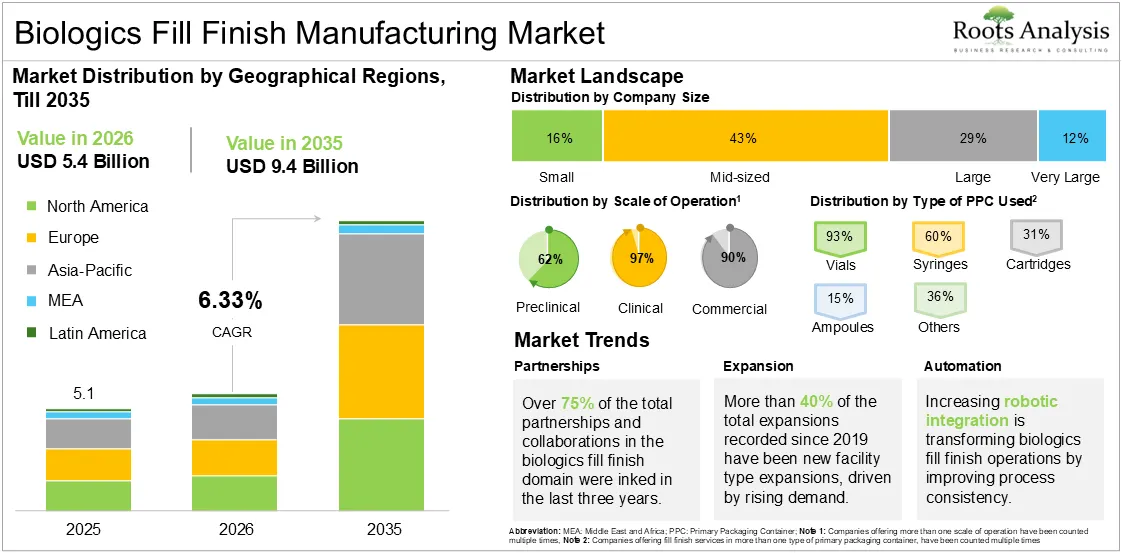
The global biologics fill finish manufacturing market, valued at USD 5.1 billion in 2025, is projected to reach USD 5.4 billion in 2026 and USD 9.4 billion by 2035, representing a CAGR of 6.33% during the forecast period 2026 to 2035. This growth is supported by expanding pipelines of antibodies, recombinant proteins, vaccines, other advanced biologics, and continued investment in automated aseptic fill and finish technologies to enhance manufacturing efficiency and product quality.
To learn more about this report, request a free sample copy
Market Report: Key Takeaways
Market Size & Trends
- By type of primary packaging container used, vials hold the highest share of the current fill finish manufacturing market.
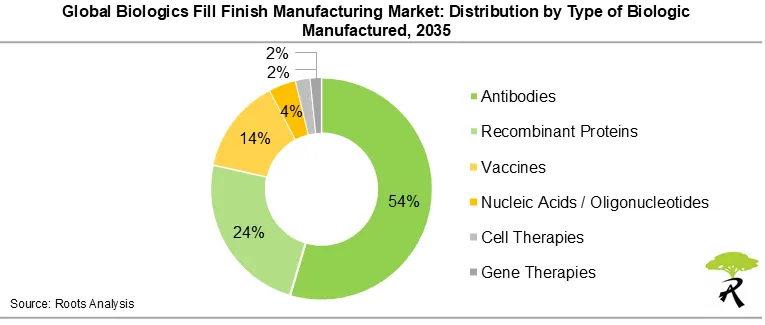
- Among the biologics manufactured, antibodies dominate the current market, accounting for around 55% of market revenue.
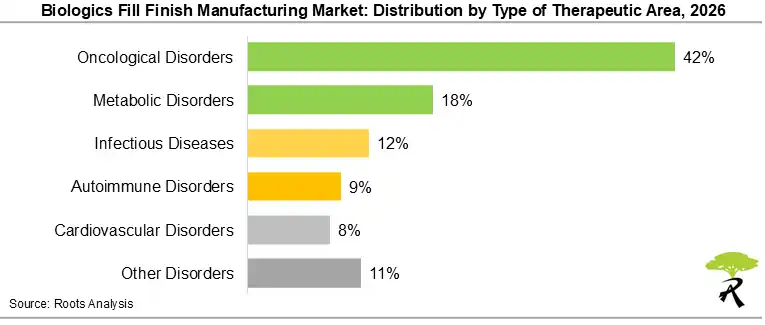
- Oncological disorders capture the largest share (>40%) of the biologics fill finish manufacturing market, and this trend is expected to persist through the forecast period.
- Commercial-scale operations hold majority share (>90%) of the current biologics fill finish manufacturing market
- Among end-users, pharmaceutical / biopharmaceutical companies capture the majority of the current market.
- By company size, large companies hold the highest share of the global biologics fill finish manufacturing market.
- With respect to type of player, industry players dominate the current biologics fill finish manufacturing market.
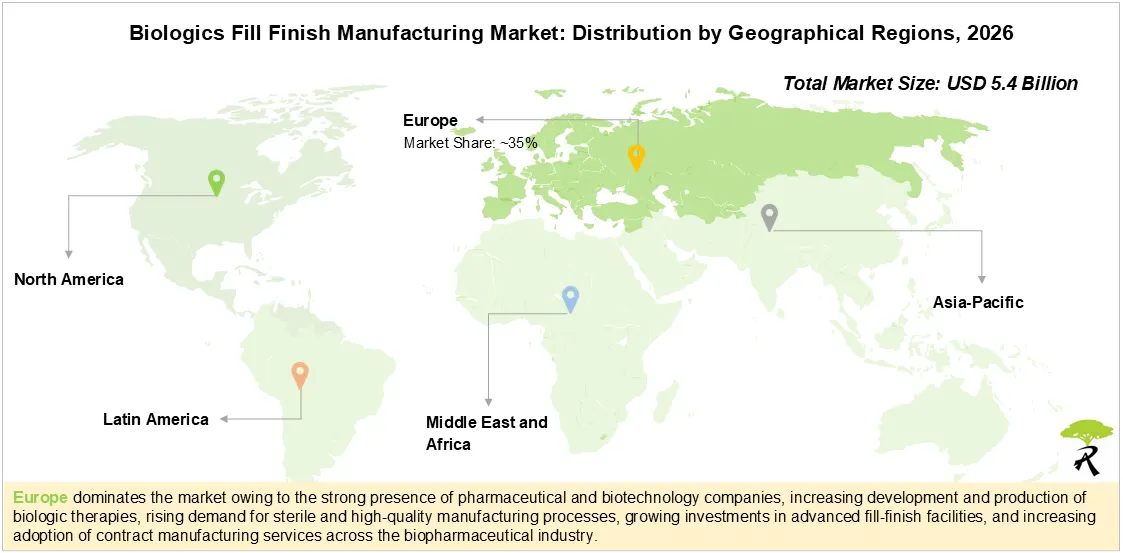
- Europe currently captures approximately 35% of the market, while Asia-Pacific is expected to register the fastest growth during the forecast period.
Key Market Statistics
- Market Size in 2026: $5.4 Billion
- Estimated Market Size in 2035: $9.4 Billion
- CAGR (2026-2035): 6.33%
- Europe: Largest market in 2026
- Asia-Pacific: Fastest growing region
What is Biologics Fill Finish Manufacturing?
Biologics fill finish manufacturing refers to the final drug-product stage in which a formulated biologic is transferred into primary container under tightly controlled conditions. Depending on the product and presentation, the process can include formulation hold, aseptic filling to a defined fill volume, stoppering or sealing, visual inspection, labeling and packaging, as well as lyophilization when required. Common primary packaging formats include vials, prefilled syringes, cartridges and ampoules used for injectable biologic products.
Because biologics are derived from living systems and may be sensitive to temperature, light, pH, oxygen, agitation and surface interactions, fill finish operations require rigorous contamination control, validated processes and robust quality systems. Manufacturers must maintain product sterility, stability and container-closure integrity while meeting applicable good manufacturing practice (GMP) and regulatory expectations. This places particular emphasis on cleanroom controls, environmental monitoring, aseptic-process validation, automated or manual inspection and quality assurance throughout the filling and finishing workflow.
Biologics Fill Finish Manufacturing Market Overview
The market is expanding as pharmaceutical and biopharmaceutical companies advance larger and more diverse pipelines of monoclonal antibodies, recombinant proteins, vaccines, cell and gene therapies and nucleic-acid-based products. At the same time, patient and healthcare-system preferences are increasing demand for convenient injectables, including prefilled syringes, cartridges, autoinjectors and other ready-to-use formats. These shifts are raising requirements for flexible fill volumes, formulation-specific handling and scalable drug-product manufacturing. Owing to the technical and capital-intensive nature of sterile manufacturing, developers are increasingly relying on CMOs and CDMOs for clinical and commercial fill finish services, gaining access to specialized infrastructure, experienced personnel, isolator-based aseptic lines, lyophilization, automated inspection, cold-chain handling and regulatory-compliance capabilities without building equivalent capacity internally.
Service providers are also investing in automation, robotics, single-use consumables, digital monitoring and data-management systems to improve process consistency, reduce manual intervention and support multi-product operations. Together, rising biologics demand, capacity expansion, regulatory requirements and technology adoption are expected to sustain growth in the biologics fill finish manufacturing market size over the forecast period.
How is the Biologics Fill Finish Manufacturing Market Segmented?
Based on the research, the biologics fill finish manufacturing market is segmented by type of primary packaging container, type of biologic manufactured, scale of operation, therapeutic area, end-user, type of player, company size and geography. This segmentation enables pharmaceutical and biopharmaceutical companies, CMO / CDMO business development teams, procurement and technical-operation teams, quality and regulatory professionals, investors and other market participants to assess the opportunity most relevant to their strategic requirements.
By Type of Primary Packaging Container
- Vials, Syringes, Ampoules, and Cartridges
By Type of Biologic Manufactured
- Antibodies, Recombinant Proteins, Vaccines, Cell Therapies, Gene Therapies, and Nucleic Acids / Oligonucleotides
By Scale of Operation
- Clinical Scale and Commercial Scale
By Therapeutic Area
- Oncological Disorders, Cardiovascular Disorders, Metabolic Disorders, Infectious Diseases, Autoimmune Disorders, and Other Disorders
By End-user
- Pharmaceutical / Biopharmaceutical Companies, and Contract Manufacturing Organizations / Others
By Type of Player
- Industry and Non-Industry
By Company Size
- Large Companies, Mid-sized Companies, and Small Companies
By Geographical Regions
- North America: US, Canada, and Mexico
- Europe: France, Germany, Switzerland, UK, Italy, Spain, Austria, Netherlands, Belgium, Portugal, Poland, and Rest of Europe
- Asia-Pacific: India, China, South Korea, Taiwan, Singapore, Japan, Australia, and Rest of Asia-Pacific
- Middle East and Africa: South Africa, Bahrain, Saudi Arabia, and Israel
- Latin America: Argentina, Rest of Latin America
Biologics Fill Finish Manufacturing Market Key Insights
What are the Key Drivers for Biologics Fill Finish Manufacturing Industry Growth?
- Partnerships and Collaborations: Strategic outsourcing and long-term manufacturing partnerships are becoming increasingly important as sponsors seek access to validated sterile capacity, specialized technical expertise and faster clinical-to-commercial scale-up. Agreements increasingly cover cartridge and syringe filling, technology transfer, commercial drug-product manufacturing and integrated supply support. For instance, in July 2026, Lonza expanded its strategic collaboration with a leading US-based biopharmaceutical company to support multiple biologics programs through its integrated development and manufacturing network, including commercial drug substance and drug product manufacturing services.
- Increasing Demand for Advanced Drug-Delivery Formats: Growing adoption of prefilled syringes cartridges, autoinjectors, and wearable injectors, is increasing demand for fill finish capabilities that support patient-friendly, ready-to-use and self-administered biologics. Container selection increasingly depends on dose volume, route of administration, formulation stability, device compatibility and patient-use requirements, creating demand for flexible filling platforms and robust container-closure systems.
- Capacity Analysis: Majority (35%) of the biologics fill finish manufacturing capacity for vials is installed at facilities located in Europe. Within Europe, close to 20% of the vial filling capacity is available with the facilities based in France. Moreover, for ampoules, more than 60% of the capacity is installed in Europe; of these, majority of the capacity is installed in the facilities located in France.
What are the Main Challenges in Biologics Fill Finish Manufacturing?
- Complexity of Handling Diverse Biologic Modalities: The increasing diversity of biologic products, including monoclonal antibodies, recombinant proteins, vaccines, cell and gene therapies, and nucleic-acid based products, creates product-specific requirements for formulation, fill volume, container compatibility, storage and handling. These differences limit standardization and increase the need for customized process development, validation and quality-control strategies.
- Scale-up and Capacity Expansion Challenges: Expanding biologics fill finish operations requires substantial investments in aseptic filling lines, cleanroom infrastructure, isolators, automated inspection and packaging systems. Equipment qualification, process validation and regulatory inspection timelines can delay capacity additions, making flexible scale-up from small clinical batches to high-volume commercial production a key operational challenge.
Growing Adoption of Automated Filling Systems and Isolators
Biopharmaceutical manufacturers and CDMOs are increasingly adopting automated filling systems, isolator-based technologies and advanced inspection platforms to strengthen sterility assurance, dose accuracy process consistency and manufacturing efficiency. Automation can reduce direct operator intervention in critical aseptic zones, while isolators create a physical barrier between personnel and the filling environment. Manufacturers are also increasing use of single-use consumables, such as disposable filling assemblies, tubing and bags, to simplify product changeovers and reduce cross-contamination risk in multi-product facilities. Digital data capture, in-process monitoring and validated control systems further support traceability, deviation investigation and quality assurance across the fill finish lifecycle. This trend is reflected in recent capacity investments: in April 2026, PCI Pharma Services announced a more than $1 billion investment across its global network, including a $100 million investment at its San Diego campus for a high-speed isolator filling line for ready-to-use prefilled syringes and cartridges. Similarly, Grand River Aseptic Manufacturing announced a $100 million expansion in April 2026, including a new isolator-equipped filling line designed to support up to 50 million syringe and cartridge units annually, with automated weight checks and stopper placement.
Primary Containers, Lyophilization and Cold-Chain Requirements Increase Service Complexity
Primary packaging is a critical part of biologic drug-product performance. Vials remain the leading format, while prefilled syringes and cartridges are gaining importance as subcutaneous administration and self-injection expand. Selection of glass or polymer-based systems, elastomeric stoppers and other closure components must consider product compatibility, extractables and leachables risk, dose accuracy, device integration and container-closure integrity. For biologics with stability limitations, lyophilization can extend shelf life, while validated cold-chain storage and distribution are essential for products that remain temperature sensitive after filling.
Recent Developments in Biologics Fill Finish Manufacturing Market
- In June 2026, Adimmune announced that it had assisted Sanofi in securing US FDA approval for a second manufacturing line supporting a partnered biologic product. The expansion followed GMP inspection, process validation and regulatory submission activities and increased available aseptic filling capacity.
- In June 2026, Shantha Biologics announced an outsourcing agreement with Novo Nordisk to provide cartridge fill-finish manufacturing services in India. The collaboration highlights growing demand for specialized cartridge filling capacity and internationally compliant sterile manufacturing.
- In May 2026, Made Scientific and RoosterBio announced a strategic partnership to expand scalable manufacturing of mesenchymal stem cell and extracellular-vesicle therapies. The collaboration includes downstream processing and multiple fill-finish options, including manual and semi-automated filling in vial and bag formats.
Scope, Methodology and Industry Expert Interviews
The findings in this report were developed through a structured methodology combining secondary research, proprietary databases and primary stakeholder interviews. Secondary research included company disclosures, regulatory information, facility and capacity announcements, scientific and technical literature, partnership activity and other publicly available market evidence. Senior stakeholders across the biologics fill finish manufacturing value chain informed the study through structured interviews. The participants list includes founders, chief executives, business and commercial leaders, scientific executives, and academic experts from North America, Europe, and Asia. Findings were triangulated across market sizing, segmentation, capacity, technology adoption, outsourcing activity and regional trends before finalization.
Emphasizing the recent advancements in biologics fill finish manufacturing market, Paula De Oliveira (Senior Marketing Manager, Lifecore Biomedical), stated, " The projected growth of biologics is a significant opportunity in this domain as it is driving the growth in fill / finish for injectables and related components, such as autoinjectors. Additionally, this growth is also being fueled by new and unique drug delivery technologies which offer a range of benefits to patients."
The market report includes transcripts of the following primary research interviews:
- Sales Support Specialist, Mid-sized Organization, US
- External Communication & Marketing Manager, Very Large Organization, France
- Senior Marketing Manager, Mid-sized Organization, US
- Marketing Specialist, Mid-sized Organization, Poland
- Senior Director, Drug Product Sales, Large Organization, US
- Business Development Manager, Very Large Organization, Netherlands
- Vice President and Head of Formulations, Very Large Organization, India
- Former Vice President, Business Development, Marketing and the Proposal Center, Mid-sized Organization, US
- Former Technology Watch Manager, Mid-sized Organization, France
- Former Chief Commercial Officer, Large Organization, Germany
- Former Head of Business Development, Small Organization, Czech Republic
- Former Global Business Development Manager, Mid-sized Organization, Netherlands
In addition, the market report includes transcripts of the following other third-party discussions:
- Vice President, Business Development, Very Large Organization, US
- Vice President, Business Development, Mid-sized Organization, US
- Chief Scientist, Mid-sized Organization, US
- Co-founder, Very Large Organization, US
- Founder & Owner, Mid-sized Organization, US
- Director, Biologics Business Development, Very Large Organization, US
- CEO and Board Member, Mid-sized Organization, Switzerland
- Vice President, Drug Product Operations, Mid-sized Organization, US
- Vice President, Technical Sales, Mid-sized Organization, US
- Senior Director, Business Development and Market Strategy, Large Organization, US
- Director, Product Management, Very Large Organization, US
- CEO, Mid-sized Organization, US
- Chief Executive Officer, Mid-sized Organization, US
- Senior Director and Head of ADC / mRNA Operations, Very Large Organization, South Korea
- Vice President, Operations, Mid-sized Organization, US
- Vice President, Strategic Partnerships, Mid-sized Organization, US
- Vice President and Head of Marketing and Corporate Communications, Large Organization, US
Biologics Fill Finish Manufacturing Market Share Insights
Market Share by Type of Primary Packaging Container Used: Vials Accounts for the Largest Share
Vials currently account for majority share of the biologics fill finish manufacturing market, reflecting their widespread use across development and commercial supply and their suitability for a broad range of biologic formulations. Prefilled syringes are expected to register a faster CAGR during the forecast period, supported by the shift toward ready-to-use formats, self-administration and reduced handling at the point of care.
Market Share by Type of Biologic Manufactured: Antibodies Account for the Largest Share
Antibodies currently account for 55% of biologics fill finish manufacturing market revenue, supported by their widespread use in oncology, autoimmune and other chronic conditions and by a strong development pipeline. Because most antibody therapies are administered by injection, they require specialized aseptic fill finish operations. Growth in subcutaneous formulations and patient-friendly delivery formats, including prefilled syringes, cartridges and autoinjectors, is further increasing demand for scalable sterile drug-product capacity.
Market Share by Therapeutic Area: Oncological Disorders Occupy Highest Share
Oncological disorders currently account for the largest therapeutic-area share (>40%), reflecting the extensive use of biologics in cancer treatment. Autoimmune disorders are expected to register a comparatively faster CAGR during the forecast period, supported by increasing use of targeted biologic therapies in chronic conditions such as rheumatoid arthritis, psoriasis, and inflammatory bowel disease.
Regional Analysis
Market Share by Regions: Europe Dominating the Market by Securing Highest Share
Currently, Europe is likely to capture the largest share (~35%) of the overall market. However, in the coming years, the market in Asia Pacific is likely to grow at a relatively higher CAGR, during the forecast period. This growth is driven by expanding biomanufacturing capabilities, increasing outsourcing activity and rising investments in biologics manufacturing infrastructure.
Key Players in the Biologics Fill Finish Manufacturing Market
The report profiles Alcami, Asymchem, Boehringer Ingelheim BioXcellence, Catalent Biologics, Cenexi, Charles River, CordenPharma, Curia, Evonik, Fareva, Fresenius Kabi, Grand River Aseptic Manufacturing, GSK, Hetero, Lifecore Biomedical, Lonza, Northway Biotechpharma, Novocol Pharma, Patheon pharma services, Recipharm, Syngene, WACKER and WuXi Biologics. A complete list of close to 250 companies captured is available within the full report.
Report Deliverables and Customization
Alongside the core market report, clients receive complimentary Excel data packs covering the biologics fill finish manufacturing market landscape, company competitiveness analysis, partnerships and collaborations, recent expansions analysis, demand analysis, capacity analysis and market sizing and opportunity analysis. A complimentary PowerPoint presentation summarizing the full report is also included, and 15% free customization scope is available on request. The report is designed to support pharmaceutical and biopharmaceutical business-development teams, procurement and technical-operations functions, R&D teams, quality and regulatory professionals, supply-chain teams, investors and CMO / CDMO leadership evaluating outsourcing partners, capacity requirements, technology choices and regional expansion opportunities.
Independence and Non-Affiliation
Roots Analysis is an independent market research and consulting firm. This report draws on publicly available information, primary interviews, and proprietary analysis. Roots Analysis is not affiliated with, endorsed by or acting on behalf of the USFDA, the European Medicines Agency, any pharmaceutical or biopharmaceutical company, CMO / CDMO, branded therapeutics or individuals named in this report. Company and product names are referenced solely for factual and market-analysis purposes.
This report represents the sixth edition of an ongoing research series tracking the biologics fill finish manufacturing market. Roots Analysis maintains an independent primary-research process and does not receive compensation from companies profiled in the report in exchange for inclusion or favorable characterization.
The report is intended to provide a transparent view of market scope, segmentation depth, competitive activity and research methodology so readers can evaluate the relevance of the analysis to their strategic decisions.