
Lowest Price Guaranteed
Pages
501
Last Updated
September 2026
View Count
15754
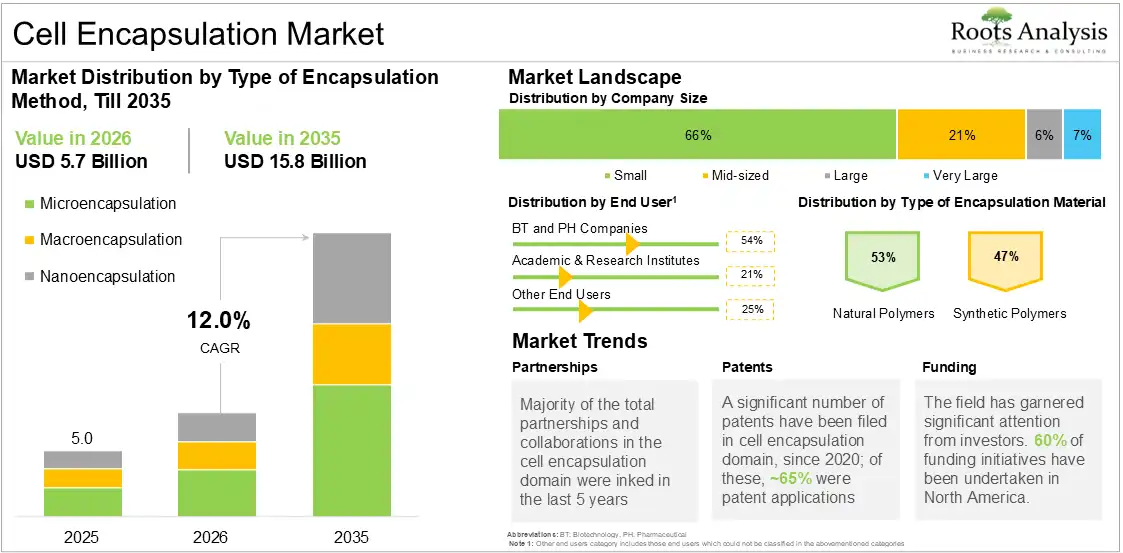
The global cell encapsulation market, valued at USD 5.0 billion in 2025, is projected to reach USD 5.7 billion in 2026 and USD 15.8 billion by 2035, representing a CAGR of 12.0% during the forecast period 2026 to 2035.
The prevalence of chronic diseases has significantly increased over the years, raising serious concerns worldwide. According to the American Cancer Society, approximately 2,114,850 new cancer cases and 626,140 cancer deaths are projected to occur in the US in 2026. This alarming trend highlights the pressing need for effective cancer therapeutics and other advanced treatment options.
Over the years, advances in cell biology and regenerative medicine have led to the development of various cell-based therapies with the potential to address unmet needs across many chronic clinical conditions. In fact, mesenchymal stem cells have demonstrated promising potential in improving patients' resistance to various infectious disorders, such as COVID-19.
However, several major challenges continue to limit the clinical translation of cell-based interventions. These include the scarcity of viable donors, inherent immunogenicity of transplanted cells, and difficulties in ensuring adequate oxygen and nutrient supply to grafted cells. Furthermore, constraints associated with efficient drug delivery and the frequent need for repeated cell administration add to the complexity of treatment, thereby restricting the widespread adoption and clinical success of cell-based therapies.
In response to these challenges, extensive research on cell encapsulation strategies has enabled the development of a variety of technologies capable of enclosing therapeutic entities within biocompatible matrices / carriers. Encapsulated therapy products offer a myriad of advantages and demonstrate the capability to address existing concerns related to cell sourcing, eliminating the need for complex surgical procedures. This enables targeted drug delivery without the need for immunosuppressive follow-on regimens.
Based on the research, we have segmented the Cell Encapsulation Market into type of encapsulation material, type of encapsulation method, type of manufacturing technique, type of technology, application area, end user, and geographical regions.
By Type of Encapsulation Material
By Type of Encapsulation Method
By Type of Manufacturing Technique
By Type of Technology
By Application Area
By End User
By Geographical Regions
Driven by the escalating prevalence of chronic diseases that require stem cell therapies and immunoprotected strategies, the cell encapsulation domain is expected to grow in the near future.
Yuval Avni (Former Chief Executive Officer, Beta-O2 Technologies), stated that, “Live cell encapsulation is likely to emerge among the most lucrative markets within the healthcare industry. Future market opportunities within this domain are likely to be dependent on the cost of the combination product. In addition, devices with more favorable features, such as biocompatibility, retrievability, and patient-friendliness, are likely to have higher adoption among patients suffering from insulin-dependent diabetes.”
Discussions with multiple stakeholders in this domain influenced the opinions and insights presented in this study. The market report includes transcripts of the following discussions:
In addition, the market report includes transcripts of the following other third-party discussions:
This segment highlights the distribution of market value for cell encapsulation across various types of encapsulation materials, such as natural polymers and synthetic polymers.
Currently, the natural polymers segment captures the majority of the cell encapsulation market share. This dominance stems from the superior biocompatibility, easy renewability, low toxicity, and mild gelation conditions offered by natural polymers, such as alginate, chitosan and collagen. These attributes enable high cell viability during encapsulation and post-implantation, which is particularly critical for sensitive applications such as islet cell transplantation in diabetes and regenerative medicine therapies. Established clinical and preclinical data, along with strong regulatory familiarity (alginate's extensive use in trials supported by organizations like JDRF and NIH), further accelerate adoption among therapy developers.
In contrast, synthetic polymers are expected to register the highest CAGR during the forecast period. This accelerated growth is fueled by the superior mechanical and chemical stability, and excellent batch-to-batch reproducibility of synthetic polymers. These features address key limitations of natural polymers, such as variable mechanical strength and sourcing inconsistencies, making synthetic polymers increasingly attractive for scalable manufacturing.
Based on the type of encapsulation method, the global market is segmented into macroencapsulation, microencapsulation and nanoencapsulation.
Presently, the microencapsulation sub-segment is likely to capture the majority of the cell encapsulation market size. This is due to the fact that micro-scale capsules (1-1000 µm) offer an optimal balance between nutrient and oxygen diffusion driven by a favourable surface-to-volume ratio and effective immunoprotection, while enabling minimally invasive delivery. These attributes have facilitated broader regulatory acceptance and lower production costs, supported by technologies such as alginate-based systems, electrospray, and microfluidics. Consequently, microencapsulation platforms are particularly beneficial for near-term commercialization and revenue generation, especially in metabolic and eye disorders where prolonged cell survival without immunosuppression is critical.
Moreover, it is worth highlighting that, as per the cell encapsulation market analysis, the market share for nanoencapsulation sub-segment is likely to grow at a relatively higher CAGR during the forecast period. Nano-scale particles offer improved passive and active targeting, higher cellular uptake along with overcoming the biological barriers that limit microencapsulated systems. This makes them suitable for next-generation therapies requiring site-specific action or combination with other modalities like gene editing.
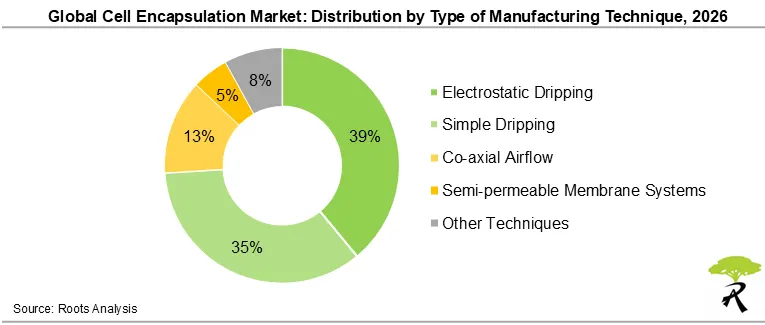
Based on the type of manufacturing technique, the global market is segmented into co-axial airflow, electrostatic dripping, semi-permeable membrane systems, simple dripping and other techniques.
According to our market analysis, electrostatic dripping occupies the highest (around 40%) market share in the cell encapsulation market. This trend stems from its long-standing use in clinical manufacturing which has generated extensive supporting data on process consistency, capsule uniformity, and product characterization. The availability of such a robust evidence base reduces regulatory uncertainty relative to newer, higher-throughput alternatives. As a result, companies can leverage existing validation frameworks, analytical methods, and comparability protocols to reduce time-to-IND or BLA submission.
On the contrary, the co-axial airflow segment is likely to grow at a higher CAGR during the forecast period. This is due to its advantages in providing ultra-low shear forces, which are essential for encapsulating delicate cell types while maintaining high viability rates.
On the basis of type of the technology, the global market is distributed into 3D printing, electrostatic spray, emulsification, extrusion, jet cutting, and other technologies.
Currently, the extrusion sub-segment occupies the highest share in the overall market due to its ability to deliver reliable, scalable, and cost-efficient manufacturing of simple, high-throughput microspheres and hydrogel beads. These are some of the attributes that are crucial to early-stage cell therapy CDMOs, established regenerative medicine product teams, and manufacturers targeting regulatory approval quickly. Further, extrusion’s mature supply chain and validated quality control workflows translate directly into faster time-to-market and predictable cost-per-dose economics.
Moreover, it is worth highlighting that, as per cell encapsulation market analysis, the market share for 3D printing is likely to grow at a relatively higher CAGR (~15%) during the forecast period. This is due to the fact that hydrogel-based 3D environments better mimic native tissues, support cell proliferation, and enable sustained bioactive molecule secretion. In addition to this, as biomaterial inks and printing speeds improve, 3D printing increasingly enables differentiated product claims and platform exclusivity.
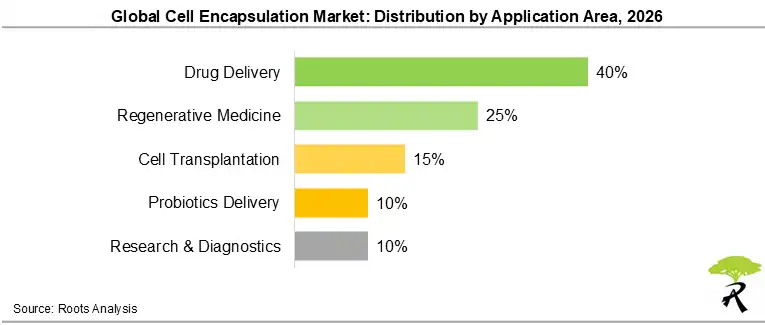
Based on the application area, the global market is segmented into cell transplantation, drug delivery, probiotics delivery, regenerative medicine, and research and diagnostics.
According to our projection, the drug delivery segment holds the highest (~40%) cell encapsulation market share. This dominance is primarily because encapsulated cells provide programmed, sustained secretion therapeutics like insulin, enzymes, and antibody fragments that convert biologics into long-acting, minimally invasive implants or injectables. This directly improves therapeutic efficacy, reduces dosing frequency, and enhances patient compliance, outcomes that are highly valued by both consumers and clinicians. Moreover, cell encapsulation for drug delivery has already secured regulatory traction in multiple indications, with clearer reimbursement pathways in hospital and specialty pharmacy settings. This is particularly evident in diabetes treatment, where companies like Avant Technologies and SGAustria are leveraging cell encapsulation to protect genetically modified insulin-producing cells, enabling glucose-responsive insulin secretion without immunosuppression.
Moreover, in the coming years, regenerative medicine sub-segment is expected to grow at a higher CAGR during the forecast period. This growth is fueled by accelerating research and innovation in tissue engineering, stem cell applications and immune-evasive therapies. In addition, cell encapsulation mitigates critical barriers like immune rejection and poor cell survival post-transplantation, enabling applications in tissue repair, organoid development, and personalized regenerative treatments. Moreover, advancements in stem cell encapsulation have demonstrated promising results, with encapsulated stem cell-derived beta cells showing glucose control in patients and resolving hypoglycemic events. This trend is supported by the recent joint venture signed between Avant Technologies and SGAustria with an aim to combine stem cell differentiation with encapsulation technology to target 589 million insulin-dependent diabetes patients globally.
In terms of geographical regions, the global market is distributed across North America, Europe, Asia-Pacific, Middle East and Africa, and Latin America.
According to our cell encapsulation market forecast, North America is likely to capture the majority (around 45%) of the cell encapsulation market share in the current year, and this trend is unlikely to change. The region’s dominance is driven by a mature, investment-rich ecosystem that accelerates translational success and commercialization. Moreover, the region benefits from supportive FDA frameworks, robust venture capital and non-dilutive funding, dense CDMO infrastructure and landmark commercial validations. For instance, Neurotech Pharmaceuticals’ FDA-approved encapsulated cell therapy for Macular Telangiectasia Type 2 launched with Cencora as the exclusive US specialty distributor.
The market in Asia-Pacific is likely to grow at a high CAGR during the forecast period till 2035. This is primarily due to rapid R&D expansion, government-backed regenerative medicine initiatives, rising chronic disease burden, and cost-competitive manufacturing scale in the region. Moreover, proactive licensing and commercialization of indigenous cell encapsulation IP policies in countries like India are further accelerating the adoption of cell encapsulation. For instance, in March 2026, SRM Institute of Science and Technology licensed its cell encapsulation technology to Anabond (INR 1 crore upfront plus royalties), reflective of domestic IP maturation and near-term commercial pathways.
| Key Report Attributes | Details | |
| Historical Trend | Since 2019 | |
| Forecast Period | Till 2035 | |
| Market Size 2026 | $5.7 Billion | |
| Market Size 2035 | $15.8 Billion | |
| CAGR (Till 2035) | 12.0% | |
| Segments Covered |
|
|
| Key Players | (A complete list of players captured is available in the report) | |
| PowerPoint Presentation (Complimentary) |
Available | |
| Customization Scope | 15% Free Customization | |
| Excel Data Packs (Complimentary) |
Available | |