
Lowest Price Guaranteed
Pages
656
Last Updated
August 2026
View Count
36072
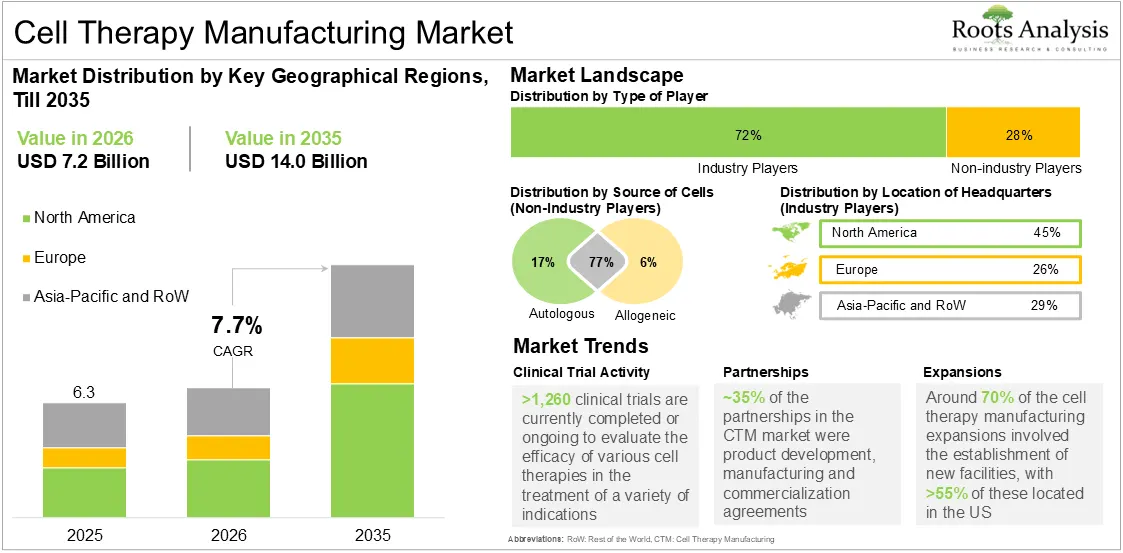
The global cell therapy manufacturing market, valued at USD 6.3 billion in 2025, is projected to reach USD 7.2 billion in 2026 and USD 14.0 billion by 2035, representing a CAGR of 7.7% during the forecast period 2026 to 2035.
To learn more about this report, request a free sample copy
Over the years, various technological advances and discoveries have significantly changed the practice of medicine. One such advancement is the development of cell-based therapies, which have demonstrated significant therapeutic potential and may help reduce toxicity-related concerns associated with conventional pharmacological interventions.
Researchers are investigating more than 1,000 cell and gene therapy candidates for the treatment of a myriad of disease indications. Amongst these, around 45 cell-based therapies have already been approved by various regulatory authorities across the globe. Further, several organizations are launching initiatives that address manufacturing complexities and support the long-term success of these novel therapies.
Cell and gene therapy manufacturing is a complex process conducted in a highly controlled, contamination-free environment and involves various critical steps such as the isolation, modification, and expansion of immune cells, including T-cells and stem cells. Each step requires specialized systems and strict adherence to regulatory guidelines to ensure product safety, efficacy, and consistency.
The industry is increasingly adopting closed and automated manufacturing platforms to reduce manual intervention, improve process consistency and support scalable production. For instance, Cellares is advancing automated cell therapy manufacturing through its Cell Shuttle platform, which enables end-to-end, closed-system production. Such technologies are expected to help developers reduce operational variability, address logistical challenges, and improve manufacturing efficiency.
| Key Manufacturer | Headquarters | Type of Manufacturer | Type of Cell Therapy | Scale of Operation |
| Lonza | Switzerland | CDMO | CAR-T Cells, Stem Cells, NK Cells | Clinical and Commercial |
| Catalent | US | CDMO | CAR-T Cells and TCR Therapies | Clinical and Commercial |
| AGC Biologics | Japan | CDMO | Stem Cells and CAR-T Cells | Clinical |
| Sartorius | Germany | Technology Provider | CAR-T Cell Therapies, Stem Cell Therapies, TCR Therapies, TIL Therapies, Dendritic Cell Therapies, and Other Cell Therapies | Clinical and Commercial |
| Thermo Fisher Scientific | US | Technology Provider and CDMO | CAR-T Cells, TIL Therapies, and Stem Cells | Clinical and Commercial |
Based on our research, we have segmented the Cell Therapy Manufacturing Market into type of cell therapy, source of cells, origin of cells, technology, scale of operation, type of manufacturer and key geographical regions.
By Type of Cell Therapy
By Source of Cells
By Origin of Cells
By Technology
By Scale of Operation
By Type of Manufacturer
By Key Geographical Regions
Due to tariffs imposed on pharmaceuticals by the current administration, there has been an increase in agreements and investments aimed at expanding manufacturing operations in the US. In May 2026, the US Commerce Department launched an application process for pharmaceutical manufacturers seeking reduced Section 232 tariff rates if they commit to expanding or relocating manufacturing operations in the US. This move is aimed at supporting continued investment in domestic advanced therapy manufacturing. For instance, in May 2026, FUJIFILM Cellular Dynamics launched a new iPSC development and manufacturing facility in Madison, Wisconsin, which is expected to quadruple its iPSC manufacturing capacity and support future contract manufacturing of cell therapy products.
Driven by the need to improve patient access, reduce production variability and support commercial-scale supply, cell therapy manufacturing is shifting toward more standardized, reproducible, and cost-efficient production models.
Emphasizing this shift, Pierre-Alain Ruffieux (Group Executive, Bioprocess, Cytiva) stated, “Cell and gene therapies are often life-changing for patients; however, high costs and technological constraints remain barriers to access. Scaling these therapies globally will require manufacturing that is more consistent, reproducible, and cost-effective. Current processes are complex, often patient-specific, and difficult to reproduce consistently at scale. Progress will depend on increasing standardization and automation to reduce variability and improve process control. Platform-based and modular manufacturing approaches are beginning to address these issues by enabling more predictable scale-up and scale-out.”
Discussions with multiple stakeholders in this domain have influenced the opinions and insights presented in this study. The market report includes transcripts of the following discussions:
In addition, the market report includes transcripts of the following other third-party discussions:
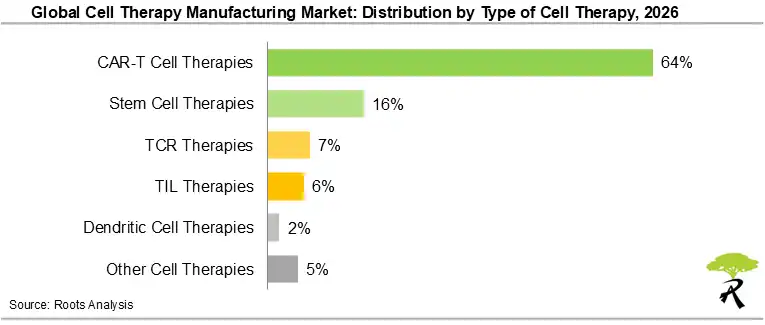
Based on type of cell therapy, the global cell therapy manufacturing market is segmented into CAR-T cell therapies, stem cell therapies, TCR cell therapies, TIL cell therapies, dendritic cell therapies, and other cell therapies.
Currently, CAR-T cell therapies account for the largest share of the cell therapy manufacturing market, capturing nearly 65% of the overall market. This dominance is primarily due to the strong clinical and commercial adoption of CAR-T therapies, particularly across hematological malignancies. The segment also benefits from a growing number of approved products, expanding treatment access, and continued investment in specialized manufacturing infrastructure. In addition, CAR-T therapies often involve complex, high-value manufacturing workflows, including cell collection, activation, genetic modification, expansion, quality testing, and release, which significantly increases their contribution to the overall manufacturing market.
The other cell therapies segment, including natural killer cell therapies and genetically modified cell therapies, is likely to grow at a higher CAGR of 16.15% during the forecast period. This growth is driven by increasing interest in next-generation cell therapy platforms that can support broader patient access and improved manufacturing scalability. Natural killer cell therapies, in particular, are gaining traction due to their favorable safety profile, lower risk of graft-versus-host disease, and potential to support off-the-shelf treatment approaches. As developers continue to advance these emerging platforms, demand for manufacturing capabilities across other cell therapy segments is expected to increase significantly.
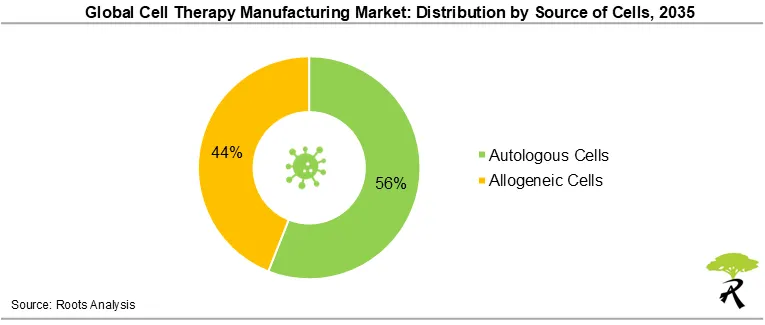
With respect to source of cells, the global cell therapy manufacturing market is segmented into autologous cells and allogeneic cells.
Currently, autologous cells account for the larger share of the cell therapy manufacturing market, capturing more than 50% of the overall market. This dominance is due to the strong clinical adoption of patient-specific therapies, particularly across CAR-T cell therapy manufacturing. Since autologous therapies use a patient’s own cells, they reduce the risk of immune rejection and graft-versus-host disease. Recent approvals, such as Waskyra®, an autologous blood stem cell-based gene therapy for Wiskott-Aldrich syndrome, further highlight the continued clinical relevance of patient-specific cell therapy approaches.
Autologous cells are also likely to grow at a higher rate during the forecast period. This growth is supported by the continued expansion of personalized therapies across oncology and other complex disease areas, where patient-specific manufacturing remains critical. Ongoing improvements in automation, closed-system processing, and quality control workflows are also expected to improve the scalability of autologous cell therapy manufacturing.
Based on origin of cells, the global cell therapy manufacturing market is segmented into induced pluripotent stem cells, bone marrow, umbilical cord, adipose tissue, neural stem cells, and others.
Currently, the bone marrow segment accounts for the largest share of the cell therapy manufacturing market. This dominance is due to the long-established use of bone marrow-derived cells in hematopoietic stem cell transplantation and regenerative medicine applications. The segment also benefits from well-defined collection, processing, and storage protocols, along with extensive clinical validation across multiple therapeutic areas.
Induced pluripotent stem cells are likely to witness significant growth during the forecast period. Their ability to propagate indefinitely and differentiate into multiple specialized cell types makes them suitable for scalable and standardized cell therapy manufacturing. As developers focus on allogeneic, off-the-shelf, and next-generation regenerative medicine platforms, demand for iPSC-derived therapies is expected to increase.
In terms of technology, the global cell therapy manufacturing market is segmented into somatic cell technology, 3D bioprinting technology, cell immortalization technology, viral vector technology, genome editing technology, and cell plasticity technology.
Currently, somatic cell technology captures the largest share of the cell therapy manufacturing market. This dominance is due to its widespread use across established manufacturing workflows, including isolation, processing, expansion, and modification of cells for therapeutic applications. Its strong adoption across CAR-T cell therapies, TCR cell therapies, dendritic cell therapies, and stem cell-based approaches reinforce its role as a core technology in current cell therapy manufacturing operations.
3D bioprinting technology is likely to grow at the highest rate during the forecast period. This growth is supported by its increasing use in developing personalized, cell-laden constructs that mimic native tissue structure and function. Its ability to support precision manufacturing, tissue-specific constructs, and next-generation regenerative medicine applications is expected to drive strong adoption in the coming years.
In terms of key geographical regions, the global cell therapy manufacturing market is segmented into North America, Europe, Asia-Pacific and the Rest of the World.
According to our analysis, North America captures the largest share of the cell therapy manufacturing market. This dominance is supported by the presence of cell therapy developers, advanced GMP manufacturing infrastructure, established clinical research networks, and a supportive regulatory environment in the US. For instance, in January 2026, the FDA announced a more flexible approach to chemistry, manufacturing, and control requirements for cell and gene therapies to expedite product development and support BLA readiness.
North America is also likely to grow at the highest CAGR during the forecast period, driven by continued expansion of specialized cell therapy manufacturing capacity across the region. For instance, in April 2026, Made Scientific announced a 12,000-square-foot expansion of its Princeton GMP facility, while Johnson & Johnson, in February 2026, announced an investment of more than USD 1 billion to establish a next-generation cell therapy manufacturing facility in Montgomery County, Pennsylvania. These developments are expected to strengthen the region’s position in clinical and commercial cell therapy manufacturing.
| Key Report Attribute | Details | |
| Historical Trend | Since 2023 | |
| Forecast Period | Till 2035 | |
| Market Size 2026 | $ 7.2 Billion | |
| Market Size 2035 | $ 14.0 Billion | |
| CAGR (Till 2035) | 7.7% | |
| Segments Covered |
|
|
| Key Players |
(A complete list of players captured is available in the report) |
|
| PowerPoint Presentation (Complimentary) |
Available | |
| Customization Scope | 15% Free Customization | |
| Excel Data Packs (Complimentary) |
Available | |