
Lowest Price Guaranteed
Pages
230
Last Updated
September 2026
View Count
16190
In my opinion, the global market for drug delivery technologies is still in its infancy and I expect a significant growth once technologies under evaluation are clinically validated and begin to generate revenues. Until this takes place, the market is likely to be driven by technology access fees, and upfront and milestone payments.
-- CEO, a California-based mid-sized technology developer
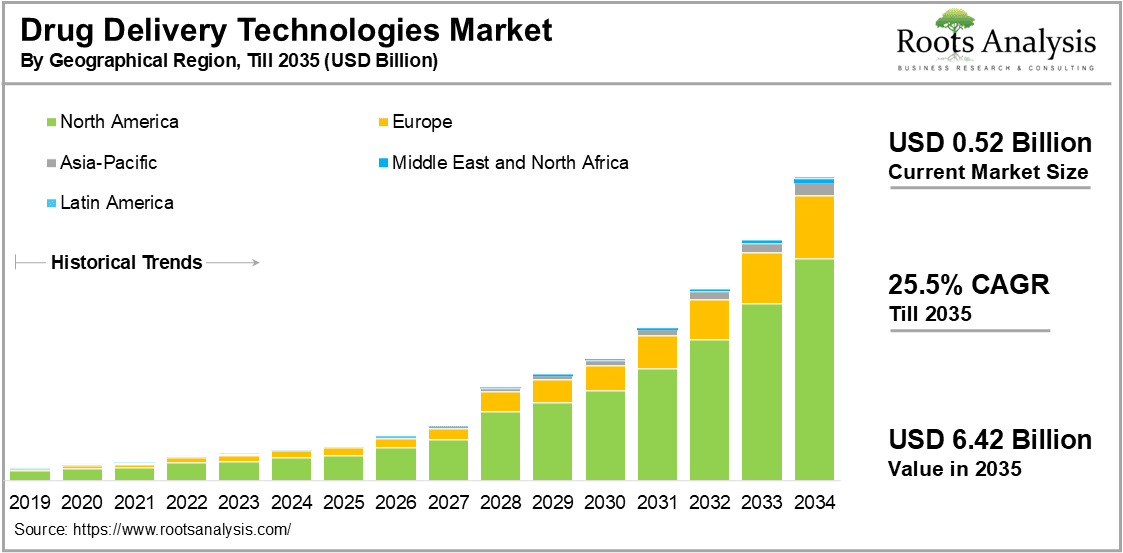
The global drug delivery technologies market is currently valued at $0.52 billion and is poised to reach $6.42 billion by 2035, at a CAGR of 25.5%, during the forecast period.
Over the years, the incidence and prevalence of chronic diseases, such as diabetes, multiple sclerosis and rheumatoid arthritis, have increased significantly. Presently, the recommended treatment options for such clinical conditions are mostly biologics, which need to be administered via parenteral routes in order to ensure maximum therapeutic benefit.
 |
To learn more about this report, request a free sample copy
Biologics, also known as biopharmaceutical drugs, are a specialized form of drugs having active pharmaceutical ingredients isolated from living cells. Given the inherent requirement for frequent medication, patients suffering from such long-lasting clinical conditions generally end up spending high amounts on not only the prescribed therapeutic regimen, but also on numerous hospital visits for dose administration. Since 2018, more than 250 biologics (including antibody drug conjugates, enzyme and proteins) have received the United States Food and Drug Administration (FDA) approval. These drugs pose active pharmaceutical ingredients that are short lived, and instability to cross gastrointestinal tract owing to its large molecular weight.
Furthermore, these drugs are derived from living cells that are prone to enzymatic degradation. Owing to its instability to cross gastrointestinal tract and short-lived nature, these drugs require specialized drug delivery systems that enable its direct delivery at targeted sites. With the rising demand for such biologically derived drugs / therapies, the need for drug delivery technologies capable of efficiently aiding the delivery of therapy products, has also become more pronounced. Considering the ongoing demand several pharmaceutical drug developers are actively attempting to develop advanced drug delivery systems that enable delivery of drug at targeted sites. It is important to highlight here that several drug delivery technologies have been developed based on various strategies, such as nanoparticles, aerosol generation systems, micro-encapsulation, long-acting microneedles and DNA-based delivery technologies that facilitate improved drug penetration. Across related applications, nasal drug delivery offers a non-invasive administration route with potential for rapid systemic and nose-to-brain delivery. A specialized application involves drugs and delivery technologies for back-of-the-eye disorders, where ocular barriers influence local exposure and dosing strategy.
Notably, long acting drug delivery has emerged as the novel and advanced drug delivery system which manipulate the dosing regimen of the drug in the body in order to sustain its therapeutic level. These novel systems circumvent the limitations of conventional drug delivery system, such as multiple dosing frequency, fluctuating plasma levels, high toxicity levels and poor patient compliance. The incorporation of various drug delivery mechanism has led to the development of drugs that exhibit prolonged, controlled, extended or sustained effect. Several initiatives have been taken by the industrial stakeholder to drive innovation in this field. For instance, in April 2024, Medincell entered into a strategic agreement with AbbVie for the development of long-acting injectables across various therapeutic indications, through leveraging former’s long-acting injectable technology platform. Earlier, in January 2024, DelSiTech announced that it successfully raised € 10 million in financing round in order to support the clinical development of silica-based drug delivery technology platform. Driven by the ongoing R&D, collaborations and investments made in this domain, we believe the drug delivery technologies market will grow at a higher CAGR during the forecast period.
 |
 |
 |
The market research report presents an in-depth analysis of the various drug delivery technology developers, across different segments, as defined in the table below:
| Key Report Attributes | Details | |
| Historical Trend | Since 2019 | |
| Forecast Period | Till 2035 | |
| Market Size 2035 | USD 6.42 Billion | |
| CAGR (Till 2035) | 25.5% | |
| Type of Technology |
|
|
| Type of Biologic |
|
|
| Route of Administration |
|
|
| Therapeutic Area |
|
|
| End User |
|
|
| Geographical Regions |
|
|
| Companies Profiled |
|
|
| PowerPoint Presentation (Complimentary) |
Available | |
| Customization Scope | 15% Free Customization | |
| Excel Data Packs (Complimentary) |
|
|
 |
 |
 |
One of the key objectives of market report was to estimate the current market size, opportunity and the market growth potential, over the forecast period, till 2035. We have provided informed estimates on the likely evolution of the market for the forecast period.
The drug delivery technologies market analysis also features the likely distribution of the current and forecasted opportunity within the market across various segments, such as distribution by type of technology (targeted drug delivery, controlled release drug delivery, polymeric drug delivery, sustained release technology, drug delivery vehicles and other technologies), type of biologic (proteins / peptides, antibodies and nucleic acids), route of administration (parenteral, oral, inhalational and other routes), therapeutic area (oncological disorders, metabolic disorders, neurological disorders, infectious diseases, ophthalmological disorders and other therapeutic areas), end user (hospitals, ambulatory surgical centers / clinics, home care settings, diagnostic centers and other end users) and key geographical regions (North America, Europe, Asia-Pacific, Middle East and North Africa, and Latin America). In order to account for future uncertainties and to add robustness to our model, we have provided three drug delivery technologies market forecast scenarios, namely conservative, base and optimistic scenarios, representing different tracks of the industry’s growth.
The opinions and insights presented in this market research report were influenced by discussions conducted with multiple stakeholders in the market. The market report features detailed transcripts of interviews held with the following stakeholders:
All actual figures have been sourced and analyzed from publicly available information forums and primary research discussions. The financial figures mentioned in this market research report are in USD, unless otherwise specified.
Based on the type of technology, the global drug delivery technologies market is segmented into targeted drug delivery, controlled release drug delivery, polymeric drug delivery, sustained release technology, drug delivery vehicles and other technologies. Currently, controlled release drug delivery technologies accounts for the highest share of the market. This can be attributed to the advantages conferred by these technologies, such as better bioavailability and maintenance of plasma drug level in a given therapeutic window. However, in the long run, targeted drug delivery technologies will grow at a higher CAGR owing to the high demand for target drug delivery systems to specified sites particularly for the eradication of tumor cells.
Based on type of biologics delivered, the global market into proteins / peptides, antibodies and nucleic acids. Based on our projection, antibodies occupy the highest share of the current market. This can be attributed to the growing demand for monoclonal antibodies for the treatment of a wide variety of diseases, such as autoimmune disorders, infectious diseases and oncological disorders. However, during the forecast period, nucleic acids segment is anticipated to grow at a higher CAGR. This can be attributed to the growing demand for gene therapies, DNA-based treatments and RNA-based therapeutics. Furthermore, the growing preference for personalized medicine is likely to be the key driver for the nucleic acids segment.
Based on the type of route of administration, the global drug delivery technologies market is segmented across parenteral, oral, inhalational and other routes. It is worth mentioning that the parenteral segment accounts for the highest share of the current market. This can be attributed to the better efficacy and therapeutic outcomes of the biologics and biosimilar drugs administered through any parenteral route, for the treatment of chronic diseases. However, in the long run, oral route will show lucrative growth potential driven by the convenience of drug administration, cost-effectiveness and growing preferences by geriatric population. The oral route will grow at a higher CAGR of 25% during the forecast period.
The global market is segmented across therapeutic areas, such as oncological disorders, metabolic disorders, neurological disorders, infectious diseases, ophthalmological disorders and other therapeutic areas. Presently, the oncological disorders segment accounts for the highest share of the market. This market share is likely to remain the highest in the coming years, owing to the growing demand for targeted drugs and advanced immunotherapies for the treatment of cancer, which require specialized drug delivery modalities. However, in the long run, metabolic disorders will grow at a higher CAGR during the forecast period. This can be attributed to the growing prevalence of metabolic disorders, such as diabetes and obesity. As per the World Health Organization, 422 million people are suffering from diabetes and nearly 1.5 million deaths occur each year due to this chronic, metabolic disorder. For the effective management of this disease, there is an urgent need for better and effective controlled drug delivery methods, such as insulin pens and drug delivery pumps for delivering drugs into the patients on a regular basis.
Based on the end user, the global drug delivery technologies market is segmented into hospitals, ambulatory surgical centers / clinics, home care settings, diagnostic centers and other end users. Currently hospitals occupy the highest market share. However, during the forecast period, home care settings will grow at a higher CAGR driven by the growing preferences for autoinjectors for self-drug administration by patients at home to manage chronic conditions.
Based on the geographical regions, the global market is segmented into North America, Europe, Asia-Pacific, Middle East and North Africa, Latin America. Currently, North America accounts for the highest drug delivery technologies market share. This highest growth share is due to the growing preferences for minimal invasive targeted drug delivery methods by patients with chronic diseases. Furthermore, the rising focus on specialized drugs such as biologics in this region that required target specific drug delivery methods is anticipated to be the key reason for highest growth share. However, in Asia-Pacific, the market of drug delivery technologies is anticipated to grow at a lucrative rate driven by the growing prevalence of chronic diseases in this region. Additionally, the expanded usage of advanced targeted medication delivery technologies in healthcare facilities located in countries, such as India, Japan and China have contributed to the growth of the market in this region.
The “Drug Delivery Technologies Market: Industry Trends and Global Forecasts, Till 2035” market report features an extensive study of the current market landscape, market size and future opportunities within the drug delivery technology industry, during the given forecast period. The market report highlights the efforts of several stakeholders engaged in this rapidly emerging industry. Key takeaways of the market report have been briefly discussed below.
The market for drug delivery technology is expected to be driven by the growing prevalence of chronic diseases across the globe. Chronic disorders, such as cancer, diabetes, cardiovascular diseases and respiratory disorders have underscored the requirement of target specific drugs, such as biologics. These specialized drugs further require advance drug delivery methods for targeted delivery. It is worth highlighting that the growing preferences for minimally invasive / non-invasive treatment option is further driving the market during the forecast period. These types of drugs require infusion pumps, targeted drug delivery autoinjectors and prefilled syringes which has contributed towards the market growth. In parallel, oral thin films delivers active ingredients through rapidly dissolving or mucoadhesive films designed for convenient administration.
Some of the potential challenges that may hinder the growth of the market include the high cost of manufacturing drug delivery methods and regulatory hurdles. It is worth noting that navigating the complex regulatory hurdles for the development of biologics across various drug delivery methods may impede market growth during the forecast period. Furthermore, drug delivery methods, such as implantable devices and nanoparticles required advanced infrastructure and technical expertise. This further increases the overall cost of manufacturing. In order to address these challenges, several market players are emphasizing strategic initiatives to combat the developmental challenges.
Despite the challenges, the drug delivery technologies market will continue to gain momentum during the forecast period. Nanotechnologies (based on lipid nanoparticles) have shown significant potential in delivery drug with higher efficacy and minimal off-target effects. Owing to the high target efficacy, nanotechnology has gained traction as the innovative drug delivery method. Furthermore, the growing demand for self-administered biopharmaceuticals has created opportunities for the technology developers to bring innovation in the conventional delivery modalities. Additionally, growing R&D capabilities and increase in partnerships with drug developers is anticipated to enable the technology developers to gain considerable traction and support in translating the biologic candidates into successful therapies. Within this workflow, oral proteins and peptides address enzymatic degradation and absorption barriers to enable non-injectable biologic delivery.
The market landscape of drug delivery technologies is highly competitive, featuring the presence of several well-established and new entrants with the required expertise to develop advanced drug delivery systems and technologies. In order to achieve a competitive edge, several industry leaders who are currently engaged in this domain are focusing on the integration of advanced features within drug delivery platforms and affiliated offerings. It is important to highlight here that over 2,000 patents have been granted or are currently being filed by the pharmaceutical companies related to drug delivery technologies for biologics, indicating the continuous efforts for driving innovation in this field. Furthermore, the increasing strategic initiatives, such as collaborations and partnerships for the development of advanced biologics based on innovative technologies, driving the drug delivery technologies market growth.
Currently, the global drug delivery technologies market is estimated at USD 0.52 billion and is expected to reach USD 6.42 billion by 2035. This higher growth potential is likely to be the result of increasing demand for advanced drug delivery systems for delivering biologics at targeted sites with higher efficacy rate. The growing opportunities in the field of biologic drugs has substantially increased the number of new companies that are entering the drug delivery domain. In July 2024, NLH Health Ventures and Verily announced the launch of Exolvo Biosciences, a standalone biotechnology company focused on the development of next-generation solutions for delivery of biologics. As mentioned by the Brian Longstreet (Chief Executive Officer of Exolvo) “Talk to anyone living with a chronic disease like diabetes and they will mention the struggle of having to inject themselves - in some cases - even multiple times a day. There is a need for innovative solutions that can make treatments more accessible and less invasive for people that live with chronic conditions.”
Examples of companies engaged in drug delivery technologies market report (which have also been profiled in this market report; the complete list of companies is available in the full report) include Aphios, Arbutus Biopharma, Camurus, ConjuChem, InnoCore Pharmaceuticals and LATITUDE Pharmaceuticals. This market report includes an easily searchable excel database of all the companies providing drug delivery technologies for the delivery of proteins, antibodies and nucleic acids, worldwide.
 |
 |
 |
The “Drug Delivery Technologies Market: Focus on Proteins, Antibodies and Nucleic Acids, Till 2035” market report features an extensive study of the current market landscape, partnerships and collaborations, patent analysis, market size and future opportunities in this field.
The market research report features an in-depth analysis, highlighting:
Several recent developments have taken place in the field of drug delivery technology. We have outlined some of these recent initiatives below. These developments, even if they took place post the release of our market report, substantiate the overall market trends that have been outlined in our analysis.