
Lowest Price Guaranteed
Pages
442
Last Updated
August 2026
View Count
20532
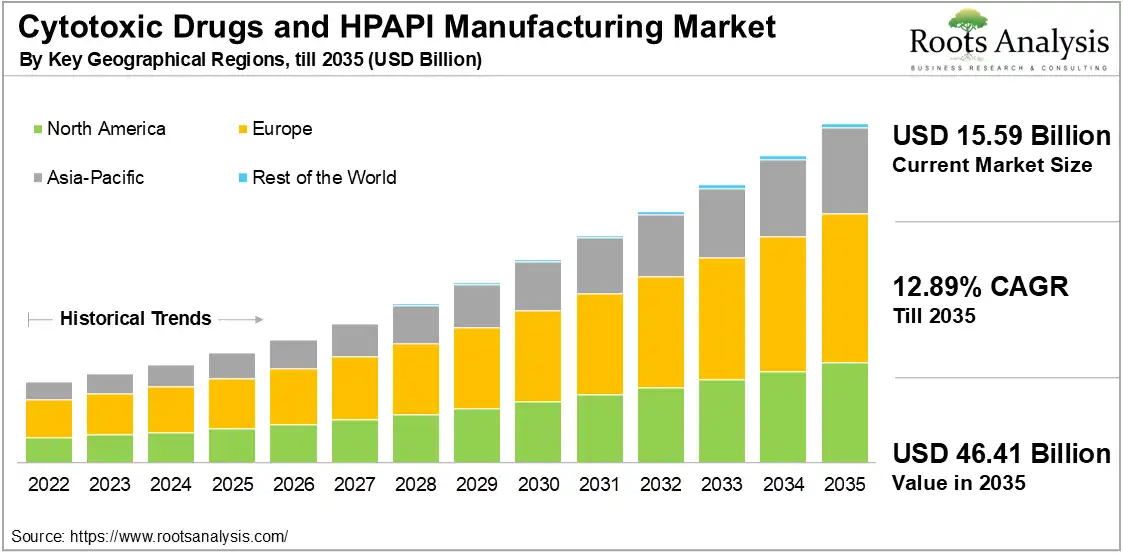
The cytotoxic drugs and HPAPI manufacturing market, valued at USD 13.98 billion in 2025, is projected to grow to USD 15.59 billion in 2026 and USD 46.41 billion by 2035, representing a CAGR of 12.89% during the forecast period 2026 to 2035. The growth is being supported by rising demand for targeted oncology therapies, antibody-drug conjugates (ADCs), highly potent small molecules and other complex drug candidates that require specialized containment, process development and good manufacturing practice (GMP) manufacturing capabilities.
To learn more about this report, request a free sample copy
The cytotoxic drugs and HPAPI manufacturing market covers outsourced development and manufacturing services for highly potent drug substances and finished dosage forms that require specialized handling because of their pharmacological activity, toxicity or occupational exposure risk. HPAPI is primarily a potency and containment concept: these compounds can produce biological effects at very low exposure levels and therefore require risk-based controls during development and manufacturing. Cytotoxic drugs, by contrast, are defined by their ability to damage or inhibit cells and are widely used in oncology. The two categories overlap substantially, but they are not interchangeable.
Contract manufacturers support pharmaceutical and biotechnology companies across route and process development, custom synthesis, pre-formulation and formulation development, analytical testing, scale-up, clinical supply, commercial API manufacturing, highly potent FDF production, packaging and fill / finish. The outsourcing model is particularly relevant for small and mid-sized drug developers that may not have the capital, infrastructure or specialist workforce required to establish and maintain high-containment facilities internally.
Oncology remains the most important demand driver. Targeted therapies, precision-oncology programs and ADCs increasingly depend on highly potent small-molecule payloads, linker-payload intermediates and other complex drug substances that require specialized chemistry, purification and containment. The market is also supported by selected potent therapies outside oncology, including certain immunosuppressive and specialty-drug programs.
The commercial case for outsourcing is strengthened by high capital expenditure, complex regulatory compliance and the need for a trained workforce with experience in highly potent material handling. Specialized CDMOs can provide advanced manufacturing infrastructure and flexible capacity from gram-scale development through clinical and commercial production while helping sponsors avoid large fixed investments.
Capacity investment is also increasing as molecules become more potent and technically complex. New projects increasingly combine HPAPI synthesis with analytical development, payload-linker chemistry, bioconjugation, drug product manufacturing and broader supply-chain support, particularly for antibody drug conjugates and other targeted-therapy programs.
The market estimates were developed through a structured methodology combining secondary research, public company and regulatory information, proprietary datasets and primary stakeholder validation. The report evaluates market evolution under conservative, base and optimistic forecast scenarios and triangulates market size across product type, molecule type, dosage form, manufacturing scale, company size and geography.
The opinions and insights presented in this study were influenced by discussions conducted with eleven stakeholders representing senior operational, technical, commercial and business-development roles across organizations in the UK, Italy, the US, Luxembourg, Switzerland, Germany and Belgium. These perspectives support the assessment of outsourcing behavior, capacity, manufacturing requirements, service selection and future market development. In addition, the research report features detailed transcripts of interviews conducted with the following industry stakeholders (arranged in decreasing order of seniority level):
The report evaluates the market across type of highly potent product manufactured, type of highly potent molecules manufactured, type of highly potent FDF manufactured, scale of operation, company size, and key geographical regions. This structure is designed to support pharmaceutical and biotechnology companies, business-development teams, R&D and process-development groups, procurement and purchasing functions, quality and regulatory teams, supply-chain leaders and investors evaluating manufacturing partners, capacity and market opportunity.
| Key Report Attributes | Details | |
| Type of Highly Potent Product Manufactured |
|
|
| Type of Highly Potent Molecules Manufactured |
|
|
| Type of Highly Potent FDF Manufactured |
|
|
| Scale of Operation |
|
|
| Company Size |
|
|
| Key Geographical Regions |
|
|
APIs currently account for approximately 60% of the market. Demand is supported by continued development of potent drug substances for oncology and other targeted therapies, as well as the need for specialist synthesis and containment before downstream formulation.
Small molecules currently account for the largest share of the market. Highly potent biologics represent a smaller segment but are projected to grow at a higher CAGR during the forecast period, supported by the expansion of ADCs and other complex biologic modalities.
Oral solids currently account for more than 45% of the highly potent FDF manufacturing segment. Their position reflects established oral-dose manufacturing infrastructure and, for suitable molecules, lower manufacturing complexity and administration burden than injectable formats.
Commercial-scale manufacturing currently contributes to the majority of the market revenues, reflecting the value associated with validated GMP production, larger batch requirements and long-term supply for approved products.
Europe currently captures approximately 45% of the cytotoxic drugs and HPAPI manufacturing market; this is due to the dominating presence of big pharma players and CDMOs with diverse experience in contract manufacturing and maximum installed capacity for HPAPI and cytotoxic drugs manufacturing, long-standing process-chemistry expertise and high-containment infrastructure within this region.
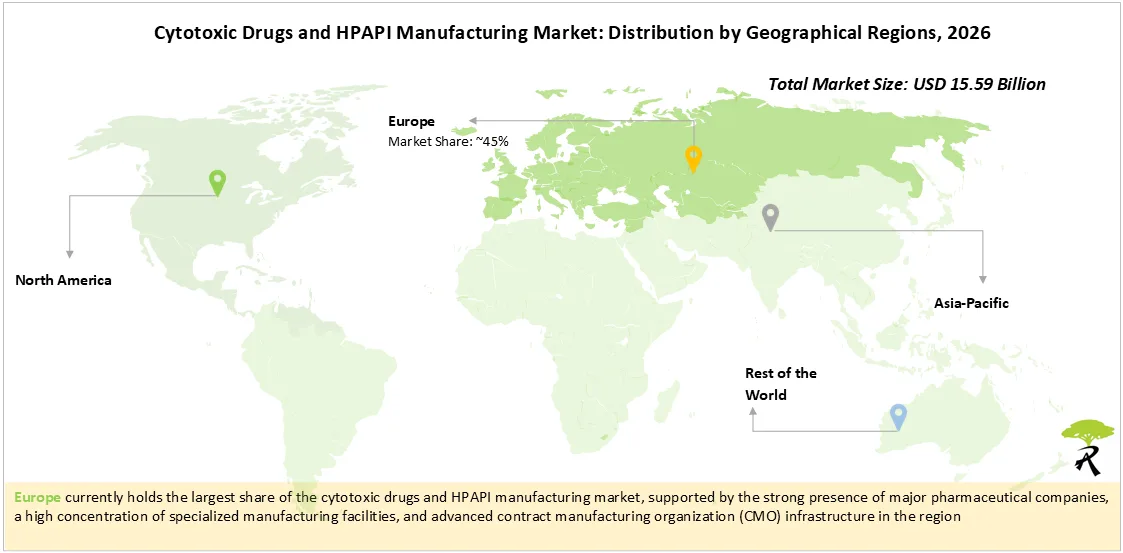
Asia-Pacific capacity has expanded rapidly, supported by investment in advanced manufacturing, cost-competitive operations and expansion of regional CMO / CDMO capabilities. The cytotoxic drugs and HPAPI manufacturing market in rest of the world is expected to benefit from continued pharmaceutical investment and supply-chain diversification.
Majority (over 35%) of the cytotoxic drugs and HPAPI manufacturing capacity is installed at facilities located in Europe. Within Europe, more than 40% of the capacity is available with the facilities based in Italy.
Over the past few years, the cytotoxic drugs and HPAPI manufacturing capacity in Asia-Pacific has increased at a substantial pace due to the technological advancements, low labor costs, and socio-economic reforms that favor the development of specialty industries, such as the highly potent drugs industry in this region.
HPAPI and cytotoxic manufacturing requires a risk-based containment strategy that protects operators, prevents cross-contamination and preserves product integrity. Potency assessment, toxicology and occupational exposure limits (OELs) or occupational exposure bands (OEBs) are used to define the level of engineering and procedural control required for individual compounds and unit operations.
High-containment infrastructure can include isolators, closed transfer systems, rapid transfer ports, negative-pressure processing areas, dedicated air-handling arrangements and controlled material and personnel flows. These controls are particularly important during weighing, charging, filtration, drying, milling, dispensing and packaging, where the potential for occupational exposure can be highest.
GMP, occupational safety and health, environmental controls and documented quality systems must operate together. Manufacturers also need validated cleaning procedures, contamination-control strategies, deviation and change-control systems, data integrity and ongoing workforce training to maintain consistent compliance across development and commercial operations. For global development and commercial programs, manufacturers must also align their operations with applicable US FDA current Good Manufacturing Practice (cGMP) requirements, EU GMP expectations and relevant ICH quality guidance. This requires validated quality systems, controlled documentation, deviation and change management, data-integrity controls and regulatory-ready records throughout process development, technology transfer and commercial manufacturing.
A capable HPAPI contract manufacturer must combine high-containment infrastructure with process chemistry and pharmaceutical manufacturing expertise. Core services can include route scouting, process development and optimization, custom synthesis, pre-formulation and formulation development, impurity control, crystallization, scale-up, technology transfer, clinical supply and commercial production.
Analytical capabilities are equally important. Programs may require method development and validation, assay and purity testing, impurity identification and characterization, stability studies, cleaning verification and release testing. Integrating development, analytical and manufacturing teams early can improve process robustness and reduce the risk of late-stage changes as a project moves from laboratory or kilo scale to commercial manufacturing.
Manufacturing partner selection increasingly extends beyond technical capacity. Sponsors evaluate raw-material sourcing, supply-chain resilience, business-continuity planning, project governance, technical support, on-time delivery performance and the ability to scale capacity as clinical demand changes.
For high-value or proprietary molecules, secure handling of process data, analytical methods and intellectual property is also important. Procurement and business-development teams may therefore assess confidentiality controls, information security, ownership of process improvements, technology-transfer responsibilities, change-notification procedures and supply commitments alongside manufacturing cost and technical capability.
The decision to manufacture HPAPIs in-house or outsource depends on capital, capability and risk. In-house manufacturing can offer direct control over proprietary processes and scheduling, but it requires sustained investment in containment infrastructure, EHS systems, specialist laboratories, validation, maintenance and workforce competence.
Outsourcing can reduce fixed capital requirements and provide access to established infrastructure and experienced teams, particularly when a sponsor needs specialized chemistry, low-OEL containment or flexible clinical-to-commercial capacity. The appropriate model depends on project scale, potency, process complexity, expected lifecycle demand, technology-transfer requirements, supply-chain strategy, cost of internal capacity and the strategic importance of direct manufacturing control.
Examples of key companies engaged in contract manufacturing of HPAPI and cytotoxic drugs (which have also been profiled in this market report) include AbbVie, Abzena, Aenova, Cambrex, CARBOGEN AMCIS, Catalent, Hovione, Intas Pharmaceuticals, Lonza, Pfizer CentreOne, Piramal Pharma Solutions, Scinopharm, STA Pharmaceutical (a WuXi AppTec company), Syngene, and Teva API. This market report includes an easily searchable excel database of all the companies that are engaged in cytotoxic drugs and HPAPI manufacturing industry.
The report provides an in-depth assessment of the cytotoxic drugs and HPAPI manufacturing industry, covering market evolution, manufacturing capabilities, installed capacity, competitive dynamics, outsourcing activity and future growth opportunities. The analysis is designed to help pharmaceutical and biotechnology companies, manufacturing partners, investors and other stakeholders evaluate market opportunities and make informed strategic decisions.
Alongside the core market report, clients receive complimentary Excel data packs covering areas such as market landscape analysis, company competitiveness analysis, partnerships and collaborations, recent expansions, capacity analysis, regional capability assessment, and market sizing and opportunity analysis. A complimentary PowerPoint presentation and 15% free customization are also available with the report.
This report has been co-authored by Simriti Gupta and Pemba Lahmo, both part of Roots Analysis's healthcare and pharma research practice. Their work focuses on drug development and manufacturing, competitive intelligence, company benchmarking and market forecasting.
Roots Analysis is an independent secondary and primary market research publisher. This report is not affiliated with, endorsed by or produced on behalf of any CRO, CMO, CDMO, pharmaceutical company, biotechnology company, therapy developer or other organization named or profiled within the study.
The findings are developed independently using secondary research, publicly available information, market analysis and primary stakeholder discussions. References to companies, therapeutic products and regulatory authorities are included solely for market-analysis and informational purposes.