Workout Supplements Market
Workout Supplements Market, by Form (Powder, Ready-to-Drink Liquids, Capsules / Tablets and Other Forms), Formulation (Stimulant-Based and Stimulant-Free), Primary Functional Ingredient (Caffeine, Creatine, Beta-alanine, BCAAs, Citrulline, Adaptogens / Nootropics, Electrolytes and Other Ingredients), Consumer Profile, Distribution Channel, and Geography – Trends and Forecast 2026-2035
-
Lowest Price Guaranteed
-
Pages
138 -
Last Updated
November 2026 -
View Count
3147 -
Market Outlook
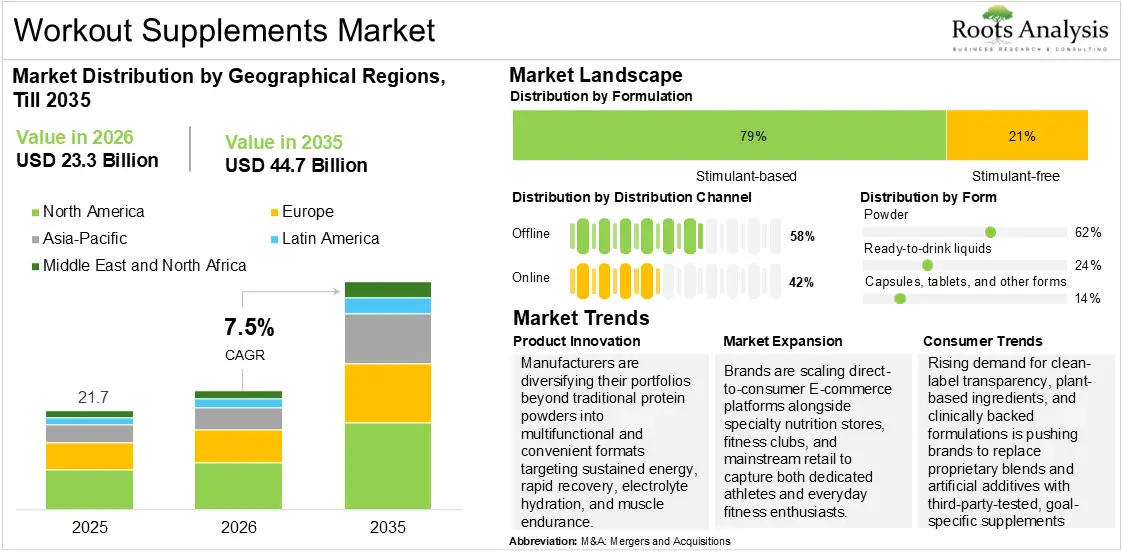
The workout supplements market, valued at USD 21.7 billion in 2025, is projected to reach USD 23.3 billion in 2026 and USD 44.7 billion by 2035, representing a CAGR of 7.5% during the forecast period 2026 to 2035. The growth is supported by broader participation in resistance training, endurance exercise and recreational fitness, demand for convenient energy and hydration products, and the migration of sports nutrition from specialist bodybuilding channels into mainstream retail.
To learn more about this report, request a free sample copy
Market Report: Key Takeaways
Market Size & Trends
- On the basis of form, powder sub-segment accounts for the largest share of the overall market due to the fact that it supports flexible serving sizes, multi-ingredient formulations and comparatively efficient shipping.
- Stimulant-based products lead the overall market, accounting for nearly 80%, while stimulant-free products are expanding faster among caffeine-sensitive consumers and people who train later in the day.
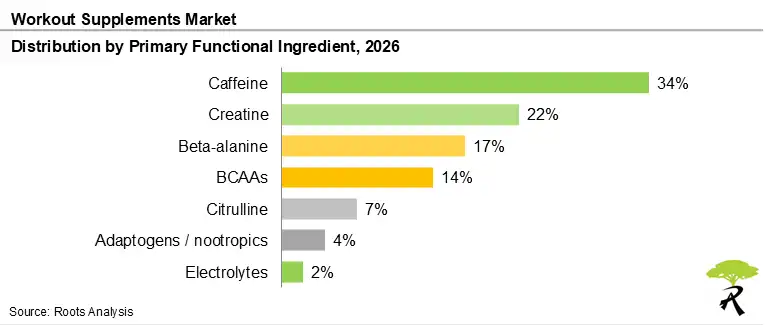
- Caffeine currently accounts for the largest share of the market by primary functional ingredient.
- Athletes and bodybuilders account for the leading segment, while casual fitness users are the fastest-growing consumer group.
- Offline channels leads the distribution channel segment; however, online channels are growing faster through direct-to-consumer sales, subscriptions, reviews and wider product availability.
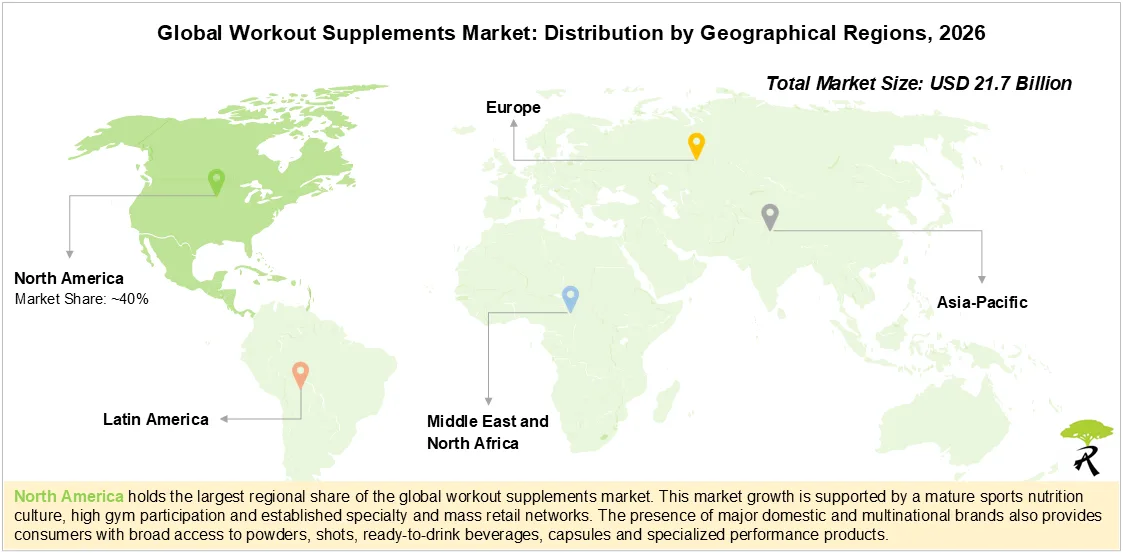
- North America is the leading region with a share of nearly 40%. Asia-Pacific is the fastest-growing region as gym participation, domestic brands and digital retail expand.
Key Market Statistics
- Market Size in 2026: $23.3 billion
- Estimated Market Size in 2035: $44.7 billion
- CAGR (2026-2035): 7.5%
- North America: Largest market in 2026
- Asia-Pacific: Fastest growing region
Market Introduction
Workout supplements are nutritional products formulated to support exercise performance, energy, muscle development, recovery and hydration. These products include pre-workout supplements, protein supplements, amino acids, creatine, branched-chain amino acids (BCAAs), electrolytes and other formulations consumed before, during or after physical activity. They are available in formats such as powders, capsules, tablets, gummies and ready-to-drink beverages and are used by athletes, fitness enthusiasts and recreational exercisers.
The workout supplements market is being supported by growing participation in strength training, endurance exercise and recreational fitness, along with increasing demand for convenient products that support energy, muscle growth and recovery. Product innovation is further expanding the consumer base, with brands introducing stimulant-free formulas, ready-to-drink products, electrolyte formulations and simplified single-ingredient supplements. In parallel, digital commerce, social media and fitness creators are influencing product discovery, education and repeat purchasing.
However, the market faces challenges related to varying levels of scientific evidence across ingredients and formulations, excessive stimulant intake, product adulteration and contamination risks, particularly among competitive athletes subject to anti-doping requirements. Consequently, transparent ingredient labeling, third-party testing, quality assurance and credible product claims are becoming important factors influencing consumer trust and brand differentiation.
Market Segmentation
Based on the research, we have segmented the workout supplements market into form, formulation, primary functional ingredient, consumer profile, distribution channel, and geographical regions.
- By Form: Powder, Ready-to-Drink Liquids, Capsules / Tablets and Other Forms
- By Formulation: Stimulant-Based and Stimulant-Free
- By Primary Functional Ingredient: Caffeine, Creatine, Beta-alanine, BCAAs, Citrulline, Adaptogens / Nootropics, Electrolytes and Other Ingredients
- By Consumer Profile: Athletes and Bodybuilders, Casual Fitness Users and Other Active Consumers
- By Distribution Channel: Offline and Online
- By Geographical Regions: North America, Europe, Asia-Pacific, Latin America, Middle East and North Africa
Workout Supplements Market Key Insights
What Are the Key Growth Drivers of the Workout Supplements Market?
- Diversifying Fitness Participation: Demand is expanding beyond competitive bodybuilding as recreational gym users, runners, cyclists, team-sport participants and home-fitness consumers increasingly use supplements for energy, hydration, focus and recovery.
- Growing Ingredient Familiarity: Consumer awareness of established ingredients such as caffeine, creatine, amino acids and protein is supporting demand for single-ingredient and transparently dosed products, particularly where consumers can easily understand the intended benefits.
- Innovation in Product Formats: Format innovation is creating more convenient consumption occasions. Alongside traditional powders, ready-to-drink beverages, shots, stick packs, effervescent tablets and capsules offer portability, controlled serving sizes and easier integration into daily fitness routines.
What are the Main Challenges for Market Growth?
- Variability in Evidence and Formulation Quality: Evidence differs across ingredients and products, particularly for multi-ingredient formulas. Proprietary blends and limited dose disclosure can make it difficult for consumers and professionals to evaluate formulation effectiveness.
- Safety and Anti-doping Concerns: Excessive stimulant intake and overlapping products can increase adverse-effect risks. Competitive athletes also face contamination and undeclared-ingredient risks, making third-party batch testing and quality assurance increasingly important.
- Regulatory Complexity Across Markets: Differences in permitted ingredients, dosage limits, labeling, notifications and health claims across countries increase compliance requirements. Products making disease-related claims may also fall under pharmaceutical regulations.
Recent Developments in the Workout Supplements Market
- In September 2026, Science in Sport partnered with Nike as the Official Performance Fuel and Hydration Partner for the Nike After Dark Tour and introduced a co-branded performance nutrition range across selected markets. The collaboration covers nutrition products designed to support runners during preparation, performance and recovery.
- In September 2026, cbdMD entered into a definitive agreement to acquire operating assets and brands of Twinlab, including the Twinlab sports nutrition and dietary supplement business. The proposed transaction expands cbdMD into established supplement categories and is expected to increase the company's annual revenue base.
- In August 2026, Sports Research expanded its creatine portfolio with the launch of Creatine Capsules containing 5 grams of creatine monohydrate per serving. The product was introduced through Costco and Amazon, broadening consumer access to creatine in a non-powder format for strength, recovery and active-lifestyle applications.
Industry Experts on Workout Supplements Market
Workout supplements are increasingly moving beyond traditional sports performance, with consumers seeking products that support energy, recovery, strength, and broader active lifestyles.
In February 2026, Colin Watts, CEO of Thorne, highlighted the growing mainstream adoption of sports nutrition among younger and everyday consumers. Discussing this shift, Colin Watts stated, "The line is deeply blurred between what we have historically called sports nutrition and what we also have talked about as wellness or prevention. This performance market is not just sports, and it's certainly not, professional athletes. It's the everyday consumer. It involves energy, recovery, cognition, strength, resilience, and in some ways for us, it's become quite foundational about the way our product operates."
Primary discussions with multiple stakeholders across the workout supplements market informed the qualitative insights presented in this study. The market report includes interview transcripts from executives at sports nutrition brands, supplement retailers, E-commerce companies and personalized sports nutrition businesses, including the following roles:
- Chief Executive Officer, Leading Sports Nutrition Brand, US
- Chief Executive Officer, Major Sports Supplement Retailer, US
- Chief Executive Officer & Co-founder, Leading Sports Nutrition Brand, India
- Co-founder, Leading Sports Nutrition E-commerce Company, India
- Co-founder & Chief Operating Officer, Personalized Sports Nutrition Company, US
- Chairman & Chief Executive Officer, Leading Sports Nutrition Company, US
- Chief Executive Officer, Leading Sports Nutrition Company, US
- Chief Executive Officer, Sports Nutrition Brand, US
- Founder & Chief Executive Officer, Sports Nutrition Brand, Australia
- Founder & Chief Executive Officer, Leading Sports Nutrition Company, US
Market Share Insights
Which Form Accounts for the Largest Share of the Workout Supplements Market?
- Powders hold the leading share of the workout supplements market, supported by their suitability for gram-level dosing of creatine, citrulline, beta-alanine, amino acids and carbohydrates. The format also allows consumers to adjust serving sizes while offering manufacturers efficient blending, packaging and transportation.
- Ready-to-drink liquids are expected to register the fastest growth during the forecast period, driven by convenience and increasing demand for on-the-go supplementation. Their ready-to-consume format supports impulse purchases and wider placement across gyms, convenience stores and refrigerated retail channels, although formulation stability and higher distribution costs remain considerations.
Which Formulation Represents the Biggest Opportunity in the Workout Supplements Market?
- Stimulant-based products hold the leading share of the workout supplements market, accounting for nearly 80% in the current year, driven by the widespread use of caffeine for energy and focus. Their presence across powders, shots, capsules and ready-to-drink formulations, along with established consumer familiarity, supports broad adoption, particularly in pre-workout products.
- Stimulant-free products are expected to register the fastest growth during the forecast period, driven by rising demand among evening exercisers, caffeine-sensitive consumers and users already consuming coffee or energy drinks. Formulations increasingly emphasize citrulline, electrolytes, creatine, amino acids and cognitive-support ingredients as alternatives to stimulant-based products.
Which Primary Functional Ingredient Accounts for the Largest Share of Market?
- Caffeine holds the leading share of the workout supplements market, accounting for nearly 35% in the current year, driven by its broad consumer recognition and established use for energy, focus and endurance. Its relatively low cost and incorporation across multiple supplement formats further support widespread adoption.
- Adaptogens and nootropics are expected to register the fastest growth during the forecast period, driven by increasing demand for focus, stress-management and cognitive-performance benefits within workout and daily wellness products. Growth will favor formulations supported by ingredient-specific evidence, appropriate dosing and compliant product claims.
What Makes Offline Channels the Leading Choice in the Workout Supplements Market?
-
Offline channels hold the leading share of the workout supplements market, supported by broad product availability across specialty stores, gyms, pharmacies, supermarkets and mass retailers. Physical retail enables product inspection, staff recommendations, in-store sampling and high-traffic placement, supporting product trial and impulse purchases.
- Online channels are expected to register the fastest growth during the forecast period, driven by wider product assortments, ingredient-based search, subscriptions, bundles and convenient price comparison. Direct-to-consumer sales also enable brands to strengthen consumer education and loyalty, although counterfeit products and unauthorized sellers increase the need for authentication measures and approved-seller programs.
Regional Analysis: Which Region is Emerging as the Global Workout Supplements Hub?
North America: Largest Regional Market
- North America holds the leading share of the workout supplements market, accounting for nearly 40% in the current year, supported by a mature sports nutrition culture, high gym participation and established specialty and mass retail networks. The presence of major domestic and multinational brands also provides consumers with broad access to powders, shots, ready-to-drink beverages, capsules and specialized performance products.
Asia-Pacific to Experience the Fastest Growth During the Forecast Period
- Asia-Pacific is expected to register the fastest growth during the forecast period and accounts for more than 20% of the market, driven by rising disposable incomes, expanding fitness communities, growing local brands and increasing product availability through E-commerce marketplaces. Manufacturers in India and Australia are also expanding portfolios across pre-workout supplements, creatine, amino acids, hydration products and batch-tested sports nutrition.
Key Players Profiled in Workout Supplements Market
The workout supplements market includes sports nutrition companies, dietary supplement manufacturers, fitness nutrition brands and specialty wellness companies involved in the development, production and supply of workout supplements, including Glanbia, Optimum Nutrition, Nutrabolt, Cellucor, MuscleTech, BSN, Kaged, and GNC.
Report Deliverables and Customization
The report includes complimentary Excel data packs covering market landscape analysis, company competitiveness analysis, company profiles, partnerships and collaborations, funding and investment analysis, and market sizing and forecast analysis. A complimentary PowerPoint presentation is available, and up to 15% customization can be requested subject to data availability.
Report Authorship
Author(s): Simriti Gupta and Pemba Lahmo. Both authors contribute to Roots Analysis's healthcare and pharma research practice, covering sports nutrition, dietary supplements, workout supplements, and consumer health market studies.
Independence and Non-Affiliation
This report is an independent work of market research and analysis published by Roots Analysis. It is not affiliated with, sponsored by, endorsed by, or reviewed by Glanbia, Optimum Nutrition, Nutrabolt, Cellucor, MuscleTech, or any other sports nutrition company, supplement brand, ingredient supplier, or regulatory body referenced within it. No content in this report should be construed as medical advice. Roots Analysis maintains its own proprietary primary research process, and does not receive compensation from any company profiled within the report, in exchange for inclusion or favorable characterization.