
Lowest Price Guaranteed
Slides
236
Last Updated
October 2025
View Count
20012
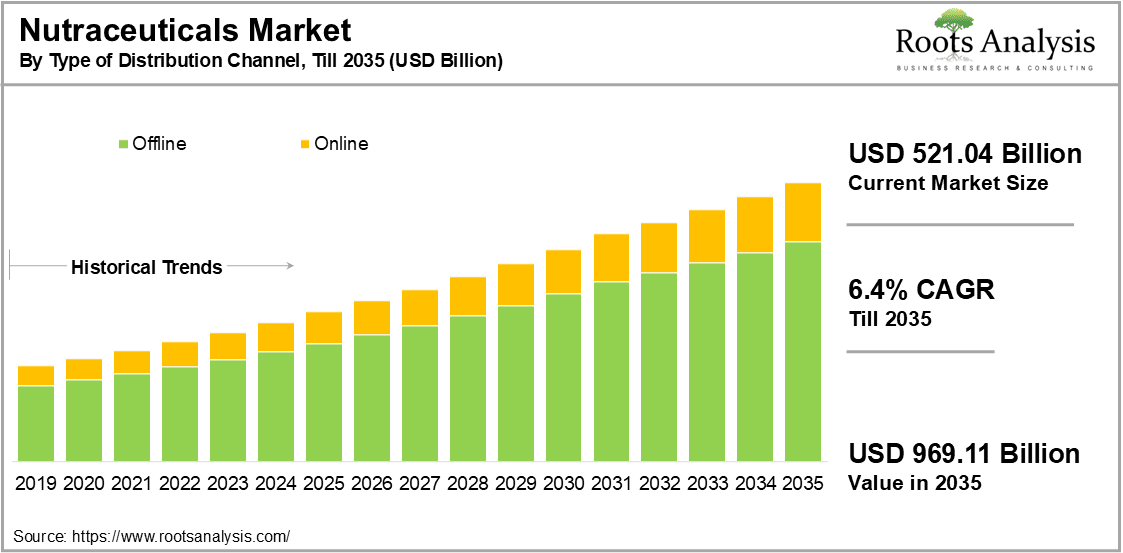
The global nutraceuticals market, valued at USD 483.49 billion in 2024, is projected to reach USD 521.04 billion in 2025 and USD 969.11 billion by 2035, representing a CAGR of 6.4% during the forecast period.
 |
To learn more about this report, request a free sample copy
Nutraceuticals refers to the products that are derived from food sources and offer health benefits in addition to nutritional values. These food supplements have recently gained attention due to their safety profile, therapeutic effects and added nutritional benefits. Presently, nutraceuticals industry is growing exponentially driven by rising incidence of chronic diseases such as diabetes and obesity.
According to the recent report published by World Health Organization, nearly 830 million people globally have diabetes and approximately half of the people with diabetes are not receiving any treatment. In addition to diabetes, obesity is one of the most prevailing condition across the globe that necessitated the demand for advanced formulation to manage weight and overall health. Additionally, the increasing shift towards clean diet and plant-based dietary supplements such as omega-3-fatty acids, vitamins and carotenoids for nutrition and health benefits is fueling the demand for nutraceuticals.
Considering the ongoing demand, several industrial players are increasing their research initiatives to develop more advanced nutraceutical solutions for the global population. However, their primary focus will be on extraction and processing technologies that helps to create bioavailable formulations by using natural ingredients. It is important to highlight here that industrial players are leveraging partnerships to develop specialized nutraceutical products and extraction technologies. For instance, in December 2024, Akums Drugs & Pharmaceuticals entered into an in-licensing agreement with Caregen to introduce specialty nutraceuticals and pharmaceuticals that are specifically tailored to meet unique nutritional and health requirement of Indian consumers.
In addition to specified nutraceuticals, industrial players are revolutionizing nutraceuticals formulation by combining botanicals and biotics to develop next-generation dietary supplement solutions. Owing to the ongoing trends, we believe nutraceuticals market will continue to gain momentum during the forecast period.
The research report provide invaluable information on leading industrial players who are presently active across various segments of the nutraceuticals industry.
| Key Report Attributes | Details | |
| Historical Trend | Since 2019 | |
| Forecast Period | Till 2035 | |
| Current Market Size | $ 521.04 Billion | |
| Market Size 2035 | $ 969.11 Billion | |
| CAGR (Till 2035) | 6.4% | |
| Type of Product |
|
|
| Type of Form |
|
|
| Type of Ingredient |
|
|
| Application Area |
|
|
| Distribution Channel |
|
|
| Geographical Regions |
|
|
| Key Players Profiled |
|
|
| PowerPoint Presentation (Complimentary) |
Available | |
| Customization Scope | 15% Free Customization | |
| Excel Data Packs (Complimentary) |
Available | |
One of the key objectives of the market report was to estimate the current nutraceuticals market size, opportunity and the market growth potential, over the forecast period, till 2035. We have provided informed estimates on the likely evolution of the market for the forecast period.
The nutraceuticals market analysis also features the likely distribution of the current and forecasted opportunity within the market across various segments, such as type of product (functional foods (cereal, bakery and confectionary, dairy, snack, and other functional food types), functional beverage (energy drinks, sports drinks, fortified juice, dairy and dairy alternative beverage, and other functional beverages), and dietary supplement (vitamins, minerals, botanicals, enzymes, fatty acids, proteins, and other dietary supplements)), type of form (capsule and tablets, liquid, powder, and other forms), type of ingredients (botanical ingredients (ashwagandha, aloe vera, curcumin, ginseng, hemp and others), cannabidiol (BCD), probiotics, proteins & amino acids, phytochemicals & plant extracts, minerals (calcium, iron, magnesium, selenium and others), fibers & specialty carbohydrates, omega-3 fatty acids, vitamins (vitamin A, vitamin B, vitamin C, vitamin D, vitamin E, vitamin K and other vitamins), prebiotics, carotenoids (astaxanthin, lutein, lycopene and others), emulsifiers, spirulina, collagens and others (glucosamine, chondroitin, isoflavones and polyols)), type of application area (allergy & intolerance, healthy ageing, bone & joint health, cancer prevention, children's health, cognitive health, diabetes, digestive / gut health, energy & endurance, eye health, heart health, immune system, infant health, inflammation, maternal health, men's health, nutricosmetics, oral care, personalized nutrition, post pregnancy health, sexual health, skin health, sports nutrition, weight management & satiety, women's health and other applications), by distribution channel (offline (supermarkets & hypermarkets, pharmacies, specialty stores, practitioner, grocery stores and others) and online (amazon and other online retail stores)), geographical region (North America, Europe, Asia-Pacific, Middle East and North Africa, and Latin America) and leading players.
In order to account for future uncertainties associated with some of the key parameters and to add robustness to our model, we have provided three market forecast scenarios, namely conservative, base, and optimistic scenarios, representing different tracks of industry’s evolution.
All actual figures have been sourced and analyzed from publicly available information forums and primary research discussions. The financial figures mentioned in this market report are in USD, unless otherwise specified.
Based on the type of products, the global market is segmented into functional foods (cereal, bakery and confectionary, dairy, snack, and other functional food types), functional beverage (energy drinks, sports drinks, fortified juice, dairy and dairy alternative beverages, and other functional beverages), and dietary supplements (vitamins, minerals, botanicals, enzymes, fatty acids, proteins, and other dietary supplements).
According to our projection, dietary supplements occupy the largest nutraceuticals market share (34%) and the trend of dominance will remain unchanged during the forecast period. This dominance is due to the increasing adoption of dietary supplements such as vitamins, proteins, minerals and other botanicals to maintain overall health. Additionally, tailored dietary supplements are in great demand for weight management and immunity support, which is likely to contribute to the highest share of this segment.
It is worth mentioning here that functional beverages segment is likely to gain momentum at a higher CAGR during the forecast period. Functional beverages such as energy drinks, dietary alternative beverages and sports drinks enriched with essential minerals, vitamins and antioxidants are increasingly adopted by sports people and people seeking alternative supplement sources for health. Additionally, functional energy drinks help to boost energy and relief stress which further increases its demand during the projected period.
This segment highlights the distribution of global nutraceuticals market size across different types of form, such as capsule and tablets, liquid, powder, and other forms. Among these, capsules and tablets account for the largest share (28%) of the market. This can be attributed to the fact that nutraceutical supplements such as vitamins are widely consumed in the form of capsules and tablets.
However, in the long run, liquid form is likely to grow at a higher CAGR during the forecast period. This lucrative growth is due to the fact that liquid form is primarily adopted to create blends, functional beverages, smoothies, probiotics & prebiotics and yogurt. With increasing popularity of functional beverages, liquid form is likely to show a substantial growth during the forecast period.
According to our projection, presently proteins and amino acids hold the highest share of the market. This can be attributed to the growing adoption of proteins and amino acids as a dietary supplement to maintain overall well-being and muscle growth and repair.
However, in the long run, omega-3-fatty acids, probiotics and cannabidiol (CBD) segments are likely to gain traction at a higher CAGR during the forecast period. This can be attributed to the increasing usage of cannabidiol based products for the treatment of chronic conditions and growing adoption of omega-3-fatty acid to treat inflammation and maintaining optimal level of good cholesterol.
The global market is segmented across different type of applications, such as allergy & intolerance, healthy ageing, bone & joint health, cancer prevention, children's health, cognitive health, diabetes, digestive / gut health, energy & endurance, eye health, heart health, immune system, infant health, inflammation, maternal health, men's health, nutricosmetics, oral care, personalized nutrition, post pregnancy health, sexual health, skin health, sports nutrition, weight management & satiety, women's health and other applications.
According to our projection, weight management & satiety accounts for the largest nutraceuticals market share (over 15%). This can be attributed to the growing prevalence of obesity and weight associated health consumers. Notably, patients with obesity are seeking plant-based formulations with proven scientific research for managing weight, which further fuel the demand for nutraceuticals for a holistic weight loss approach.
However, in the long run, men’s health is likely to grow at a substantial CAGR rate during the forecast period. This is likely to be the result of increasing preferences for nutritional supplements for managing stress level, prostate health, muscle development and overall health.
Furthermore, men health issues such as erectile dysfunction and low testosterone level has further fueled the demand for nutraceuticals for maintaining overall well-being. It is important to highlight here that women’s health segment also holds a substantial share of the market driven by the rising demand for dietary supplement for hormonal balance and weight management.
According to our projection, offline mode segments, such as hypermarket / supermarkets, pharmacies/ drug stores and specialty hold the dominance. This can be attributed to the fact that consumers are prefer offline pharmacies and specialty stores to get nutraceutical supplements.
Moreover, offline pharmacies are backed with experienced personnel, and availability of physician’s guidance helps to get personalized dietary supplements and wellness solutions. However, in the long run, online channel is likely to grow at a higher CAGR during the forecast period. This can be attributed to the ease of delivery and wider availability of dietary supplements on online platforms.
The global nutraceuticals industry is distributed across different geographical regions, such as North America, Europe, Asia-Pacific, Middle East and North Africa, and Latin America. According to our projection, currently Asia-Pacific holds the highest share (38%) of the market. This is likely to be the result of increasing awareness about healthy lifestyles and wide pool of population seeking advanced formulations to maintain immunity and digestive health. It is important to highlight here that Asia-Pacific countries like India is well-known for spices and botanical species that holds high pharmaceutical values and likely to use for managing pain and inflammation in the body. Additionally, the growing disposable income and rising demand for functional beverages such as energy drinks and prebiotics has further fueled the nutraceuticals market growth in this region.
However, in North America the market is expected to grow at a higher CAGR during the forecast period. This dominance is due to the increasing awareness about dietary supplements for maintaining overall health. Moreover, North America has high consumer base for nutraceuticals and aging population with chronic conditions has further bolstered the demand for personalized nutraceuticals to manage health conditions.
The “Nutraceuticals Market: Industry Trends and Global Forecasts, till 2035” market research report features an extensive study of the focus on competitive landscape of strategic initiatives, emerging mega trends, company profiles and key drivers and restraints. The market report highlights the efforts of several stakeholders engaged in this rapidly evolving segment of the health and wellness industry. Key takeaways of the market data analysis are briefly discussed below.
Currently, the market landscape of nutraceuticals has a strong presence of several new entrants / startups looking to find their own niche in the industry, such as gut health specialist or sports nutraceutical brands. A number of startups are focused on direct-to-consumer (D2C) business models and are also attracting investor attention. In January 2025, India based Botanic Healthcare raised USD 30 million in financing round led by Stakeboat Capital.
The industrial players are increasing their strategic initiatives to develop advanced nutraceutical formulations with added pharmaceutical benefits. For instance, in November 2024, Solvenian Bran Ars Pharmae launched BetaCold Amino (immunity boosting supplement) that combines minerals, vitamins and Wellmune betaglukan to support overall wellness of humans. Overall, the market is highly competitive featuring the presence of several small, mid-sized and large companies.
Some of the notable drivers that are anticipated to propel the market include growing awareness about overall well-being and rising preferences for dietary supplements to boost immunity. Furthermore, the growing geriatric population with chronic conditions has further necessitated the demand for nutraceuticals to enhance immunity and manage disease conditions. In addition, nutraceuticals have been widely adopted as a weight management formulation and immunity booster amongst men and women which is anticipated to drive the market at a steady rate during the forecast period.
Nutraceuticals market is witnessing several challenges that needs to be addressed for widespread adoption. Some of the notable challenges include lack of standard regulatory guidelines for product approval, that may impede market growth. Additionally, high cost associated with nutraceutical products and limited adoption among low to medium income population may restraint the market growth during the forecast period.
Despite challenges, several factors that are likely to propel the nutraceutical industry growth during the forecast period includes personalized nutrition supplement demand for overall well-being and rising shift towards plant-based products to fulfill nutritional needs and environmental sustainability. Additionally, growing understanding about link between chronic conditions and health nutrition for managing diseases is likely to drive the market during the forecast period. Furthermore, demand for clean label products and shifting preferences for non-pill formulation for managing health are the key trends that are likely to drive the industry during the forecast period.
Currently, the global nutraceutical market is valued at USD 521.04 billion and is poised to reach at USD 969.11 billion by 2035. The market is expected to be driven by the presence of robust consumer base who are increasingly adopting dietary supplements. It is important to highlight here that market players are aiming to develop personalized nutraceuticals to meet the unmet nutritional needs.
For instance, in November 2024, Persona Nutrition (leading company in providing personalized dietary supplement subscriptions) recently launched a white label service that helps other brand to mark their entrance in personalized dietary supplement space. This new program helps to deliver a sophisticated approach that cover essential elements such a proprietary algorithm, customized vitamin assessment and access to proprietary drug-nutrient interaction checker of Persona, supplements and tailored nutrition supplement services along with back-end management of subscription. As more market leaders continue to accelerate their initiatives in this field, the market is expected to grow at a CAGR of 6.4% during the forecast period.
Examples of key players engaged in this field of nutraceuticals (which have also been captured in this report) include Archer Daniels Midland Company, Abbott, Amway, BASF, Danone, Gaia Herbs, General Mills, Glanbia, Herbalife Nutrition, Jamieson Wellness, Nestle Health Science, NOW, Otsuka Pharmaceutical, PepsiCo, Ritual, The Kraft Heinz Company, The Hain Celestial Group and Yakult Honsha. This market report includes an easily searchable excel database of all the companies focusing on nutraceutical products.
The market report presents an in-depth analysis, highlighting the capabilities of various companies engaged in this domain across different segments. Amongst other elements, the market report includes:
Several recent developments have taken place in the field of nutraceuticals. We have outlined some of these recent initiatives below.