
Lowest Price Guaranteed
Pages
194
Last Updated
June 2025
View Count
11804
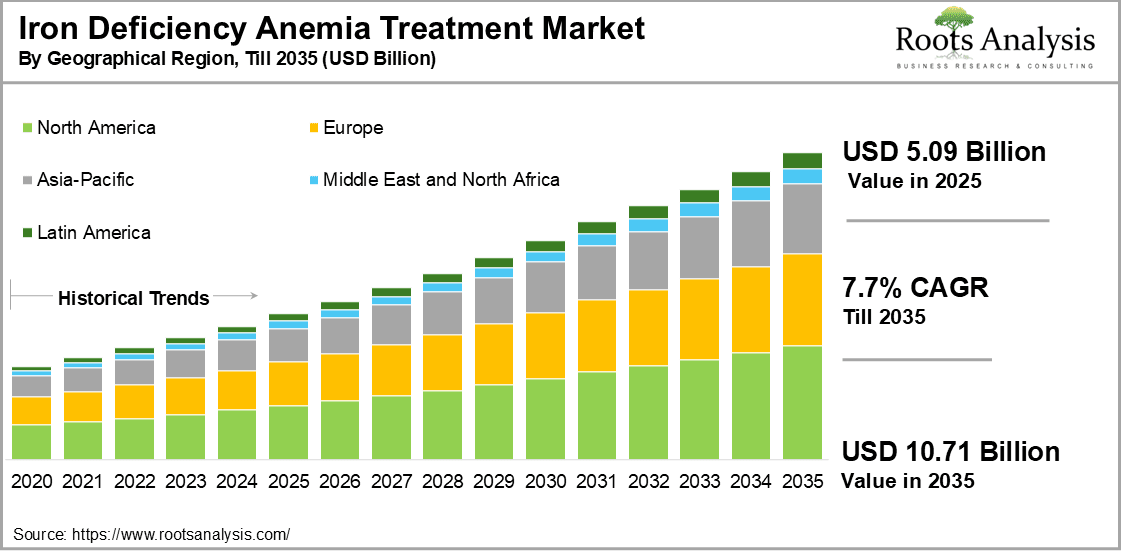
The global iron deficiency anemia treatment market, valued at USD 4.66 billion in 2024, is projected to reach USD 5.09 billion in 2025 and USD 10.71 billion by 2035, representing a CAGR of 7.7% during the forecast period.
 |
To learn more about this report, request a free sample copy
Iron deficiency anemia is a condition when body lacks red blood cells due to insufficient iron, leading to low level of oxygen throughout the body. Dizziness, pale skin, cold hands and lightheadedness are some of the common symptoms of iron deficiency anemia. As per the report published by World Health Organization in February 2025, anemia impact around 40% of children (aged 6-9 months), 37% of pregnant women, and 30% women 15-49 years of age.
Usually, iron supplement has been provided to patients to address the underlined causes, such as malabsorption and blood loss. Owing to the limited availability of therapeutic treatment, presently market players are accelerating their research for advancements in iron supplements and developing new therapeutic drugs, and formulating nutraceutical products to treat iron deficiency anemia.
For instance, in November 2024, Cadila Pharmaceuticals launched Militol (an innovative iron supplement that contains Ferric Maltol, Folic Acid and Vitamin, C and B12) specifically designed to provide a combination of nutrients that enhance iron absorption to address iron deficiency. Additionally, several industrial players are raising investments and commercializing advanced iron and nutrient supplements that aid in iron recovery. For instance, in September 2024, Helaina successfully raises USD 45 million in Series B funding to accelerate the commercialization of Human Bioactive Proteins and starting with effera™ Human Lactoferrin.
Considering the ongoing initiatives in this field, we believe that the iron deficiency anemia treatment industry is estimated to grow at a steady pace during the forecast period.
The market report provides comprehensive information on drug developers who are currently active across various segments of the industry as mentioned in the table below.
| Key Report Attributes | Details | |
| Historical Trend | Since 2020 | |
| Forecast Period | Till 2035 | |
| Market Size 2025 | USD 5.09 Billion | |
| Market Size 2035 | USD 10.71 Billion | |
| CAGR (Till 2035) | 7.7% | |
| Type of Therapy |
|
|
| Type of Drug |
|
|
| Dosage Form |
|
|
| Therapy Areas |
|
|
| Age Group |
|
|
| Distribution Channel |
|
|
| End User |
|
|
| Geographical Regions |
|
|
| Key Companies Profiled |
|
|
| PowerPoint Presentation (Complimentary) |
Available | |
| Customization Scope | 15% Free Customization | |
| Excel Data Packs (Complimentary) |
Available | |
One of the key objectives of the iron deficiency anemia treatment market report was to estimate the current size, opportunity, and the market growth potential, over the forecast period, till 2035. We have provided informed estimates on the likely evolution of the market for the forecast period.
The global iron deficiency anemia treatment market analysis report also features the likely distribution of the current and forecasted opportunity within the market across various segments, type of therapy (oral iron therapy, parenteral iron therapy, red blood cell transfusion and others), type of drug (ferrous sulfate, ferrous gluconate, ferrous fumarate, ferric hydroxide and others), dosage form (table, liquid, capsules and others), therapy areas (inflammatory bowel disease, renal, obstetrics and gynecology, congestive heart failure (CHF), oncology and other therapy areas), age group (adults, pediatric and geriatric), distribution channel (hospital pharmacies, retail pharmacies, and online pharmacies), end-user (clinics, hospitals and home healthcare), geographical region (North America, Europe, Asia-Pacific, Middle East and North Africa, and Latin America) and leading players.
In order to account for future uncertainties associated with some of the key parameters and to add robustness to our model, we have provided three market forecast scenarios, namely conservative, base, and optimistic scenarios, representing different tracks of industry’s evolution.
All actual figures have been sourced and analyzed from publicly available information forums and primary research discussions. The financial figures mentioned in this market report are in USD, unless otherwise specified.
Based on the type of therapy, the global market is segmented into oral iron therapy, parenteral iron therapy, red blood cell transfusion and others. According to our iron deficiency anemia treatment market report, presently parenteral iron therapy segment accounts for the largest share (60%) of the market. This can be attributed to the parenteral iron therapy ideal for patients who are intolerant to oral iron supplement. Furthermore, parenteral iron therapy is also essential for individuals with anemia recombinant erythropoietin therapy or experiencing chronic disease that may impact the absorption of iron into the blood through oral route.
However, it is worth mentioning that oral iron therapy segment is expected to grow at a higher CAGR during the forecast period. Oral iron therapies are easy to consume, and cost-effective, which makes it a viable solution for patients to fight anemia.
The global market is segmented across different type of drug, such as ferrous sulfate, ferrous gluconate, ferrous fumarate, ferric hydroxide and others. Among these, presently ferrous sulfate holds the highest share (nearly 40%) of the iron deficiency anemia treatment market. Ferrous sulfate is inexpensive and widely available oral iron supplement as an alternative to intravenous supplement, which enhance its adoption across patients. Unlike other drugs, ferrous sulfate that causes nausea and constipation, ferrous sulfate is easy to take and does not cause any side effects. Driven by the growing preference, this segment is likely to maintain its dominance and grow at a steady CAGR during the forecast period.
This segment highlights the distribution of global market across different drug dosages, such as table, liquid, capsules and others. According to our iron deficiency anemia treatment market trends, presently tablets segment is dominating the market by holding nearly 45% of the overall revenue share. Tablets are easy to swallow and available in versatile dosage form, allowing healthcare providers to tailor the dosage according to the patient requirement. Additionally, tablets are designed for self-administration which further enhance convenience of maintaining regular iron dosage. Owing to the versatility, this segment will continue to grow at a higher CAGR during the forecast period.
Based on the therapy area, the global market is segmented into inflammatory bowel disease, renal, obstetrics and gynecology, congestive heart failure (CHF), oncology and other therapy areas. Currently, the inflammatory bowel disease segment occupies the highest share (nearly 30%) of the iron deficiency anemia treatment market.
This can be attributed to the fact that inflammatory bowel disease leverages to chronic inflammation which further impacts the absorption of essential nutrients, such as iron, resulting in anemia. Thus, the growth incidence of inflammatory bowel disease has contributed to the high demand for iron therapies. It is worth mentioning that iron deficiency anemia therapies deliver efficient amounts of iron directly into the bloodstream to replenish iron in the body.
The global market is further categorized across different age groups, such as adults, pediatrics and geriatrics. According to our projection, presently adults segment holds the largest iron deficiency anemia treatment market share (64%). This can be attributed to the rising prevalence of anemia in adults specifically women. Additionally, the changing lifestyle and bad eatery habits cause nutrient deficiency which further result into anemia in people due to low iron.
However, in the long run, pediatric segment is likely to register a higher CAGR during the forecast period. This lucrative growth is due to the fact that pediatric population is more susceptible to anemia due to insufficient intake of iron. Additionally, the growing initiatives by government organizations to mitigate the concern of anemia in children has further fueled the growth of this segment over the forecasted period.
Based on the distribution channel, the global market is segmented into hospital pharmacies, retail pharmacies and online pharmacies. According to the iron deficiency anemia treatment market forecast, hospital pharmacies currently holds over 50% share of the market. This can be attributed to the preferences of patients to avail treatment from the healthcare professionals in hospitals. Driven by the growing preferences, this segment is likely to remain dominant during the forecast period, anticipated to grow at a higher CAGR during the forecast period.
On the basis of end-user, the global market is segmented into clinics, hospitals and home healthcare. It is worth mentioning that presently the hospitals segment is dominating the iron deficiency anemia treatment market by holding 43% share. This dominance is due to the preference of advanced healthcare infrastructure and availability of healthcare professionals to delivery iron intravenously to the patients with anemia due to the chronic conditions.
However, in the long run, home healthcare segment is likely to grow at a higher CAGR during the forecast period. This can be attributed to the growing preferences for patients to get sustainable iron therapies specifically oral iron drugs in their home comfort zones.
Based on the geographical region, the global market is distributed across North America, Europe, Asia-Pacific, Middle East and North Africa, and Latin America. According to our iron deficiency anemia treatment market report, presently North America holds the highest share (37%) of the market. This can be attributed to the availability of favorable regulatory guidelines, rising incidence of anemia due to chronic conditions and increasing government initiatives to mitigate the concern of nutrient deficiency.
In Asia-Pacific, the market for iron deficiency anemia treatment is expected to register a substantial CAGR during the forecast period. The increasing awareness about anemia among people and rising incidence of anemia in Asian countries is likely to increasing the demand for iron deficiency anemia treatment.
The “Iron Deficiency Anemia Treatment Market: Industry Trends and Global Forecasts, till 2035” report features an extensive study of the current market landscape, market size, market share, market growth, market trends, market value, market forecast, market outlook, statistics, and future opportunities for iron deficiency anemia treatment developers. The market research report lays emphasis on the iron deficiency anemia therapies that are being developed. Key takeaways of the market report are briefly discussed below.
Currently, the iron deficiency anemia treatment market landscape is immensely competitive featuring the presence of several well-established and new entrants. It is worth mentioning that majority of the industrial players are focusing on developing advanced iron supplements and therapeutics to treat patients with iron deficiency anemia. Key market players, such as Akebia Therapeutics, Bayer and Sanofi are taking strategic initiatives in this field.
Furthermore, in May 2024, TopGum launched IronGum (high dose iron gummies with sensory appeal) that help patients with anemia to overcome challenges in taking iron supplements. As industrial players continue to innovate iron supplements, we believe that the market will remain competitive over the forecasted period.
Some of the notable factors that are contributing to the iron deficiency anemia treatment growth includes rising incidence of anemia and expanding research on oral iron therapies. Notably, pharmaceutical market players are presently emphasizing the development of advanced iron therapies to treat patients with anemia and those who experience anemia due to other chronic conditions. Additionally, the patient preferences for oral iron therapies has further bolstered the research to develop oral supplments, which is expected to be a key driver for the market.
It is worth mentioning that high cost of iron supplements may limit its adoption across low to middle income countries. Contrastingly, lack of awareness about anemia and its consequences among population may further hinder the adoption rate, thereby impacting the market growth during the forecast period.
Presently, the market players are focusing on the personalized treatment that are tailored according to the patient requirements, considering factors, such as iron deficiency, and chronic conditions. Additionally, the growing product launch with improve ferrous sulfate formulation to address the underlying causes of iron deficiency are the noticeable trends in this emerging market. Furthermore, the untapped market in regions such as Asia-Pacific, Middle East and North Africa, and Latin America offer numerous opportunities to industrial players to develop advanced drugs to treat large pool of patients suffering from iron deficiency anemia.
Currently, the global market for iron deficiency anemia treatment is valued at USD 5.09 billion and is poised to reach USD 10.71 billion by 2035, expecting to grow at a CAGR of 7.7% during the forecast period. It is worth mentioning that ferric carboxymaltose (a newer IV formulation) is recently gaining momentum owing to its efficacy and safety in replenishing iron in single infusion. Additionally, several organizations and market players are focusing on increasing awareness among population about anemia.
Considering the ongoing initiative, in November 2024, Emcure Pharmaceuticals and launched a nationwide public awareness campaign to address the increasing concern of anemia in Indian men and encouraging early diagnosis and treatment. Driven by the increasing number of patients with iron deficiency anemia and ongoing initiatives, we believe that the market will remain progressive during the forecast period.
Examples of key players engaged in this domain (which have also been captured in this report) include Akebia Therapeutics, AdvaCare Pharma, Apotex, AbbVie (Allergan), Azurity Pharmaceuticals, Bayer, CSL Vifor, GSK, Johnson & Johnson, Novartis, PHARMACOSMOS, Sanofi, Teoxane and Zydus. This market report includes an easily searchable excel database of all the companies focusing on the development of iron deficiency anemia treatment solutions.
The market report presents an in-depth analysis, highlighting the capabilities of various companies engaged in this domain across different segments. Amongst other elements, the market report includes:
Several recent developments have taken place in the field of iron deficiency anemia treatment. We have outlined some of these recent initiatives below.