


 Download Free Sample
 Buy Now
Market Size
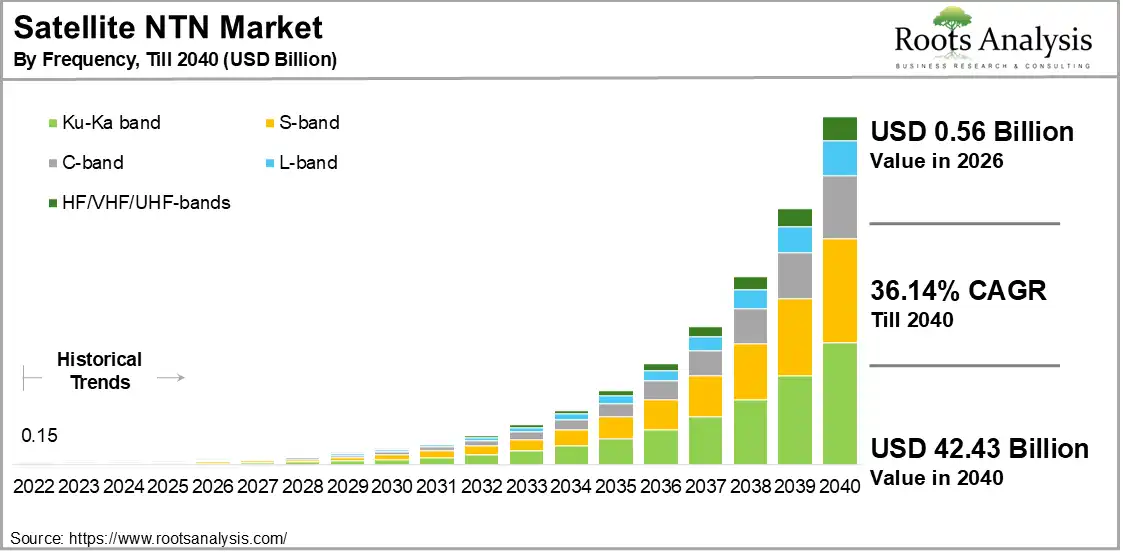
The global satellite NTN market, valued at USD 0.36 billion in 2025, is projected to reach USD 0.56 billion by 2026 and USD 42.43 billion by 2040 with a 36.14% CAGR during the forecast period 2026 to 2040.
See What’s in the Full Report – Request Your Complimentary Insights!
Market Report: Key Takeaways
- In terms of technology, NTN NR holds the highest share (63%) of the market.
- On the basis of frequency, Ku-Ka Band leads current market with 31.14% share.
- Based on orbit, Low Earth Orbit (LEO) dominates the industry. Notably, it tends to grow at a high CAGR 37% during the forecast period.
- According to regional analysis, currently, North America holds the highest market share (38.07%), while Asia-Pacific is expected to grow at a relatively high CAGR 38.45%.
- The 2026 satellite NTN market landscape features innovations, such as 5G NTN integration, AI enabled network optimization, advanced beamforming and direct to device connectivity, enhancing global coverage and resilient broadband services.
Market Overview
Satellite NTN refers to wireless communication systems that use platforms like orbits and high-altitude platform stations and drones to provide connectivity beyond ground based cellular network. Non-Terrestrial Networks (NTN) are communication networks used by satellites. NTN solution brings accessible connectivity to areas such as remote locations, seas, mountains, and less populated regions.
Satellite NTN technology is used in various types of sectors, where connectivity is lacking via traditional network. Further, NTN demonstrates core components for signal processing with user equipment supporting direct to device links for integration of satellite NTN in IoT and remote area communications. For example, NTN technology can be deployed in maritime communications, where reliable connectivity is essential for safety and navigational purposes. Satellite NTN solutions are widely used in aviation sector (improving air traffic) and are also relevant in Internet of Things (IoT) applications as (asset tracking and sensor network).
Satellite backhaul for NTN connectivity in these devices, enabling data collection and control from virtually anywhere on Earth. As 5G NTN accelerates across developed and developing economies, organizations demand satellite NTN connectivity solutions to have quick responses in their operational efficiency. This leads to increase the reliability and stability across well-organized infrastructure and expertise to provide conventional coverage.
The benefits of satellite-cellular convergence, including regenerative payload handles as Ku-Ka band, technologies in 5G & future 6G networks. Strategic choice for sustainable connectivity across crucial locations using orbits like Geostationary Orbit (GEO), Highly Elliptical Orbit (HEO), Low Earth Orbit (LEO), Medium Earth Orbit (MEO).
Satellite NTN drives future connectivity through network coverage independently across the geographical locations and infrastructure. Therefore, by integration of satellites and aerial platforms creating more opportunities to improve business processes and increase communication reliability.
Recent Industry Developments
- In October 2025, Sharp’s 5G NTN compatible LEO satellite wins the award for communication user terminal wins at ministry for internal affairs and communication.
- In September 2025, Space42 and Viasat launched Equatys for global D2D and 5G satellite venture to enhance the connectivity services to grow worldwide.
- In August 2025, Echostar selects our new MDA D2D software defined satellites to meet its demand in technical and business requirements to have smooth and effective working on satellite operators to enhance expanded product capacity.
- In June 2025, Karots defense and security solutions reported over the air testing with Intelsat to demonstrate a 5G network over a satellite in geostationary orbit.
Market Share Insights
Hardware Component Dominates the Satellite NTN Market
Based on components, the global satellite NTN market size is segmented into hardware, service and software. Among these, hardware is dominating the global market, capturing 67.90% of total market share. This is driven by increasing demand for robust and efficient satellite communication infrastructure. Hardware includes components such as antenna onboard processors, onboard processor unit, and RF front end. These components are continuously optimized to enhance performance and enhance multi-band operations.
Additionally, hardware is widely deployed across satellite constellations orbit which is further fueling the need for power-efficient and high-capacity hardware solutions. Moreover, hardware is creating a foundation pillar in the NTN connectivity market to advance globally and provide high speed connectivity.
Market Share by Application: Direct to Device Connectivity Dominate Current Industry
The direct to device connectivity application captures the maximum market share, representing the highest CAGR 38.21% during the forecast period. The growth patterns are driven by satellite NTN projections with smartphones and IoT sensors, consumer devices for universal coverage.
The dominance of direct-to-device connectivity is driven by the increasing investments in standardization of 3GPP. Further, direct-to device connectivity is used in various companies such as L3Harris Technologies, Teledyne through its (teledyne control division) enable devices to connect directly to an aircraft’s existing data systems. This NTN direct-to-device communication improves performance and safety enhancing the management to exchange the information between ground and in the air.
Regional Market Growth: North America leading the Satellite NTN Market
Currently, North America dominates the satellite NTN market by capturing 38.07% market share. This is due to the region’s strong technological infrastructure. The roll of 5G and significant government and defense investments are increasing the demand to deploy strong defense communication investment and early adoption by major operations.
Within North America, US captures most of the market share, driven by high demand for connectivity by satellite NTN service providers. The initiatives are made to bridge digital gaps and support regulations from governments that lead to diverse growth in this region. Companies like SpaceX provide high speed internet via starlink constellation using direct to device connectivity application. It enables services like communication, cross industry synergies and orbital logistics.
Want Information on Specific Region / Segment?
Regulatory frameworks across North America prioritize digital usage and substantial investment in network upgrades. The development can be observed by using technology of 5G deployments, LEO, regulatory support, defense commercial synergies to support R7D in various institutes for artificial intelligence (AI) optimized beamforming and NTN standardization 3GPP integration.
Market Dynamics
Key Market Drivers
- 5G Expansion and Integration with Terrestrial Networks: There is rapid integration for 5G networks with terrestrial networks, enabling global coverage, real-time data interchange, improved backhaul for remote region and standardization via 3GPP protocols deployment.
- Growth of LEO Satellite Deployments and Advanced Payloads: LEO satellite NTN integration with high-capacity payloads and low-latency links boost competitiveness of constellations especially for broadband, emergency response, and end users.
- Expanding Broadband Access and Rural Connectivity Initiatives: Reduction in commercial sector investments leads to “digital divide” within satellite NTN deployments for remote and rural connectivity, especially in fast-growing regions like Asia-Pacific, Africa, and North America.
Market Challenges
- Long Time Supply Chain Vulnerabilities: Global events and supply-chain constraints (e.g., COVID-19) pandemic exposed dependencies in satellite manufacturing and launch systems for delay in service rollouts.
- Orbital Congestion and Spectrum Interference: With growing number of LEO and GEO satellites, there is higher risk in space debris, orbital congestion, and frequency overlap which requires effective regulation and coordination.
- Ensuring Safety, Sustainability, and Regulatory Alignment: Environmental impact such as space debris, emissions, and data privacy require satellite NTN vendors to prioritize sustainable, and compliant practices by regulating international standards.
Key Market Insights
Competitive Landscape of Key Players in Satellite NTN Market
The satellite non-terrestrial network market is fragmented and is experiencing intense competition and changing dynamics, with the presence of several small and large companies. The industry spans advanced launch capabilities and integrated coverage services. Through their global coverage strategies, partnership in telecom operations and investment in orbit constellations these companies will experience strong revenue streams.
Satellite manufacturers dominate the current market, leveraging satellite NTN solutions for 5G and beyond mobile connectivity established distribution networks, space system integration. On the other hand, LEO and MEO satellites are tailored for continuously improving their offerings to broadband, communication and defense NTN solutions. These companies focus on playing leading role in European and global next-gen and 5G services-related initiatives including secure satellite communication missions.
Major players in the satellite NTN market include Airbus Defense and Space, Amazon, Apple, AST SpaceMobile, BAE Systems, Eutelsat OneWeb, Honeywell International, Hughes Network Systems, L3Harris Technologies, Lockheed Martin, NEC Corporation, Safran, SES, SpaceX, SWISSto12, Teledyne, Telesat, and Viasat.
These companies are adopting aggressive competitive strategies centered on innovation, strategic alliances, and portfolio expansion. For instance, in July 2025, SES leading space solution company announced the competition for acquisition with Intelsat to create strong global satellite operators with expansion across orbits to serve the evolving needs of customers including government, aviation and NTN in smart city infrastructure development.
Key Market Trends in LEO satellite NTN Deployments for Broadband
LEO satellite NTN deployments lead the market with 69% of global share. It is driven by low latency, high services for rural, maritime, and aviation coverage via massive constellations.
- Constellation Expansion
Companies like SpaceX, Starlink, and Amazon lead with Ku-Ka band payloads for targeting users to launch orbits. Growing investment in satellite constellations drives the NTN satellite communications market by facilitating better coverage in rural and remote areas. SpaceX operates the largest satellite constellation in the world with over 8,000 satellites as of 2025. - 5G NTN Integration
Expansion in 5G NTN technology leads to drive the growth in satellite NTN market. To facilitate connectivity between satellite and terrestrial networks. According to mobile economy report, global 5G connections are projected to stabilize in the market to meet the growing needs of connectivity within geographical regions.
Regulatory Challenges and Spectrum Allocation for Satellite NTN
As per the satellite NTN market report, Cross-border spectrum, licensing, and international regulatory hurdles slow project timeline that compound to operational risks and create fragmentation in service models.
- Spectrum Coordination and Management: Satellite NTN share spectrums with mobile networks, requiring strict coexistence to avoid interruptions. This involves transmission power limits to safeguard terrestrial services, complicated payload design, coverage areas, and operational parameters.
- Licensing and Business Model Constraints: Satellites must partner with mobile network operations (MNO’S) to lease spectrum licenses, and operational dependency. This creates barrier in bands, resulting in slow innovation.
- Technical and Operational Impacts: Regulations to influence architecture payloads complexity, power usage and adaptive coverage strategies to impose higher costs and operational constraints that can affect quality and global scalability.
Your Business is Unique – Why Shouldn’t Your Report Be?
Market Segmentation
Satellite NTN Market: Scope of the Report
| Key Report Attributes | Details | |
| Historical Trend | Since 2022 | |
| Forecast Period | Till 2040 | |
| Market Size 2026 | $ 0.56 Billion | |
| Market Size 2040 | $ 42.43 Billion | |
| CAGR (Till 2040) | 36.14% | |
| Segments Covered |
|
|
| Key Players Profiled | ||
| PowerPoint Presentation (Complimentary) | Available | |
| Customization Scope | 15% Free Customization | |
| Excel Data Packs (Complimentary) |
|
|
Market Segments
Based on research, we have segmented the satellite NTN market into technology, component, frequency, orbit, architecture, application, end use, geographical regions, and key players.
Market Share by Technology
- IoT NTN
- NTN NR
Market Share by Component
- Hardware
- Antenna Onboard Processors
- Onboard Processor Unit
- RF Front End
- Service
- Ground Segment and Terminal Equipment
- Managed Security Services
- Network services
- Satellite infrastructure
- System Integration
- Software
Market Share by Frequency
- C-band
- HF/VHF/UHF-bands
- Ku-Ka band
- L-band
- S-band
Market Share by Orbit
- Geostationary Orbit (GEO)
- Highly Elliptical Orbit (HEO)
- Low Earth Orbit (LEO)
- Medium Earth Orbit (MEO)
Market Share by Architecture
- Regenerative Payload
- Transparent Payload
Market Share by Application
- Backhole and network extension
- Broadband Internet Access
- Direct to device connectivity
- IOT/MTM connectivity
Market Share by End Use
- Commercial
- Government
- Defense
Market Share by Geographical Regions
- North America
- US
- Canada
- Mexico
- Rest of North America
- Europe
- Austria
- Belgium
- Denmark
- France
- Germany
- Ireland
- Italy
- Netherlands
- Norway
- Russia
- Spain
- Sweden
- Switzerland
- UK
- Rest of Europe
- Asia
- China
- India
- Japan
- Singapore
- South Korea
- Rest of Asia
- Latin America
- Brazil
- Chile
- Colombia
- Venezuela
- Rest of Latin America
- Middle East and Africa (MEA)
- Egypt
- Iran
- Iraq
- Israel
- Kuwait
- Saudi Arabia
- UAE
- Rest of the MEA
- Rest of the World
- Australia
- New Zealand
- Other countries
Have Questions? Let’s Get Them Answered.


