
Lowest Price Guaranteed
Slides
234
Last Updated
October 2024
View Count
13450
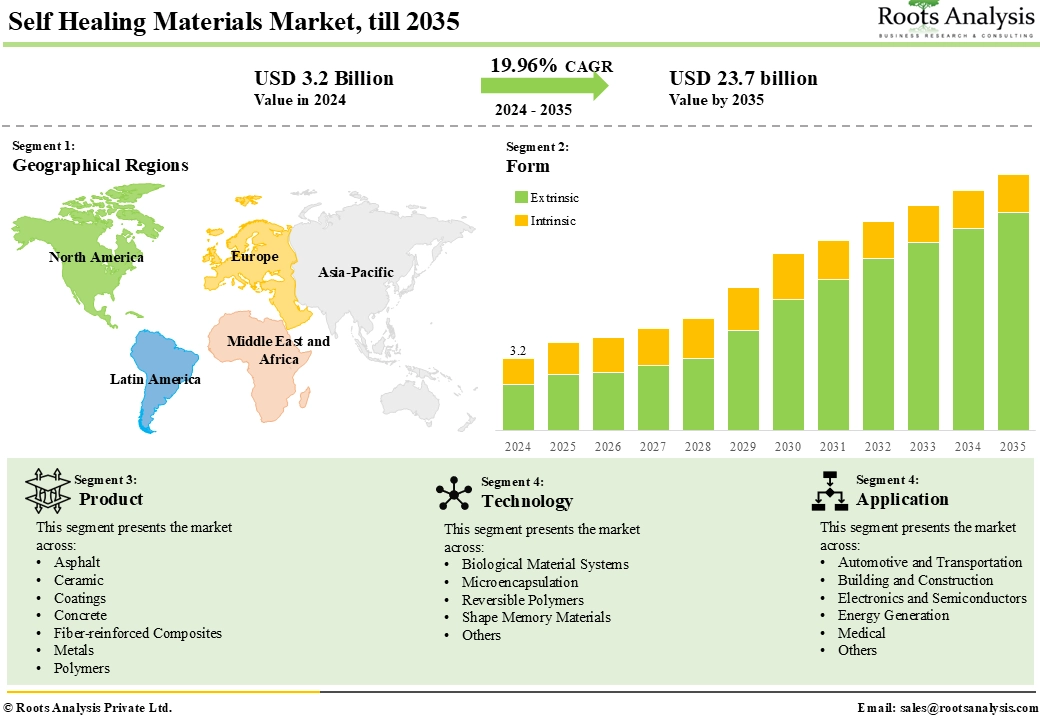
The global self-healing materials market size is projected to grow from US$3.2 billion in 2024 to US$23.7 billion by 2035, representing a CAGR of 19.96%, during the forecast period, 2024-2035.
 |
To learn more about this report, request a free sample copy
The new research study consists of global self-healing materials market industry trends, detailed market analysis of self-healing materials market manufacturer, Porter’s five forces analysis, megatrends analysis and market impact analysis. The report includes self-healing market forecast and opportunity analysis.
Self-healing materials are smart materials that have the ability to restore their original form after suffering mechanical damage such as cut or fracture . This material has unique physical properties of self-healing polymer, such as interfacial reduction, seamless connection lines, temperature / pressure responses, and phase transitions, enabling a multitude of innovative applications in various sectors, such as aerospace, automotive, construction, and electronics. Further, self-healing materials (such as self-healing composite materials and self-healing epoxy) can also help save considerable amounts of waste disposal and resource conservation by minimizing frequent repairs or parts replacements.
Driven by the increasing need for high-performance, low-maintenance materials across various sectors such as construction, aerospace, automotive, and electronics, the demand for self-healing materials has increased. In addition, with more focus on sustainability coupled with environmental concerns market is poised to experience significant growth during the forecast period.
The self-healing materials market research report presents an in-depth analysis of various leading players involved in manufacturing of self-healing material market, across different segments, as defined in the table below:
| Key Report Attributes | Details | |
| Historical Trend | 2018-2023 | |
| Base Year | 2023 | |
| Forecast Period | 2024-2035 | |
| Market Size 2024 | $ 3.2 Billion | |
| Market Size 2035 | $ 23.7 Billion | |
| Growth Rate | CAGR of 19.96% from 2024 to 2035 | |
| Form |
|
|
| Product |
|
|
| Technology |
|
|
| Application |
|
|
| Geography |
|
|
| Key Companies Profiled in the Self-healing Materials Market |
|
|
| PowerPoint Presentation (Complimentary) |
Available | |
| Customization Scope | 15% Free Customization | |
| Excel Data Packs (Complimentary) |
|
|
One of the key objectives of this market report was to estimate the current market value, opportunity and the future growth potential of the manufacturers in the global self-healing materials market, over the forecast period. Based on multiple parameters, likely adoption trends and through primary / secondary validations, we have provided an informed estimate on the market evolution during the forecast period 2024-2035.
The market report also features the likely distribution of the current and forecasted opportunity for manufacturers in the global self-healing materials market across various segments, such as form (extrinsic and intrinsic), product (asphalt, ceramic, coatings, concrete, fiber-reinforced composites, metals and polymers), technology (biological material systems, microencapsulation, reversible polymers, shape memory materials and others), healing mechanisms (chemical, electrical, mechanical, optical and thermal), healing time (rapid, moderate and slow), sustainability profile (bio-based, biodegradable, energy-efficient, low carbon footprint and recyclable), application (automotive and transportation, building and construction, electronics and semiconductors, energy generation, medical and others) and geography (North America, Europe, Asia-Pacific, Latin America, and Middle East and North Africa). In order to account for future uncertainties associated with some of the key parameters and to add robustness to our model, we have provided three self-healing materials market forecast scenarios, namely conservative, base, and optimistic scenarios, representing different tracks of the industry’s evolution.
All actual figures have been sourced and analyzed from publicly available information forums and primary research discussions. Financial figures mentioned in this market report are in USD, unless otherwise specified.
The global self-healing materials market is segmented into different forms, such as extrinsic and intrinsic. Currently, intrinsic segment is projected to have the largest share in this market and is likely to continue this trend during the forecast period. This market dominance is due to the fact that these materials do not require external force (such as heat and solvent) to restore their integrity, as intrinsic materials have the innate ability to restore integrity after damage.
The global self-healing materials market is segmented into different product, such as asphalt, ceramic, coatings, concrete, fiber-reinforced composites, metals and polymers. Currently, self-healing concrete is projected to have the largest share in this market. This can be attributed to several significant advantages offered by self-healing concrete, including its ability to repair its cracks and avert the disintegration of structures on its own. Additionally, these materials offer low maintenance cost and enhance longevity, making it a prominent material in the building and construction industry.
The global self-healing materials market is segmented into different technology, such as biological material systems, microencapsulation, reversible polymers, shape memory materials and others. Currently, reversible polymer technology is expected to capture the highest share in this domain. The growth can be attributed to the increasing adoption of technology in medical sector due to its application in precision medicine, drug delivery and self-healing.
The global self-healing materials industry is segmented into different application, such as automotive and transportation, building and construction, electronics and semiconductors, energy generation, medical and others. Currently, building and construction segment is expected to capture the highest share. This is due to the rise demand of self-healing material in construction activities, specifically in China and India due to its various advantages, such as low maintenance cost, sustainability, and enhance longevity.
The “Self-healing Materials Market: Industry Trends and Global Forecasts, Till 2035” market report features an extensive study of the current market size and future opportunities associated with manufacturers within the self-healing materials market industry, during the given forecast period. The market report highlights the self-healing materials market analysis. Key takeaways of the self-healing materials market report are briefly discussed below.
The growth of the self-healing materials market is primarily driven by the fact that it is gaining recognition as an environmentally sustainable option. Further, these materials are gaining attention as they have the potential to improve material reliability, extend the service life, reduce replacement costs, and improve product safety. In addition, the increasing infrastructural activities in developing countries, coupled with the increased use of composites, polymers, and other advanced materials instead of conventional self-healing concrete, are driving growth in this domain.
This segment highlights the distribution of self-healing materials market across various geographies, such as North America, Europe, Asia, Latin America, and Middle East and Africa. According to our projections, the self-healing materials market in Europe is likely to capture majority of the share in 2024. Further, market of Asia-Pacific is expected to grow at a healthy CAGR until 2035 due to high industrialization and government investment in the automotive sector, driving demand for these materials in the region.
Examples of key companies operating in the global self-healing materials industry (which have also been captured in this market report, arranged in alphabetical order) include Acciona , Akzo Nobel, Apple, Arkema, Autonomic Materials, Avecom, BASF, Bayer, Covestro, Dow Chemical, E.I. Du Pont De Nemours and Company, Evonik Industries, Goodyear Tire and Rubber, High Impact Technology, Huntsman International, MacDermid Autotype, Michelin, NEI, Sensor Coating Systems and Slips Technologies. This market report includes an easily searchable excel database for the leading companies operating in self-healing materials domain along with information on their service/product portfolios.
Several recent developments have taken place in the market, some of which have been outlined below.