


 Download Free Sample
 Buy Now
Market Overview
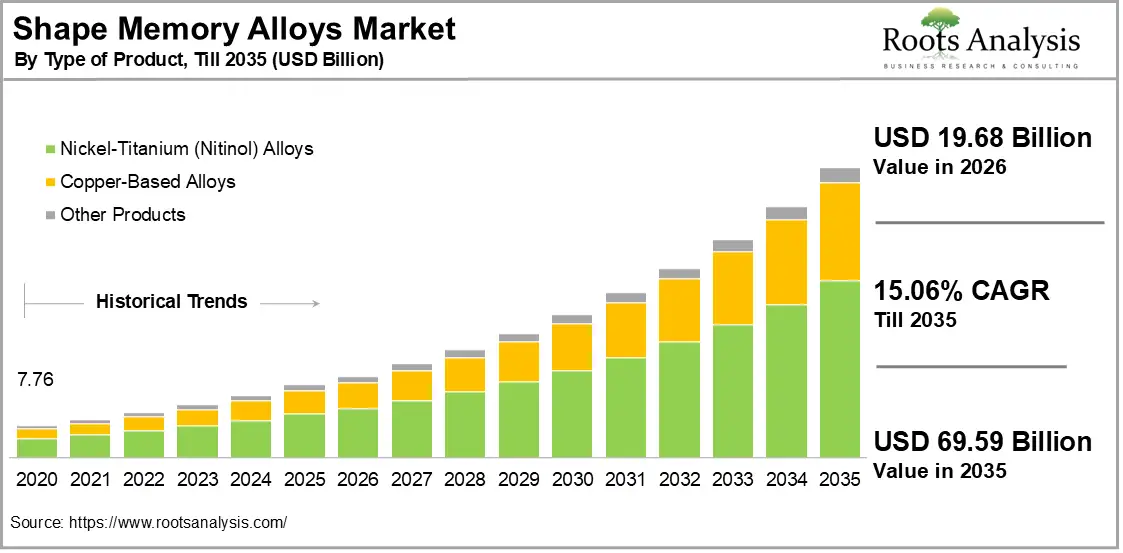
The global shape memory alloys market, valued at USD 19.68 billion in 2026, is projected to reach USD 34.50 billion in 2030 and USD 69.59 billion by 2035, representing a CAGR of 15.06% during the forecast period.
See What’s in the Full Report – Request Your Complimentary Insights!
Shape memory alloys are crucial for aerospace and robotics industries due to their light-weightiness and simple design that allows such sectors to benefit from the alloys. Not limited to these industries, SMA biomedical devices are being adopted swiftly. This is because the improved implant stability and reduced complications help in fast healing and recovery.
It is worth highlighting that miniaturization reducing power consumption and improved performance. For reference, the exceptional capabilities in autofocus and optical image stabilization in cameras are boosting SMA in consumer electronics applications.
The rapid demand for SMA in automotive actuators is driving the market growth. The prominent reason for this growth is their compact and lightweight design coupled with high work density and efficiency.
In addition, the development of efficient SMA phase transformation for high recoverable strain and reversible and diffusion less transition that enables repeated cycle between shapes without degradation of metal properties.
Consequently, these alloys are rapid and precise in activation that triggers signal quickly and within temperature range, forwardly expanding the SMA fire alarm components market.
Shape Memory Alloys Markets Share Insights
Which Type of Product Will Dominate the Market?
According to the shape memory alloys market forecast, the nickel-titanium (nitinol) alloys segment is set to take the lead, holding a significant market share of over 61.87% of the market. Further, this segment is also expected to grow with a relatively higher CAGR of 16.56% in the forecasted period.
This nitinol market growth is largely a result of superior superelasticity that offers biocompatibility and widespread use in biomedical shape memory alloys applications. It is worth highlighting that SMA fatigue resistance is being favored in aerospace and automotive SMA actuators. For instance, in 2024, Fort Wayne Metals supplied 50% of US stent manufacturers expanding nitinol applications in the sector.
Which Type of Technology is Leading the SMA Market?
According to the shape memory alloys market analysis, the one-way shape memory effect segment really stands out as the dominant application area with 37.64% market share. In fact, it’s expected to grow with a shape memory alloys market growth rate of 17.79% during the forecast period.
Here’s how; one-way SME are heavily used in medical implants and actuators like adaptable orthopedic implants and surgical tools. In addition, due to their simple shape and working they do not require any complex processing, making them easily available.
Get an Instant Quote in 10 Minutes. Lowest Price Guaranteed
Which Type of functionality will Witness the Fastest Growth Rate?
As per the industry analysis, the actuators segment is expected to own significant shape memory alloys market size (with a share of 39.45%). In fact, this segment is also forecasted to grow a relatively faster with a projected CAGR of 18.78% during the forecast period.
Here’s why, actuators have high applications in aerospace, automotive and biomedical applications. The prominent reason for this is their ability to offer high power-to-weight ratios, compact designs and reliable performance even under demanding conditions.
Which industries are the largest end-users of shape memory alloys?
According to our SMA market segmentation analysis, the biomedical segment is expected to own 41.54% of the overall market share. Further, this segment is also forecasted to grow a relatively faster with a projected CAGR of 18.01% during the forecast period.
The prominent reason for this growth is SMA’s high usage in stents, dental wires and implants. As world population is aging these implants are on the rise forwardly boosting the shape memory alloys market.
Furthermore, NiTi exhibits excellent resistance to corrosion in the body, which is crucial for long-term device performance. While super elasticity allows them to be molded into any desired shapes for improved performance.
Which Regions Dominate the SMA Market Globally?
According to our shape memory alloys technology market analysis, the North America shape memory alloys market currently exhibit dominance with 32.14% of the overall market share. In addition, this region is also expected to grow with a relatively higher intent data tools market CAGR 19.52% in the coming decade.
This is mainly because of the well-established market for biomedical and healthcare in North America. SMA plays a crucial role in manufacturing life-saving medical devices like coronary stents, bone fracture fixation and laparoscopic tools.
Another key driver for shape memory alloys is that North America benefits from advanced technological infrastructure and extensive research and development, resulting in continuous innovation and product improvement.
Have Questions? Let’s Get Them Answered
Shape Memory Alloys Market Key Insights
Growth drivers for shape memory alloys?
The rising biomedical device demand is continuously playing a lead role in shape memory alloys market drivers. For briefing, SMA surgical instruments and implants like stents and orthopedic devices are witnessing high demand. This is because of their effective biocompatibility and shape recovery properties.
Various countries around the world are mandating shape memory alloys due to their super elasticity and precise motion control that makes them ideal for electronics, wearables and autonomous vehicles. While copper-based shape memory alloys are swiftly adopted in safety valves, fluid connectors and control equipment.
In addition, the ongoing technological advancements in manufacturing processes such as the introduction of artificial intelligence for reduced material waste and costs and enhanced manufacturing precision.
What Strategies are Companies Using to Gain Shape Memory Alloys Market Share?
Shape memory alloys suppliers are using smart strategies to stay ahead. Big players are focusing on partnerships, acquisitions, joint ventures, and innovations to strengthen their position while also investing in R&D to bring innovative and novel products to the market. Launching new technologies and expanding into regions where industry automation is growing are key moves helping them capture more market share.
What Challenges Exist in Testing and Standardizing SMA Products?
The major shape memory alloys market challenges are high raw material costs. For instance, nickel and titanium both require precision manufacturing that results in increased product prices. Moreover, SMA market does not have any testing standardization that leads to inconsistent product quality and reliability concerns, particularly in aerospace shape memory alloys and medical application.
Another major challenge is these alloys require precise composition, heat treatments and dedicated processing techniques. These layers of treatments consume a long time and expenses. It is worth highlighting that limited awareness regarding SMA benefits finites the market growth.
Pay Only for What You Need – The Best Way to Optimize
How does the High Cost of Raw Materials Affect the SMA Market?
The high cost of raw materials such as nickel and titanium significantly increase the overall price of shape memory alloys (SMAs). This makes SMAs less competitive compared to conventional materials. Consequently, high costs limit adoption resulting in a slow market.
How is AI Impacting the Manufacturing and Quality Control Of Smas?
AI is rapidly enhancing the SMA manufacturing by optimizing material compositions and processing parameters, resulting in improved product quality and consistency. It also enables real-time defect detection and process adjustments coupled with reduced waste and costs.
What are the Applications of Nickel-Titanium Based Shape Memory Alloys in Medical Devices?
With extensive usage in cardiovascular stents, nickel-titanium alloy market is making a significant presence in the domain. In addition, these alloys are also highly used in orthodontic wires, root canal files and surgical tools.
What are the Emerging Applications of SMAs in Robotics and Automotive Sectors?
SMA in robotics are introducing soft, flexible actuators for wearables devices and compact movement in robotic arms. On the other hand, SMAs are used in smart actuators for thermal management, silent mechanism and adaptive components making an impressive impact in automotive shape memory alloys market.
Recent Developments in Shape Memory Alloys Market
- In April 2025, Nanoval, a German based metal powder company partnered with Ingpuls, a German shape memory alloys manufacturer to advance nickel-titanium shape memory alloy powder production.
- In January 2025, Waters, a US based analytical laboratory instrument manufacturer, announced launch of thermogravimetric analyser smart-seal pans manufactured with shape memory alloys.
Unlock Deeper Insights – Schedule Your Personalized Workshop Today!
Shape Memory Alloys Market: Report Attributes / Market Segmentations
| Key Report Attributes | Details | |
| Historical Trend | Since 2020 | |
| Forecast Period | Till 2035 | |
| Market Size 2026 | $ 19.68 Billion | |
| Market Size 2035 | $ 69.59 Billion | |
| CAGR (till 2035) | 15.06% | |
| Type of Product |
|
|
| Type of Technology |
|
|
| Type of Functionality |
|
|
| Type of Manufacturing Process |
|
|
| End-User |
|
|
| Geographical Regions |
|
|
| Leading Market Players |
|
|
| PowerPoint Presentation (Complimentary) | Available | |
| Customization Scope | 15% Free Customization | |
| Excel Data Packs (Complimentary) |
|
|


